

Notifications
Clear all
Joining the Renewable Heating Hub forums is completely free and only takes a minute. By registering you’ll be able to ask questions, join discussions, follow topics you’re interested in, bookmark useful threads and receive notifications when someone replies. Non-registered members also do not have access to our AI features. When choosing your username, please note that it cannot be changed later, so we recommend avoiding brand or product names. Before registering, please take a moment to read the Forum Rules & Terms of Use so we can keep the community helpful, respectful and informative for everyone. Thanks for joining!
Energy Storage
324
Posts
23
Users
110
Reactions
43.1 K
Views

11/08/2026 3:21 pm
Hi, can you remind me how to enable 3kW feed in when grid tied, do we need base unit plus two batteries?
Under existing ENA G98 rules, any battery system capable of grid discharge—whether throttled to 800W or operating at full 3.68kW—is classed as a grid-tied energy storage system. There is currently no special exemption under BS 7671 that treats an 800W battery discharge differently from a 3kW battery discharge when connected to home wiring. Both require standard G98 notification and BS 7671 compliance.
Not interested in a plug in device, or 800w. Just need to know from a hardware standpoint, what system config do I need to make sure I can feed in 3kW from this unit if i purchase it @indevolt-tech
Obviously, it will be installed by a qualified solar electrician, and G98 submitted.
This post was modified 2 months ago 7 times by dansus

12/08/2026 8:52 am
@dansus
To achieve a full 3kW (3000W / 13A) continuous AC feed-in into your home grid, you will need equip 1× PowerFlex 3000 and at least 1× Extra Battery module (e.g., PFA4000) (or 2× Extra Batteries for optimal storage capacity and battery lifespan).
Operating at a continuous 3000W output requires the discharge C-rate supported by adding at least one expansion battery pack. A single standalone base unit operates at a lower continuous output limit.
Once your electrician has completed the fixed AC installation (via a dedicated CU circuit / switched isolator):
1. Open the Indevolt App during initial system commissioning.
2. Select "Fixed Grid-Tied / Hardwired Mode".
3. Accept the in-app Compliance Disclaimer confirming that the system is hardwired according to BS 7671 and registered under G98.
4. The firmware will immediately unlock the full 3000W AC grid feed-in limit.
Hope this gives you the exact hardware list you need for your pre-order! Feel free to ask if you need any further specs for your electrician!
⚡ Indevolt UK Technical Team
Official Support | Smart Energy Storage & Home Automation Solutions
🛠️ Discord: https://discord.gg/aZTvvTK9pt
📧 Support: support.uk@indevolt.com
1
12/08/2026 2:43 pm
Hope this gives you the exact hardware list you need for your pre-order! Feel free to ask if you need any further specs for your electrician!
This is very helpful, thank you.

13/08/2026 11:24 am
I seem to recall that you may have suggested that, provided an appropriately registered electrician installs and certifies the circuit up to a suitable breaker, the final connection to the inverter can be made by a reasonably competent householder. From my reading of Part P it is possible to infer that, the installation of the new circuit either requires a competent person or is notifiable under building regs, connecting up the inverter if done separately (unless its in a 'special location') is not at least to my reading. Can you clarify your interpretation/correct my memory please? G9x is separate of course, Im not asking about that just about the electrical installation itself.
This post was modified 2 months ago 3 times by JamesPa
4kW peak of solar PV since 2011; EV and a 1930s house which has been partially renovated to improve its efficiency. 7kW Vaillant heat pump.


13/08/2026 8:06 pm
I seem to recall that you may have suggested that, provided an appropriately registered electrician installs and certifies the circuit up to a suitable breaker, the final connection to the inverter can be made by a reasonably competent householder.
That depends on the inverter. Some require hard-wired 240v AC connections, whereas others have a plug & socket for the mains input.
Indevolt are using a circular 3-pin connector for grid input/output. If the electrician has installed a switched fused-spur and connected the Indevolt flying lead to it, then that's all that would be covered by his Part-P certificate.
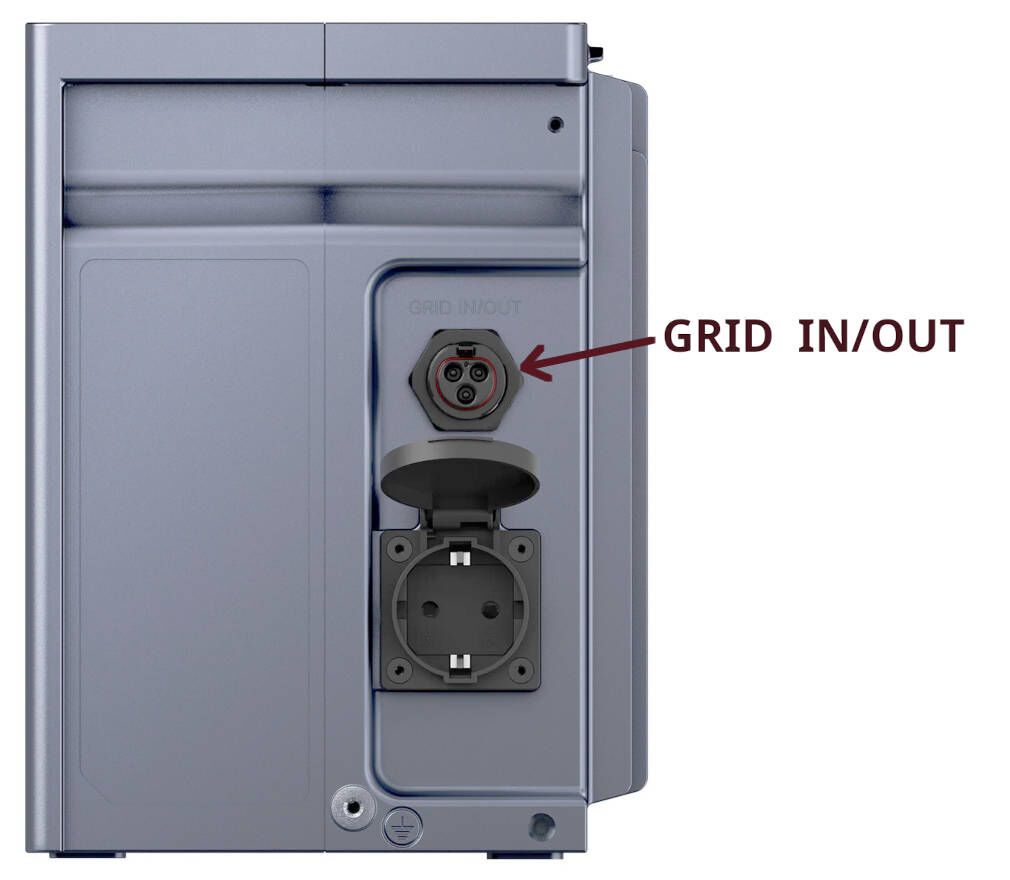
Customers should be paying greater attention to the PV panel inputs rather than thinking that it's only the mains which can bite! There are no regulations to prohibit end-users from connecting MC4 plugs and sockets. But a typical solar panel might be outputting 40-50v DC (open circuit), depending on the model. Although the Indevolt Powerflex specification states 11v-60v for each MPPT connection, I can foresee people trying to put two in series.
Unlike AC electricity, the human body doesn't have a reflex action to a DC shock. It's rather like the DC connector 'sticks' to the skin.
This is another of those areas where the public have insufficient knowledge of energy matters to understand what is and isn't safe.
Save energy... recycle electrons!
13/08/2026 8:25 pm
Indevolt are using a circular 3-pin connector for grid input/output. If the electrician has installed a switched fused-spur and connected the Indevolt flying lead to it, then that's all that would be covered by his Part-P certificate.
Thanks, however that's an answer to a subtly different question. What, in your view, is the situation if the electrician does wiring up to a breaker (other than in a "special place") certifies, and leaves? To my reading Part P requires any connection of equipment (eg an inverter) to the breaker to be safe, but it does not require it to be done by a 'competent person' (in the technical sense) or notified.
4kW peak of solar PV since 2011; EV and a 1930s house which has been partially renovated to improve its efficiency. 7kW Vaillant heat pump.

04/10/2026 6:31 pm
Just wondering what we currently think may be good options for battery plugin in the uk. Just a simple system with a ct clamp and looking for a low £/kwh.
8kW Solis S6-EH1P8K-L-PLUS hybrid inverter; G99: 8kW export; 16kWh Seplos Fogstar battery; Ohme Home Pro EV charger; Vaillant Arotherm Pro 7kW; 100Amp head, HA lab on mini PC
04/10/2026 6:35 pm
I saw some around £370/kwh. Some of these systems are modular, like in 2kwh boxes.
8kW Solis S6-EH1P8K-L-PLUS hybrid inverter; G99: 8kW export; 16kWh Seplos Fogstar battery; Ohme Home Pro EV charger; Vaillant Arotherm Pro 7kW; 100Amp head, HA lab on mini PC

04/10/2026 7:05 pm
@batpred Plug in batteries are not yet legal so maybe best to hang on until they are if you want to be certain of compliance
4kW peak of solar PV since 2011; EV and a 1930s house which has been partially renovated to improve its efficiency. 7kW Vaillant heat pump.
04/10/2026 7:26 pm
wondering what we currently think may be good options for battery plugin in the uk. Just a simple system with a ct clamp and looking for a low £/kwh.
... and you're aware that Plug-in Storage is not yet permitted in the UK ?
You can buy such a unit, but it would need to be hardwired by a qualified electrician.
It's not OK to fit a 13A square-pin plug and connect it via a wall socket.
See this other discussion topic on battery storage without solar. There I provide an illustration of how the requirement for hard-wiring can be satisfied using a fused-switched-spur outlet.
The problem with giving an answer to your question is that there isn't yet an agreed definition of what might be classed as a plug-in battery when the Government does make it legal.
It may or may not be limited to an output not exceeding 800w, which is the limit presently applied to plug-in solar.
But there could be further constraints in order to provide a better safety margin for current being injected into an existing ring-main.
Government will need to consider dwellings which have already purchased the two plug-in solar kits which are permitted by law. How should a plug-in storage device 'decide' whether it is sharing the same ring-main as those two existing plug-in solar inverters?
Will there be a need for software to prevent three plug-in kits exporting at 800w simultaneously?
There's a lot to consider, quite apart from cost per kWh
Save energy... recycle electrons!
04/10/2026 8:03 pm
... and you're aware that Plug-in Storage is not yet permitted in the UK ?
You can buy such a unit, but it would need to be hardwired by a qualified electrician.
It's not OK to fit a 13A square-pin plug and connect it via a wall socket.See this other discussion topic on battery storage without solar. There I provide an illustration of how the requirement for hard-wiring can be satisfied using a fused-switched-spur outlet.
To be honest, I was not sure about the status. I see that the approved solar DIY is without energy storage..
I will take a look at the link, thanks for sharing.
It would be useful to understand what kit currently being sold for electrician install is likely to be best for DIY (once that is approved).
8kW Solis S6-EH1P8K-L-PLUS hybrid inverter; G99: 8kW export; 16kWh Seplos Fogstar battery; Ohme Home Pro EV charger; Vaillant Arotherm Pro 7kW; 100Amp head, HA lab on mini PC
1


Topic starter
04/10/2026 8:58 pm
I've got a podcast recording scheduled this week where we're going to tackle where plug-in batteries are and what's likely to happen to them in the UK from a regulation perspective.
🔥 Britain’s Heat Pump Shitshow
How Installing a Heating System Became a National Nervous Breakdown
Free UK shipping.
📗 Heat Pumps Explained
A Jargon-Free Guide for Homeowners
Rewritten and updated for 2027
📘 From Zero to Heat Pump Hero
🛠️ Bodge Buster
New to heat pumps?
Take the Heat Pump Fundamentals course and use INTRO50 at checkout for 50% off.
SPONSORS

Degrees of Separation

Latest Posts
-

RE: How should the Boiler Upgrade Scheme be reformed?
Not quite, regular A2W heat-pumps need a load of extra ...
By Temperature_Gradient , 10 hours ago
-
RE: Heat Geek installations: share your experiences
one thing i learnt from reading people’s comments and e...
By Batpred , 12 hours ago
-
RE: Cooling/heating with one unit
"The way we use A2A on a cheap overnight EV tariff is t...
By mrkfm , 14 hours ago
-
RE: Do I add Air Con or MVHR to existing A2W ASHP?
We have ‘signed on the dotted line’ today for a Panason...
By Toodles , 15 hours ago
-
RE: Heat pump branding. Clever, contemporary… or a bit too much?
...or it was there and was lost thanks to laziness and ...
By Majordennisbloodnok , 15 hours ago
-
@bobflux Thank you for your response. I am trying to ...
By RonV. , 15 hours ago
-
This post is about how I successfully configured a buff...
By Tony.Stolz , 19 hours ago
-
The installer visited yesterday and suggested the noise...
By JamesChatz , 20 hours ago
-
RE: HeatGeek vs Octopus surveys: puzzling disparity - any ideas why?
Your house sounds a lot like mine. 2 surveyors each sp...
By JamesPa , 22 hours ago
-
RE: Heat Geek Zero Disrupt: Are We Sleepwalking Into Another Race to the Bottom?
Thats true only if you do the wrong experiment. Done c...
By JamesPa , 23 hours ago
-
RE: battery storage without solar
As of October 1st they need specific qualifications to ...
By EtchedPixels , 2 days ago
-
RE: Renewables & Heat Pumps in the News
With regards to the BUS grant raid, I gave it more thou...
By ASHP-BOBBA , 2 days ago
-
RE: Why are ASHP installs so expensive?
The whole system seems to work on the basis of...
By ian33a , 2 days ago
-
RE: Missing flow temperature in Heat Geek proposal
Good plan. If you can get half hourly meter readings a...
By JamesPa , 2 days ago






SPONSORS

