

Notifications
Clear all
Joining the Renewable Heating Hub forums is completely free and only takes a minute. By registering you’ll be able to ask questions, join discussions, follow topics you’re interested in, bookmark useful threads and receive notifications when someone replies. Non-registered members also do not have access to our AI features. When choosing your username, please note that it cannot be changed later, so we recommend avoiding brand or product names. Before registering, please take a moment to read the Forum Rules & Terms of Use so we can keep the community helpful, respectful and informative for everyone. Thanks for joining!

02/11/2026 8:41 am
Why do you think hybrids are unsuitable for a failed boiler scenario?
Because, if the boiler has failed, who is going to put in a new boiler and a new heat pump? Almost nobody because the heat pump (or the boiler) is superfluous! Its just not a saleable proposition and the plumber installing it, who is sceptical anyway about heat pumps, will ensure that is the case.
Incidentally this is another way in which the current system is designed to fail, it relies on a limited number of closed-shop dedicated installers, and excludes ordinary plumbers who are the principal sales channel and delivery agent for boilers!
I'd count air/air in with hybrid systems and in fact even more resilient...
I know plenty of people who went air/air to do cooling and reduce the gas usage, who've never actually used the gas boiler since
I wouldn't put them in the same category as hybrid but agree with your conclusion. I think air to air are a different, and much more useful/saleable, category altogether. For modest open plan houses they may be all you need for space heating and cooling and the second part of your comment is spot on. For larger house retrofits without UFH they are currently the only practical cooling option (although new products may be in the wings) and as an easy way in they are a good one. I don't think we yet understand properly the role that air to air might play!
This post was modified 3 weeks ago 4 times by JamesPa
4kW peak of solar PV since 2011; EV and a 1930s house which has been partially renovated to improve its efficiency. 7kW Vaillant heat pump.

02/11/2026 11:09 am
The industry has not even tried to develop a way to respond to the 'failed boiler' scenario, which is the only time most people consider replacing their heating.
I too assumed this is the case, but what little (and rather poor) research there is on the subject suggests the situation is more complex. In particular, there appears to be some confusion about so-called 'distress installations', and the differences between words (what people say they would do) and actions (what they actually do).
Distress installations can mean both the obvious (dead boiler, not possible to repair or not worth repairing it) but also the less obvious anticipated rather than actual distress, my boiler is on its last legs scenario. These two situations are fundamentally different, the first is an emergency with little or no time to apply a considered and planned response, the latter provides ample time, measured in weeks if not months, to consider and plan a response.
Most studies look at what people say they would do, rather than what they actually do. For example the DESNZ Public Attitudes Tracker: Heat and energy use in the home, Winter 2025, UK asked about when people say they will change their heating system. Just over half of respondents (54%) said only when it has breaks down or deteriorates, thus conflating actual distress with anticipated distress. Meanwhile, only 13% of respondents said they would consider replacing a working system, and of course to consider something is not the same as doing it.
However those percentages also account for (include in the denominator) the hopeless (the 'don't knows') and the powerless ('not my decision to make, guvnor'). If we remove them, and look at just those who are, or think they are, in a position to make a decision, the 54% and 13% become 80% and 20%. We still don't know how many of the 80% are actual distress replacements, and how many are anticipated distress replacements.
But what do people actually do, rather than what they say they would do? This of course is the real question, but there is less research published on this, the most recent that I could find being from 2012/13. The methodology section of the report is convoluted to say the least, and the Technical Annex which contains the actual survey questions is not available, but it seems most likely the survey included a 'representative sample' of around 2000 homeowners who were asked among other things whether that had replaced their heating system, and if so why?
Replacements were most often prompted by existing heating systems breaking down (30% gave
this as the main reason). Non-emergency situations were also commonly cited as the main reason,
either because they were told the heating system would not last much longer (14%), it needed too
frequent repairs(14%), or as part of wider property renovation (13%).
The same results charted, with more detail:
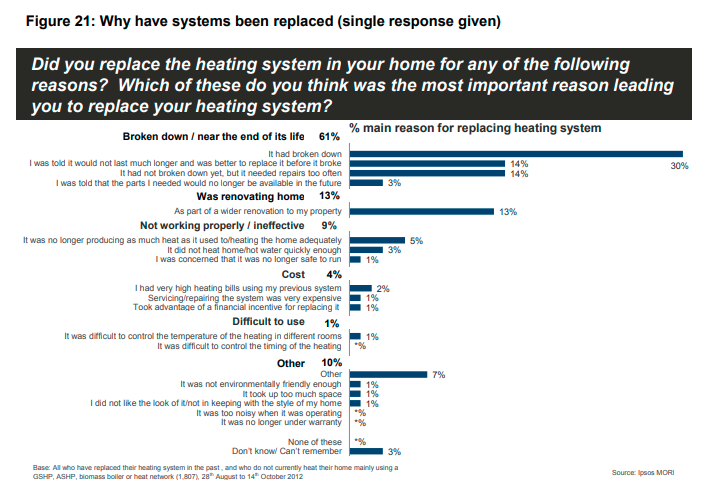
It appears that about 60% of those who replace their heating system do so because of actual or anticipated distress, but only half of the 60% (30% of the total) did so because of actual distress ('it had broken down'). If that is representative of current general behaviour, then around 70% of heating system replacement decisions are not done in a panic, and there is time to make a considered decision. Boiler failure leading to panic replacement does happen, but not in the majority of cases.
Midea 14kW (for now...) ASHP heating both building and DHW

Topic starter
02/11/2026 11:14 am
The "failed boiler" problem is something that you have mentioned in a few posts. I think that really gets to the nub of the problem of transitioning from gas to low carbon heating.
The statistics provide an acute focus on this aspect. There are around 1.7 million new gas boilers being installed each year. About 80% of these boilers are combis with no hot water tank. About 58% of the replacements are distress purchases, made up of 30% total failure, and 28% on its last legs with failure imminent ( https://www.nesta.org.uk/feature/speed-testing-ideas-to-cut-carbon-emissions-from-uk-homes/interim-boilers-for-broken-heating/ ).
So very roughly, there are somewhere around 700,000 to 800,000 combis where the household has to make a distress replacement each year, with no real option except for immediate replacement as soon as they can get someone to do it.
Are there any viable options that could be employed and subsidised by Govt. to nudge a reasonable proportion of these distress purchases into low / lower carbon heating? (The default outcome potentially locks in fossil fuel heating for another 15 years or so, before the same happens again...)
Hybrid would seem to be a possibility. This would involve a combi boiler and say a 5-6kW (one size fits all or perhaps simple menu choices based on house size and age) heat pump, and a control box that switches between them depending on weather conditions and hot water demand. Via subsidy, the household could see no extra install costs above that of a replacement boiler. Depending on gas prices, one would hope that their running costs are lower, and the CO2 emissions would be greatly reduced. The combi would only take over at very low outdoor temperatures and for hot water. The footprint of the system would need to be almost the same inside the house, with just the heat pump sitting outside as the major addition.
Is this viable economically, or would the grant needed end up similar to what the BUS grant is now?
Could such a scheme be offered to households with a boiler that is working perfectly well, simply as a way of moving to lower carbon heating?
Editted to add @cathoderay good point about just how much a distress purchase is an absolutely immediate one. I think that for most people though, if they have a problem with their boiler going into winter and are told by the heating engineer that it is likely to fail anytime soon, they are going to react quickly and go for a replacement boiler. I agree it's not quite the same urgency as a failed boiler and no heating, but it doesn't leave that much time for consideration of more complex changes, e.g. getting heat loss surveys etc. for a heat pump install that likely has a much longer lead time and fewer companies that can do the work.
This post was modified 3 weeks ago 2 times by Rob of York
02/11/2026 11:26 am
The statistics provide an acute focus on this aspect. There are around 1.7 million new gas boilers being installed each year. About 80% of these boilers are combis with no hot water tank. About 58% of the replacements are distress purchases, made up of 30% total failure, and 28% on its last legs with failure imminent.
So very roughly, there are somewhere around 700,000 to 800,000 combis where the household has to make a distress replacement each year, with no real option except for immediate replacement as soon as they can get someone to do it.
See my comments above (in effect we cross posted, 11:09 vs 11:14) - true distress purchases do happen, but they are a minority of all purchases (30% of all purchases), leaving 70% that are not distress/panic purchases, meaning people have at least some to consider what to replace their current heating system with. The implication is that most people choose not to have a heat pump.
Midea 14kW (for now...) ASHP heating both building and DHW

02/11/2026 11:33 am
I think that for most people though, if they have a problem with their boiler going into winter and are told by the heating engineer that it is likely to fail anytime soon, they are going to react quickly and go for a replacement boiler. I agree it's not quite the same urgency as a failed boiler and no heating, but it doesn't leave that much time for consideration of more complex changes, e.g. getting heat loss surveys etc. for a heat pump install that likely has a much longer lead time and fewer companies that can do the work.
More cross posting! I agree, the 'anticipated distress' category is broad, ranging from 'anytime soon' to 'time to think about changing the heating at some point'. Distress purchase isn't really a very useful term, I suggest the two categories are panic purchase (which conveys the implied loss of reasoning ability through pressure of time) and anticipatory purchases, where in many if not all cases there will be time to make a considered decision.
Midea 14kW (for now...) ASHP heating both building and DHW

02/11/2026 2:30 pm
Yes in terms of air/air + gas versus air/water + gas I think whether they are the same thing really depends on the question
At a high level they serve the same purpose and address a similar psychological question, as well as sizing questions. Obviously once you get into the question of "how do I heat this house" then they are very different technically and in terms of how they fit.
There are two debates really - but the one I think is important starts "How do I make people want a heatpump" and that really comes before technical details. It's about risk, RoI, available money, existing heating systems and many many more aspects. There are technical things that feed in at that level - how do I make the installs reliable, how do I keep the costs low, etc.
I don't think the majority of people in the UK care if their heatpump is air source, ground source, DIY, installer fitted or beamed in by aliens. They have some wants - heating, cooling, water, maybe dehumdification and someone who knows that area is supposed to figure out the solution and offer the bits they need (whatever combination insulation, heatpmps. MVHR etc). That stage doesn't happen until the decision to change the current setup has occurred.
"For modest open plan houses they are all you need"
I'm beginning to think this goes on the same board as "heatpumps only work on modern houses" and "EVs don't work in the winter"
02/11/2026 3:18 pm
"For modest open plan houses they are all you need"
I'm beginning to think this goes on the same board as "heatpumps only work on modern houses" and "EVs don't work in the winter"
Sorry I thought and meant to put 'may' in, but the difficulties of typing on a phone got me. I will edit the original post to do so once I have finished this one!
Yes in terms of air/air + gas versus air/water + gas I think whether they are the same thing really depends on the question
At a high level they serve the same purpose and address a similar psychological question, as well as sizing questions. Obviously once you get into the question of "how do I heat this house" then they are very different technically and in terms of how they fit.
There are two debates really - but the one I think is important starts "How do I make people want a heatpump"
100% agree, hence my comments above that the current system (tarrifs, grants, regulation, customer protection) is designed to fail. It doesn't make people want a heat pump unless they are moderately well off, dont believe what they hear on social media and either (a) want to show off or (b) are fundamentally green-minded. Thats a fair few, but by no means the majority!
The key to making the majority of people want a heat pump is (a) cost (capital plus running, but particularly running as capital costs can be dealt with in other ways) and (b) comfort.
The statistics provide an acute focus on this aspect. There are around 1.7 million new gas boilers being installed each year. About 80% of these boilers are combis with no hot water tank. About 58% of the replacements are distress purchases, made up of 30% total failure, and 28% on its last legs with failure imminent (
Putting the numbers together we have
- 320K non combi boilers installed annually, implying either a DHW tank or another way to heat hot water.
- 1.6M combi boilers installed annually
- Approx either 100k or 50K heat pumps fitted annually, depending on which statistic you choose
This alone illustrates the extent of the system failure, we aren't even impacting the ones where the DHW isn't a problem!
Also 30%+28%=58% of boiler replacements where the news is given to you by someone who, in almost all cases, cant sell you a heat pump, because they are excluded from the market by the MCS monopoly/overhead. Guess what their next sentence, after giving you the bad news, is going to be?
The remaining 42% where there is no time pressure equates to 700K boilers, against which our rate of instal of heat pumps is pathetic.
Hybrid would seem to be a possibility. This would involve a combi boiler and say a 5-6kW (one size fits all or perhaps simple menu choices based on house size and age) heat pump, and a control box that switches between them depending on weather conditions and hot water demand.
My fundamental problem with hybrid is the sales proposition in a boiler failed/imminent failure scenario. As soon as a heat pump installer says 'I'm going to fit a new boiler and a new heat pump' they are saying to the customer 'My technology doesn't work', at which point most customers will says 'ok then I will ask my local plumber to fit a replacement boiler which does work'. If this is our solution we are, IMHO, planning for failure. Its true that hybrid solutions are popular in some other countries, but this is frequently to deal with much more extreme conditions than those we enjoy.
Fortunately, as I think its the road to failure, I also don't see why it is necessary. The OFGEM standard house consumes 11.2MWh of gas per year, so has a loss <6kW. There are presumably lots of houses in this category, or smaller. For these you are anyway fitting a 6kW heat pump. So fit one (no need to size it, just do some sanity checks to ensure the house is in fact <6kW) and run it at whatever temperature is necessary to make the rads work, most probably <55 delivering a SCOP of 3.3 or more, as heat geek appear to have discovered. Then offer rad changes as an optional upgrade if there is a business case, which in many instances there will not be (essentially what Heat Geek are doing!).
In addition, if you really cant find space for a UVC, fit a heat geek mini store with a 3kW immersion where the combi was. This will deliver real time and continuously the same amount of water as a typical 9kW electric shower (and more than your proposed combi) and for one or two showers a lot more even than that because of the stored energy.
Job done for a whole class of houses. Once you have mastered that class, move onto the more difficult ones.
To make this work the MCS monopoly has to go and plumbers trained to do these relatively simple cases so that
- you are not in a position where the person that the homeowner will almost certainly approach first when their boiler fails/is on its last legs is incentivised to argue against a heat pump, because they are excluded from the market by the MCS closed shop.
- there is sufficient manpower
The MCS brigade can concentrate on the complex houses until that is also productized, so they wont be put out of business.
Thats not a complete recipe but its the start of one possible recipe that needs evaluating and production engineering. The current system is IMHO designed to fail (and certainly is failing). We need to think radically and across the whole system if we want a design that even has a chance of working.
This post was modified 3 weeks ago 22 times by JamesPa
4kW peak of solar PV since 2011; EV and a 1930s house which has been partially renovated to improve its efficiency. 7kW Vaillant heat pump.
Topic starter
03/11/2026 12:00 pm
I get that. Hybrid is not a good advert for heat pumps when the alternative is just a boiler on its own.
Houses with a heat only boiler and hot water tank are definitely the easiest starting point.
Some simple rules of thumb and easy checks would be enough to see that a heat pump is going to work. For example annual gas usage divided by 2000 gives a conservative heat pump sizing without being too far over. Basic size measurements of radiators and their type and look up in a simple app could be used to tot up radiator power at DT50 and from that check what radiator temperature is needed to transfer all the power that the heat pump can produce.
Using my own house as an example, 14000 units annual gas usage translates to a 7kW heat pump. Radiator power at DT50 is roughly 12kW. The ratio of the two is 7/12 = 0.58. Looking that up in a table of how radiator power drops with temperature, shows that anything under 0.63 is workable at a radiator temperature of 55C.
Ten minutes effort and the heat pump is sized and the radiators are checked for running at 55C.
The install could then be as near as possible a drop in replacement for the gas boiler. In my case, about 3m extra flow and return pipes from where the boiler is situated to an outdoor location for the heat pump. The pipes could even go through the existing hole for the flu. Heat pump sited on paving slabs, so nothing much to do there. Electrical hook up is an extra compared with a new gas boiler as it would need an appropriate circuit running from the consumer unit.
If a gas boiler costs say £1300 plus £1700 installation, I really don't see why a heat pump install should be any more than about £3000 for the heat pump, £2500 for the install plus £500 for the electrics. Total cost £3000 for a new gas boiler, £6000 for a new heat pump. A £3000 Govt. subsidy would then do the job, or better still simply make it a 50-50 match with whatever the householder needs to put in, so if a new hot water tank is needed and extra plumbing the subsidy cost matches on that too.
Am I completely off the mark with where the pricing should end up in a mature market?
In this context, the BUS grant and its added complexity appear to be wasting a huge amount of taxpayers money...

1
03/11/2026 12:21 pm
Duplicate
This post was modified 3 weeks ago by JamesPa
4kW peak of solar PV since 2011; EV and a 1930s house which has been partially renovated to improve its efficiency. 7kW Vaillant heat pump.
03/11/2026 12:21 pm
Electrical hook up is an extra compared with a new gas boiler as it would need an appropriate circuit running from the consumer unit
Agree with everything else.
Personally I think the assumption of a dedicated circuit also needs to be challenged. Most if not all 6kW heat pumps as draw max 16 A and mine for example can be limited to 13A in the installer menu. Ring circuits are good for 32A and even if broken for 20A. Many rings are very underloaded because, these days, it's generally only kitchen items that take power and then only for a short time. I suspect that a good 50% of 6kW heat pumps could be wired into the ring. That said, running an electrical cable isnt an enormous cost so long as it's not also necessary to change/check the CU so it might not be worth differentiating.
I know some will pop up and talk about types of RCD but there is no obligation for external fixed plant to be RCD protected. The next risk is very likely still reduced if you are no longer piping an explosive gas into your house, a risk we cheerfully accept.
This post was modified 3 weeks ago 3 times by JamesPa
4kW peak of solar PV since 2011; EV and a 1930s house which has been partially renovated to improve its efficiency. 7kW Vaillant heat pump.

05/11/2026 12:21 am
Absolutely agree. The massive Hager CU my vaillant required should be seen as a design flaw, not as proof the pump is a precious item..
8kW Solis S6-EH1P8K-L-PLUS hybrid inverter; G99: 8kW export; 16kWh Seplos Fogstar battery; Ohme Home Pro EV charger; Vaillant Arotherm Pro 7kW; 100Amp head, HA lab on mini PC
1
Page 2 / 2
Prev

