Notifications
Clear all
Joining the Renewable Heating Hub forums is completely free and only takes a minute. By registering you’ll be able to ask questions, join discussions, follow topics you’re interested in, bookmark useful threads and receive notifications when someone replies. Non-registered members also do not have access to our AI features. When choosing your username, please note that it cannot be changed later, so we recommend avoiding brand or product names. Before registering, please take a moment to read the Forum Rules & Terms of Use so we can keep the community helpful, respectful and informative for everyone. Thanks for joining!
Government Schemes, Regulations, Training, Planning & Organisations
9
Posts
7
Users
9
Reactions
608
Views

Topic starter
22/10/2026 2:19 pm
The Prime Minister has asked the Chancellor and Energy Secretary to look into removing the standing charge from gas bills.
At a first glance, such a measure appears to have a negative impact on the transition to heat pumps, since removing gas entirely and hence no longer paying the standing charge is one benefit of the transition to low carbon heating.
However, the actual impact of such a move very much depends on how the shortfall in revenue is recovered. Currently, the gas standing charges cover: day-to-day operating costs for suppliers including metering services, the warm home discount and green levies, supplier profit and risk management, and leveling costs across different payment methods.
There are two possible ways to meet the shortfall, the first is to cover the costs through general taxation, the second through increases to unit rates.
There are about 23 million domestic gas meters in the UK, and the standing charge is about £108.30 per year, so the total revenue is about £2.5 billion. This is a lot to cover through general taxation at a time when there are many competing demands on taxpayers money. The alternative is to increase unit rates. Ofgem estimates that the average gas usage is now 9500kWh per year for domestic consumers. Hence shifting the cost of removing the standing charge onto unit rates would increase the latter by about 1.14p per unit.
How does this help the transition from gas boilers to heat pumps?
In Jan 2027, gas unit prices are forecast to be 9.76p with electricity unit prices at 30.28p (Cornwall Insight). Removing the gas standing charge and recovering the lost revenues through higher unit rates would lead to prices of 10.9p per unit for gas and 30.28p per unit for electricity. This gives a spark gap of 2.78, much less than previously.
Assuming that an air-to water heat pump can be run 50% on half price electricity and 50% on full price electricity (a reasonably conservative assumption about time of use tariffs) and that the achieved efficiency is 3.5 (a stretch but not impossible) and a gas boiler has an efficiency of 0.9, we have the following:
Gas heating cost per year for 9500 kWh input is 0.109 x 9500 = £1035.50
Heat pump heating cost per year for 9500 x 0.9 kWh output is (0.75 x 30.28) x 9500 x 0.9 / 3.5 = £554.78
Saving is £480.72
Over a 15 year life, that amounts to a saving of £7210.
This is getting close to the level at which Govt could replace the BUS grant with an interest free loan for all of the costs of a heat pump upgrade, repayable over the lifetime of the heat pump (15 years). The saving in energy bills during that time would contribute over £7200 on top of the cost of around £3000 for a new gas boiler, so £10k to fit a heat pump and be overall cost neutral versus gas. This is the sort of argument that could just about work.
To really make it work, steps would need to be taken to ensure that the spark gap does not creep up above 2.8 again. This could be done by loading more costs onto gas unit prices - for example 20% VAT rather than 5% and use the additional revenues to reduce the unit price of electricity. This would leave Ofgem average customers no worse off overall, but create a stronger incentive to transition to low carbon heating.
It will be interesting to see what steps Govt takes in this area in next week's budget.
3

22/10/2026 3:11 pm
Removing the standing charge and has the effect of helping low gas users by comparison with high users. Although the correlation is far from 100%, there is more or less certainly a positive correlation between poorer people and low use. So there is a social argument, albeit not an overwhelming one. Perhaps stronger is that it puts these less well off people more in control of their own costs. With the standing charge they have no control, with a unit charge they do. Various organisations have been arguing for some time that the standing charge needs to be reduced for low poor users.
A scop of 3.5 is well achievable unless there is a deliberate decision not to upgrade radiators (From memory I think heat Geek will guarantee 3.3 in this case) or it's poor install.
This post was modified 3 weeks ago 4 times by JamesPa
4kW peak of solar PV since 2011; EV and a 1930s house which has been partially renovated to improve its efficiency. 7kW Vaillant heat pump.
1

22/10/2026 5:46 pm
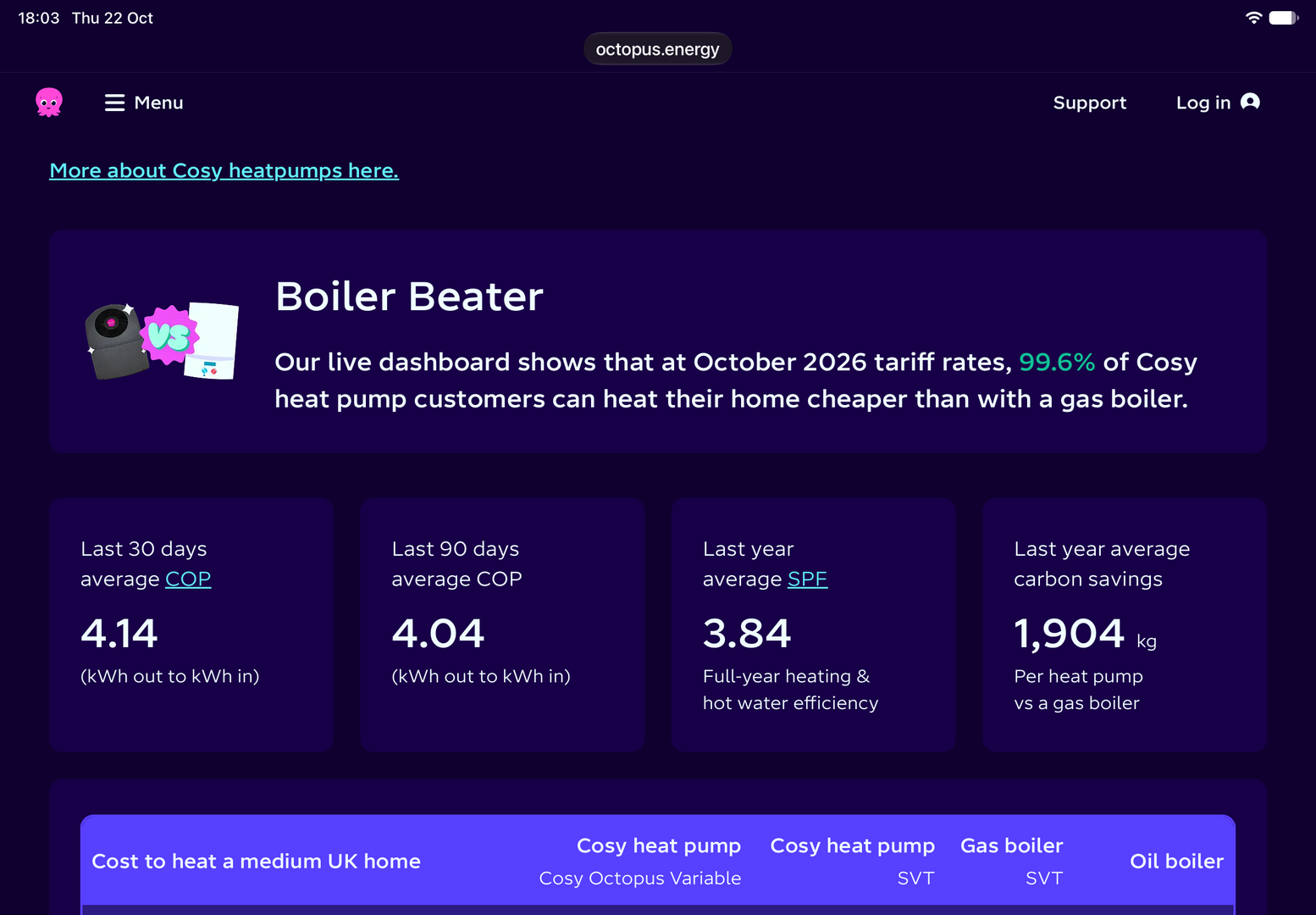
@watcher According to Homely who take their data from the Daikin heat pump, the last (fairly mild weather) week yielded 4.65 here. I must admit though that these figures must be taken with a large pinch of salt but, I should think the nett figure might be 4.0 anyway. Though Daikin show ‘rounded up’ figures for daily/ weekly consumption, the recently added ‘usage’ tab in Homely takes two decimal points for reports; they do add a few words of rear-end covering conditional warning though about accuracy depending on data supplied (GIGO?!) Either way, by moving the revenue raised from SC’s to unit rates does sound as though it would benefit the lower consumption user a little - and help with the spark gap too! Toodles.
Toodles, heats his home with cold draughts and cooks food with magnets.


22/10/2026 6:12 pm
GIGO always stands!
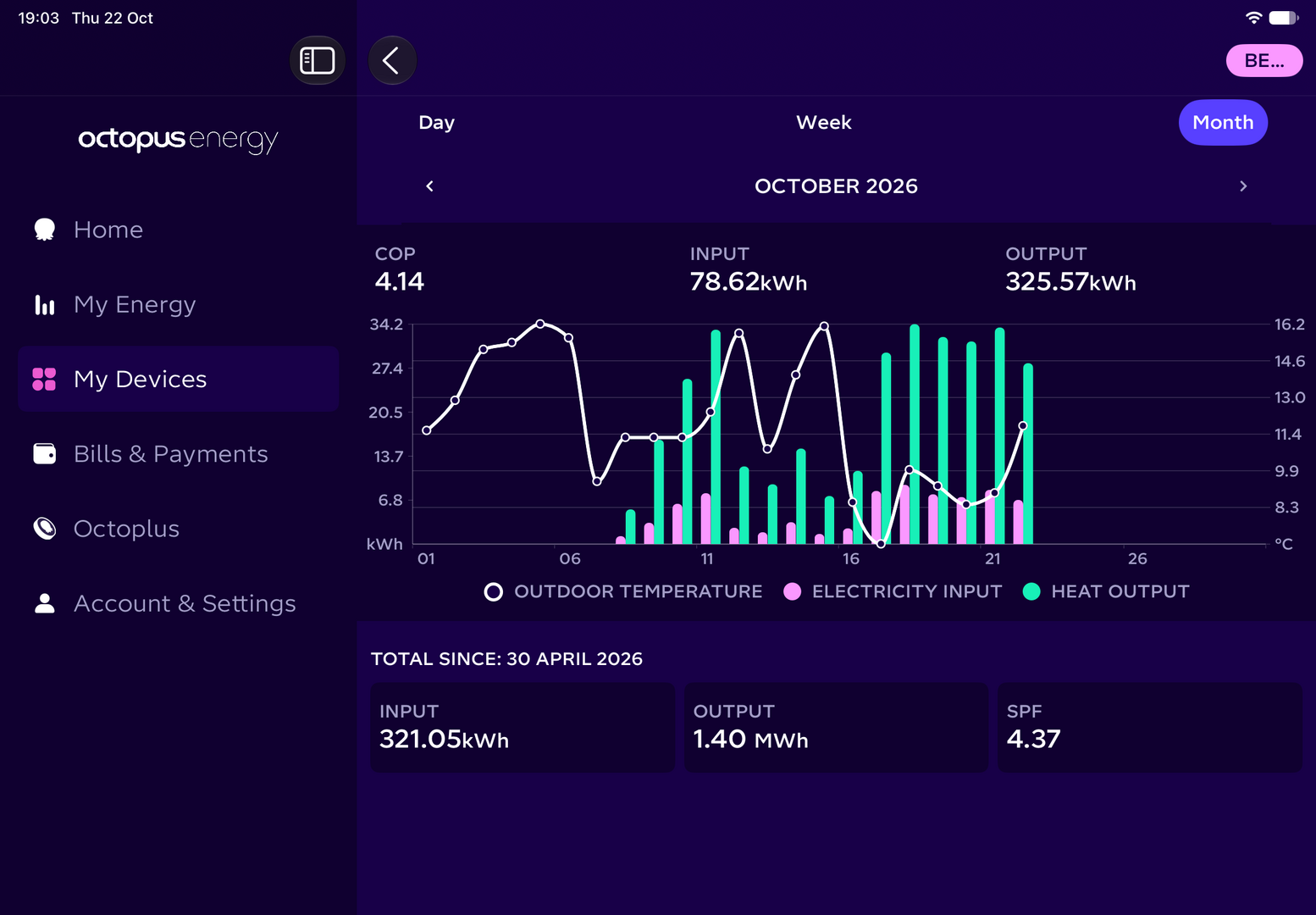
My Cosy 6, as you can see, was installed late April so no real basis to judge for 6 months yet. But my ‘last 30 days’ will be above average quoted above so I have faith in Octopus. (So far!! 🤣 )
Last week was 4.06.
2

23/10/2026 9:30 am
The shoulder months are very difficult to judge COP on in my experience. They're "inflated" because the temperature is high, but "deflated" because it tends to cycle more. Additionally, for us, the heating isn't on all day every day because it does get warm enough during the day that we can turn it off entirely. Finally, if Hot Water heating is also included, this will probably be an outsized factor when it's still quite mild out compared with Central Heating output. So it's really hard to judge from even a relatively cold October how well the heat pump is performing.
It does look good for you though @watcher 👍
ASHP: Mitsubishi Ecodan 8.5kW
PV: 5.2kWp
Battery: 8.2kWh
1

23/10/2026 9:42 pm
I'm not sure it makes much of a difference to heat-pumps, I see it having more of an impact on other gas appliances once a household gets a heat-pump, the incentive to disconnect and pocket the savings from the gas standing charge are removed, so keeping the gas cooker/hobs/oven and the gas fire are more attractive.
It's bit 'cave man' but there's something quite nice about having a hot, glowing fire in the winter. And with the recent Government push on people being resilient to emergencies, having a back-up source of heat which is not reliant on an electricity supply to function is quite a handy insurance policy in case of a power-cut.
1

24/10/2026 2:12 pm
I think it has an enormous impact on air/air users. The grant is basically dead in the water, most air/air people keep a bit of gas for the water heating and oddments (eg the cooker) and shift over time. If you take the standing charge off gas that makes the kind of partial migration that people want to do the in the real world much cheaper to run as you'll be using almost no gas and can launder your gas costs onto people who still do.
The whole thing is a complete mess though. Like many countries we have a system that pulled a lot of fixed costs out of the fixed part of the bill and hid them in the unit cost so that it notionally helped poorer low users. Today the skew of bad housing and inefficient heating is strongly towards poor people so it doesn't actually work properly. Moving them all onto unit charges is basically taking money from poor people and giving it to the well off, holiday home owners, foreign investors who hold vast numbers of our houses empty as just numbers in a spreadsheet and so on. (We've got 350,000 long term empty usable properties in the UK mostly held as "investments", many by people who've never visited the UK, let alone by rubber dinghy).
The even bigger problem though is the end of gas problem - and this makes it worse. If gas disconnections continue to randomly distributed, or worse yet everyone "mostly disconnects" the fixed costs of the gas network have to be covered somehow. That drives gas prices up which drives disconnections up but not in a way you can shut down any large pieces of the network. All the economic modelling basically says if you allow that your gas operators go under and you get a multi-billion pound a year bill to keep the mess running with pretty much no way out.
And unfortunately discussion about "turning gas off area by area" which is actually needed is so toxic our governments desperately kick the can down the road.

Topic starter
25/10/2026 11:10 am
The BUS grant funding for 2026/27 will run out at the current rate of uptake. Of the £400,000,000 allocated, only £143,585,000 was left at the end of Sept 2026, half way through the financial year. There was a £34 million decrease in what was left in August and a £56 million decrease in Sept. At that rate, the money is likely to run out around the end of the calendar year. (Note the figures include all vouchers issued but not yet reclaimed or expired). The funding is accessed first-come first-served in terms of vouchers issued, so once the funding is used up, that's it no more vouchers issued* until the next financial year. (*Not quite true as there would be a trickle as expired ones come back in).
With Treasury pressure on funding, it is unlikely that the Govt. will top up the total amount available this financial year, as has happened in the past. With the remaining funding looking like it will run out short of the end of the financial year, and pressure for cuts to the overall budget (just under £2 billion allocated for the financial years 2027/28 to 2029/30), it would make economic sense to cut the amount of the grant. That way the limited funding remaining for 2026/27 can support more heat pump installations, and cuts could be made to the budget for subsequent years, while still notionally supporting the same number of heat pump installations.
https://www.ofgem.gov.uk/data/bus-monthly-scheme-update as published 13th Oct 2026.
Changes to the grant can only take effect 28 days after they are published. So if there is a change at the budget, there should at least be a limited time for those well advanced in the process of getting a heat pump to access a voucher at the current rates.
If the BUS grant is reduced, and the gas standing charge removed with the costs placed on the unit rate, then the case for air-to-air as a hybrid solution providing space heating and cooling alongside limited use of gas (for central heating, hot water, and cooking) is going to become compelling.
This post was modified 3 weeks ago 2 times by Rob of York
SPONSORS

Degrees of Separation
Latest Posts
-

RE: How Can I Prove Coal Was My Main Heating Source Without Receipts?
Got excepted for the grant now so thanks for the replie...
By Chilli304 , 9 minutes ago
-
Welcome to the forums. That's a frustrating situation, ...
By Mars , 1 hour ago
-
RE: DIY powerflushing tutorial
Same 🤣 Near Lyon, France. Water has lots ...
By bobflux , 2 hours ago
-
RE: Buffer tank on a 2 x 14kw Ecodan system
Pretty much as I had guessed in my crude scaling from m...
By JamesPa , 4 hours ago
-
RE: Help me keep the faith with my air source heat pump installation
Well you have a vibration generator running at some fre...
By bobflux , 17 hours ago
-
RE: Why don't people choose heat pumps?
@susannasaunders The link I have found may provide a li...
By Toodles , 20 hours ago
-
RE: Who's your electricity provider and what's your tariff?
@downfield Thats a decent rate, I’m shocked they hadn...
By Papahuhu , 2 days ago
-
RE: Should Households Who Can Afford It Pay More for Energy to Help Those Who Can't?
@batpred I mentioned earlier that targeting the payment...
By Toodles , 2 days ago
-
RE: Adventures in heat loss calculations
@toodles thanks! So as suspected, around a doubling of ...
By SusannaSaunders , 2 days ago
-
Six books in three years and I think I’ve now covered j...
By Mars , 2 days ago
-
RE: Grant Aerona3 13kw - Buffer Tank - Heating Journey
@heymikey Well done in achieving as nearer a match acro...
By Toodles , 2 days ago
-
Grant Aerona - Weather Compensation and Schedules
Im trying to set up a friends Grant Aerona. The WC curv...
By bontwoody , 3 days ago
-
RE: Air-to-Air Heat Pumps & Air Conditioning: UK Heating and Cooling Q&A
@jamespa I agree, the efficiency of Cosy Cooler ought...
By Rob of York , 3 days ago
-
RE: How much of your renewable and home setup would still work if the internet went down?
I think you're right! 🤨
By Transparent , 4 days ago


SPONSORS