

Notifications
Clear all
Joining the Renewable Heating Hub forums is completely free and only takes a minute. By registering you’ll be able to ask questions, join discussions, follow topics you’re interested in, bookmark useful threads and receive notifications when someone replies. Non-registered members also do not have access to our AI features. When choosing your username, please note that it cannot be changed later, so we recommend avoiding brand or product names. Before registering, please take a moment to read the Forum Rules & Terms of Use so we can keep the community helpful, respectful and informative for everyone. Thanks for joining!
Government Schemes, Regulations, Training, Planning & Organisations
15
Posts
6
Users
2
Reactions
481
Views

Topic starter
03/10/2026 1:25 pm
The Boiler Upgrade Scheme (BUS) is essential in encouraging the adoption of heat pumps for domestic space heating and hot water in the UK, however, in its current form the scheme has a number of drawbacks. There are a number of ways in which it could be improved that are discussed below.
Background
The Boiler Upgrade Scheme is paid for through general taxation. It provides grants of £7500 for Air-to-Water (A2W) and £2500 for Air-to-Air (A2A) heat pumps when they are installed as a replacement for a gas boiler. BUS grants are also available for replacing oil boilers and direct electric boilers, however, here we focus on gas.
Existing electric supplementary heaters are permitted to stay in place e.g. electric towel rails, electric immersion heaters, etc. The output of the heat pump must cover the full space heating requirements of the property, and together with any supplementary appliances, it must also cover the space heating and hot water requirements of the property.
The full regulations are here:
https://www.legislation.gov.uk/uksi/2022/565/regulation/9/made
How the scheme could be improved
Technology agnostic
At present, the amount of the BUS grant depends on the technology used rather than only on the desired outcome, i.e. low carbon heating. This situation should be avoided since it leads to a poor use of public money. As an example, consider a property with two viable alternatives: (i) an A2W system including hot water heating at a total cost of £10500, and (ii) an A2A system again including hot water heating at a total cost of £6500. In a free market (no subsidies) option (ii) would be the most economic choice. However, with the current subsidies, the household assuming that they are indifferent to the technology choice would choose option (i) as the cost to them is £3000, rather than £4000 for option (ii). In this case, the difference in subsidies creates a distortion that wastes £5000 of public money to make the householder £1000 better off, with no benefit with respect to the outcome.
The solution to this issue is to provide the same incentive independent of the technology used and hence achieve the desired outcome, the adoption of low carbon heating, at the lowest overall cost. The subsidy provided should aim to only create a market distortion with respect to gas heating, and not one between different heat-pump based systems. Air-to-water, air-to-air, air-source or ground source does not matter; they are all heat pumps capable of providing low carbon heating. If they can meet a sufficiently high SCOP, currently just 2.8, then the subsidy should be the same. This would ensure that the most cost-effective technology is deployed and that taxpayers get the best overall value for money and hence the total funds for the BUS grant go further, achieving larger reductions in CO2 emissions.
A variable grant rather than a fixed one
The BUS grant currently provides a fixed subsidy of £7500 or £2500 depending on the technology used to replace a gas boiler. The grant is the same irrespective of the size of the property, the size of the system that is replaced, and the efficiency of the technology used. This leads to the situation where the BUS grant is both over-generous and under-generous at the same time.
For a small property, replacement of a gas boiler with an A2W system might cost £8000 of which the BUS grant pays £7500 and the householder just £500. However, the householder may well have gone ahead anyway even if the cost to them was £2500, less than installation of a new gas boiler at around £3000. As a consequence, £2000 of public money has been wasted on something that would still have happened if the grant were £5500.
For a larger property, replacement of a gas boiler with an A2W system might cost £14000 of which the BUS grant pays £7500 and the householder £5500. In this case the house holder may have been willing to pay £4000 but decides that paying nearly twice the cost of a replacement gas boiler simply isn’t worth it and therefore does not go ahead. An opportunity to install low carbon heating is missed.
An additional problem caused by the price distortion is the effect on the amount of due diligence that some householders apply and the choices that they make. Three quotes of £8000, £9000, and £10000 where all the money comes from household funds needs serious consideration in terms of quality, checking installer reputation, equipment used etc. However, after the BUS grant, the costs to the householder are £500, £1500, and £2500, which may well create a race to the bottom. It would be easy to fall into the trap that the lowest price quote at 1/3rd the cost of the middle one and 1/5th the cost of the most expensive is the one to go for. By not caring because it is so cheap, £500 and a huge £7500 in grant, the householder sets themselves up to be exploited by cowboys out to make a fast buck. The result is a poor quality system that does not meet the householders needs, something they may come to regret in future.
The solution here is to make the grant a percentage of the overall cost up to some maximum value. This is what is done in some other European countries. As an example, the percentage could be 75% and the maximum say £10,000. This would work for the small and large property examples described above. The proportionate cost to the householder would also lead to better due diligence, since the cost to them of the different options in the example above would be proportionate to the overall costs, i.e. £2000, £2250, and £2500 in this case. Now a high quality install with better equipment appears to be what it in fact is, much better value for money.
Note, in changing to a variable rather than a fixed amount for the grant, there should also be some restrictions on what can be included in the figure that the grant is based upon. For example, the cost of radiator replacements or underfloor heating should not be included when these are at the discretion of the householder rather than an essential requirement. Only the costs necessary to install a heat pump and achieve a SCOP of at least 2.8 would qualify with respect to the grant.
The perfect is the enemy of the good
No support is currently available to install low-carbon heating alongside an existing gas boiler. It’s all or nothing as far as the BUS grant is concerned. Unfortunately, this is an example of the perfect being the enemy of the good.
Over 10 million homes have gas boilers that are less than 10 years old, i.e. potentially less than half of the way through their lives. There are ways in which partial de-carbonisation can be achieved which are of great benefit in terms of carbon emissions, without replacing the existing stock of relatively new gas boiler.
A small grant, call it the Boiler Enhancement Scheme (BES) could cover 50% of the costs, up to a maximum of £1000, of installing an A2A heat pump alongside existing gas boilers. The uptake of such A2A systems would likely be very high, since they cost as little as £1600 fully installed for a single-split system. Such a system could provide at least 3000kWh of heating in a property that has the Ofgem average gas consumption (9500 units of gas, about 8550kWh of heat). This would reduce the property’s CO2 emissions by around 1/3rd. This is a far more efficient reduction in CO2 emissions per £1000 of public money compared to the existing BUS grant for A2W, which costs £7500 to remove 3 times as much CO2 emissions. On those figures, the BES grant would be 250% more effective than the BUS grant for the same amount of taxpayers’ money.
Would households actually use A2A for space heating? A2A systems have easily achievable SCOPs of over 5. Currently, the gas price is about 7.97p per unit and electricity 26.32p per unit. Assuming gas boiler efficiency of 0.9, an A2A heat pump with efficiency of 5 costs just below 60% the price of gas per kWh of heat delivered. People don’t need an incentive to make the maximum use of an A2A system for heating, as it is already there in the existing spark gap. They only need consider their bank balance! In Jan 2027, the argument will become even more compelling. The latest forecast based on 30th Sept figures for wholesale gas prices put the price of gas at 9.76p and electricity at 30.28p from 1st Jan 20207, so A2A heating will then cost only 56% the price of gas.
By introducing households to heat-pumps via the A2A route, they are much more likely to be fully onboard with an A2W replacement for their gas boiler when the latter reaches the end of its life.
Conclusions
I think there are good economic arguments for reforming the BUS grant so that it is technology agnostic, pays a variable rather than a fixed amount based on the essential upgrade cost, and also encourages hybrid upgrades as well as complete ones.
I’d be interested to hear what others think about these suggestions both for and against. What do you think of the existing BUS grant? Is it fit for purpose? Could the same amount of money be spent in a better way to encourage the transition to low carbon heating? Is a grant for hybrid / partial low carbon heating a good idea? How do you think the use of taxpayers’ money could be improved to encourage more people to make the transition to low carbon heating?
This topic was modified 3 weeks ago by Rob of York
1

03/10/2026 8:48 pm
I'd argue the core problem is that currently the 'Boiler Upgrade Scheme' doesn't do what it says on the tin, it can't simply upgrade your boiler with something cleaner and greener. As soon as you get into the process of an A2W heat-pump upgrade it turns into a much bigger project to replace significant parts of the hot water and heating system, changing hot water cylinders and often relocating them to a new location (or finding space for one if you had a combi), replacing radiators, finding space for buffer/volumisers and expansion vessels, plus all of the replumbing to hook all of this up.
You see photos of retrofit installs online and most need a lot of space, they almost need their own plant room for all of the kit. I think that's why the uptake for replacing existing boilers has been so poor, there's too much disruption and hassle involved which then puts people off. To get millions of households to upgrade their boilers, it needs to be made simple and straightforward and with the current requirements for A2W all-electric heat pumps, it isn't and that will greatly delay the shift away from purely gas heating.
I'm actually quite envious of those European countries which support hybrid heat-pumps, they look a great technology to rapidly get households upgraded - a small indoor unit next to the existing boiler (or an integrated unit to replace the boiler), connect into the existing pipework next to the boiler, run in some small-bore refrigerant pipework to the compact outdoor unit, wire it in with a modest power supply and controls. Job done. That's a true "boiler upgrade" - emissions significantly reduced, simple, quick, not disruptive and so the kind of thing that almost every household could install and would likely consider installing.
Again, it's perfect being the enemy of the good. No doubt the current all-electric heat-pump upgrades are environmentally perfect being zero emission, but the cost and disruption means the uptake is really poor. Whereas a hybrid isn't perfect as there's still some gas usage, it's merely good but by being simpler to install would probably get many more homes to retrofit them so actually saving more carbon overall.
So yes, amend the BUS to include hybrid heat-pumps, with a more modest grant of a few thousand to support these.
1

03/10/2026 10:29 pm
I think there are good economic arguments for reforming the BUS grant so that it is technology agnostic, pays a variable rather than a fixed amount based on the essential upgrade cost, and also encourages hybrid upgrades as well as complete ones.
Whenever the BUS grant comes up for review, it makes sense to change it. I suppose one radical option would be to adjust the cost of gas to account for carbon capture costs. Electricity prices would become competitive as the grid moves from 50% to 95% carbon free. Perhaps the financial incentive needed to encourage retrofit would diminish and hybrid would be penalised around level of use of carbon fuels.....
The fact that A2A retrofits are receiving less incentive is probably because the current data indicates less incentive is needed. The current A2W effort is likely to require higher incentive to keep going. The workforce is trained, what sense would it make to "shock the system" with all the confusion to consumers (most of us are not that interested in heating technology beyond it working..) by reviewing/aligning incentives? Trying to make it work with a SCOP of 2.8 defies maths with the current gas to electricity price ratio. The current system is trying to make it less likely that running costs for a heatpump are above a gas boiler (by including rad upgrades). Removing that (without price changes) would mean more bad stories about heatpump bills (or freezing homes).
But I have the same question as you, on why A2A was not supported on BUS before. Specially as I believe it is the technology that has been more widely available for longer...
8kW Solis S6-EH1P8K-L-PLUS hybrid inverter; G99: 8kW export; 16kWh Seplos Fogstar battery; Ohme Home Pro EV charger; Vaillant Arotherm Pro 7kW; 100Amp head, HA lab on mini PC
03/10/2026 10:33 pm
I'm actually quite envious of those European countries which support hybrid heat-pumps, they look a great technology to rapidly get households upgraded - a small indoor unit next to the existing boiler (or an integrated unit to replace the boiler), connect into the existing pipework next to the boiler, run in some small-bore refrigerant pipework to the compact outdoor unit, wire it in with a modest power supply and controls. Job done. That's a true "boiler upgrade" - emissions significantly reduced, simple, quick, not disruptive and so the kind of thing that almost every household could install and would likely consider installing.
Yes, their gas typically costs twice ours and electricity is often cheaper than ours. So the maths work differently. Plus perhaps their homes have more spare space to keep the backup gas kit...
8kW Solis S6-EH1P8K-L-PLUS hybrid inverter; G99: 8kW export; 16kWh Seplos Fogstar battery; Ohme Home Pro EV charger; Vaillant Arotherm Pro 7kW; 100Amp head, HA lab on mini PC

04/10/2026 10:10 am
Plus perhaps their homes have more spare space to keep the backup gas kit...
It's the reverse, the hybrids need less space. The back-up gas kit is the boiler already on the wall, but by keeping the boiler it then reduces the space needed for hot water kit by either using the combi to provide it (hot water provision is a small proportion of energy consumption overall), so avoiding the need to find space for an entirely new cylinder, or it allows smaller hot water cylinders so avoids the need to relocate them into garages/bedrooms etc, because the boiler can provide additional heat/temps to recover HW temperatures reducing the necessary cylinder volume.
Topic starter
04/10/2026 2:11 pm
Posted by: @temperature_gradient
I'd argue the core problem is that currently the 'Boiler Upgrade Scheme' doesn't do what it says on the tin, it can't simply upgrade your boiler with something cleaner and greener.
I'm actually quite envious of those European countries which support hybrid heat-pumps, they look a great technology to rapidly get households upgraded - a small indoor unit next to the existing boiler
That is a great pragmatic solution. It would address the space issues where there is a combi boiler and no hot water tank and give people the reassurance that the heating system is definitely going to be sufficient in the depths of winter. It works as an upgrade to an existing gas boiler rather than throw that away and replace it. It's a shame that the Govt. so far isn't will to subsidise this route. I guess the sound bites just don't work and the media would instantly criticise the idea of a subsidy to keep gas boilers, without seeing the nuance or the potentially to greatly reduce CO2 emissions.
Posted by: @batpred
Whenever the BUS grant comes up for review, it makes sense to change it. I suppose one radical option would be to adjust the cost of gas to account for carbon capture costs. Electricity prices would become competitive as the grid moves from 50% to 95% carbon free. Perhaps the financial incentive needed to encourage retrofit would diminish and hybrid would be penalised around level of use of carbon fuels.....
Yes, the spark gap is the absolute crux of the matter. The graph below is enlightening.
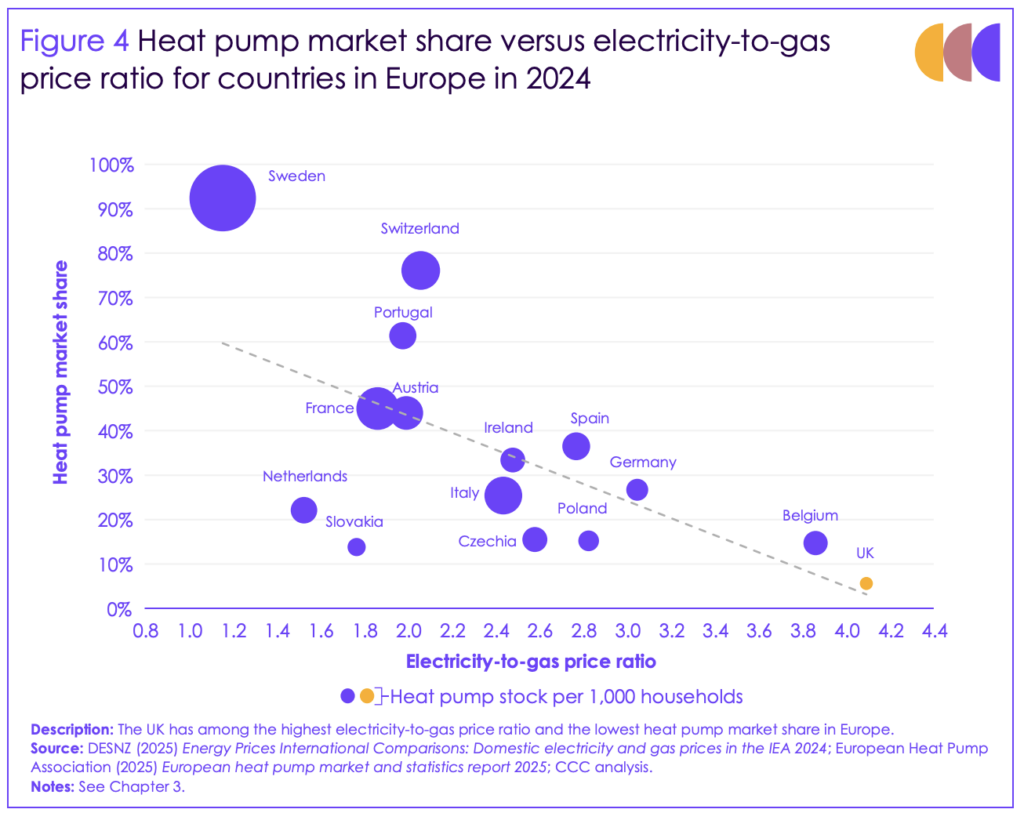
Unless something is done, then into the 2030s, electricity prices are going to be much too expensive due to the grid upgrades needed already and those that will be required in the future to support higher demand from EVs and heat pumps. These costs are currently paid for out of the revenue from electricity bills. Covering these costs from general taxation would arguable be a much better approach, since it would be far more progressive and significantly reduce the spark gap, which would in turn provide a better incentive for the take up of these technologies.
In economics terms, if the Govt. wants to encourage more of something, then they should make it cheaper i.e. subsidise it, whereas if less consumption is desired, it should be made more expensive i.e. taxed. For this reason, I have never understood why energy, both gas and electricity had 5% VAT rather than 20%, while we were encouraged to buy low energy appliances (fridges, freezers etc) on which 20% VAT is charged. Now the Govt. has zero rated VAT on electricity, indicating that it wants us to use more of it...I'm not sure that is entirely the right message.
One measure that could be taken to decrease the spark gap would be to increase VAT to the standard 20% rate on gas and use the additional tax take to reduce the cost of electricity i.e. cover some or all of the grid upgrade costs from general taxation. Considering current prices of 26.32p per unit for electricity and 7.97p per unit for gas, increasing the VAT on gas to 20% would increase the cost to about 9.1p per unit. Using that extra tax to subsidise electricity would bring the price down by about 4.3p to around 22p. The spark gap would then be just 2.4 rather than 3.3. This change would make a huge difference to the economic viability of heat pumps in terms of their running costs versus gas. Further, the overall cost to an Ofgem average consumer (2500kWh electricity, 9500kWh gas) would be the same. The gas would be more expensive and the electricity cheaper. For those with much larger gas consumption, and hence the biggest potential for cutting CO2 emissions and making a saving via installing insulation and/or a heat pump, the costs would be considerably higher. For those that have already moved to low carbon heating, the cost would be lower. This is exactly the message that is needed for the low carbon transition to take place.

04/10/2026 3:22 pm
One measure that could be taken to decrease the spark gap would be to increase VAT to the standard 20% rate on gas and use the additional tax take to reduce the cost of electricity i.e. cover some or all of the grid upgrade costs from general taxation.
Political suicide given that the vast majority depend on gas for heating.
Cue the pictures of frozen grannies on the front page of the Daily Fail (other sources of misinformation and propaganda are available!)
This post was modified 3 weeks ago 2 times by JamesPa
4kW peak of solar PV since 2011; EV and a 1930s house which has been partially renovated to improve its efficiency. 7kW Vaillant heat pump.
04/10/2026 6:15 pm
It's the reverse, the hybrids need less space. The back-up gas kit is the boiler already on the wall, but by keeping the boiler it then reduces the space needed for hot water kit by either using the combi to provide it (hot water provision is a small proportion of energy consumption overall), so avoiding the need to find space for an entirely new cylinder, or it allows smaller hot water cylinders so avoids the need to relocate them into garages/bedrooms etc, because the boiler can provide additional heat/temps to recover HW temperatures reducing the necessary cylinder volume.
Ah, that makes sense when a combi is in place. The boiler is always more compact than a hot water cylinder. I underestimated how much pipework and expansion vessels added to the heatpump space requirement... I assume a hybrid system would be the same.
I wonder whether most systems keeping a boiler aim to provide backup, facilitate meeting peak heat demand or to handle hot water.
8kW Solis S6-EH1P8K-L-PLUS hybrid inverter; G99: 8kW export; 16kWh Seplos Fogstar battery; Ohme Home Pro EV charger; Vaillant Arotherm Pro 7kW; 100Amp head, HA lab on mini PC


15/10/2026 4:44 pm
Slightly tangential, but one thing I'd do is address the installation costs of A2A. A simple single head mini split can be purchased for about £500, but to install it comes to about £2500. Where does the £2k go, when many installs are just drilling some holes and plugging into an existing circuit? I realize there are F-gas reasons, but vacuum testing pipes isn't hard...
So what I'd do is legalize the installation of pre-gassed R32 systems that come with their own pipework. Mount the indoor unit, feed the pipes through the wall. Plug in the bayonet connector in the back of the unit, then press the 'commission' button. Have the unit do its own vacuum test and it'll only release the gas if it's happy.
Then anyone can do A2A installs. That leaves A2A hot water - I wonder if it would work too promote 'heat pump water heaters' where the ASHP is inside the cylinder like they have in the US?

15/10/2026 6:08 pm
R32 is dead from 1/1/2027 for most use cases. It's really about R290 which AFAIK you can still self install (although the shills for the F gas world were lobbying government extensively to stop their cash cow going away).
I think the question I would ask is why it costs 2 grand here for a single minisplit install and far far less in Spain. Like a single split is a bit over grand (UKP) installed and about 4/500 of that is labour.
Heck even Norway is typically cheaper, and that's not exactly a low cost labour country. Aside from regulatory things as far as I can tell thats because
- There are lots of installers
- Anyone who can work a big drill without ending up in hospital can drill the holes (it's not casual DIY if you don't know wtf you are doing)
- There are lots of installations
- There is a lot less paperwork. You turn up, drill a hole, fit the unit, leave. Nobody has to wait 6 weeks for the DNO, or consult a planning department. Builders fit aircon, maybe with someone who "knows aircon" to do the pipes.
I would agree though the magic we need is something like the Midea Portasplit but with a detatchable elephant trunk that can be run through a wall and has idiot proof connectors. Even if the connector added 200 quid to the unit cost it would be cheaper than the time and hassle of a qualifed installer. That or we need to offer grants for sash windows instead where it's a trivial to do a portasplit.
15/10/2026 7:13 pm
Unfortunately it's very hard to actually buy R290 units. It seems to be mostly Aircon Direct, who are experienced in sailing close to the wind, who will supply. Other suppliers are all 'you need to supply your company F-gas number before we will accept an order', even for R290. And Aircon Direct are only selling their own Electriq brand (ie cheap Chinese units) - all the major brands are still R32. Mitsubishi have the MSZ-RZ in R290 but the only supplier I could find offering it wants an F-gas number.
I suspect that adding a vacuum pump and pressure transducer to a unit wouldn't add massively to the cost - after all a basic Chinese vacuum pump as a standalone product can be had for about £60, and that cost will likely fall with volume. Then you have the option of detachable hoses as you suggest.
15/10/2026 8:10 pm
@prunus That should be changing really rapidly quite soon because the R32 products won't be sellable in the EU or I believe even shippable through the EU from Jan 2027. Basically the EU is the dog and we are the tail. So we are going to get wagged whatever our government thinks.
Page 1 / 2
Next
SPONSORS

Degrees of Separation
Latest Posts
-

RE: New Build 3 Phase or 1Phase
£16K (or even £25K!) would go a fair way towards employ...
By Toodles , 1 hour ago
-
-
Mars asked for an update on progress so …. Out HP has...
By DavidB , 3 hours ago
-
RE: How much of your renewable and home setup would still work if the internet went down?
Yes I actually have a copy of a tool that whenever a ce...
By EtchedPixels , 5 hours ago
-
RE: How will removing the standing charge on gas bills benefit heat pumps?
The shoulder months are very difficult to judge COP on ...
By scrchngwsl , 6 hours ago
-
RE: Indevolt Batteries UK Support & Info Thread
@editor Hi, To resolve this, please tap on the A...
By Indevolt Tech , 12 hours ago
-
RE: Double or Triple Glazed Windows?
Posted by: @singlespeed With 9 years repairing windo...
By Rob of York , 1 day ago
-
@transparent we’re still running a secure version of PH...
By Mars , 1 day ago
-
RE: How quickly would you want/expect heat recovery to take from setback?
Much longer than that here. The heating isn't even on. ...
By bobflux , 2 days ago
-
RE: Passiv Smart Thermostat - Help & Forum Support
Obviously the weather is changeable but there's a defin...
By Singlespeed , 2 days ago
-
RE: The Changing Jet Stream Could Challenge UK Air Source Heat Pumps
@rob-of-york I must admit that when we had a Daikin hea...
By Toodles , 2 days ago
-
RE: Forum updates, announcements & issues
Get the Renewable Heating Hub heads-up on WhatsApp. I...
By Mars , 2 days ago
-
RE: Safety study for plug in batteries out to tender - looks like Q3 2027 at best before legal
@editor I pointed out to the one of the Fuse execs that...
By dansus , 2 days ago
-
RE: 15kw pump for 225m2 1990's house - over kill?
@seaviews As well as loft insulation, there are othe...
By Rob of York , 2 days ago



SPONSORS
