

Notifications
Clear all
Joining the Renewable Heating Hub forums is completely free and only takes a minute. By registering you’ll be able to ask questions, join discussions, follow topics you’re interested in, bookmark useful threads and receive notifications when someone replies. Non-registered members also do not have access to our AI features. When choosing your username, please note that it cannot be changed later, so we recommend avoiding brand or product names. Before registering, please take a moment to read the Forum Rules & Terms of Use so we can keep the community helpful, respectful and informative for everyone. Thanks for joining!

Topic starter
11/11/2026 10:00 pm
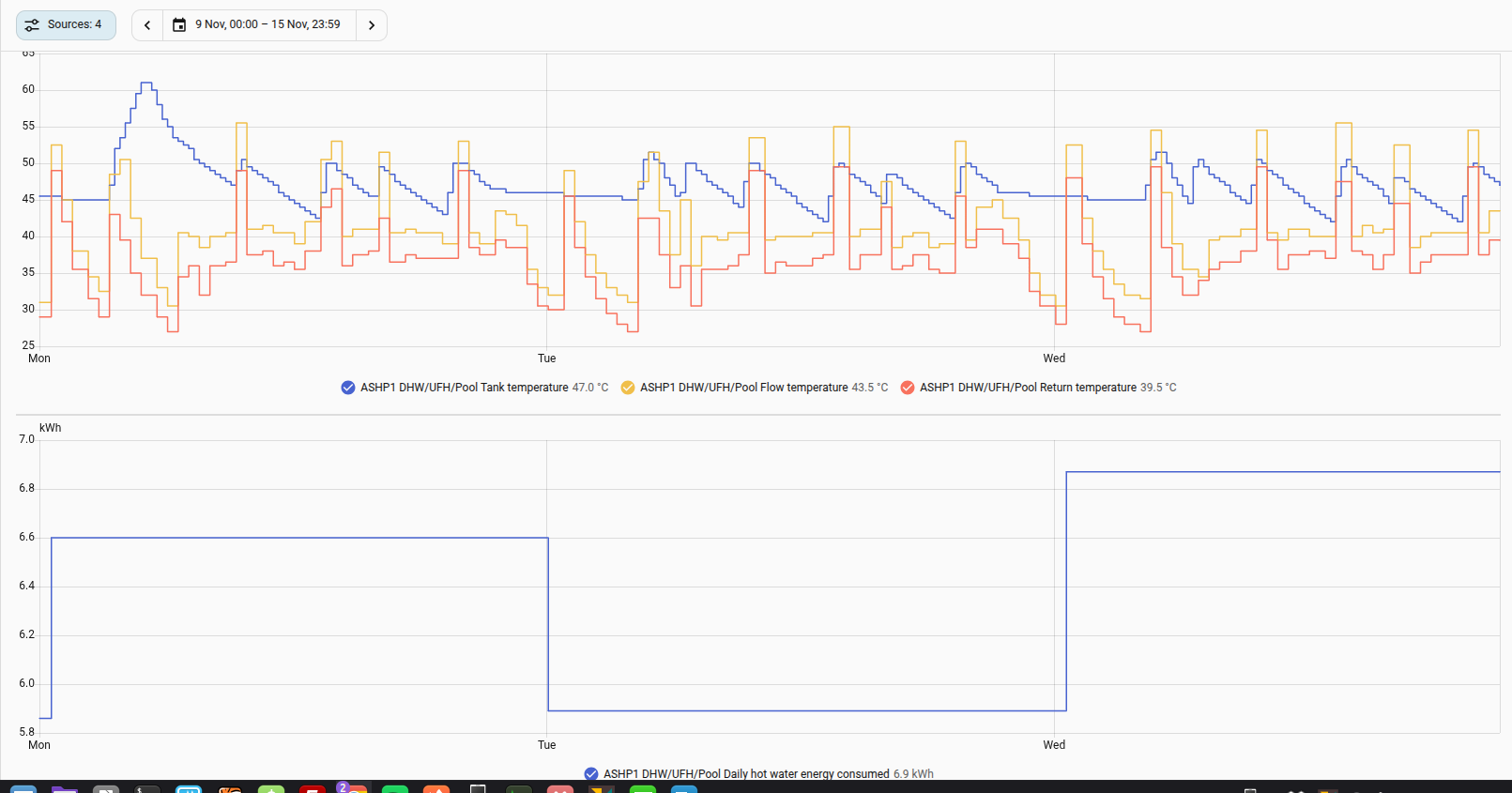
@JamesPa WRT the DHW: I am happy that is working OK and the heat loss is acceptable. The circulation pump runs so that there is always hot water at the kitchen sink, and we accept the heat loss to achieve it. The heat-up times are set to utilise off-peak electric as much as possible, or solar during the day. As shown on the schematic, the DHW tank is a 250lt Tempest, and power consumption just for DHW is less than 7kW / day.
WRT the property,
heating was assessed as “space heating annual demand” = 48,176kWh/yr
insulation standard = not specified
Property shape = 3 linear wings, with 2 adjacent to a square pool area. (Think of an L shape, with a wing of rooms off the bottom of the L and the pool in the middle of the L)
Pool insulation – unspecified
The area quoted was from something the estate agent produced, and I see in the heat calculations doc that they said the area is 278mSq, but do not include the pool.
Can you clarify exactly what the figures of 60kWh and 264kWh both of which you quote above, cover.
The 60kWh is what the total daily consumption sensors of the 2 pumps report, of which 7kWh are attributable to DHW. As shown on the graphs, the 264kWh was a rough tot up of a days energy produced by both pumps (heating & DHW) and quoted as a sanity check that energy consumed and heat generated with a COP around 4 was about where you would expect it.
@bobflux Yes the thermostat graphs are shaded = heating, and look to be working as they should. The pool heating uses a Heatmiser timer as a timer, so I have online control for pump running times, but the temperature and control is a proprietary set up that there is no online control over, so no monitoring. I could put a temp sensor onto the pipe either side of the heat exchanger, but my gut feeling is the pool heat loss is not likely to have changed significantly in the last few weeks.
The Grundfos pump is UPM3S Flex AS 25-60 130 AZA
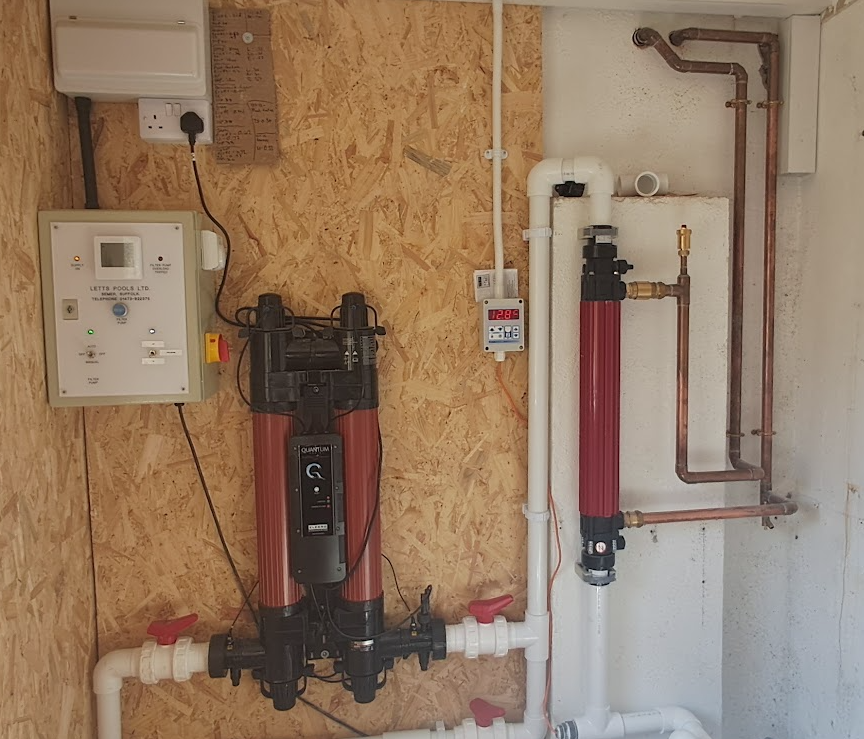
I do appreciate your efforts on this, as the original question was just of the buffer tank - is it appropriate in its current configuration, but if there is something obvious that would reduce the power consumption, that would be good. The 40C flow to heat the pool to 29C might be OTT, but it is in use quite a bit so I can not easily drop it down to experiment with. It seems incredible, but the red unit on the right, is the heat exchanger for the pool heating (the other red tubes are UV anti-bacterial tubes). Nothing has ever been looked at regarding the flow rate to that heat exchanger - again, a 3rd company was responsible for the pool, that did not talk to the other 2...


11/11/2026 10:01 pm
@fosterl2, ah, that changes the picture somewhat. I’d assumed the two Ecodans were still operating as a cascade, but having two independent controllers feeding into a common buffer raises another question for me… what happens hydraulically when one heat pump is running and the other isn’t? Are there non-return valves preventing unwanted circulation between the units, particularly when one is producing hot water while the other is heating the pool or house.
I’m also curious whether simply removing the cascade controller and repositioning the sensors was sufficient to convert the original design into two genuinely independent systems. It may be absolutely fine, but given everything else you’ve uncovered, I’d want to know whether the revised configuration was actually designed and checked or simply ‘made to work’.
And as for Britain’s Heat Pump Shitshow, I bet your early experiences will mirror the first half of the book rather closely! That initial excitement about getting a heat pump, putting your faith in the people designing and installing it, followed by the gradual realisation that things aren’t quite right and that you’re somehow becoming responsible for diagnosing problems you paid professionals to avoid. It’s a depressingly familiar story.
What makes your experience particularly interesting is that you’re clearly doing a lot of the investigative work yourself, and I suspect there are still a few surprises waiting to be uncovered. Hopefully the discussion here will help you get some proper answers.
Dad’s Outside with the Heat Pump Again
He wanted to save the planet. His family just wanted him to come inside.
Get the book → · Free UK shipping
The Ultimate Guide to Heat Pumps · Britain’s Heat Pump Shitshow
Heat Pumps Explained · From Zero to Heat Pump Hero · Bodge Buster
From Zero to Heat Pump Hero and Bodge Buster are rewritten and updated for 2027.
New to heat pumps? Heat Pump Fundamentals course — 50% off with INTRO50.
Page 2 / 2
Prev

SPONSORS

Degrees of Separation
Latest Posts
-

RE: Buffer tank on a 2 x 14kw Ecodan system
@fosterl2, ah, that changes the picture somewhat. I’d a...
By Mars , 1 hour ago
-
RE: Help me keep the faith with my air source heat pump installation
Well you have a vibration generator running at some fre...
By bobflux , 4 hours ago
-
RE: Why don't people choose heat pumps?
@susannasaunders The link I have found may provide a li...
By Toodles , 6 hours ago
-
RE: Who's your electricity provider and what's your tariff?
@downfield Thats a decent rate, I’m shocked they hadn...
By Papahuhu , 1 day ago
-
-
RE: Should Households Who Can Afford It Pay More for Energy to Help Those Who Can't?
@batpred I mentioned earlier that targeting the payment...
By Toodles , 1 day ago
-
RE: Adventures in heat loss calculations
@toodles thanks! So as suspected, around a doubling of ...
By SusannaSaunders , 1 day ago
-
Six books in three years and I think I’ve now covered j...
By Mars , 1 day ago
-
RE: Grant Aerona3 13kw - Buffer Tank - Heating Journey
@heymikey Well done in achieving as nearer a match acro...
By Toodles , 2 days ago
-
Grant Aerona - Weather Compensation and Schedules
Im trying to set up a friends Grant Aerona. The WC curv...
By bontwoody , 2 days ago
-
RE: Air-to-Air Heat Pumps & Air Conditioning: UK Heating and Cooling Q&A
@jamespa I agree, the efficiency of Cosy Cooler ought...
By Rob of York , 3 days ago
-
RE: How much of your renewable and home setup would still work if the internet went down?
I think you're right! 🤨
By Transparent , 3 days ago
-
RE: Renewables & Heat Pumps in the News
ECO4 muddies the water somewhat, and then some. I thi...
By cathodeRay , 3 days ago
-
RE: Vaillant ecoTEC Plus - Flow Temp and Set Up
If there is a drain nearby that's exactly what I would ...
By JamesPa , 3 days ago
-
I think that CCGT plant in Lingen is more likely to suc...
By Transparent , 4 days ago


SPONSORS

