Joining the Renewable Heating Hub forums is completely free and only takes a minute. By registering you’ll be able to ask questions, join discussions, follow topics you’re interested in, bookmark useful threads and receive notifications when someone replies. Non-registered members also do not have access to our AI features. When choosing your username, please note that it cannot be changed later, so we recommend avoiding brand or product names. Before registering, please take a moment to read the Forum Rules & Terms of Use so we can keep the community helpful, respectful and informative for everyone. Thanks for joining!
Hi. Wondering if someone can offer some basic advice on this subject to a novice.
I've been reading up about battery storage and seen videos etc where this is being promoted as an option without solar as long as you have a cheap overnight tariff.
Is this worth looking in to now? Or do I need to wait for gov deregulation first? I noticed Octopus are looking at selling these themselves but this seems a way off.
Are the Ecoflow Stream 5000 or the DJI Power 2000 options for saving without waiting 10 years to break even? No one seems to add the cost of an electrician doing an install to the return on investment.
And do both need a "fuse spur" to be able to export the power back into the grid?
@mrkfm It's definitely an option worth considering even without solar, particularly if you have a heat pump (and thus a medium constant load for 6 months of the year). However current install prices make the business case difficult until you do both solar and battery at once.
I already have solar. I also have a heat pump. My main potential benefit from adding batteries is time shifting with a tou tarrif not optimisation of the solar.
However even including the optimisation of my existing solar, I can't make the business case work with professionally installed batteries, so I'm waiting for plug in at which point it becomes a no brainer
You will need to do your own numbers but if you are a typical user I doubt you can currently justify it, but you may well be able once plug in arrives. I would not be prepared to proceed on the basis of a business case with the 10+ years payback that installed delivers, because of market uncertainties and battery lifetime, but <5, which is easily achievable once plug in becomes legal, is fine in my book.
This post was modified 3 weeks ago 4 times by JamesPa
4kW peak of solar PV since 2011; EV and a 1930s house which has been partially renovated to improve its efficiency. 7kW Vaillant heat pump.
Good questions @mrkfm Domestic battery storage is definitely worthwhile investigating now.
No, it's not possible to calculate your Return on Investment (RoI) with any degree of accuracy because that depends on tariffs which will emerge in future years.
However, increased use of renewable generation for power on the grid means that fluctuating pricing isn't going to go away. We will continue to have cheaper-rate periods for consumers who choose Time of Use (ToU) tariffs.
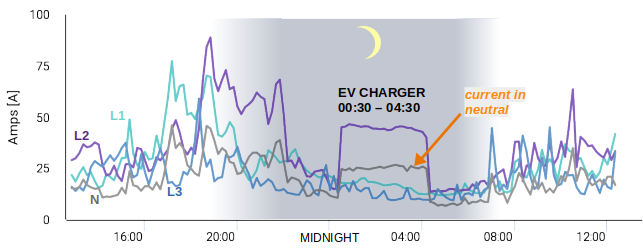
It's less likely that the cheapest period will continue to be soon after midnight. That's when EV-owners will be recharging their cars. A typical EV requires double the amount of electricity (in kWh) than the house, and there's not much solar around in the middle of the night!
Beware of RoI calculations which rely on exporting back to the grid.
If government actually understood how the grid works, they'd be discouraging grid export from homes that have single-phase supplies anyway. Phase-imbalance at local substations now accounts for losses of around 10% of total generation. That's a horrendous waste.
Imbalance in demand across the three phases also results in current flowing back to the substation transformer via the Neutral wire. Many older housing estates with underground cabling have a neutral conductor which is thinner than the three phases. At the time it was a sensible way of saving expensive copper.
High neutral currents are reflected in thermal overload. The heat breaks down the insulation and causes a short circuit. That means we are going to experience more power-cuts in future.
Let me stop there for a moment, and you tell us if that's the level of (technical) information which is helpful.
@transparent most of that went way over my ahead im afraid! TBH, the calculated savings on the ecoflow website for their Stream 5000 (without solar) were about 8 years at least which made me think it wasn't worth it.
The real difficulty I'm having more and more is that its almost impossible to find independent reviews anymore which makes it almost impossible for me to make a decision so i think i will hold off for now. I"m on octopus and have registered an interest in their nook cubes in case they will work for me.
do both need a "fuse spur" to be able to export the power back into the grid?
The "fused spur" you've heard about is a method of having an electrician install a small portable battery for you.
Typically this option is considered because "plug-in storage" isn't yet permitted in UK. It allows a unit to be hard-wired, rather than plugged into a 13A wall socket.
It has no direct relationship to the concept of exporting to the grid.
The "fused spur" you've heard about is a method of having an electrician install a small portable battery for you.
Is it actually a legal way of connecting with the usual interpretation of 'fused spur'.
My understanding is that generators, with the sole exception of the carve out for plug in solar, must be on a separate circuit on the supply side of the cu. The term 'fused spur' is usually taken sofaik to mean a separately fused sub circuit connected to the ring which is on the load side of the CU.
Am I wrong?
This post was modified 3 weeks ago 3 times by JamesPa
4kW peak of solar PV since 2011; EV and a 1930s house which has been partially renovated to improve its efficiency. 7kW Vaillant heat pump.
My understanding is that generators, with the sole exception of the carve out for plug in solar, must be on a separate circuit on the supply side of the cu.
Nope.
Generators, inverters storage-batteries are connected to the Consumer Unit just as any other "load circuit" would be.
That means they have a protection device (fuse, circuit breaker) in the CU in similar fashion to a ring-main or a lighting circuit.
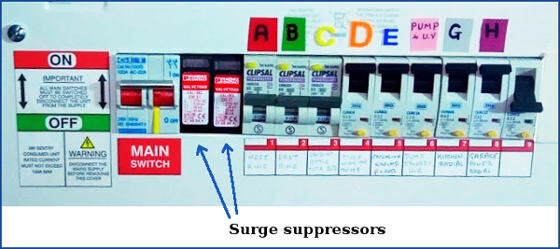
It would be dangerous (& illegal) to have anything connected on the supply side to the CU. It would mean that nice red "Main Switch" would leave the inverter live when it's moved to the OFF position. Aagh!
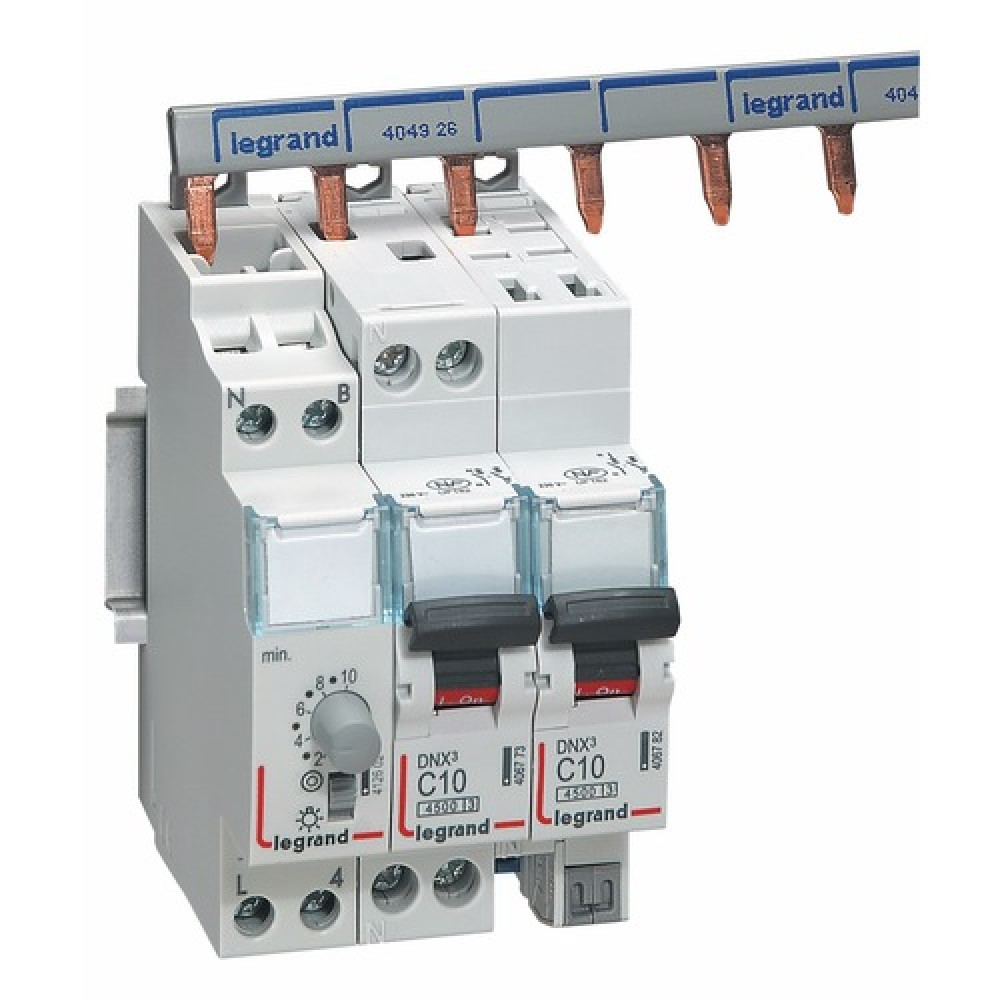
Suppose the supply is rated to 32A and the consumer unit breakers are connected using a 32A rated copper comb. Here's a pic, note FR and UK consumer units are upside down relative to each other, because of course they are:
In this case, the main breaker between the grid and the CU limits current to 32A, which protects the comb (or other distribution system feeding all the breakers) from overcurrent.
If a 6kW PV inverter is added on the load side, it can also inject 32A into the comb, which can then carry 64A, exceeding its rating. So the distribution inside the consumer unit has to be sized for the sum of maximum currents from both the grid side main breaker and the PV inverter.
My understanding is that generators, with the sole exception of the carve out for plug in solar, must be on a separate circuit on the supply side of the cu.
Nope.
Generators, inverters storage-batteries are connected to the Consumer Unit just as any other "load circuit" would be.
That means they have a protection device (fuse, circuit breaker) in the CU in similar fashion to a ring-main or a lighting circuit.
It would be dangerous (& illegal) to have anything connected on the supply side to the CU. It would mean that nice red "Main Switch" would leave the inverter live when it's moved to the OFF position. Aagh!
Ok I used the wrong/confusing term. I meant upstream of the load side of the devices protecting the load circuits but (to my mind obviously) downstream of the main breaker. I have seen it described as 'the supply side' but agree it's misleading. As you say, this is nothing more than a separate connection to the busbar just like the load ciircuits (or alternatively on a separate CU with it's own main switch connected via a Henley block). Apologies for confusion, I meant exactly what you have described.
The principal question still remains however which is, is it legal to connect to a 'fused spur'. In the usual meaning of 'fused spur' this would be downstream of the devices protecting the load circuits and indeed spurred of of one of those circuits.. My understanding was no, it requires a separate circuit, but I have seen several times talk of connection to a fused spur and indeed you do this in your response to mrkfm
This post was modified 3 weeks ago 4 times by JamesPa
4kW peak of solar PV since 2011; EV and a 1930s house which has been partially renovated to improve its efficiency. 7kW Vaillant heat pump.
The principal question still remains however which is, is it legal to connect to a 'fused spur'. In the usual meaning of 'fused spur' this would be downstream of the devices protecting the load circuits and indeed spurred of of one of those circuits.. My understanding was no, it requires a separate circuit, but I have seen several times talk of connection to a fused spur and indeed you do this in your response to mrkfm
I'm going to attempt answering this whilst simultaneously responding to the point about busbar current limits by @bobflux
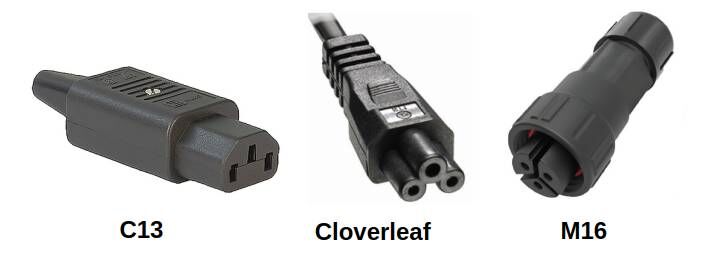
Because the OP mentioned Ecoflow Stream 5000 or the DJI Power 2000, I've been assuming this Topic is addressing portable storage devices. These would connect to the mains at less than 13A, using a flexible lead with shrouded contacts. We don't mind what the connector is, but it might be one of these:
If it were already permissable to obtain plug-in storage devices in the UK, then the other end of the lead would probably have a 13A-rated square-pin plug and a fuse suitable for the current limitations of the cable.
You can already buy such devices, but they would presently need to be hardwired into the house by a qualified electrician. For that reason it is his/her decision as to how this is done, and it isn't mandatory to have a new dedicated cable supply from the Consumer Unit.
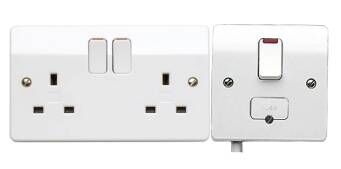
If the storage battery unit is of sufficiently low export current, then the electrician might decide to install a fused-spur faceplate adjacent to an existing 13A mains outlet on the ring circuit:
That doesn't mean that the Fused Spur outlet has been wired in as a spur on the ring. It's just that the name of that outlet is a Switched Fused Spur.
As it's adjacent to an existing socket, the ring can be broken at this point with one wire terminated at the double socket and the other at the fused-spur. It is then rejoined by connecting three short wires between the two outlets. Because an electrician does the work he will then test the entire ring, ensure that the trip in the CU is appropriate and issue a nice shiny new Part-P completion certificate. 😊
Since the electrician will know that the storage battery might be inserting more current onto the comb busbar in the CU, he will check its rating and replace it with a new 100A one if required.
All of the above is compliant with the regulations because it's done by a qualified electrician.
If that's what you want, then there's no change of regulations you need to wait for.
This post was modified 3 weeks ago 4 times by Transparent
That's most helpful. Essentially the process you outline creates a fixed connection to the ring rather than a spur off the ring.
I'm not sure where I read the requirement that the generator must be on a separate circuit, and that this currently applies even to generators limited to 800W (ie intended eventually for plug in once legal). I must check my sources!
4kW peak of solar PV since 2011; EV and a 1930s house which has been partially renovated to improve its efficiency. 7kW Vaillant heat pump.