

Notifications
Clear all
Joining the Renewable Heating Hub forums is completely free and only takes a minute. By registering you’ll be able to ask questions, join discussions, follow topics you’re interested in, bookmark useful threads and receive notifications when someone replies. Non-registered members also do not have access to our AI features. When choosing your username, please note that it cannot be changed later, so we recommend avoiding brand or product names. Before registering, please take a moment to read the Forum Rules & Terms of Use so we can keep the community helpful, respectful and informative for everyone. Thanks for joining!

Topic starter
18/02/2023 10:26 am
Hi all. I've had a request in from a friend who rents a flat. It's a long term rental and she doesn't see there being an issue with her not being able to rent it for another 5 years or so. She is interested in getting battery storage to help with rising energy costs and was wondering how she might go about convincing a landlord that this would be a good idea. There's also the possibility that she could own the battery and take it with her if she moves on i a few years time.
This is something I have no experience of and thought I would post here. Does anyone have any thoughts on what a renter could do to access and use these home energy technologies, such as a battery?
Cheers
Al

18/02/2023 1:09 pm
What does your friend hope to achieve with the battery? Are they looking to store cheap rate energy and use it at peak hours? This might just about make sense if they were getting an EV charger and tariff (e.g Octopus Go).
However there are significant costs associated with installing a battery and inverter. The sums may not work out.
Something like Ripple Energy may be a way of hedging electricity costs, but I am not sure when their next offering will open.


19/02/2023 11:45 am
I see the benefits of her installing the battery in the rental flat – I'm nor sure she'll get her investment back in five years, and I also think it'll be financially prohibitive for her to "uninstall" the battery if/when she leaves. An interesting question though. I'll give it some more thought.
🔥 Britain’s Heat Pump Shitshow
How Installing a Heating System Became a National Nervous Breakdown
Free UK shipping.
📗 Heat Pumps Explained
A Jargon-Free Guide for Homeowners
Rewritten and updated for 2027
📘 From Zero to Heat Pump Hero
🛠️ Bodge Buster
New to heat pumps?
Take the Heat Pump Fundamentals course and use INTRO50 at checkout for 50% off.
1

19/02/2023 3:19 pm
Hi all. I've had a request in from a friend who rents a flat. It's a long term rental and she doesn't see there being an issue with her not being able to rent it for another 5 years or so. She is interested in getting battery storage to help with rising energy costs and was wondering how she might go about convincing a landlord that this would be a good idea. There's also the possibility that she could own the battery and take it with her if she moves on i a few years time.
This is something I have no experience of and thought I would post here. Does anyone have any thoughts on what a renter could do to access and use these home energy technologies, such as a battery?
Cheers
Al
One of the things that your friend could consider is a portable type of battery storage as used with RV's and campers.
Much depends upon how much electrical energy they use, when it is used, and the likely peak loading. There are portable battery storage units that can supply loads of 3kW, but possibly not for extended periods of time.
It may mean the hassle of plugging and unplugging devices into the portable battery storage as required, though I suppose for certain items of electrical equipment it may be possible that the portable battery storage could act like an uninterruptible power supply.


19/02/2023 5:44 pm
@editor technically it's pretty easy. A battery charger is fairly cheap, you could get one for around £500-600 (on eBay used). Then you need a battery. Given it's a flat they need to be fairly "lightweight". So probably 5kwh is the max you could lift/lug around. No idea on their daily power use, but let's guess 10kw per day as a minimum. Batteries are going to be around £1300+ for 5kwh (if you can get them cheap, which is a challenge in this power cost climate)
I would guess £3k for 10kwh and maybe the charger if you are lucky. Then you need to install. You could probably do this fairly ghetto if really needed, but budget another £500 just in case.
On the sums. £0.34/kW x 10kw x 365 days= £1242 per year on electricity.
90% depth of discharge gives us 9kwh of storage. My area is 12p/kw for octopus Go off peak. Thats £394 per year in cost. Saving per year £848 or payback is 4.12 years at £3,500 cost (at the current rate). If you can get some free solar payback is even better.
Topic starter
20/02/2023 11:05 am
@chickenbig Hi there. I think that she wants to offset the cost of her energy use and also become more renewables based. This seems like an extreme way to do it, but I think that she is frustrated that she is stuck in rented housing and the landlord doesn't have the same world view on all this as her - and buying her own property is some way off I think.
Thanks for the Ripple suggestion - I'll point her at their website
Topic starter
20/02/2023 11:08 am
@derek-m Thanks for this suggestion. This could be a way for her to go. She has a small balcony that faces south so maybe some portable set up would be relatively simple to set up. I think anything that helps reduce the amount of imported electric would be useful.


20/02/2023 3:09 pm
Interestingly i think overall i would be minded to recommend, save the money up to buy a property sooner rather than spending capital on a sizeable battery solution.@chickenbig Hi there. I think that she wants to offset the cost of her energy use and also become more renewables based. This seems like an extreme way to do it, but I think that she is frustrated that she is stuck in rented housing and the landlord doesn't have the same world view on all this as her - and buying her own property is some way off I think.
Thanks for the Ripple suggestion - I'll point her at their website
Also the Octopus Tracker rate today is 21.49p for my area. We could see fixed rates being introduced again in the next 6 months at rates much less than 34p, and the variable dramatically cheaper than 34p. It might make the battery payback look very different depending on what happens of course

21/02/2023 6:28 pm
Hi all. I've had a request in from a friend who rents a flat. It's a long term rental and she doesn't see there being an issue with her not being able to rent it for another 5 years or so. She is interested in getting battery storage to help with rising energy costs and was wondering how she might go about convincing a landlord that this would be a good idea. There's also the possibility that she could own the battery and take it with her if she moves on i a few years time.
This is something I have no experience of and thought I would post here. Does anyone have any thoughts on what a renter could do to access and use these home energy technologies, such as a battery?
Cheers
Al
In conversation last time they were here, my battery installer told me that they reasonably often get requests to move batteries that they have installed, to a new property when someone moves house.
Clearly and obviously if this is your plan up front, you've got to factor in the extra cost of paying them to remove it and then fit it to the new property. But thats likely to be a lot less than the capital cost of new batteries (again, depending on what size and type). But it might be more than what you save in purely monetary terms during that period.
Even with a permanent installation, a good electrician should be able to install it in such a way that it could be reversed easily and safely. I know from looking at how he's done mine, that it'd be quite trivial. The Meter tails which used to go the the CU, now loop through the powerwall gateway on the way to the CU. Simplistically, de-energising the batteries, unlooping the meter tails so they went back to direct to the CU, and then removing everything, would be the method. Obviously a bit more to it than that but you get the picture!
If it were me though, if I didn't own the property I'd want to be looking carefully at
a) If done as a permanent install that was intended to be reversed, establish a legally unchallengable position regarding who owns the battery - make sure the landlord doesn't say "its mine" just before she wants to move out.
b) making good / reversing the electrical setup to the pre-battery state - agreeing what that is and how it would be confirmed before and after.
c) whether a permanent one, or a temporary/portable one as has been also suggested, how she stands on electrical safety responsibility and liability to the landlord. I'd suspect that standard landlord-renter insurance for electrical faults, would cover typical portable domestic electrical and electronic devices, but maybe not high power batteries?
My octopus signup link https://share.octopus.energy/ebony-deer-230
210m2 house, Samsung 16kw Gen6 ASHP Self installed: Single circulation loop , PWM modulating pump.
My public ASHP stats: https://heatpumpmonitor.org/system/view?id=45
11.9kWp of PV
41kWh of Battery storage (3x Powerwall 2)
2x BEVs
1

21/02/2023 9:21 pm
All of the above suggestions assume that your friend is to obtain a battery storage system which connects back into the house mains supply. Ie it receives energy from the grid when it's cheap/green, and then supplies it back to the house via the same connection to the consumer unit.
That's clearly a system which has become part of the electrical supply to the building, even if there is a written agreement with the landlord that it remains her property.
As it's a rental property, the electrical 'installation' in its entirety comes within the requirements for electrical safety checks (annually?).
Alternatively, if she has certain appliances that are particularly heavy on electrical demand, then she could use the battery output to supply only those devices.
Ie she still imports electricity from the grid, but the output from the storage system might supply just a few items within the kitchen, for example:
- electric cooker / oven
- kettle (2.5kW - 3kW)
- microwave (800w - 1000w)
- toaster
We'd need to know about the electrical demands of the flat to pursue that conversation further.
2: The maximum size of a domestic storage battery which can moved/relocated will be 4kWh - 5kWh.
That's because it will weigh just under 25Kg, after which the Health & Safety legislation starts to impose additional constraints.
You will notice that there are many companies offering "server rack" style batteries of around this capacity.
They can be stacked, and connected together to form larger capacity arrays.
3: Solar panels of sufficient size to be viable as an input to the systems being discussed here are likely to be 1600x1000mm in size and yielding 350w in peak sunlight.
They each weigh about 20-22Kg and are pretty flimsy until they get clamped onto aluminium mounting rails.
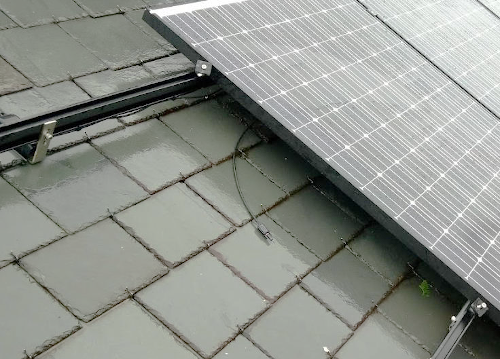
If this strategy is still of interest for the balcony, then we need to discuss how such PV panels could be secured in place.
Save energy... recycle electrons!
2
Topic starter
24/02/2023 1:59 pm
Thanks everyone for your comments and thoughts. I'll pass a link of this through to my friend and hopefully she can mull things over - if this goes anywhere then I'll let you know here.
I have to say, this forum is comprised of some brilliant individuals who make discussing these sorts of issues so easy. So much better than on the more general social media sites.
1
SPONSORS

Degrees of Separation

Latest Posts
-

RE: Heat pump branding. Clever, contemporary… or a bit too much?
I think Heat Geek have done an amazing job on their bra...
By Tomtheheatingengineer , 2 hours ago
-
RE: HeatGeek vs Octopus surveys: puzzling disparity - any ideas why?
I have just had 3 heat loss surveys, one by heat geek o...
By David , 3 hours ago
-
RE: Heat Geek Zero Disrupt: Are We Sleepwalking Into Another Race to the Bottom?
I think that's the key question. After all inverter uni...
By Prunus , 4 hours ago
-
RE: battery storage without solar
As of October 1st they need specific qualifications to ...
By EtchedPixels , 5 hours ago
-
RE: How should the Boiler Upgrade Scheme be reformed?
A unit which uses water to transfer the heat/chill from...
By Temperature_Gradient , 5 hours ago
-
RE: Renewables & Heat Pumps in the News
With regards to the BUS grant raid, I gave it more thou...
By ASHP-BOBBA , 6 hours ago
-
RE: Why are ASHP installs so expensive?
The whole system seems to work on the basis of...
By ian33a , 6 hours ago
-
RE: Missing flow temperature in Heat Geek proposal
Good plan. If you can get half hourly meter readings a...
By JamesPa , 11 hours ago
-
RE: Heat Pumps Without Grants: Would You Have Installed One & Will You Now?
@editor Most certainly. The heat pump was an ideal s...
By Abernyte , 11 hours ago
-
Although regulations may well vary from country to coun...
By Majordennisbloodnok , 12 hours ago
-
RE: Does anyone have experience of a smart water meter?
Yep I caught our slow leak from a £100 bill rise 8)
By EtchedPixels , 12 hours ago
-
RE: Do You Need a Buffer Tank or Low Loss Header for Underfloor Heating in a Large Property?
@jamespa in some cases, failing the Turing test might b...
By GrahamF , 15 hours ago
-
RE: Passiv Smart Thermostat - Help & Forum Support
@energystoragetech The heat capacity of some...
By JamesPa , 17 hours ago
-
RE: tepeo ZEB UK Support & Info Thread
Sorry you are correct, I was remembering figures from t...
By JamesPa , 1 day ago




SPONSORS
