

Notifications
Clear all
Joining the Renewable Heating Hub forums is completely free and only takes a minute. By registering you’ll be able to ask questions, join discussions, follow topics you’re interested in, bookmark useful threads and receive notifications when someone replies. Non-registered members also do not have access to our AI features. When choosing your username, please note that it cannot be changed later, so we recommend avoiding brand or product names. Before registering, please take a moment to read the Forum Rules & Terms of Use so we can keep the community helpful, respectful and informative for everyone. Thanks for joining!

Topic starter
29/08/2026 12:57 pm
My journey toward a heat pump continues, albeit slowly:
For those who are aware of my past dealings with installers, a quick update first -
After having been, I'd say, strung along, for over a month, an installer who came across well, when nudged, gave us a quote which was more than twice what I expected and was immediately rejected. I wasn't impressed as it was time totally wasted and we are quickly moving toward the autumnal months.
Anyway, a couple more installers have been out and I await their heat loss surveys and quotes. Both though, because I have been upfront, have expressed concerns about the fact that we get our water from a bore hole.
I remember Aira turning us down flatly because of this a few months ago and I respect the fact that some cylinder manufacturers don't want the risk of private water supplies destroying tanks. We do have basic water treatment, but it is basic and my wife and I haven't died just yet from water poisoning and, in all honesty, don't have the wish or the space to install a chemical plant which would make an Ineos engineer proud.
We are being told that many hot water cylinder manufacturers will not guarantee their tanks unless it can be proven that water going through them remains PH neutral and chemical free or that it only comes from a public supply. Consequently, we risk sitting on a leaking time bomb - or potentially so.
There is, we're told, an alternative glass lined tank but I am struggling to find the sort of thing that is being described (as quotes are still awaited) . I've been told that glass lined tanks come with about a £1000 surcharge.
I suspect our house will need a 300 litre tank, or thereabouts, and one of the installers is considering a Vaillant 12KW unit as the heat pump.
Have any of you been down the glass lined discussion with installers ? Did you go glass lined or just stay stainless steel and keep your fingers crossed?
thanks
Escaped to the country : central Devon - 280 sqm converted mill - 4KW Solar - 15 KWh Battery - UFH - Vaillant Arotherm V2 Plus 12KW (soon!)


29/08/2026 3:28 pm
@ian33a, this is an interesting one. I hadn’t really appreciated that private water supplies could cause warranty issues with cylinders until reading your post.
If it were me, I’d probably want a recent water analysis and then ask the cylinder manufacturer directly whether they’re happy to warranty their product on that supply. That feels safer than relying on a general "boreholes are fine" or "you need glass-lined" answer.
I’d also want to know what maintenance the glass-lined option needs before paying another £1,000 for it, because my understanding is that some rely on sacrificial anodes.
And separately, the possible 12kW Vaillant caught my eye. Once you get the heat loss figures back, it would be interesting to see what has led them to that size.
Do post the cylinder options when you get them. I suspect quite a few rural homeowners will eventually run into the same question.
🔥 Britain’s Heat Pump Shitshow
How Installing a Heating System Became a National Nervous Breakdown
Free UK shipping.
📗 Heat Pumps Explained
A Jargon-Free Guide for Homeowners
Rewritten and updated for 2027
📘 From Zero to Heat Pump Hero
🛠️ Bodge Buster
New to heat pumps?
Take the Heat Pump Fundamentals course and use INTRO50 at checkout for 50% off.
Topic starter
29/08/2026 4:00 pm
@Mars We did our own water analysis when we moved in four years ago. It didn't show anything of concern. Plenty of neighbours have bore holes and, rural ways as they are, they have minimal filtration and no chemical treatment. We don't all walk around with three legs or appear light green so ... So we haven't done more than the basic maintenance and periodic filter replacement.
One of the installers said that everything would be fine until the point that a warranty claim becomes necessary and then it may start to become an issue as the suppliers find ways to wriggle out of a claim. I really need to get complete details of the options on the table, glass liners or not, before trying to dissect the small warranty print and consider what to do. We haven't experienced an issue with our existing tank but, as it's a thermal store, it isn't cycling lots of fresh water through the whole of the cylinder internals, just the heat exchanger. So I don't really have any historical data that I can turn to.
I am aware of the sacrificial anodes issue. Again, I'll need to consider what the cost of these is over a set period and if they are changed routinely as part of a heat pump maintenance schedule.
With regard to the heat loss survey, the installer who took an age to come up with a figure came in at 14.5 KW. One of the installers who has visited recently gave a figure of 14.7 KW (yet to be confirmed with paperwork) and the other seemed to think the figure was more like 12 (again, subject to confirmation). I have put the house through HeatPunk and my figures sit at about 12.5. Such is the variability of material estimation!
Our house is old, diverse in construction, reasonably large, adequate (but not exceptional) insulation. Interestingly, one of the 14.5 installers claimed that several of the rooms that we currently heat with UFH and a flow temperature of about 45 said that the rooms do not have sufficient emitters for that design temperature. That all of these rooms are toasty warm in cold weather is a slight concern!
I will certainly post what I discover, but welcome thoughts from other home owners and installers too.
Escaped to the country : central Devon - 280 sqm converted mill - 4KW Solar - 15 KWh Battery - UFH - Vaillant Arotherm V2 Plus 12KW (soon!)
1

29/08/2026 4:37 pm
@ian33a I have a private supply from a spring. After we bought the house 20 plus years ago it became obvious that the copper (pipes and tank) were being slowly eaten by our acidic water. The ph was around 5. I subsequently dosed our large holding tanks (out on the hill side) with calcium carbonate chips and the ph is now generally about 6 - which I can live with. The supply is gravity fed and the pressure is very low - just enough to fill a loft tank.
When we rebuilt the house, all plumbing was in plastic pipe. I installed a stainless cylinder in our guest cottage and that has been fine for 10 years.
We installed our ASHP last year. The system is open vented. One of the things which gave me comfort in choosing the installer was the advice given re water quality. Given that the whole Vaillant system is pre plumbed in copper the installer suggested importing the water from the public supply. This was done using a borrowed IBC part filled with about 400l and pumped in with a battery driven pump to flush and final fill the system. The system is pressurised to 2 Bar using a hand pump. I have only had to re pressurise once in 12 months.
The key is knowing the specifics of your bore hole water analysis and making judgements accordingly. I figured the stainless of my new 150l cylinder would probably be ok with our raw water while the copper of the closed heating system is filled with water from the public supply.
1

Topic starter
29/08/2026 5:36 pm
@davidb That's really interesting information, thank you.
Our water sits at about 7.5, certainly well less than 8 - so, moderately alkaline and the water hardness is about 80 ppm. We do get some scale build up, but compared to where we used to live, it's not much.
The public supply in our area has a measured average PH of 7.75 (summarised over 2025) but the water is considered soft. That said, the reservoir is a long way from where we live.
Certainly, if we progress with a heat pump, I will discuss matters with the installer and it's a good call that you singled out one who understood the importance of PH.
Escaped to the country : central Devon - 280 sqm converted mill - 4KW Solar - 15 KWh Battery - UFH - Vaillant Arotherm V2 Plus 12KW (soon!)
29/08/2026 10:29 pm
This has turned into a fascinating little rabbit hole. I’ll admit that before this thread I’d never really given much thought to how the source and chemistry of the water could influence the choice of cylinder quite so much.
It’s also a good example of why apparently simple questions around heat pump installations so often aren’t simple at all. You start with “which cylinder?” and suddenly you’re into borehole water chemistry, different materials, anodes, warranties and treatment systems.
@ian33a, definitely keep this updated when the quotes come back. I’d be particularly interested to see whether the installers end up proposing the same solution once they’ve actually looked at your water, or whether you get two completely different answers. This feels like one of those niche rural property issues that could be really useful for somebody else stumbling across the thread in a couple of years.
🔥 Britain’s Heat Pump Shitshow
How Installing a Heating System Became a National Nervous Breakdown
Free UK shipping.
📗 Heat Pumps Explained
A Jargon-Free Guide for Homeowners
Rewritten and updated for 2027
📘 From Zero to Heat Pump Hero
🛠️ Bodge Buster
New to heat pumps?
Take the Heat Pump Fundamentals course and use INTRO50 at checkout for 50% off.

02/09/2026 12:42 pm
I too have a private water supply. It's a well holding around 10,000-litres, and was blasted with dynamite when you were still allowed to do such things.
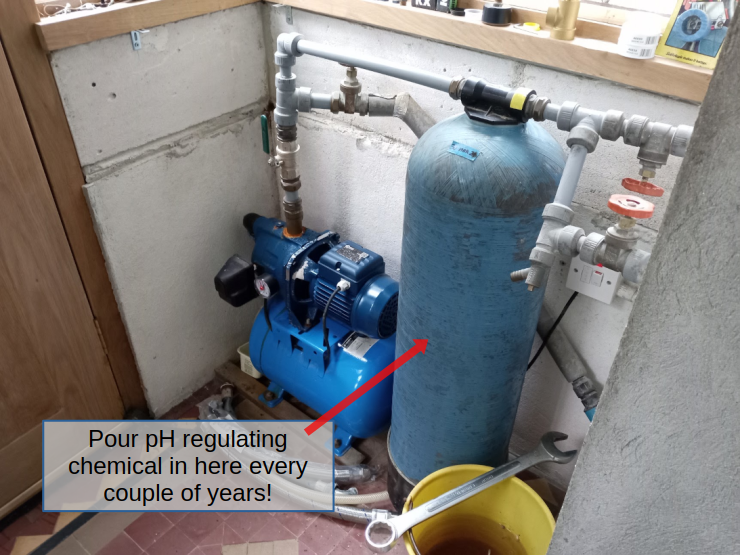
The UK Drinking Water Inspectorate states that mains water should be between pH6.5 to pH9.5 which is a fortuitously wide range. That's readily achievable from a borehole or well using a dosing cylinder with a product such as Magnodol.
I can't see what the manufacturers of heat-pumps and cylinders are getting worked up about. Anyone with their own water supply is very likely to operate it within the parameters used by commercial suppliers anyway.
Save energy... recycle electrons!

02/09/2026 1:43 pm
One thing that bothers me with DHW from monobloc A2W heat pump is they quite often want their own cylinder, which usually comes in a big white box with all sorts of custom piping and electronics that also play the part of the indoor unit. In other words... the outdoors unit is married to this thing.
That kinda spoils the monobloc concept for me... I like monobloc. It's plug and play. When it eventually dies, it is relatively simple to replace it with another monobloc: two pipes... a bunch of cables... an indoor unit to replace, but it's only electronics so no piping... I built the slab under the monobloc too large just in case...
But if it is married to its same-brand cylinder, now another can of worms is opened.
That's why I'm installing this ridiculously huge tank which contains an equally enormous corrugated stainless steel coil. It's the opposite of a normal DHW tank: the stored water inside is part of the heating circuit, and DHW is heated on demand inside the stainless steel coil.
Well, the actual reason I picked this one is I've been burned (or rather frozen) with a dead heat pump in December, so my brand new installation will be dual-fuel: heat pump and wood furnace, and the latter requires an enormous tank. And I sure don't want another one tank just for DHW. This one is already bulky enough. Hence the dual use tank.
Anyway. I'd recommend picking your own DHW tank and plumbing it with the usual 3 way valve driven from the heat pump, so it becomes an independent and orthogonal problem vs the heat pump itself.
Stainless steel is probably not going to corrode with well water. The pump in your well is most likely stainless, mine is too, and these die from electrical issues, leaky seals around the shaft, or running without water, but not from corrosion. Although you could check your Chloride ion concentration.
If the glass lined tank is actually steel, like most domestic DHW tanks, then it is going to corrode eventually, they all do. It'll take a while, but it'll get there. In a proper heating circuit, oxygen can't enter, so steel does not corrode (rust). But with an endless supply of oxygenated water, it sure does. The usual way around this is cast iron: just make it thick enough that it'll take 100 years to corrode enough to leak. But that doesn't work for tanks.

02/09/2026 2:05 pm
It's the opposite of a normal DHW tank: the stored water inside is part of the heating circuit, and DHW is heated on demand inside the stainless steel coil.
I have one of those... a Thermal Store.
In my case the secondary heat source is a solar-thermal array, which has its own coil at the bottom of the 280-litre cylinder.
Mine is copper, which is fine so long as the pH of the well water is above 7.5
But I wouldn't buy from that supplier ever again.
The electrical connections were pre-installed in a box attached to the cylinder. Six out of seven earth wires were red, and only two of the screw terminals had been tightened onto the wires. Quality-control obviously wasn't working that day.
Save energy... recycle electrons!
2
Topic starter
04/09/2026 4:47 pm
Thank you, once again, for your replies.
Yes, our current setup is a thermal store too - but we will likely go with a new tank (as per the initial thread title).
At the moment, our favoured installer is checking with the manufacturer to see what the warranty limitations really are.
Once I hear more I'll post some more.
Escaped to the country : central Devon - 280 sqm converted mill - 4KW Solar - 15 KWh Battery - UFH - Vaillant Arotherm V2 Plus 12KW (soon!)

SPONSORS

Degrees of Separation

Latest Posts
-

RE: Renewables & Heat Pumps in the News
@ashp-bobba I don’t think it would kill the heat pump i...
By Mars , 10 minutes ago
-
RE: Why are ASHP installs so expensive?
@rob-of-york I think the most revealing question here i...
By Mars , 37 minutes ago
-
RE: Does anyone have experience of a smart water meter?
@downfield You are opening a whole can of cans there!
By Toodles , 38 minutes ago
-
RE: Replacing Storage Heaters with a Heat Pump in a Stone Cottage
I found some interesting data about the price of heat p...
By Rob of York , 5 hours ago
-
RE: Air-to-Air Heat Pumps & Air Conditioning: UK Heating and Cooling Q&A
Thanks for that, quite interesting. I liked the bit a...
By springswood , 6 hours ago
-
RE: PV and battery long payback - sense check query
Thanks for all the comments. I finally got to the bott...
By DavidB , 7 hours ago
-
RE: Indevolt Batteries UK Support & Info Thread
People following this thread who are hoping that plug i...
By JamesPa , 17 hours ago
-
Safety study for plug in batteries out to tender - looks like Q3 2027 at best before legal
Whilst searching for other information I came across th...
By JamesPa , 17 hours ago
-
RE: Passiv Smart Thermostat - Help & Forum Support
By Singlespeed , 19 hours ago
-
RE: Help me keep the faith with my air source heat pump installation
just had Vaillant over to service the HP and asked abou...
By AdamK , 19 hours ago
-
RE: tepeo ZEB UK Support & Info Thread
OK so ZEB is basically a variant on a storage heater, b...
By JamesPa , 2 days ago
-
RE: Heat Geek installations: share your experiences
@editor I suspect that the Heat Geek online quote is a ...
By AndrewJ , 2 days ago
-
RE: Adding additional Solar Panels to a DC coupled battery system
Ah, yes. Thanks for clarifying.
By Transparent , 2 days ago
-
RE: Vaillant ecoTEC Plus - Flow Temp and Set Up
@trebor12345 I have been meaning to get home assista...
By Batpred , 3 days ago



SPONSORS
