

Notifications
Clear all
Joining the Renewable Heating Hub forums is completely free and only takes a minute. By registering you’ll be able to ask questions, join discussions, follow topics you’re interested in, bookmark useful threads and receive notifications when someone replies. Non-registered members also do not have access to our AI features. When choosing your username, please note that it cannot be changed later, so we recommend avoiding brand or product names. Before registering, please take a moment to read the Forum Rules & Terms of Use so we can keep the community helpful, respectful and informative for everyone. Thanks for joining!

01/10/2026 2:54 pm
Hi. Wondering if someone can offer some basic advice on this subject to a novice.
I've been reading up about battery storage and seen videos etc where this is being promoted as an option without solar as long as you have a cheap overnight tariff.
Is this worth looking in to now? Or do I need to wait for gov deregulation first? I noticed Octopus are looking at selling these themselves but this seems a way off.
Are the Ecoflow Stream 5000 or the DJI Power 2000 options for saving without waiting 10 years to break even? No one seems to add the cost of an electrician doing an install to the return on investment.
And do both need a "fuse spur" to be able to export the power back into the grid?
I get the feeling we've gone a bit off piste rather quickly here, so I'm going to throw some generalisations towards you, @mrkfm. Everything @transparent and @jamespa have mentioned is good, solid advice but the fused spur issue is perhaps a bit of side show rather than the main event and you did ask for a basic introduction.
Eventually, a battery is only useful for timeshifting; buying at one time and using at another. Whilst there is value in being able to use that power during a power cut, the benefit is almost always in the difference in cost between the leccy when you buy it and the leccy price when you want to use it. This much is blindingly obvious and I'm sure not news to you.
You obviously need to be on a tariff with at least two prices to allow for this time shifting to work, and the simplest is a standard "economy 7" style tariff. Right at the moment, in my region, the peak rate is 33.47p and the cheap rate is 14.17p. I'm going to assume your domestic consumption (apart from heat pump and EV) is about 9 kWh; it's a fairly safe assumption for most. I'm also going to assume your domestic consumption is pretty evenly spread throughout the day, so doing the sums on that means that if you had a big enough battery to tide you over the 16 peak hours so you could make all 9 kWh cheap ones, you'd save about £420. To achieve that would take a battery of slightly more than 6kWh and a typical bundle of a battery like that with a single phase inverter would be about £2,500 (without fitting), and therefore a payback on kit alone of just under 6 years. The bundle I'm using for this exercise is from Fogstar and whilst I'm quite interested in their batteries I am in no way making any kind of recommendation.
If you had a heat pump (I'll use the averaged-out consumption of mine of 12.8 kWh/day), the same sums would give an annual saving of slightly over £1,000. However, that's rather a lot of smoke and mirrors, since the heat pump isn't heating the house for quite a lot of the year. Averaging out the months when it is really necessary gives a daily figure more in the region of 21.7 kWh, so in order to service that with cheap rate leccy would need a battery more in the region of 32 kWh. A typical battery/inverter bundle (from the same supplier as before) is around £5,200 and a payback on kit alone of just over 5 years.
As @transparent pointed out, tariffs fluctuate so these figures are very rough and ready based on the huge assumption of the difference between peak and cheap rates remaining fairly constant for the next 5 years or so. It is also true that you could adopt several supplementary strategies to further reduce the net cost of the energy you buy in such as:
- Adding solar panels and using what you generate, storing what you generate and/or exporting what you generate. All pretty obvious.
- If you size the battery for a heat pump, in summer you will have a lot of spare capacity which you could use to buy at cheap rate and then export back to the grid when the export rate is higher than the cheap rate. Not likely to be cost effective whilst cheap rate is around 14p.
- Redoing the sums with different tariffs, particularly time of use ones. Octopus Go, for instance, has a cheap rate of 9.5p in my region.
Bear in mind, of course, that having an EV will have no bearing on the benefit of having a battery, but it may limit how much you can draw from the grid to charge said battery.
Any qualified sparky should be able to install a battery and inverter pretty easily and you can expect around £400 as a day rate. Many sparks are also set up (themselves or through subcontractors) to install solar panels although you'd want to be a bit careful about who you choose there to make sure your roof remains weathertight after such an installation.
Anything like this that is connected to the grid is likely to require that the energy distributor (UK Power Networks in my case) is informed about the installation and quite probably in advance. Your installer should be able to do this for you or at least guide you through doing it yourself. In fairness, I found the red tape far more of a challenge than any other part of getting my installation done.
Overall, forget any projected savings quoted by anyone trying to sell you something and concentrate on doing the maths yourself. That way you are far more likely to understand the assumptions you're making and the compromises you're accepting.
Does that help?
105 m2 bungalow in South East England
Mitsubishi Ecodan 8.5 kW air source heat pump
18 x 360W solar panels
1 x 6 kW GroWatt battery and SPH5000 inverter
1 x Myenergi Zappi
1 x VW ID3
Raised beds for home-grown veg and chickens for eggs
"Semper in excretia; sumus solum profundum variat"
1

01/10/2026 8:30 pm
Anything like this that is connected to the grid is likely to require that the energy distributor (UK Power Networks in my case) is informed about the installation and quite probably in advance. Your installer should be able to do this for you or at least guide you through doing it yourself. In fairness, I found the red tape far more of a challenge than any other part of getting my installation done.
Allow me to clarify this for the benefit of @mrkfm
Firstly the application process with your Distribution Network Operator (DNO) is much improved over the past two years. In the majority of cases you apply online and you can get a response within 24hrs. There is no fee to pay, and most people now handle this themselves.
If you are only making an application for a single domestic energy device, then it comes under the G98 classification, and you don't require approval in advance.
Now let's consider three possible categories of home storage battery with an inbuilt mains inverter/charger:
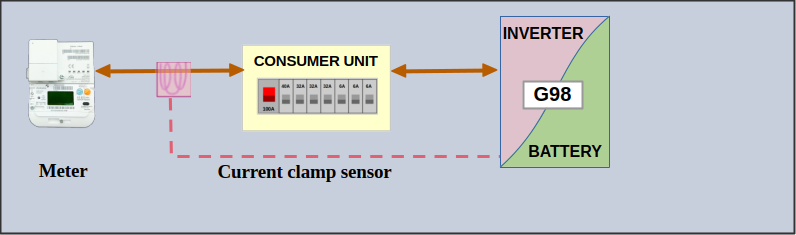
This is a grid-tied system. The battery can charge from the grid and can run lights and appliances which are already connected to circuits supplied from the consumer unit.
If there's insufficient power or the battery has "run out", then the rest of the electricity is drawn from the grid as normal.
There's a current-clamp to detect if electricity is being exported back to the grid, but some batteries can be configured to "zero export".
If there's a power-cut then the energy stored in the battery can't be used. The integral inverter will only work when there's mains power available because it requires the 50Hz frequency to synchronise to.
The storage system must have G98 certification. This can be checked by looking at the Approved Device database held by the Electrical Networks Association (ENA). Approval is required even if the storage system is configured for no export from the house.
Next we will consider a domestic storage battery which also has a separate "always on" output. The technical name for this is a Maintained Port.
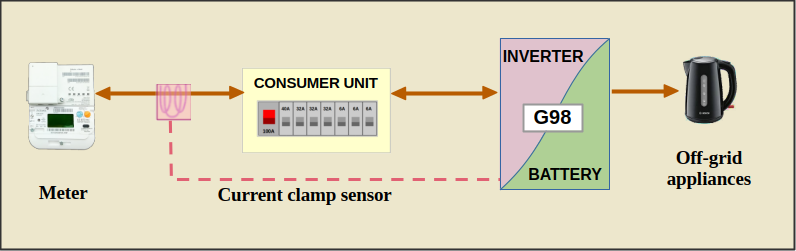
When mains power is available the battery can be recharged, and it can also run appliances connected via the Consumer Unit.
Anything plugged into the Maintained Port can also be used. Typically this could be a heat-pump, computer, WiFi router and a fridge.
During a power-cut the devices connected to the Maintained Port will continue to work whilst there is stored energy in the battery.
Because the storage system still has the potential to export to the grid, it must be G98 certified and the DNO must be notified.
Finally we'll consider a true off-grid storage system:
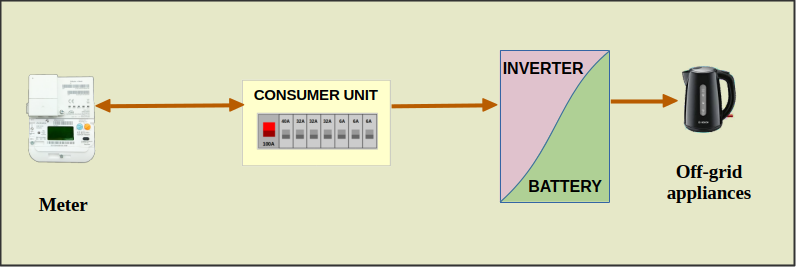
This storage battery can be charged from the grid, but has no facility to send power back to the consumer unit.
It creates its own 50Hz frequency within the unit, and can supply only those appliances which connect to the Maintained Port. They remain live during a power-cut.
Because there is no facility for exporting to the grid, the unit doesn't need to be G98 certified, nor does it require a current clamp. Some storage units still have a current-clamp connector but that would only be required in some circumstances when there is a second inverter installed in the home at a later date.
Save energy... recycle electrons!

01/10/2026 10:24 pm
Off grid.
It creates its own 50Hz frequency within the unit, and can supply only those appliances which connect to the Maintained Port.
Can this type supply power whist being charged from the grid?
1

02/10/2026 7:55 am
Can this type supply power whist being charged from the grid?
Depends on what's in the box.
Either it has a charger (AC to DC) and an inverter (DC to AC), or one bidirectional DC/AC converter which is cheaper.
1) Charger (AC to DC) + Inverter (DC to AC) not capable of grid injection
It has one GRID input, and one BACKUP output. It works in three modes:
- Grid connected to AC backup output in passthrough mode. Battery can also be charged.
- Double conversion online UPS mode: the charger charges the battery and the inverter runs at the same time, which outputs AC at voltage and frequency controlled by the inverter, providing AC voltage regulation. The inverter is fed both from battery and charger, so it can draw power from both. Drawback: power going from the grid to the inverter output is converted to DC and back, which incurs losses.
- Offgrid: same as above, with charger off.
2) Bidirectional DC/AC converter
This handles both charger and inverter roles. This is cheaper, because option 1 is basically double the number of components, and it doesn't cost much to make an inverter bidirectional, so you may as well halve the price, and have only one circuit which does both. Most boxes use this configuration.
2a) Bidirectional DC/AC converter not capable of grid injection
If it can't synchronize to the grid, then you basically have an offline UPS.
It has one GRID input, and one BACKUP output. It works in two modes:
- Grid connected to AC backup output in passthrough mode. AC/DC converter fed from grid, acting as charger.
- Grid disconnected. AC/DC converter acting as inverter, connected to AC backup output. No charging, and no passthrough, so the inverter provides all the power.
2b) Bidirectional DC/AC converter capable of grid injection (and certified for it), with CT or smartmeter to control injection
This is your typical hybrid PV inverter.
It has one GRID port, and one BACKUP port. Both are bidirectional, so they are ports, not inputs or outputs.
If it can synchronize to the grid, then it works in two modes:
- "Reduce electric bill" mode. Grid port active and connected to backup port in passthrough mode. Power flowing between both ports incurs no losses. No voltage nor frequency regulation since it is imposed by the grid. AC/DC converter acting as charger or injection inverter depending on what's needed. Loads can be powered both from the grid and the battery transparently.
- "Backup" mode. Grid disconnected. Same as above, AC/DC converter acting as inverter, connected to AC backup output. No charging, and no passthrough, so the inverter provides all the power.
2c) Bidirectional DC/AC converter capable of grid injection (and NOT certified for it)
Some manufacturers will brag about the machine being capable of using both grid and battery power at the same time but save costs by selling an uncertified injection inverter. It actually has a CT inside, so it'll do its best not to inject into the grid when running, but... it'll still do it.
1

02/10/2026 12:08 pm
2a) Bidirectional DC/AC converter not capable of grid injection
If it can't synchronize to the grid, then you basically have an offline UPS.
It has one GRID input, and one BACKUP output. It works in two modes:
- Grid connected to AC backup output in passthrough mode. AC/DC converter fed from grid, acting as charger.
- Grid disconnected. AC/DC converter acting as inverter, connected to AC backup output. No charging, and no passthrough, so the inverter provides all the power.
I'll illustrate that Bypass Mode like this:
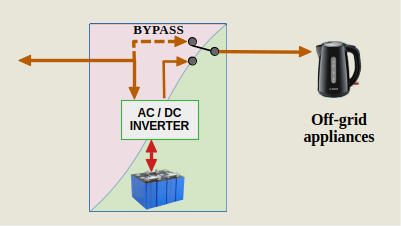
As you can see, the Maintained (always-on) port is connected via a relay within the Storage Battery Unit.
When the internal AC/DC Inverter gets switched across to recharge the battery cells from the grid, the relay contact moves up to supply the "off-grid" appliances from the grid.
Depending on the rate of charge which has been configured, the demand on the grid will now be substantially greater. It is recharging the battery in addition to running appliances.
The cable connection between the Storage Unit and the Consumer Unit must be rated high enough to handle the larger current, as must the protective trip(s). Thus a Storage Battery of this type rated at 5kW might actually need a cable and trip specified for 45A (10kW).
I have bought and installed three different inverter/charger systems in my own house over the past eight years. In the course of those changes I've had professional installers (for my first storage battery) and a qualified electrician here to make the mains connections. There were at least 20 different storage inverters for which I checked the specifications and read the manuals when deciding which units I would like to have.
I have never yet seen this provision for additional current adequately explained in the Installation Manuals. Nor was it noticed by the professionals.
When you've found a Storage Battery you'd like @mrkfm then look for the section of the installation manual which explains if it has a Bypass Mode, whilst recharging. If so, note what size trip and cable is recommended by the manufacturers.
If you have any doubts, please re-post here and ask!
Save energy... recycle electrons!
2

Topic starter
02/10/2026 1:12 pm
this all reminds me of a scene in Blackadder the 3rd where Blackadder is telling Prince George that an MPs constituency is a rotten borough and he pretends to understand because he has the mental capacity of a 12 year old and doesn't want to hurt Blackadder's feelings.
I'm pretending to understand all your responses because you are putting so much detail into your responses when in reality nearly all of it is going right over my head 🙂
I will come back to this as I can see there is useful info in the responses but the main thing I'm learning right now is not to rush into buying something when I don't understand how it works!
2
02/10/2026 3:05 pm
Depending on the rate of charge which has been configured, the demand on the grid will now be substantially greater. It is recharging the battery in addition to running appliances.
Indeed, current on the grid input = current used for charging + current output on backup port...
There is another fine print: if the internal relays carry this total current, what is their rating?... Did the manufacturer fork out extra for beefier components?... Gotta check. The breaker must protect both the wires and the relays...
Also when a grid injecting inverter is running full blast, the bus bar in the panel can carry the max current allowed by the main breaker + max current injected by the inverter, so it must be rated for it.

09/10/2026 3:04 am
Time-shifting can work without PV, but model it from your actual tariff spread and round-trip efficiency, not the headline savings. Compare shifted kWh × (peak rate - off-peak rate) × usable efficiency, then subtract standing charges, degradation, installation and any export limits.
A fused spur alone does not make export legal; the inverter, protection, DNO requirements and UK wiring rules still govern the connection. Ask an electrician for a written connection and commissioning scope.


09/10/2026 8:58 am
Time-shifting can work without PV, but model it from your actual tariff spread and round-trip efficiency, not the headline savings. Compare shifted kWh × (peak rate - off-peak rate) × usable efficiency, then subtract standing charges, degradation, installation and any export limits.
Also don't forget that in you may not be able to use the whole battery capacity every day if it's a sizeable battery and you don't have a high demand. In my own case I'm reckoning on using 10kWh plus in winter, and only about 3kWh in summer.
4kW peak of solar PV since 2011; EV and a 1930s house which has been partially renovated to improve its efficiency. 7kW Vaillant heat pump.

14/10/2026 5:27 pm
As it's adjacent to an existing socket, the ring can be broken at this point with one wire terminated at the double socket and the other at the fused-spur. It is then rejoined by connecting three short wires between the two outlets. Because an electrician does the work he will then test the entire ring, ensure that the trip in the CU is appropriate and issue a nice shiny new Part-P completion certificate. 😊
Since the electrician will know that the storage battery might be inserting more current onto the comb busbar in the CU, he will check its rating and replace it with a new 100A one if required.
All of the above is compliant with the regulations because it's done by a qualified electrician.
If that's what you want, then there's no change of regulations you need to wait for.
Thank you for sharing, very helpful. I understand you are considering a system connected to a mains ring.
In cases where the homeowner is looking to install a battery to avoid expensive imports of electricity, a CT clamp will need to sense one of the tails near the meter. So these systems will tend to be installed relatively close to the CU.
I am wondering... an electrician will probably install a dedicated RCBO to connect the battery. Let's assume it operates at max 16A, both for charging as well as discharging. Are the regulations and the qualifications that the electrician needs to have very different from when the system is plugged onto a mains ring?
And how much attention needs to be given to UK PAS 63100:2024, as it seems this is not a standard with legal weight?
8kW Solis S6-EH1P8K-L-PLUS hybrid inverter; G99: 8kW export; 16kWh Seplos Fogstar battery; Ohme Home Pro EV charger; Vaillant Arotherm Pro 7kW; 100Amp head, HA lab on mini PC
14/10/2026 9:13 pm
Let's assume it operates at max 16A, both for charging as well as discharging.
Although the topic title doesn't say so, the OP suggests that we're discussing devices which would fall into the category of plug-in storage. As such they'll be rated a lot less than 16A in either direction.
Are the regulations and the qualifications that the electrician needs to have very different from when the system is plugged onto a mains ring?
No. An electrician would take the usual approach of checking the loading for that circuit and ensuring that the cable run is adequate, and current not constrained by running beneath insulation, for example.
how much attention needs to be given to UK PAS 63100:2024, as it seems this is not a standard with legal weight?
As we're discussing plug-in storage types of devices, they don't comply with PAS63100 anyway.
That standard is recommending all battery storage should be positioned outside the dwelling.
Since DESNZ is now evaluating what plug-in storage will be permitted in GB, they must realise than none of the approved devices would meet PAS63100.
Save energy... recycle electrons!
14/10/2026 9:33 pm
Thanks.
The qualifications are multiple, it seems. Multiple obstacles to navigate..
I wonder if an NICEIC electrician needs the Level 3 Design, Installation and Commissioning of Electrical Energy Storage Systems (EESS)? As in the Electrotechnical Assessment Specification (EAS)..
8kW Solis S6-EH1P8K-L-PLUS hybrid inverter; G99: 8kW export; 16kWh Seplos Fogstar battery; Ohme Home Pro EV charger; Vaillant Arotherm Pro 7kW; 100Amp head, HA lab on mini PC
SPONSORS

Degrees of Separation

Latest Posts
-

RE: How will removing the standing charge on gas bills benefit heat pumps?
@toodles GIGO always stands! My Cosy 6, as you can...
By Watcher , 38 minutes ago
-
RE: Indevolt Batteries UK Support & Info Thread
@editor Mystery solved to some extent. Need to selec...
By dansus , 3 hours ago
-
RE: How much of your renewable and home setup would still work if the internet went down?
Interestingly we had an internet outage about a month a...
By Rob of York , 7 hours ago
-
RE: Double or Triple Glazed Windows?
Posted by: @singlespeed With 9 years repairing windo...
By Rob of York , 7 hours ago
-
@transparent we’re still running a secure version of PH...
By Mars , 11 hours ago
-
RE: How quickly would you want/expect heat recovery to take from setback?
Much longer than that here. The heating isn't even on. ...
By bobflux , 1 day ago
-
RE: Passiv Smart Thermostat - Help & Forum Support
Obviously the weather is changeable but there's a defin...
By Singlespeed , 1 day ago
-
RE: The Changing Jet Stream Could Challenge UK Air Source Heat Pumps
@rob-of-york I must admit that when we had a Daikin hea...
By Toodles , 1 day ago
-
RE: Forum updates, announcements & issues
Get the Renewable Heating Hub heads-up on WhatsApp. I...
By Mars , 1 day ago
-
RE: Safety study for plug in batteries out to tender - looks like Q3 2027 at best before legal
@editor I pointed out to the one of the Fuse execs that...
By dansus , 1 day ago
-
RE: 15kw pump for 225m2 1990's house - over kill?
@seaviews As well as loft insulation, there are othe...
By Rob of York , 1 day ago
-
RE: BT cuts you off, Plusnet blames Openreach... welcome to “seamless” broadband switching
Both of which (in most cases) use Openreach for the las...
By JamesPa , 1 day ago
-
RE: Renewables & Heat Pumps in the News
Yes, this is a swiss and german standard I believe, Vai...
By Batpred , 2 days ago
-
RE: Octopus Cosy 12 Heat Pump Regret: Incredibly Loud, Poor Heating & Constant Hum - Help!
@editor FWIW my problem was resolved, eventually, after...
By BigFish , 2 days ago




SPONSORS

