
Notifications
Clear all
Joining the Renewable Heating Hub forums is completely free and only takes a minute. By registering you’ll be able to ask questions, join discussions, follow topics you’re interested in, bookmark useful threads and receive notifications when someone replies. Non-registered members also do not have access to our AI features. When choosing your username, please note that it cannot be changed later, so we recommend avoiding brand or product names. Before registering, please take a moment to read the Forum Rules & Terms of Use so we can keep the community helpful, respectful and informative for everyone. Thanks for joining!

02/10/2026 10:10 am
So you have an import rate of 5.71p, but surely that’s only an overnight rate for 5 or 6 hours. Isn’t your heat pump running fir 24 hours a day?

02/10/2026 10:31 am
I’ve tried running it 24/7, but it doesn’t work for me. I have a 16 kW heat pump (which I think is slightly oversized, as my house is about 250 m², but it’s a new build that I insulated myself).
The lowest setting is still too much to run 24/7. My heat pump doesn’t actually stop when it reaches the target temperature; it just keeps running at the lowest output it can, which is around 900 W of input power, plus the circulation pumps. If I let it run 24/7, it overheats the house.
So what I’ve been doing is running it only during the 6-hour cheap-rate window, but setting the flow temperature higher than I would normally need if it were running all day.
O
I heat my hot water with the immersion heater, so the heat pump can focus entirely on heating the house during those 6 cheap hours.
I used to have the electric backup heater turned off on the heat pump because I didn’t need it. However, now that I need a higher flow temperature, I’ve allowed it to kick in when necessary at around 0°C outside. It’s a two-stage 2 kW + 4 kW immersion backup. I only use it to help during defrost cycles and get the temperature back up, and it’s quite rare that it’s needed because I’m in Edinburgh, right next to the sea.
We built the house ourselves and put 15 cm of Celotex insulation board under the underfloor heating. We also installed 20 mm pipe instead of the usual 16 mm.
This seems to work really well for heating the house overnight. We set the downstairs temperature to go up to 22.5°C, and it’s able to hold a very steady temperature until midnight. I’ve never seen it dip below 21°C.
Only upstairs, where we have radiators, does the heating kick in during the afternoon, usually for about 3 hours.
I hope that makes sense! 😊
16kw Samsung TDM ASHP. 8.4kw PV, power optimizers 20×420watt panels 6kw SolarEdge inverter.
02/10/2026 10:46 am
@andris That sounds a very unusual way to run your system, it’s the opposite of most people. Doesn’t make much sense to me, but if that’s how’s you want to run it then fine.
I too used to live in Edinburgh and my son has just moved away from St Andrews, it gets very cold, blowy and damp in the winter. I can’t believe how only heating overnight can keep the house warm for the remaining 18hrs, seems impossible to me. I guess you do know that there are special corrosion requirements regarding warranties for running a heat pump near the coast.
02/10/2026 11:08 am
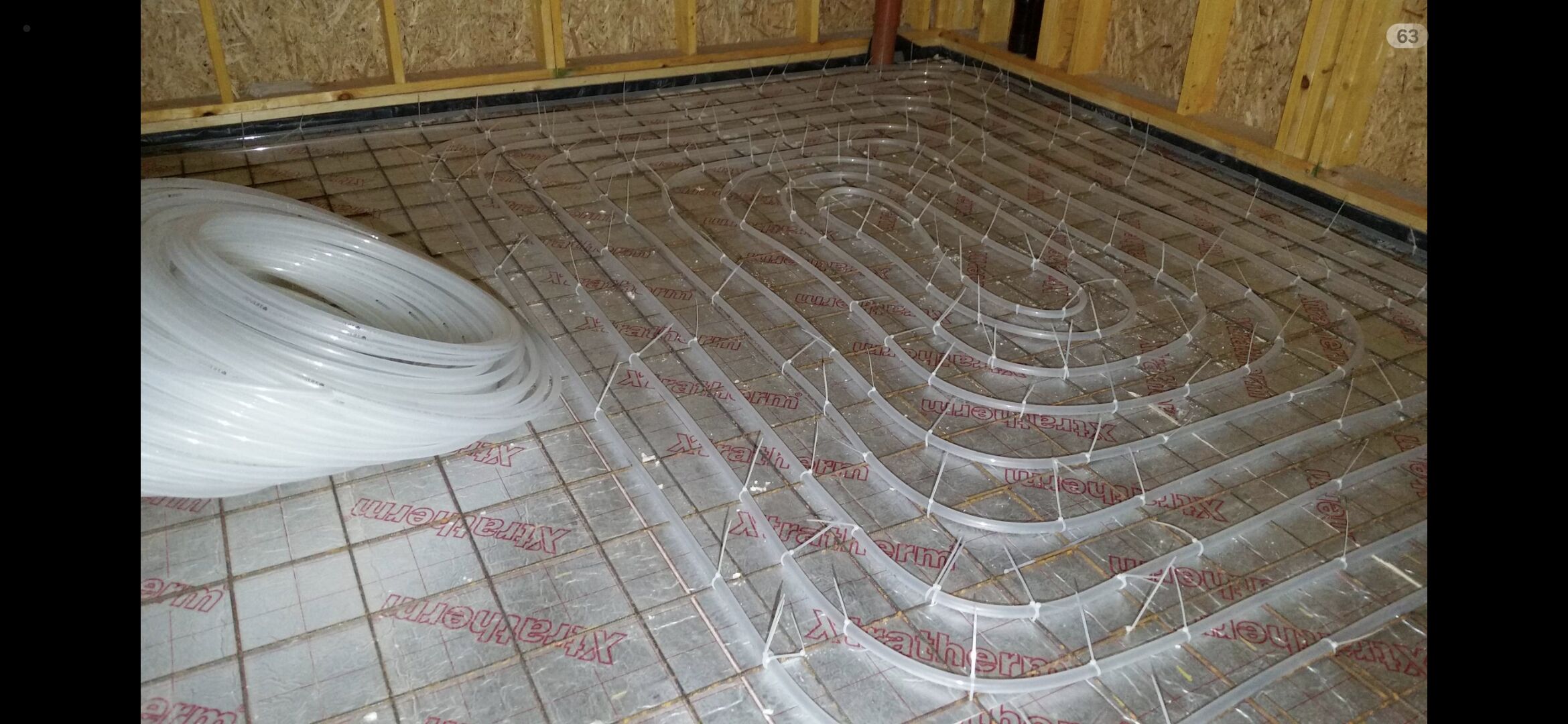
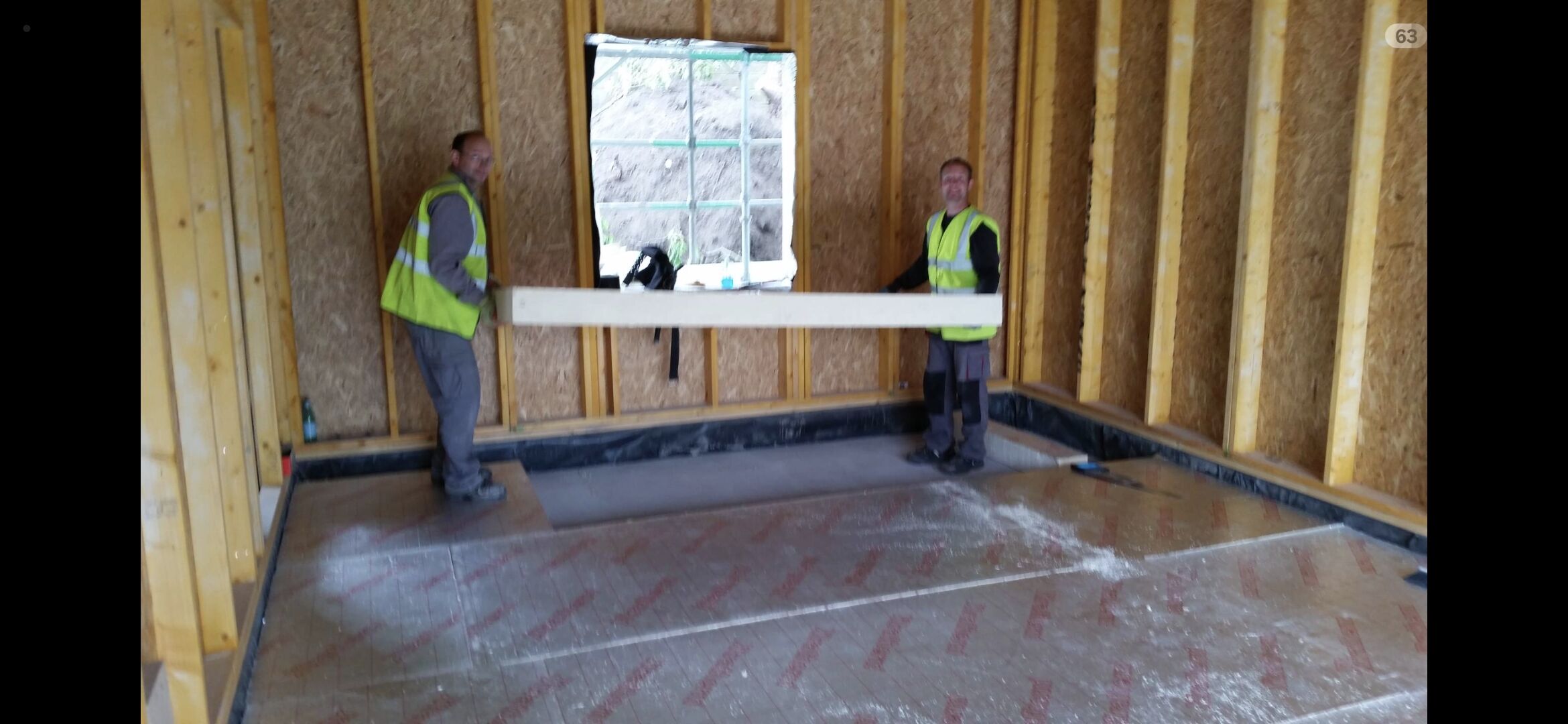
@papahuhu I know, I couldn’t believe it myself! It was worth taking the time to seal every single joint on the membrane and make the house as airtight as possible. Here are some pictures of the build — it was one crazy ride! 😅
Looking back, the mistake was oversizing the machine, but now I have to work with what we have. This was in 2015, when I couldn’t even ask for help here because hardly anyone really knew what a heat pump was. My brother from Hungary brought the heat pump and installed it himself.
This post was modified 3 weeks ago 3 times by Andris
16kw Samsung TDM ASHP. 8.4kw PV, power optimizers 20×420watt panels 6kw SolarEdge inverter.

02/10/2026 11:19 am
@andris Surely if it is truly hermetically sealed and there is no fresh cold air coming in, doesn’t the internal air get very stale and high CO and CO2 levels if there are multiple inhabitants? I can understand how you get very low heat loss, but for a timber frame construction I don’t see where the thermal energy is stored for 18 hrs. But if it works for you that’s great.
Have to say, I don’t miss the Lothian climate in the winter, I understand why the natives take to drink and drugs.
02/10/2026 11:32 am
@papahuhu, one day, when I have a battery, if that happens, I’ll go 24/7.
For now, the concrete is the battery. I hand-mixed just over 20 tons of concrete. That’s what holds the heat. It’s a strange setup, for sure. 😀. We do have ventilation over the widows.
16kw Samsung TDM ASHP. 8.4kw PV, power optimizers 20×420watt panels 6kw SolarEdge inverter.

02/10/2026 11:41 am
@andris Octopus installed my heatpump, they recommended 8kW. I negotiated for a 6kW (nominal 5.6kW) cosy6. It barely kept the house warm last winter. Since then ive insulated every wall and ceiling, the floor already had 150mm in it. Ive still a long way to go to complete the build but i can detect a 2C difference between the finished insulated room and the one thats part done. As my HP is well matched to the heat loss of the house, it takes a long time to react to changes, so i leave it running 24/7 to do its job.
im pleased with the cosy6, its very energy conservative, i can run most of the day between cosy cheap rate periods in winter. Only when the outside temp dipped to -6C did we break out the fleeces, rather than pay for supplemental resistive heating
02/10/2026 11:51 am
@agentgeorge sounds great! I think a 6kw will be my next choice for our house.
16kw Samsung TDM ASHP. 8.4kw PV, power optimizers 20×420watt panels 6kw SolarEdge inverter.

02/10/2026 11:58 am
@andris So you have a heavy solid floor, that makes more sense then. Wow, it obviously works. About 8 years ago I nearly purchased the site of the old Edinburgh Uni telescope observatory and was going to build a passive house, but I decided to leave academia and migrated south towards the sun.
1
02/10/2026 12:29 pm
@papahuhu @papahuhu A lot of tears and sweat went into the house.
I am the opposite of you—I came from a warmer climate (not the winter!) in Hungary and moved to Scotland. I used to have an air-to-air system set up back in Hungary. When we moved here, I knew this was a perfect climate for an ASHP, but coming from colder winters, I think we went a bit overboard with the insulation and the size of the heat pump.
16kw Samsung TDM ASHP. 8.4kw PV, power optimizers 20×420watt panels 6kw SolarEdge inverter.
Page 72 / 72
Prev
SPONSORS

Degrees of Separation

Latest Posts
-

RE: How will removing the standing charge on gas bills benefit heat pumps?
@toodles GIGO always stands! My Cosy 6, as you can...
By Watcher , 38 minutes ago
-
RE: Indevolt Batteries UK Support & Info Thread
@editor Mystery solved to some extent. Need to selec...
By dansus , 3 hours ago
-
RE: How much of your renewable and home setup would still work if the internet went down?
Interestingly we had an internet outage about a month a...
By Rob of York , 7 hours ago
-
RE: Double or Triple Glazed Windows?
Posted by: @singlespeed With 9 years repairing windo...
By Rob of York , 7 hours ago
-
@transparent we’re still running a secure version of PH...
By Mars , 11 hours ago
-
RE: How quickly would you want/expect heat recovery to take from setback?
Much longer than that here. The heating isn't even on. ...
By bobflux , 1 day ago
-
RE: Passiv Smart Thermostat - Help & Forum Support
Obviously the weather is changeable but there's a defin...
By Singlespeed , 1 day ago
-
RE: The Changing Jet Stream Could Challenge UK Air Source Heat Pumps
@rob-of-york I must admit that when we had a Daikin hea...
By Toodles , 1 day ago
-
RE: Forum updates, announcements & issues
Get the Renewable Heating Hub heads-up on WhatsApp. I...
By Mars , 1 day ago
-
RE: Safety study for plug in batteries out to tender - looks like Q3 2027 at best before legal
@editor I pointed out to the one of the Fuse execs that...
By dansus , 1 day ago
-
RE: 15kw pump for 225m2 1990's house - over kill?
@seaviews As well as loft insulation, there are othe...
By Rob of York , 1 day ago
-
RE: BT cuts you off, Plusnet blames Openreach... welcome to “seamless” broadband switching
Both of which (in most cases) use Openreach for the las...
By JamesPa , 1 day ago
-
RE: Renewables & Heat Pumps in the News
Yes, this is a swiss and german standard I believe, Vai...
By Batpred , 2 days ago
-
RE: Octopus Cosy 12 Heat Pump Regret: Incredibly Loud, Poor Heating & Constant Hum - Help!
@editor FWIW my problem was resolved, eventually, after...
By BigFish , 2 days ago





SPONSORS