

Notifications
Clear all
Joining the Renewable Heating Hub forums is completely free and only takes a minute. By registering you’ll be able to ask questions, join discussions, follow topics you’re interested in, bookmark useful threads and receive notifications when someone replies. Non-registered members also do not have access to our AI features. When choosing your username, please note that it cannot be changed later, so we recommend avoiding brand or product names. Before registering, please take a moment to read the Forum Rules & Terms of Use so we can keep the community helpful, respectful and informative for everyone. Thanks for joining!

15/10/2026 8:20 am
So if I want to gain the minimum level of qualifications to install a battery and inverter in my house, what would the path be? Is that even feasible for someone who isn't actually working as a tradesperson? (Pretend I don't care how much it would cost, I just want to know the pathway.)
ASHP: Mitsubishi Ecodan 8.5kW
PV: 5.2kWp
Battery: 8.2kWh

15/10/2026 9:08 am
So if I want to gain the minimum level of qualifications to install a battery and inverter in my house, what would the path be? Is that even feasible for someone who isn't actually working as a tradesperson? (Pretend I don't care how much it would cost, I just want to know the pathway.)
Would the battery and inverter be connected to the grid or standalone?
105 m2 bungalow in South East England
Mitsubishi Ecodan 8.5 kW air source heat pump
18 x 360W solar panels
1 x 6 kW GroWatt battery and SPH5000 inverter
1 x Myenergi Zappi
1 x VW ID3
Raised beds for home-grown veg and chickens for eggs
"Semper in excretia; sumus solum profundum variat"
15/10/2026 9:25 am
Grid, but would standalone be much simpler?
ASHP: Mitsubishi Ecodan 8.5kW
PV: 5.2kWp
Battery: 8.2kWh

15/10/2026 9:41 am
So if I want to gain the minimum level of qualifications to install a battery and inverter in my house, what would the path be? Is that even feasible for someone who isn't actually working as a tradesperson? (Pretend I don't care how much it would cost, I just want to know the pathway.)
That's an interesting question. Current kits are sold in the UK assuming that they will be fit by an electrician.
I believe the principle is that, provided health and safety is met, you can do DIY in your home. So the question may be "how do I ensure health and safety"?
A grid tied system should be the simplest to install.
This post was modified 3 weeks ago by Batpred
8kW Solis S6-EH1P8K-L-PLUS hybrid inverter; G99: 8kW export; 16kWh Seplos Fogstar battery; Ohme Home Pro EV charger; Vaillant Arotherm Pro 7kW; 100Amp head, HA lab on mini PC

15/10/2026 9:59 am
Grid, but would standalone be much simpler?
I don't know about simpler, but you can perfectly legally create any off-grid system you like. It's only when the kit is connected to the grid that a qualified spark is mandatory. I hasten to add that I'm only talking in lay terms since I'm not an expert who knows the detailed ins and outs. However, as I understand it, any mains-connected work like this would need to be certified by a qualified electrician.
Of course, this doesn't mean the spark has to actually do the work; it's perfectly legal for someone to do the installation themselves and just get an electrician in to do the final connection and sign everything off. Understandably, such an electrician would want to inspect and test the work VERY thoroughly before putting his or her name on any certificate but given the fact a battery, inverter and associated cabling are all likely to be easily accessible it's far more likely you'd find someone amenable to this kind of installation than any installation with buried cabling or inaccessible sections. I'd suggest you'd want to find an amenable spark before you started buying any kit, though.
If, on the other hand, you really did want to do the whole lot yourself, the answer to your original question is to take one of the many pathways to becoming a qualified electrician yourself. Perfectly doable but not necessarily quick.
105 m2 bungalow in South East England
Mitsubishi Ecodan 8.5 kW air source heat pump
18 x 360W solar panels
1 x 6 kW GroWatt battery and SPH5000 inverter
1 x Myenergi Zappi
1 x VW ID3
Raised beds for home-grown veg and chickens for eggs
"Semper in excretia; sumus solum profundum variat"
15/10/2026 10:12 am
...
I believe the principle is that, provided health and safety is met, you can do DIY in your home.
...
In general, you're right. However, the law on electrical work is rather more explicit, and governed by (I believe) Part P of the Building Regulations. That is what dictates whether any piece of electrical work is notifiable or not. For instance, replacing a light switch like for like would not normally be notifiable and you'd just need to ensure it is safe. On the other hand, anything altering a circuit would be notifiable and so even if your work is top-notch you'd still need someone qualified to sign that work off and provide a certificate - and bear in mind that whoever signs it off is putting their name to the work, not yours; they are taking responsibility for its compliance and safety.
This post was modified 3 weeks ago by Majordennisbloodnok
105 m2 bungalow in South East England
Mitsubishi Ecodan 8.5 kW air source heat pump
18 x 360W solar panels
1 x 6 kW GroWatt battery and SPH5000 inverter
1 x Myenergi Zappi
1 x VW ID3
Raised beds for home-grown veg and chickens for eggs
"Semper in excretia; sumus solum profundum variat"

15/10/2026 11:05 am
Standalone can be 'better' but it depends what you're intending to drive.
At present I'm busy purchasing components to build two portable power packs.
These will be used to run demonstration equipment, hopefully avoiding the need to run any cables between the devices.
1: My starting point was a compact power pack, typical of what you might buy on Amazon, badged Talentcell
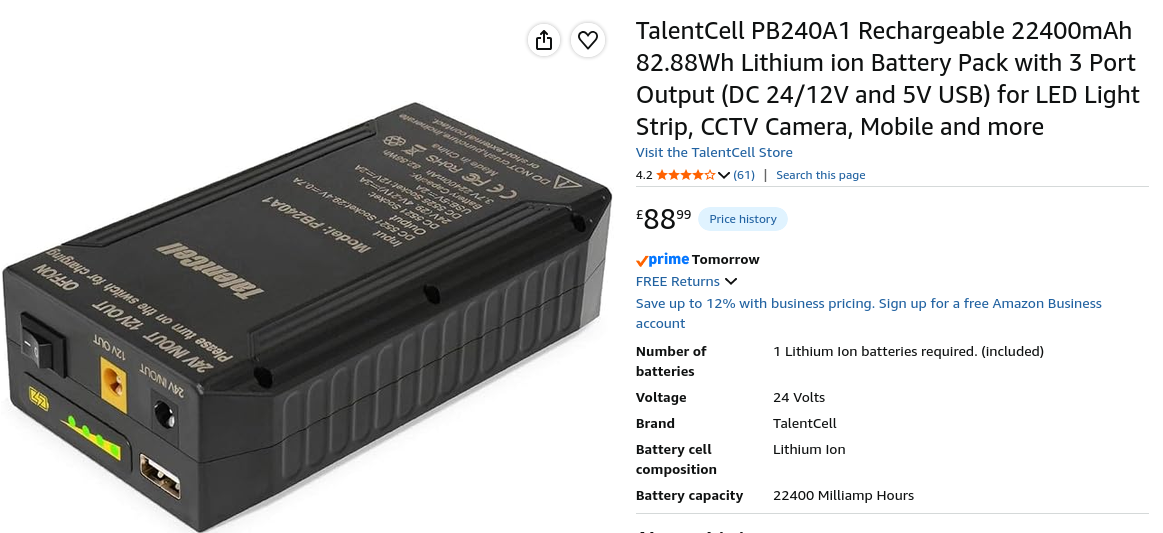
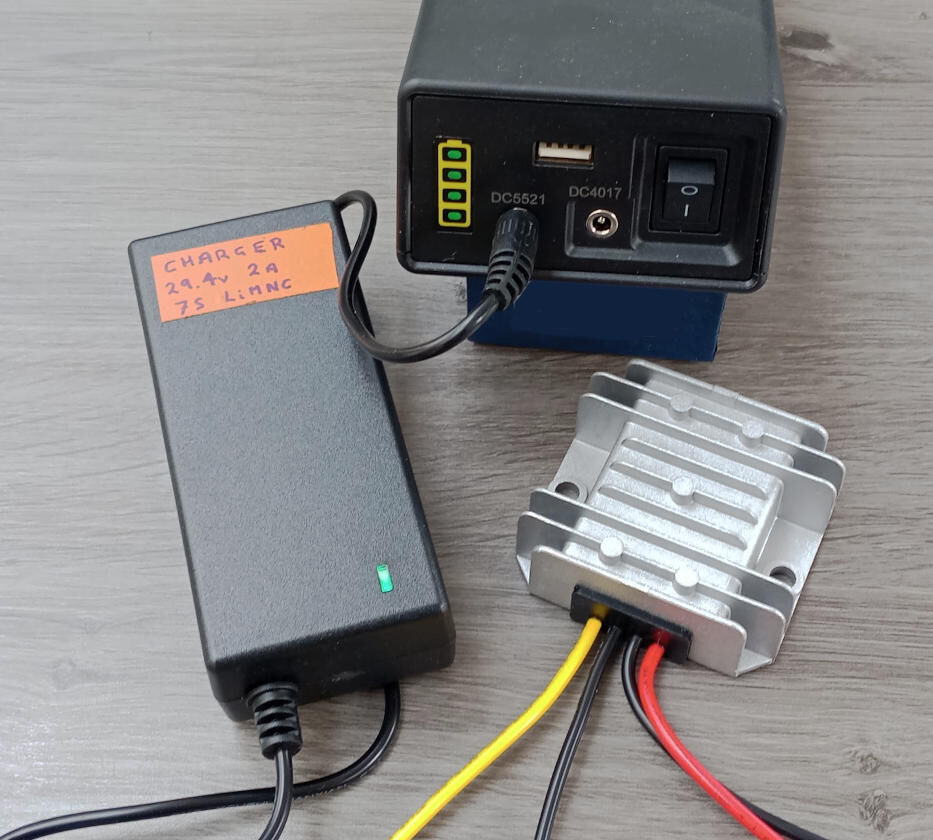
But I bought mine direct from the manufacturer in China, and got double the storage capacity (44.8Ah) in the same size aluminum enclosure.
That equates to just over 1kWh of stored power.
It can be that small because it uses LiMNC chemistry.
That's the one typically used for transport roles, such as e-bikes, and can self-combust if you over-charge it.
To that I added a 'slow' charger rated 2A, and a 12v 8A DC-DC converter.
As the charged cells release their energy, the main "24v" output will fall to 22.5v, but the Converter will hold steady at 12v at up to 5A.
2: The next PowerPack is being self-built.
It is to use LiFePO4 cells, and I've decided to use the cylindrical "C40" variant. Those are the same ones used by Eco-Power for their transportable storage.
The "C40" name relates to the size of the original cells, which are 40135.
That's 40mm diameter and 135mm in length, plus the M6 threaded terminal posts.
Storage capacity is typically 20Ah, and LiFePO4 runs at a nominal 3.2v per cell.
They currently sell for around £30 each.
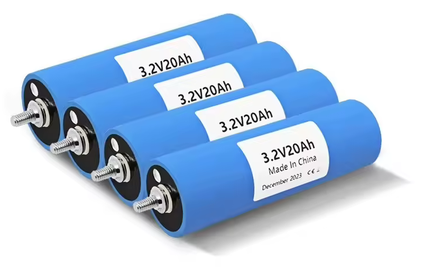
I will use an 8S configuration (eight cells in series) for a nominal 24v pack, and I've bought the slightly larger C46138 size which has 30Ah capacity, at £140 for the set.
As I write (mid-October'26) they are on a ship somewhere around South Africa!
A battery using LiMNC chemistry, as in the TalentCell units, has a high energy density, but it is unlikely be usable after 500 charge cycles.
Whereas this Lithium Ferrous Phosphate technology is good for 4000 charges. I've traded low-bulk for a longer lifetime... and greater safety.
LiFePO4 cells can't be recharged as fast as LiMNC.
A typical charger would deliver the same maximum current as the C-rating of the cells.
Thus my 30Ah pack could be safely charged at up to 30A.
The enclosure will be much bigger at 400 x 200 x 130mm. It could be smaller, but I'm constructing it with an acrylic front so that the layout with the electronics will be visible.
3: The next DIY PowerPack will use Lithium Titanate (LTO) cells in an 11S configuration to yield a nominal 24v unit.
It's the first time I've chosen to use LTO, and it's not common because each cell provides only 2.3v.
I will use the 66160 varient, manufactured by the market-leader, YinLong.
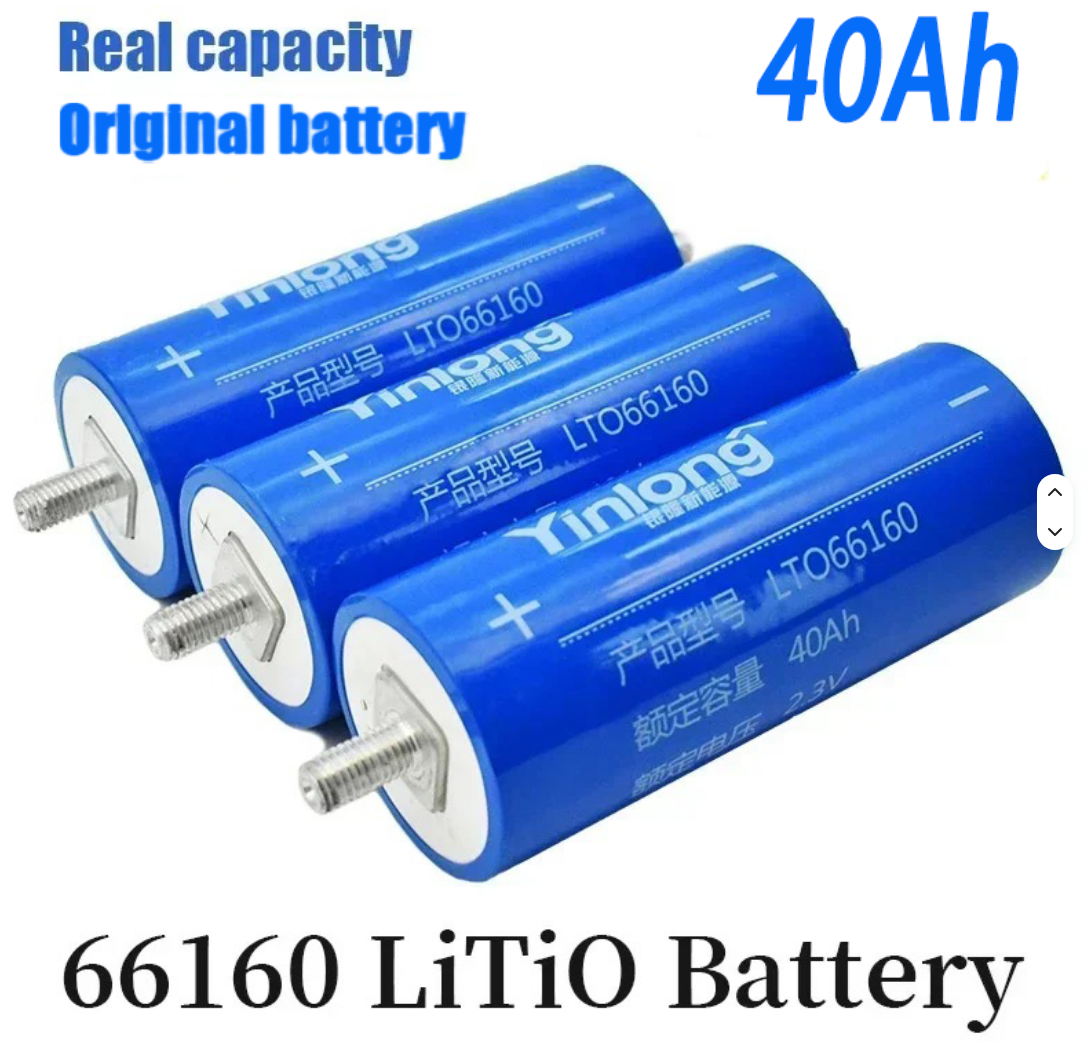
Each 40Ah cell costs around £20, but is inherently more stable and offers a lifetime upwards of 25000 charge cycles.
Once again this is a nominal 1kWh PowerPack.
Moreover LTO chemistry is very tolerant of much faster re-charging. 8C is perfectly acceptable, which means my 40Ah cells could accept a whopping 320A if I had a large enough charger unit.
I'm currently evaluating a possible 50A charger module which has options for direct MPPT input from solar panels, and also offers an RS485 communications port for a microcontroller if I wish to design one.
This PowerPack will be used to operate a 240v AC load via a Power Inverter rated 500VA (400 watts).
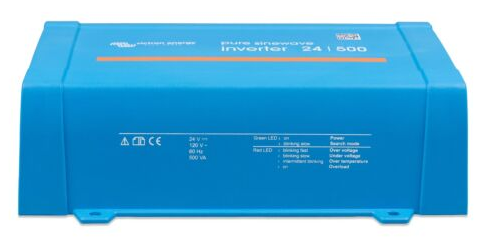
Each of these DIY packs are basically taking the concepts used by the commercial portable power market-leaders, but scaling it to do exactly what I want.
A word of warning, however...
In researching which Battery Management Systems (BMS) and cell balancing modules I required, I attempted to use Google Gemini AI on my browser. It consistently made errors, usually recommending unsuitable products. It totally failed to find any BMS capable of running with an 11S LTO setup. There are at least two: ANT/JNFN in China and Enepower in Australia.
If this detail of subject matter is of wider interest, then I can provide more construction details and explain what is and isn't safe for domestic use.
But @editor might prefer that the discussion is separated out into its own topic so that others can find it for future reference purposes.
This post was modified 3 weeks ago 7 times by Transparent
Save energy... recycle electrons!
15/10/2026 12:33 pm
I'd suggest you'd want to find an amenable spark before you started buying any kit, though.
If, on the other hand, you really did want to do the whole lot yourself, the answer to your original question is to take one of the many pathways to becoming a qualified electrician yourself. Perfectly doable but not necessarily quick.
Absolutely agree, electricians need to make sure all they do or sign-off is following standards and so often they do not even engage with anything they are not 100% sure about.
Part P needs to be followed, but I am not sure if the electrician needs to be qualified to Level 3 Design, Installation and Commissioning of Electrical Energy Storage Systems (EESS) for all battery work (specially a self contained pre-assemble battery with inverter).
8kW Solis S6-EH1P8K-L-PLUS hybrid inverter; G99: 8kW export; 16kWh Seplos Fogstar battery; Ohme Home Pro EV charger; Vaillant Arotherm Pro 7kW; 100Amp head, HA lab on mini PC

15/10/2026 12:41 pm
So if I want to gain the minimum level of qualifications to install a battery and inverter in my house, what would the path be? Is that even feasible for someone who isn't actually working as a tradesperson? (Pretend I don't care how much it would cost, I just want to know the pathway.)
You have three basic paths
1. Keep everything such that it doesn't include any "notifiable" work under part P. That's doable especially if you are keeping the voltages low (eg running solar under 120v and 48v DC round the building). It's trickier when you are doing 230v wiring and it's also generally a bad idea at 230v unless you are qualified to do so as the rules exist for a reason
2. You read the book and do it yourself but you use a building inspector. The building inspector can then approve your work if it is to the requird standard. This again is difficult unless you are qualified. It's a path some self builders do. It's a viable path for people with related electrical qualifications but perhaps not for UK home, or not current etc.
3. You use a third party certification scheme. It's basically #2 privatised
Otherwise you pay a sparky to do the work. Even a qualified sparky with the ability to sign off work can only sign off their own work. So even on a mates rates job they do the connections/electrics and you do all the conduit, drilling and carrying.
For random member of the public then #1 is realistically only viable for the case where you buy non grid tied battery/inverter boxes from someone like Anker, Bluetti or Ecoflow and plug stuff into it directly. That is genuinely plug and play and as it charges from the grid but does not export via it you don't have to wire it in or do G98 forms and stuff. As far as the regulations are concerned the BS7671 rules on battery location apply if they are a fixed install but that's between you, the council and your insurance although I'd suggest the rules are actually wise ones.
The next step up is wiring a big 48v battery and solar MPPTs up and running 48v or 12v for lots of stuff. Doesn't work for most people but the offgrid types and solarpunk folks often do this because it's way more efficient than an inverter, safer and easier to maintain. 48v off a big battery is still enough to kill you if you are unlucky though!
It's possible to do an entire non grid feed in inverter install and batteries and running some stuff off it but really that's electricians work. It's not the knowing how to do it, it's the regs (how stuff is routed for example) and also whilst an electrical engineer may know far more than an electrician it is the electrician who is trained to get it right every time.
Long answer but essentially if you have no budget limit you can order yourself a Bluetti Apex 300 and a couple of add on batteries plug it into a wall socket (I'd suggest swapping the socket for an EV rated one), plug in some solar panels and plug devices directly into it. 5 minutes in the config to set it to charge on an EV tariff overnight and done.
Is that actually useful - depends on whether you can plug all the heavy loads into it directly, or get several small ones and spread them around.
1
15/10/2026 12:48 pm
...
I believe the principle is that, provided health and safety is met, you can do DIY in your home.
...
In general, you're right. However, the law on electrical work is rather more explicit, and governed by (I believe) Part P of the Building Regulations. That is what dictates whether any piece of electrical work is notifiable or not. For instance, replacing a light switch like for like would not normally be notifiable and you'd just need to ensure it is safe. On the other hand, anything altering a circuit would be notifiable and so even if your work is top-notch you'd still need someone qualified to sign that work off and provide a certificate - and bear in mind that whoever signs it off is putting their name to the work, not yours; they are taking responsibility for its compliance and safety.
The list of notifiable work depends upon which UK country a tiny bit but
"12.—(6A) A person intending to carry out building work in relation to which Part P of Schedule 1 imposes a requirement is required to give a building notice or deposit full plans where the work consists of—
(a) the installation of a new circuit;
(b) the replacement of a consumer unit; or
(c) any addition or alteration to existing circuits in a special location.
—(9) In this regulation “special location” means—
(a) within a room containing a bath or shower, the space surrounding a bath tap or shower head, where the space extends—
(i) vertically from the finished floor level to
(aa) a height of 2.25 metres; or
(bb) the position of the shower head where it is attached to a wall or
ceiling at a point higher than 2.25 metres from that level; and
(ii) horizontally—
(aa) where there is a bath tub or shower tray, from the edge of the bath
tub or shower tray to a distance of 0.6 metres; or
(bb) where there is no bath tub or shower tray, from the centre point
of the shower head where it is attached to the wall or ceiling to a
distance of 1.2 metres; or
(b) a room containing a swimming pool or sauna heater."
All other work must be to part P (ie BS7671) including fixed equipment attached by a plug
15/10/2026 12:51 pm
...
Part P needs to be followed, but I am not sure if the electrician needs to be qualified to Level 3 Design, Installation and Commissioning of Electrical Energy Storage Systems (EESS) for all battery work (specially a self contained pre-assemble battery with inverter).
And that's the crux. There's a difference between Part P being followed and a certificate being issued.
With a degree of care, I could follow the Part P requirements but I'm not qualified to issue a certificate. I'm aware that a part of qualifying as an electrician involves having a Competent Person Scheme organisation (NICEIC, NAPIT, etc.) check examples of their work before allowing them to become a member and therefore capable of self-certifying.
One thing I'm not sure about is that it may be allowed for a non-qualified person to carry out notifiable tasks (e.g. fitting a distribution board, changing circuits or, in this case, installing a battery and inverter) to Part P standards and then, before that work is finally connected, getting a local building control officer in to inspect and approve it (which, in essence is what notification is). That inspection would, of course, have a cost associated with it. As I say, this route may be possible for a homeowner and some DIYing but I'm not sure.
105 m2 bungalow in South East England
Mitsubishi Ecodan 8.5 kW air source heat pump
18 x 360W solar panels
1 x 6 kW GroWatt battery and SPH5000 inverter
1 x Myenergi Zappi
1 x VW ID3
Raised beds for home-grown veg and chickens for eggs
"Semper in excretia; sumus solum profundum variat"
15/10/2026 12:53 pm
...
One thing I'm not sure about is that it may be allowed for a non-qualified person to carry out notifiable tasks (e.g. fitting a distribution board, changing circuits or, in this case, installing a battery and inverter) to Part P standards and then, before that work is finally connected, getting a local building control officer in to inspect and approve it (which, in essence is what notification is). That inspection would, of course, have a cost associated with it. As I say, this route may be possible for a homeowner and some DIYing but I'm not sure.
...
2. You read the book and do it yourself but you use a building inspector. The building inspector can then approve your work if it is to the requird standard. This again is difficult unless you are qualified. It's a path some self builders do. It's a viable path for people with related electrical qualifications but perhaps not for UK home, or not current etc.
...
...and there you answer my question. Thanks.
105 m2 bungalow in South East England
Mitsubishi Ecodan 8.5 kW air source heat pump
18 x 360W solar panels
1 x 6 kW GroWatt battery and SPH5000 inverter
1 x Myenergi Zappi
1 x VW ID3
Raised beds for home-grown veg and chickens for eggs
"Semper in excretia; sumus solum profundum variat"

SPONSORS

Degrees of Separation
Latest Posts
-

RE: How much of your renewable and home setup would still work if the internet went down?
Agree but remember to retain your isp router as they wi...
By JamesPa , 10 minutes ago
-
RE: The Changing Jet Stream Could Challenge UK Air Source Heat Pumps
@susannasaunders Reluctantly I think i agree with @r...
By JamesPa , 16 minutes ago
-
RE: Why don't people choose heat pumps?
It's swings and roundabouts - during off-peak periods t...
By Temperature_Gradient , 1 hour ago
-
RE: Adding data centre electricity costs to domestic energy bills?
never ceases to amaze me.. Keeping steel works going ...
By Batpred , 9 hours ago
-
RE: Electricity price predictions
great session Reminds me why some politicians can be ha...
By Batpred , 9 hours ago
-
RE: Boiler Upgrade Scheme funding reduced by circa £750 million in 2026 budget
Absolutely agree. The massive Hager CU my vaillant requ...
By Batpred , 9 hours ago
-
RE: Octopussy cosy 6 experience
People who have a Cosy appear generally to be happy wit...
By JamesPa , 13 hours ago
-
I thought the cr*p came first and the biofuel came afte...
By Majordennisbloodnok , 16 hours ago
-
RE: Aerotherm and weather compensation
@jamespa I replied yesterday with detailed readings whi...
By DavidB , 2 days ago
-
RE: Marvel Heating liquidation
@editor This is an important point. each winter, you...
By davidnolan22 , 3 days ago
-
RE: Solar Power Output – Let’s Compare Generation Figures
Very nice. we’ve been super soggy here, but rather m...
By Papahuhu , 4 days ago
-
RE: DIY powerflushing tutorial
Interesting! I toyed with the idea too. But I installed...
By bobflux , 4 days ago
-
RE: 15kw pump for 225m2 1990's house - over kill?
@seaviews Agree with the others on sequence: loft first...
By mk1234 , 4 days ago
-
RE: Vaillant ecoTEC Plus - Flow Temp and Set Up
Heating been on for 4 weeks now, continuous. It's 6C o...
By trebor12345 , 5 days ago


SPONSORS

