Joining the Renewable Heating Hub forums is completely free and only takes a minute. By registering you’ll be able to ask questions, join discussions, follow topics you’re interested in, bookmark useful threads and receive notifications when someone replies. Non-registered members also do not have access to our AI features. When choosing your username, please note that it cannot be changed later, so we recommend avoiding brand or product names. Before registering, please take a moment to read the Forum Rules & Terms of Use so we can keep the community helpful, respectful and informative for everyone. Thanks for joining!
"It was only last year, well into the process, that the UK government adopted guidelines of £200,000 per kilometre of a new cable route, plus more than £500,000 per substation"
Does this mean each 400KV pylon costs 20-40k? But there´s clearly a lot more to it than the cost of building the new power lines...
8kW Solis S6-EH1P8K-L-PLUS hybrid inverter; G99: 8kW export; 16kWh Seplos Fogstar battery; Ohme Home Pro EV charger; Vaillant Arotherm Pro 7kW; 100Amp head, HA lab on mini PC
Let me pick up a few issues from that BBC News article posted by @jeff
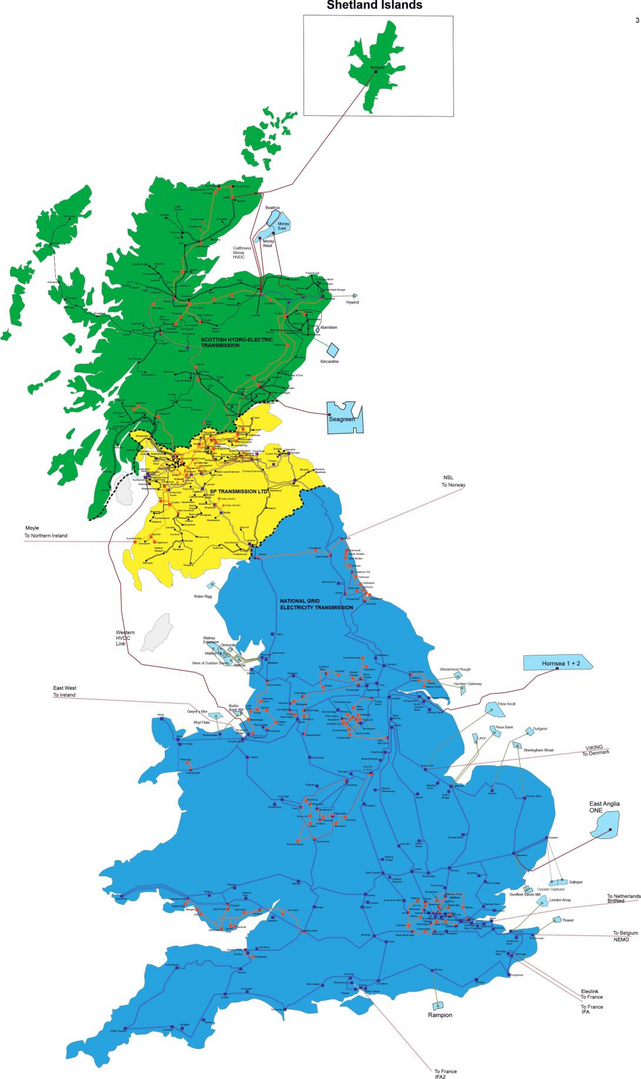
The reporters don't make it sufficiently clear that they are referring only to the Transmission Grid. That operates at 400kV in England and Wales, and at both 275kV and 400kV in Scotland.
The figure of £22bn for upgrading the SSEN-owned Scottish Hydro-electric Transmission Grid (in green above), and a further £44bn for that in Southern Scotland England and Wales is in addition to upgrades required on the lower-voltage Distribution Grid.
That's because the Scottish Highlands region is a net generator with hydro-electric plants connected at 275kV. The distance between the conductors on those transmission towers (aka pylons) is insufficient to permit re-cabling at 400kV. Instead there are new, larger transmission towers being built, often running in parallel to the existing 275kV routes. The visual impact of two sets of transmission lines running side by side is considerable. That's why there has been so much opposition from local residents.
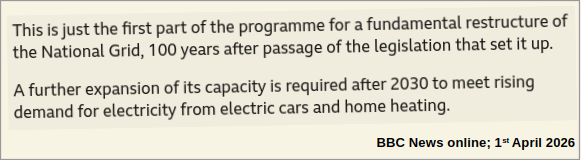
The BBC News article states:
That's misleading.
NGET informed me 4 years ago that their in-house modelling shows an increase of only 10% in Transmission capacity is required if all cars became EVs overnight. The increase required for domestic electrification of heating is much less than this because it's spread over 24hrs per day.
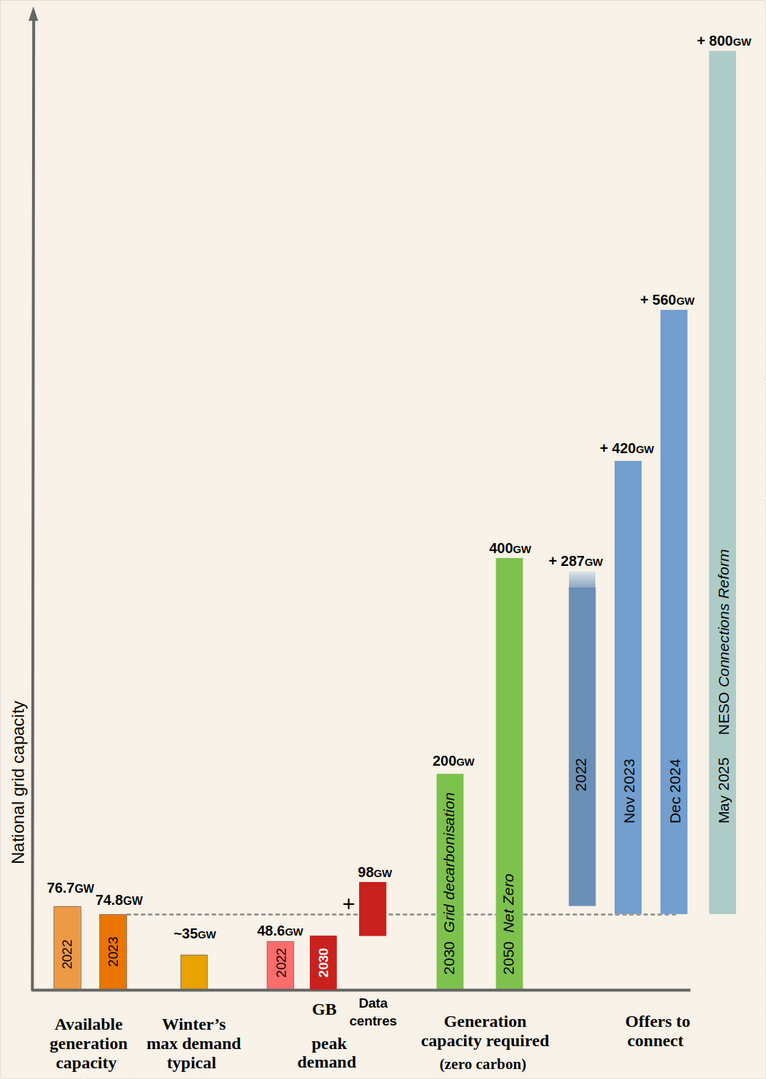
The great majority of the upgrades being planned to increase capacity over the next 5 years are due to additional data-centre demand connections. Those demand applications likely to gain approval by Ofgem/NESO total 50GW. In comparison, Electricity Demand for all other uses (domestic and commercial) is assessed at 48GW for the same period.
DCs currently make up circa 2.5% of our electricity demand and are forecast to increase to cira 9% by 2030? I was curious why the DC bar looked so high but that may be my misunderstanding? Is it to do with the peak electricity from DCs at the same time as the peak from other users?
Can DCs use batteries to shift demand away from peaks?
Are some of the network upgrades needed as we are already curtailing an eye watering amount of time and it is forecast to get worse?
Let me pick up a few issues from that BBC News article posted by @jeff
The reporters don't make it sufficiently clear that they are referring only to the Transmission Grid. That operates at 400kV in England and Wales, and at both 275kV and 400kV in Scotland.
The figure of £22bn for upgrading the SSEN-owned Scottish Hydro-electric Transmission Grid (in green above), and a further £44bn for that in Southern Scotland England and Wales is in addition to upgrades required on the lower-voltage Distribution Grid.
That's because the Scottish Highlands region is a net generator with hydro-electric plants connected at 275kV. The distance between the conductors on those transmission towers (aka pylons) is insufficient to permit re-cabling at 400kV. Instead there are new, larger transmission towers being built, often running in parallel to the existing 275kV routes. The visual impact of two sets of transmission lines running side by side is considerable. That's why there has been so much opposition from local residents.
The BBC News article states:
That's misleading.
NGET informed me 4 years ago that their in-house modelling shows an increase of only 10% in Transmission capacity is required if all cars became EVs overnight. The increase required for domestic electrification of heating is much less than this because it's spread over 24hrs per day.
The great majority of the upgrades being planned to increase capacity over the next 5 years are due to additional data-centre demand connections. Those demand applications likely to gain approval by Ofgem/NESO total 50GW. In comparison, Electricity Demand for all other uses (domestic and commercial) is assessed at 48GW for the same period.
DCs currently make up circa 2.5% of our electricity demand and are forecast to increase to cira 9% by 2030? I was curious why the DC bar looked so high
Me too!
Ofgem 'announced' the 50GW of applications for Demand from data centres in the explanatory text which accompanied the Demand Connections Reform consultation on 14th Feb.
It was concealed with a consultation rather than being a recognisable announcement or press-release.
I know that two national newspapers spotted it and placed a couple of column inches on their front pages. But I didn't notice anything being reported on TV.
I wrote a 17-page Submission in response to that Public Consultation.
My first 12-pages consisted of charts, maps and diagrams which 're-framed' the basis for their consultation. IOW I queried how Ofgem were presenting the reasons for questions in their document, based on national demand statistics, which didn't illustrate how their alternative proposals could be delivered technically.
I also challenged them on ethical issues, including my observation of Ofgem being both the proposer of the strategy regulations, and the body who authorises the increase in consumer bills to pay for it.
My 'Submission' has found its way to Councillors and MPs, and is the subject of ongoing communications with them.
Is it to do with the peak electricity from DCs at the same time as the peak from other users?
Can DCs use batteries to shift demand away from peaks?
Ofgem overlooked the need to explain this.
When you think about it, the very nature of global data-centre sites is that they operate 24/7. They have no demand peaks.
If demand is to be curtailed during times of high demand, then that role needs to be fulfilled by curtailing supplies to other consumers.
Heading up that peak demand reduction is the Consumer Led Flexibility initiative from DESNZ. This mechanism will allow 3rd-party Agents to remotely turn off heat-pumps in the home when demand is high.
Thus the warmth and comfort of domestic consumers will be sacrificed for the greater priority of keeping data-centres running.
DCs currently make up circa 2.5% of our electricity demand and are forecast to increase to cira 9% by 2030? I was curious why the DC bar looked so high
Me too!
Ofgem 'announced' the 50GW of applications for Demand from data centres in the explanatory text which accompanied the Demand Connections Reform consultation on 14th Feb.
It was concealed with a consultation rather than being a recognisable announcement or press-release.
I know that two national newspapers spotted it and placed a couple of column inches on their front pages. But I didn't notice anything being reported on TV.
I wrote a 17-page Submission in response to that Public Consultation.
My first 12-pages consisted of charts, maps and diagrams which 're-framed' the basis for their consultation. IOW I queried how Ofgem were presenting the reasons for questions in their document, based on national demand statistics, which didn't illustrate how their alternative proposals could be delivered technically.
I also challenged them on ethical issues, including my observation of Ofgem being both the proposer of the strategy regulations, and the body who authorises the increase in consumer bills to pay for it.
My 'Submission' has found its way to Councillors and MPs, and is the subject of ongoing communications with them.
Is it to do with the peak electricity from DCs at the same time as the peak from other users?
Can DCs use batteries to shift demand away from peaks?
Ofgem overlooked the need to explain this.
When you think about it, the very nature of global data-centre sites is that they operate 24/7. They have no demand peaks.
If demand is to be curtailed during times of high demand, then that role needs to be fulfilled by curtailing supplies to other consumers.
Heading up that peak demand reduction is the Consumer Led Flexibility initiative from DESNZ. This mechanism will allow 3rd-party Agents to remotely turn off heat-pumps in the home when demand is high.
Thus the warmth and comfort of domestic consumers will be sacrificed for the greater priority of keeping data-centres running.
Thanks @jeff That report is based on 'reasonable' assumptions at the time:
However, the publication date is 3rd Nov 2025.
That's a month before NESO revealed the draft analysis from their Connections Reform process.
As we've discussed here earlier, The Connections Queue which NESO inherited from NG-ESO in Oct'24 was thought to be in the region of 560GW. They used that figure as the basis of the need to instigate Connections Reform, which would weed out 'Zombie projects' and speculative applications for which there was little practical evidence of need.
Companies were required to re-register their Application in April'25, and the window closed on 10th May. Some late applications were accepted after that date, up to the 1st week of June.
When the Connections Queue analysis was reported to Ofgem in Dec'25, the total queue which NESO had examined was found to have been more than 800GW.
Culling the Applications for Generation and Storage wasn't a major problem. NESO had the authority to do so. Generation & Storage Project Applications had to meet criteria for being both 'ready' and 'needed', in keeping with the Clean Power 2030 Action Plan.
However, the TM04+ framework stipulated that Demand Applications only have to satisfy a requirement for being 'ready'. In most cases that is interpreted as meaning Planning Consent has been granted, and the Applicant has received a Final Investment Decision (FID) from its backers.
Connections Reform didn't just apply to those who had previously received an 'Offer to Connect', but also swept up a lot of new applications. The process identified that there were 140 data centre applications, requiring a total 50GW power. Almost all of these will be given a Gate-2 Offer by NESO and will proceed. 71 of those 140 data centres have FID in place as of 13feb26.
That's the basis on which Ofgem launched their Public Consultation which closed on 14th March.
If we want to find out how/why this massive increase occurred, then I'd suggest the answer lies in the TM04+ guidance.
Data Centre applications can't be rejected on grounds of location or need. They do not have to be in proximity to available power, and most aren't.
This post was modified 7 months ago by Transparent
It's now 18months since the live event was held, chaired by Tim Berners-Lee, and attended by MPs and other leaders in society.
Much has changed in that short time, and NESO is now setting the strategy and timeframe to achieve Net Zero. It will be interesting see which of the topics identified by experts are being addressed, and which are ignored.
An update to the Boiler Upgrade Scheme (BUS) has now been formally laid before Parliament and is due to come into effect on 28 April 2026, bringing a number of notable changes to how the scheme operates and what it supports.
One of the more significant shifts is the inclusion of air-to-air heat pumps for domestic properties, which will now be eligible for a £2,500 grant. This marks a clear broadening of the scheme beyond traditional wet systems, which I think is a good inclusion.
Exhaust air heat pumps have also been added, qualifying for the full £7,500 grant, which reflects growing recognition of their role in flats/apartments.
The rules around system design have also been relaxed slightly. Heat pumps can now be installed alongside non-fossil fuel supplementary heating systems, which opens the door to more hybrid-style setups using technologies like direct electric or other low-carbon sources, something that was previously more restricted under BUS. Not sure how I feel about this one.
From a process perspective, installers will now be required to apply the grant as an upfront deduction on their quotes, rather than it being treated as a backend rebate. This should improve transparency for homeowners and make comparisons between quotes more straightforward. That’s the theory anyway.
There is also alignment with the redeveloped MCS installer scheme, which signals a move towards tighter integration between standards, certification and funding eligibility. Frankly, I can’t see anything changing here and the redeveloped MCS still looks useless.
Alongside this, the requirement for a valid EPC has been removed, which should reduce friction in the application process and remove one of the more common administrative blockers… this one is probably a good thing.
From a process perspective, installers will now be required to apply the grant as an upfront deduction on their quotes, rather than it being treated as a backend rebate. This should improve transparency for homeowners and make comparisons between quotes more straightforward. That’s the theory anyway.
Our quotes have been simple to interpret in terms of the BUS grant. EDF is the exception, it is a confusing mess with their discounts, etc..
Most folk used spruce
8kW Solis S6-EH1P8K-L-PLUS hybrid inverter; G99: 8kW export; 16kWh Seplos Fogstar battery; Ohme Home Pro EV charger; Vaillant Arotherm Pro 7kW; 100Amp head, HA lab on mini PC