

Notifications
Clear all
Joining the Renewable Heating Hub forums is completely free and only takes a minute. By registering you’ll be able to ask questions, join discussions, follow topics you’re interested in, bookmark useful threads and receive notifications when someone replies. Non-registered members also do not have access to our AI features. When choosing your username, please note that it cannot be changed later, so we recommend avoiding brand or product names. Before registering, please take a moment to read the Forum Rules & Terms of Use so we can keep the community helpful, respectful and informative for everyone. Thanks for joining!

20/04/2026 8:12 pm
Yes. I used about 1m 50mm cable to connect to the inverter and then shorter cables to connect the batteries together.
Ideally you want to keep the cables as short as reasonably possible depending on the location of the equipment, but don't overly worry about it.
I bought my cables from simplysplitcharge
This post was modified 6 months ago 2 times by Bash

20/04/2026 8:18 pm
#1. is it better to have these 2 batteries connected together then connected up to the fuse/breaker etc..
The rule of thumb is to ensure that you can isolate any battery from the inverter.
Yes, they each have an inbuilt fuse and trip-switch....
... and you have only one inverter, so it matters less in your case.
I have several batteries and several inverters, which means I use a multi-in / multi-out connection board with an impressive array of trips and fuses. 😎
I have been looking to connect this to a busbar, the ones on amazon are sneaky as they state 300a but at 12v.
The busbar doesn't know what voltage it's operating at!
It's rated according to the current it can handle.
There are three factors to consider:
- the cross sectional area of the busbar and/or wires connected to it
- the size of the studs/bolts and what material they're made from
- the order of your connections onto the busbars
In your case place the battery connections either side of the wire leading to/fro the inverter.
The maximum current it can handle in normal use is dictated by the inverter.
8kW divided by 52v = 153A
You could handle that with 35mm² wire.
But take care that you properly crimp the lugs onto the ends, otherwise they'll get hot.
My choice of busbar is a raw copper bar which I drill and then cut a thread!
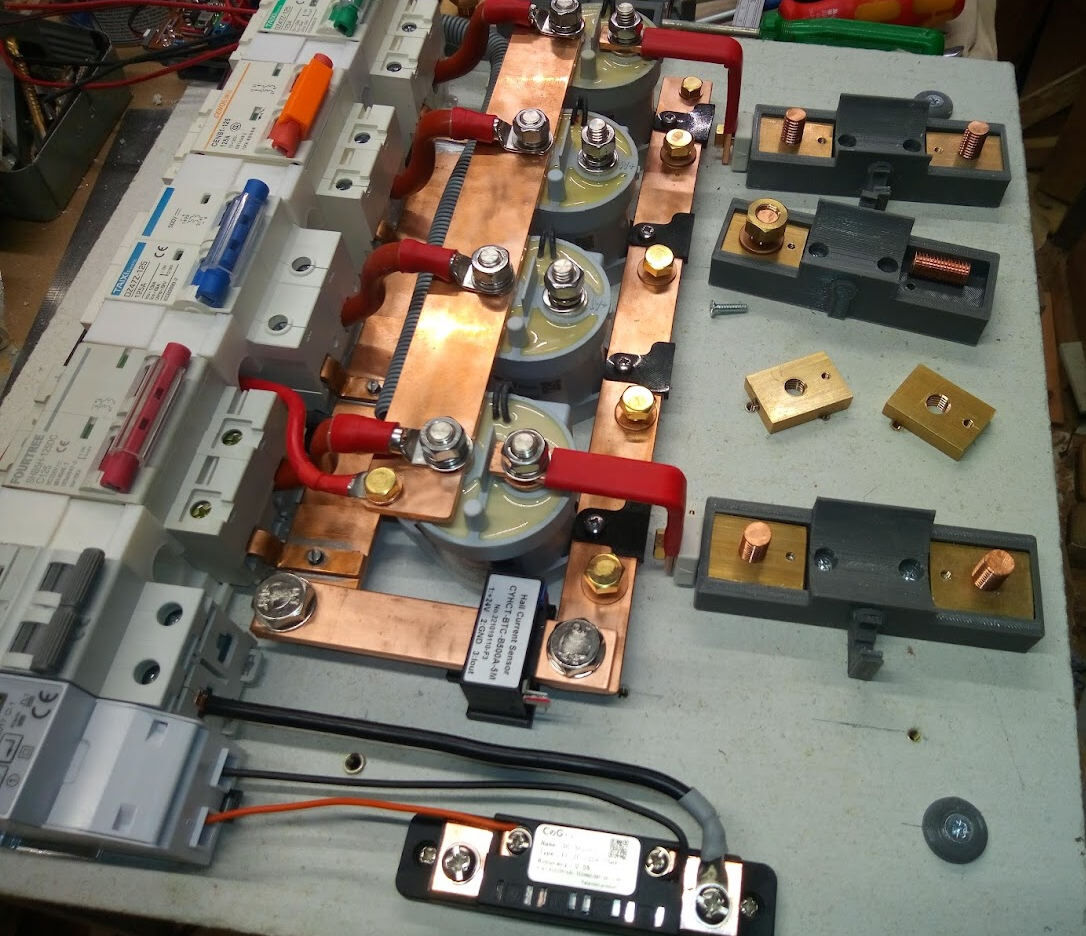
As you can see, I also make my own fuseholders with brass and threaded copper rod.
#3. Battery → Busbar / Lynx Busbar / Lynx → 200A DC FUSE → DC Isolator → Sunsynk
or
#4 Busbar / Lynx -> MEGA Fuse Holder (200A) -> DC Isolator -> Sunsynk SYNK‑8K
I've tried two different combinations of protection devices in order to see which provided me with the best options to isolate something if it develops a fault.
The photos here show my second approach:
- each battery +ve wire connects to a fuseholder, whilst the corresponding 0v battery wire bolts to the busbar just above it
- then a row of 500A gas-filled solenoids (arc suppression) which can be operated by a low current switch or a micro-controller
- the solenoid outputs are connected together and wires then supply a 125A DC-rated MCB for each inverter
No one else I know has put together something this versatile or over-specc'd, and I believe they're all still alive.
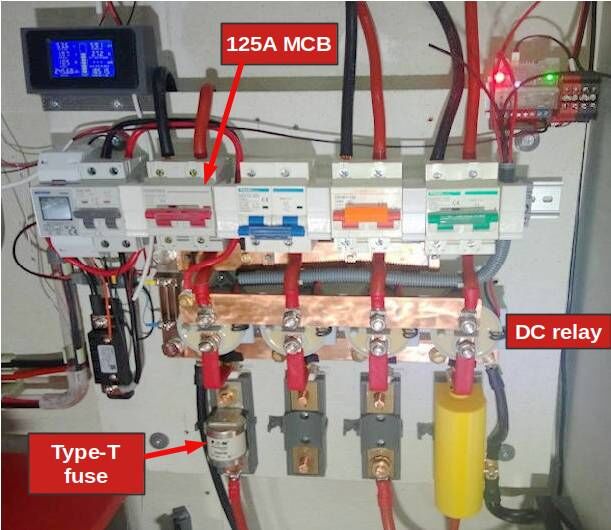
The grey MCB and adjacent meter on the left of this connections board provide 52v from the battery to directly run devices in the home.
These are pieces of equipment which continue to operate even if all of my inverters are 'off'.
Typically they go to a location where I have DC-DC converters which deliver 5v, 12v or 24v to power micro-controllers, broadband router, PCs and their monitors, electronic door entry systems etc.
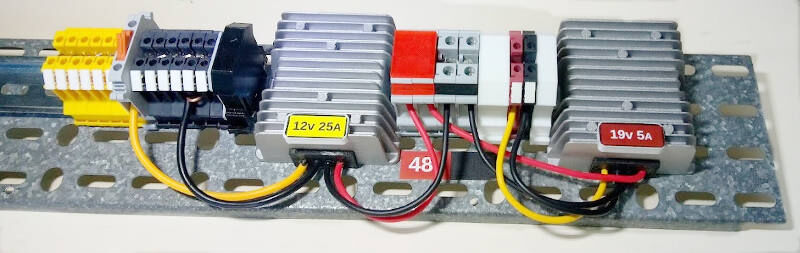
There are just two devices which don't go through a DC-DC Converter. Both the video-camera security system and the in-home wired network hub can accept a direct 52v supply. That means I have Power-over-Ethernet (PoE) available at whichever network port I want by using a 60-port patch panel.
Based on the sort of questions you're asking I'd just encourage you to "go for it".
What you first wire up may not be optimal, but it'll probably work ok.
I'd be more concerned at your house catching fire because of the older solar-inverter being in the attic!
This post was modified 6 months ago by Transparent
Save energy... recycle electrons!
1

Topic starter
26/04/2026 8:53 am
thank you to all who have already replied. I have been modelling this for about 10 days until Co-pilot premium and using an array of questions, methods. I always follow up with my own logic, check to ensure the AI isn't trying to kill me.
Anyhow, it flags up a good point - how do I protect the 1m live cable from out of the SEPLOS Mason 314. it states and I agree, that the cable run up-to the Victron lynx (I still need to decide which to pick, but it will have fused installed here) is not protected.
Fuse within battery, yes but I suggests having a MEGA or equivalent fuse as close to the battery as possible.
Any advise. The cables out of batter will be at least 70cm long before they touch the wall/trucking/where I wish to mount them
these 2 units are not in any enclosures and are simply sitting on the floor and one of top of other.
27/04/2026 6:37 pm
I don't quite understand what extra you need to do to protect the cables?
Surely there is already enough in place.
I.e you have appropriately sized the cables, there is an appropriately sized RCBO in your consumer unit, there is the Battery BMS, the fuse in the battery, the breaker in the battery and the inverter itself?
Maybe I am missing something?

Page 2 / 2
Prev

SPONSORS
Degrees of Separation

Latest Posts
-

RE: PV and battery long payback - sense check query
People following this thread who are hoping that plug i...
By JamesPa , 41 minutes ago
-
RE: Indevolt Batteries UK Support & Info Thread
People following this thread who are hoping that plug i...
By JamesPa , 43 minutes ago
-
Safety study for plug in batteries out to tender - looks like Q3 2027 at best before legal
Whilst searching for other information I came across th...
By JamesPa , 45 minutes ago
-
RE: Passiv Smart Thermostat - Help & Forum Support
By Singlespeed , 2 hours ago
-
second winter starting with Vaillant 7Kw arotherm plus still noise inside house
just had Vaillant over to service the HP and asked abou...
By AdamK , 3 hours ago
-
RE: Replacing Storage Heaters with a Heat Pump in a Stone Cottage
There are of course some installers trying it on, as th...
By JamesPa , 3 hours ago
-
RE: tepeo ZEB UK Support & Info Thread
OK so ZEB is basically a variant on a storage heater, b...
By JamesPa , 1 day ago
-
RE: Heat Geek installations: share your experiences
@editor I suspect that the Heat Geek online quote is a ...
By AndrewJ , 1 day ago
-
RE: Adding additional Solar Panels to a DC coupled battery system
Ah, yes. Thanks for clarifying.
By Transparent , 2 days ago
-
RE: Vaillant ecoTEC Plus - Flow Temp and Set Up
@trebor12345 I have been meaning to get home assista...
By Batpred , 2 days ago
-
RE: Is This Initial Free Quote From Octopus Trusted Partner Reasonable?
If you've got a sash window or a door you can remove th...
By EtchedPixels , 2 days ago
-
RE: Are We Sleepwalking Into Another Race to the Bottom?
Roughly how most air/air is done except that step 3 doe...
By EtchedPixels , 2 days ago
-
RE: Nook batteries from Octopus
@batpred If your energy use is low enough that just get...
By EtchedPixels , 2 days ago
-
RE: Missing flow temperature in Heat Geek proposal
I suspect 4 yrs ago, their approach had not got to this...
By Batpred , 2 days ago


SPONSORS