

Notifications
Clear all
Joining the Renewable Heating Hub forums is completely free and only takes a minute. By registering you’ll be able to ask questions, join discussions, follow topics you’re interested in, bookmark useful threads and receive notifications when someone replies. Non-registered members also do not have access to our AI features. When choosing your username, please note that it cannot be changed later, so we recommend avoiding brand or product names. Before registering, please take a moment to read the Forum Rules & Terms of Use so we can keep the community helpful, respectful and informative for everyone. Thanks for joining!

02/06/2026 12:54 pm
Good article. I was not aware such a high percentage of the heat pumps in the Nordics are A2A. But buildings are clearly not all the same. It seems with open plan being more prevalent there, it probably reduces the cost of deploying A2A and so becomes more appealing.
Not so sure about why Germany and Poland are more into A2W?
The UK market is hopefully going to grow further but given open plan is not very common in our homes and our weather being so different, it is not obvious A2A would become prevalent. But I have no crystal ball.
8kW Solis S6-EH1P8K-L-PLUS hybrid inverter; G99: 8kW export; 16kWh Seplos Fogstar battery; Ohme Home Pro EV charger; Vaillant Arotherm Pro 7kW; 100Amp head, HA lab on mini PC

02/06/2026 1:12 pm
Building shape and form definitely is an impact, but a lot of modern UK building is effectively open plan because the internal walls are not real walls. It's a highly insulated box with dividers in it.
There are definitely cases where one or the other is a big win and we need installers to be more proactive about offering both. Right now we have air/water people and air/air people but very few places you can get a "We could do this or that, here's the trade offs"
02/06/2026 4:40 pm
Right now we have air/water people and air/air people but very few places you can get a "We could do this or that, here's the trade offs"
That'd be a great thing, if free!
My view is that it could become the goal of a new properly trained EPC assessor.
But talking practically, I wonder which role could do that? Currently I see salespeople are the ones estimating A2W and looking to pass to next stage, the heat loss survey.. Would they be the ones to push another estimate for A2A? 😉
I agree with @editor about reducing the number of roles involved, like they did with gas boilers. They deliver retrofit gas boilers at speed. One key difference is there is a single point of accountability (and I would argue also the lack of MCS/DNO, etc paperwork helps significantly)..
So I would be concerned about anything that could make what is an already unnecessarily complex journey to an A2W heatpump even more complex.. 🙂
As for UK dwellings being like open plan, are you talking about post 1990? Or even later? And what would be the increase of thermal conductivity of the internal walls beyond which it could be considered open plan? Data will be useful..
This post was modified 5 months ago 4 times by Batpred
8kW Solis S6-EH1P8K-L-PLUS hybrid inverter; G99: 8kW export; 16kWh Seplos Fogstar battery; Ohme Home Pro EV charger; Vaillant Arotherm Pro 7kW; 100Amp head, HA lab on mini PC
1

02/06/2026 5:17 pm
...
As for UK dwellings being like open plan, are you talking about post 1990? Or even later? And what would be the increase of thermal conductivity of the internal walls beyond which it could be considered open plan? Data will be useful..
Actually, that's a very good point.
As @etchedpixels said...
... a lot of modern UK building is effectively open plan because the internal walls are not real walls. It's a highly insulated box with dividers in it.
...
...but one of the big problems with moving people away from fossil fuel heating is precisely because a lot of the UK's housing stock is older and less well insulated.
I'm not trying to suggest that "a lot of modern UK building" isn't stud wall inside, but more that "modern UK building" constitutes a significantly smaller proportion of the total housing stock than is the case in many other European countries. That's important when we consider that older buildings in the UK tend to be less well insulated external walls enclosing far more internal brick walls, both of which conflict with the ideals for A2A installations.
Of course, I've commented on one generalisation (what is our definition of "modern") with a generalisation about proportions of the UK housing stock. More accuracy is definitely needed and so @batpred's call for more data is definitely very relevant.
105 m2 bungalow in South East England
Mitsubishi Ecodan 8.5 kW air source heat pump
18 x 360W solar panels
1 x 6 kW GroWatt battery and SPH5000 inverter
1 x Myenergi Zappi
1 x VW ID3
Raised beds for home-grown veg and chickens for eggs
"Semper in excretia; sumus solum profundum variat"

02/06/2026 5:40 pm
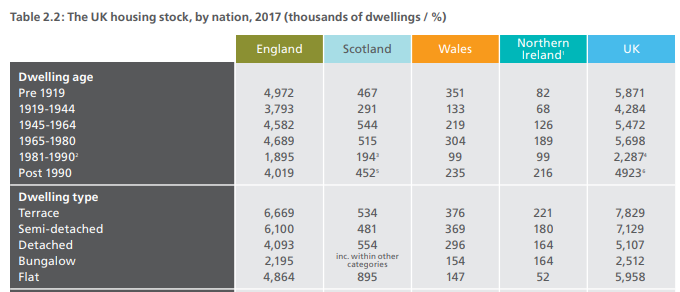
I found some in this report from the Building Research Establishment (BRE) group.
It supports the view that vast majority have internal solid walls: post 1990 builds are just around 17%, post 2000 around 7%.
This post was modified 5 months ago by Batpred
8kW Solis S6-EH1P8K-L-PLUS hybrid inverter; G99: 8kW export; 16kWh Seplos Fogstar battery; Ohme Home Pro EV charger; Vaillant Arotherm Pro 7kW; 100Amp head, HA lab on mini PC

02/06/2026 6:05 pm
Undoubtably house age/construction and layout will have major impacts on heating and cooling.
Our bungalow is 1970 double breeze exterior and single breeze on all interior but one.
Layout wise garden room/conservatory, dining room and kitchen are open, two bedrooms/en-suite have a connecting door which is usually open, master bedroom opens to hallway/entrance and is usually open.
On a cool but sunny day the solar gain from the garden room area will heat the house to 20c+ if we open all the interior doors.
It is another reason that makes me think air to air may be best for us.
We go to Southern Spain for 2/3 months in the winter, at times it can get cold there especially morning/evening and we stay on the hotel top floor which is the coldest part. The ceiling mounted air to air heating is excellent and provides great cooling in hotter times.
We have an aircon survey 11th June so I’ll know more shortly after.
02/06/2026 6:21 pm
Undoubtably house age/construction and layout will have major impacts on heating and cooling.
Our bungalow is 1970 double breeze exterior and single breeze on all interior but one.
Layout wise garden room/conservatory, dining room and kitchen are open, two bedrooms/en-suite have a connecting door which is usually open, master bedroom opens to hallway/entrance and is usually open.
On a cool but sunny day the solar gain from the garden room area will heat the house to 20c+ if we open all the interior doors.
It is another reason that makes me think air to air may be best for us.
Difficult to estimate in your case. No concerns with the extreme case of one wall/ceiling unit per room. But without seeing thermal conductivity data for even a plasterboard wall vs air, I would want to make sure any installer would provide a solid performance guarantee.
We go to Southern Spain for 2/3 months in the winter, at times it can get cold there especially morning/evening and we stay on the hotel top floor which is the coldest part. The ceiling mounted air to air heating is excellent and provides great cooling in hotter times.
We have an aircon survey 11th June so I’ll know more shortly after.
Even in a one bed flat, an aircon/heatpump may need multiple indoor units to pass the airbnb guest test! I know the last one that we stayed at in South France could not have lasted long without the several ceiling units that it had!
I wish I could share your enthusiasm, but breeze blocks will not allow any drafts! 😉
This post was modified 5 months ago by Batpred
8kW Solis S6-EH1P8K-L-PLUS hybrid inverter; G99: 8kW export; 16kWh Seplos Fogstar battery; Ohme Home Pro EV charger; Vaillant Arotherm Pro 7kW; 100Amp head, HA lab on mini PC
02/06/2026 9:13 pm
Right now we have air/water people and air/air people but very few places you can get a "We could do this or that, here's the trade offs"
That'd be a great thing, if free!
My view is that it could become the goal of a new properly trained EPC assessor.
But talking practically, I wonder which role could do that? Currently I see salespeople are the ones estimating A2W and looking to pass to next stage, the heat loss survey.. Would they be the ones to push another estimate for A2A? 😉
I agree with @editor about reducing the number of roles involved, like they did with gas boilers. They deliver retrofit gas boilers at speed. One key difference is there is a single point of accountability (and I would argue also the lack of MCS/DNO, etc paperwork helps significantly)..
So I would be concerned about anything that could make what is an already unnecessarily complex journey to an A2W heatpump even more complex.. 🙂
As for UK dwellings being like open plan, are you talking about post 1990? Or even later? And what would be the increase of thermal conductivity of the internal walls beyond which it could be considered open plan? Data will be useful..
Aircon sales people push A2A just fine, but not A2W and vice versa. Maybe we'll see a few of the bigger ones widen their scope to both - I see Heatable are talking about doing both for example. There's a real need given how confusing it all is for there to be ways to learn about different options and which might be the right one for a given property or person.
Agreed there's a need for data on what does/doesn't work with modern housing, especially with air/air.
I'm howevver the one running air/air on an 1860s victorian pile where if you put the air/air in the rooms the main fires were and open doors it just works 8)

02/06/2026 11:49 pm
I understand you are running air/air on it, so how many units do you have and how many rooms do not have one? Otherwise people reading this could get the idea that if they think their house is modern, it will work..
Could yours pass the "airbnb guest feedback" test?
8kW Solis S6-EH1P8K-L-PLUS hybrid inverter; G99: 8kW export; 16kWh Seplos Fogstar battery; Ohme Home Pro EV charger; Vaillant Arotherm Pro 7kW; 100Amp head, HA lab on mini PC
03/06/2026 12:39 am
Would it pass the airbnb feedback test no. Is it as comfortable as when it had gas - yes. Is it a reference for most people - definitely not, more a demonstration of what air/air can do to tackle old buildings with poor insulation!
It's an 1860s victorian pile of about 500m2 and I think 23 rooms depending how you count some of the basement. It's not exactly a "normal" house as it was the home of the manager of the Swansea potteries in their heyday and still has things like buttons for calling servants.
4kW ground floor drawing room where the main fireplace was (main heating, cooling for that room in summer). That opens out onto the central core of the house so any heat can rise right up the middle of the building.
4kW first floor landing (kicks in for winter, heat only)
4kW in the basement where the kitchen once was (mostly running dehumidification except in winter when it blows heat up to the floor above sourced from the basement)
1.5kW in the main bedroom (winter, summer cooling)
and 1500W or so of electric heaters in spots that are hard to do.
The basement is quite odd even by my experience of living on old houses. It's bigger than the house and fully enclosed stone so it actually never drops below about 13C even in winter whatever happens even if unheated, hence the rather odd arrangement of a portable unit using it as a source in winter to blow heat up into the main house.
It's all on 3 phase supply and backed by about 50kW of batteries and 7kW of solar (another 10kW appearing soon I hope - it's grade II so the extra solar is currently in the council planning process).
You can run a modern or even many old terraces off a couple of units (bedroom, bottom of stairs) and a small electric towel rail but it depends what feature set you want. More head units means more control obviously. There's a very definite cost/flexibility trade off.

06/06/2026 6:13 am
Thanks @escapist very interesting. What stood out for me? That you need a body to resolve problems over installations to generate trust in the technology. Which seems lacking in the UK.
High adoption of A2A is a combination of no existing hot water based heating and open plan houses.
Use of wood burners for supplementary heating. I come from a very engineering oriented family so for my whole adult life I've been aware of the 80/20 rule. For almost everything the first 80% of the aim is achieved with 20% of the effort. It's the last 20% the requires 80% of the effort. So the insistence in regulations that a heat pump system provides 100% of heating needs drives cost and complexity.

06/06/2026 10:07 am
Use of wood burners for supplementary heating. I come from a very engineering oriented family so for my whole adult life I've been aware of the 80/20 rule. For almost everything the first 80% of the aim is achieved with 20% of the effort. It's the last 20% the requires 80% of the effort. So the insistence in regulations that a heat pump system provides 100% of heating needs drives cost and complexity.
Very much with you on the 80/20 principle, I guess the challenge in designing regulations which build this in is to avoid abuse (humans are, after all, very good at that!)
The updated regulations (not sure if they are yet in force) do allow supplementary heating but it must not be fossil fuel. I can't remember the exact wording which will of course matter, but it's worth checking out if it matters to a particular case.
This post was modified 5 months ago by JamesPa
4kW peak of solar PV since 2011; EV and a 1930s house which has been partially renovated to improve its efficiency. 7kW Vaillant heat pump.
1

SPONSORS

Degrees of Separation
Latest Posts
-

Hi everyone, We will be starting a new self build ear...
By E A WEST , 18 minutes ago
-
RE: Say hello and introduce yourself
@majordennisbloodnok Thanks major.
By E A WEST , 44 minutes ago
-
Mars asked for an update on progress so …. Out HP has...
By DavidB , 2 hours ago
-
RE: How much of your renewable and home setup would still work if the internet went down?
Yes I actually have a copy of a tool that whenever a ce...
By EtchedPixels , 3 hours ago
-
RE: How will removing the standing charge on gas bills benefit heat pumps?
The shoulder months are very difficult to judge COP on ...
By scrchngwsl , 5 hours ago
-
RE: Indevolt Batteries UK Support & Info Thread
@editor Hi, To resolve this, please tap on the A...
By Indevolt Tech , 11 hours ago
-
RE: Double or Triple Glazed Windows?
Posted by: @singlespeed With 9 years repairing windo...
By Rob of York , 1 day ago
-
@transparent we’re still running a secure version of PH...
By Mars , 1 day ago
-
RE: How quickly would you want/expect heat recovery to take from setback?
Much longer than that here. The heating isn't even on. ...
By bobflux , 2 days ago
-
RE: Passiv Smart Thermostat - Help & Forum Support
Obviously the weather is changeable but there's a defin...
By Singlespeed , 2 days ago
-
RE: The Changing Jet Stream Could Challenge UK Air Source Heat Pumps
@rob-of-york I must admit that when we had a Daikin hea...
By Toodles , 2 days ago
-
RE: Forum updates, announcements & issues
Get the Renewable Heating Hub heads-up on WhatsApp. I...
By Mars , 2 days ago
-
RE: Safety study for plug in batteries out to tender - looks like Q3 2027 at best before legal
@editor I pointed out to the one of the Fuse execs that...
By dansus , 2 days ago
-
RE: 15kw pump for 225m2 1990's house - over kill?
@seaviews As well as loft insulation, there are othe...
By Rob of York , 2 days ago




SPONSORS
