

Notifications
Clear all
Joining the Renewable Heating Hub forums is completely free and only takes a minute. By registering you’ll be able to ask questions, join discussions, follow topics you’re interested in, bookmark useful threads and receive notifications when someone replies. Non-registered members also do not have access to our AI features. When choosing your username, please note that it cannot be changed later, so we recommend avoiding brand or product names. Before registering, please take a moment to read the Forum Rules & Terms of Use so we can keep the community helpful, respectful and informative for everyone. Thanks for joining!

Topic starter
16/04/2026 9:26 pm
@lejamaiscontent apologies for the slow reply as I was on holiday. I haven't looked at RT, I can't see any way to access this on the Daikin MMI controller, I wonder if that needs 3rd party monitoring equipment. Is the RT just a function of the system design or are there ways to adjust it? I have a service of the ASHP arranged for tomorrow so can possibly ask about it then.

17/04/2026 8:42 am
@lejamaiscontent apologies for the slow reply as I was on holiday. I haven't looked at RT, I can't see any way to access this on the Daikin MMI controller, I wonder if that needs 3rd party monitoring equipment. Is the RT just a function of the system design or are there ways to adjust it? I have a service of the ASHP arranged for tomorrow so can possibly ask about it then.
RT is a function of flow rate and heat demand and not something you directly adjust. It will be measured by the heat pump for sure so the information is available somewhere. Daikin heat pumps can be set up to modulate the flow rate to achieve a fixed deltaT FT-RT for reasons that have so far escaped rational explanation on this forum. DeltaT should normally be around 5 at design oat, less at current mild oats. If it's less don't worry, if a lot more suggests flow rate a bit low.
4kW peak of solar PV since 2011; EV and a 1930s house which has been partially renovated to improve its efficiency. 7kW Vaillant heat pump.
1

17/04/2026 9:30 am
@jamespa This is an aspect I have been observing on my Daikin EDLA08 Altherma 3 monobloc heat pump for some while. I have a Homely controller and their ‘installer’s app’ enables me to observe the flow rate and return temperature. The Daikin appears to have three pump speeds or flow rates in my setup; it starts up at ~28 lpm. then after a few minutes drops to ~14 lpm and finally settles down at ~7 lpm. As you say, Daikin operate this way to set the Delta T of the primary circuit - though the variation of flow rates does slightly play about with the optimisation of the flow rate of the secondary circuit with a Low Loss Header installed!
Toodles, heats his home with cold draughts and cooks food with magnets.
1

17/04/2026 2:08 pm
@mairiA apologies myself since I didn't watch my e-mails by now.
My concern is that your radiators could be hot on top but (worst case) stone cold at the bottom.
Since effective radiator temperature is roughly the average between top and bottom, it would help as much raising the bottom temperature as raising the top one; except that the latter won't compromise COP.
Flow temperature (FT) would be what enters the rad, return temperature (RT) what is leaving.
Just bend down to any radiator and feel if there's much of a temp. difference between top and bottom, or, more significant, between the two supplying pipes.
If all rads show the same pattern of being mostly hot everywhere, I was wrong, no offence meant, back to start.
If all show the same pattern of hot on top, cold (or luke warm) at the bottom, hooray, first thing to do is firing up the circulating pump.
If there are single outliers only with a cold butt -- are these in rooms which tend to stay cold: if yes, turn open first its thermostat, and if such doesn't help, try opening the lockshield valve.
When the room is fine, just pat the radiator: well done, darling.
Tell us about the results -- the suspense is killing me!

Topic starter
17/04/2026 2:16 pm
@lejamaiscontent I've now had my annual service completed today. The service engineer was able to show me that the RT is indeed available, hidden deep in the installer menu. He has been very helpful and supportive. His instinct is that the ASHP is likely undersized, but obviously I will await word on that from NAPIT. Interestingly he was surprised that the original installer used Daikin's own heat loss calculator which is less detailed than that of MCS. I will await further word from MCS and NAPIT. Maybe I will have an answer before next winter!
Topic starter
17/04/2026 2:21 pm
@lejamaiscontent It's a warm day today, OAT 12 degrees so perhaps not the best for checking the radiators as they are luke warm at best. At the moment their temperature seems pretty consistent from top to bottom. I'll check again on a colder day.
17/04/2026 3:35 pm
His instinct is that the ASHP is likely undersized, but obviously I will await word on that from NAPIT.
Personally I think you are well beyond believing an installer instinct or NAPIT. When you adjusted the heating as suggested here you were warm enough when it was cold in February, so if it is undersized the undersizing is smaller than the margin of error on any calculation, and certainly smaller than anyone's instinct. The only way now, given what you already know, to get the actual answer, is to wait until winter! Anything else is pure speculation or GIGO spreadsheetery.
. Maybe I will have an answer before next winter!
You won't for the reason stated above!
Apart from this is there anything left that you are unhappy with, please can you remind us so we can provide some more help if needed
This post was modified 6 months ago 4 times by JamesPa
4kW peak of solar PV since 2011; EV and a 1930s house which has been partially renovated to improve its efficiency. 7kW Vaillant heat pump.
18/04/2026 10:21 am
Radiator
temperature seems pretty consistent from top to bottom
.... and there it goes, my shiny theory .... so sorry, but at least I tried, and not having done so would be a shame. Keep anyway RT in mind and have a second check when you find next time the house not getting warm. In the meanwhile, sit this out and
wait until winter!
because JamesPa is spot right and nothing is wrong imo if we get to the bottom of that issue before you spend big money on some feeling.
Next winter won't come up with anything which an oil filled radiator and a few hundred kWh of electric energy couldn't mend, so don't haste.
And feeling, yes, my one was that there can't be an undersized heat pump .... yes, in theory, of course, but not in real life, because of how the business is made .... feeling .... good that JamesPa addressed this.
To come from feeling to a more solid heat loss, er, estimation:
Firstly, did we ever ask you how much gas was spent per year before the heat pump was installed?
Second, here some GIGO, tee hee, basing on the information you provided in your first post:
'four bedroom villa' -- so I think detached, 150 m², assuming a two-storey shoebox without bay windows or other gadgets with a footprint of 8 m by 10 m.
Outer walls then would be (8+10+8+10)*6 m² so well 200 m², with typically 15% of which would be windows or doors. These again came with roughly 1.5 W/m²K, together 50 W/K. The walls, you said, have their cavities (of 4 cm?) insulated, so more or less 0.66 W/m²K, makes 130 W/K. Loft insulation, say 10 cm with 1 W/m²K, 80 m² roundabout 80 W/K plus basement or foundation losses which I find difficult to ponder, however I catch 50 W/K from thin air. Bottom line would be 310 W/K, at a temperature difference (with 21 °C inside and -3 °C outside) being 24 K, making 7.4 kW heat loss plus domestic hot water for four persons, 400 W, plus some circulation losses, 200 W, altogether 8 kW, no air ventilation, no inner gain from eletricity or like, no solar input, no thermal bridges identified, while the latter four being minor issues, no way distorting that guesstimate of mine.
Of course all this is hot air but, however, as good or bad as anybody else could obtain with no more information at hand. Even when standing in front of your house it would be difficult to see into walls or hear the water circulate without advanced tools as crystal balls or dowsing rods e.g..
And now reverse-engineering a possible gas consumption: at an average yearly outdoor temperature of 11 °C (and 21° C inside continously) there would be 10 K * 310 W/K 3.1 kW plus .6 kW DHW such 3.7 kW; @ 8760 h/year I would expect 32 400 kWh/a aka 3200 m³ gas aka 3200 l oil.
Can you conform some of this or contradict, anything what would help to enhance that castle in the air? My 'feeling' anyway is that I laid somewhat heavy to the 'safe side' .... feeling, er?
When I'm going too far in stretching science or patience, please somebody intercept me.


19/04/2026 8:32 am
And now reverse-engineering a possible gas consumption: at an average yearly outdoor temperature of 11 °C (and 21° C inside continously) there would be 10 K * 310 W/K 3.1 kW plus .6 kW DHW such 3.7 kW; @ 8760 h/year I would expect 32 400 kWh/a aka 3200 m³ gas aka 3200 l oil.
Can you conform some of this or contradict, anything what would help to enhance that castle in the air? My 'feeling' anyway is that I laid somewhat heavy to the 'safe side' .... feeling, er?
When I'm going too far in stretching science or patience, please somebody intercept me.
Your ‘hand waving’ above isn’t too far off mostly. Our 200m2 detached house has a 400W/C value. We need 8kW which the 7kW Vaillant supplies, but you must have a mistake in your gas usage assumptions.
Our gas usage was ~18000kW per year, running continuously at 60C on the old condensing boiler keeping the house at 20C
This post was modified 6 months ago by Judith
2kW + Growatt & 4kW +Sunnyboy PV on south-facing roof Solar thermal. 9.5kWh Givenergy battery with AC3. MVHR. Vaillant 7kW ASHP (very pleased with SCOP >4) open system operating on WC
28/04/2026 6:56 pm
@judith
unfortunately, I completely missed your reply until now, very sorry!
Your 18 000 kWh/y knock me out -- following my basic-arithmetics-approach, distributed to 8760 h/y they would supply roughly 2 kW in average, lifting the house's temperature about 5 K over ambient.
At 11°C yearly average outdoor temp, this would be 16°C indoor .... what did I miss?
How is it up to date, does your electricity consumption fit in the picture? At 4.7 SCOP I would expect the HP uses like 3,500 kWh/y, right?
29/04/2026 7:30 am
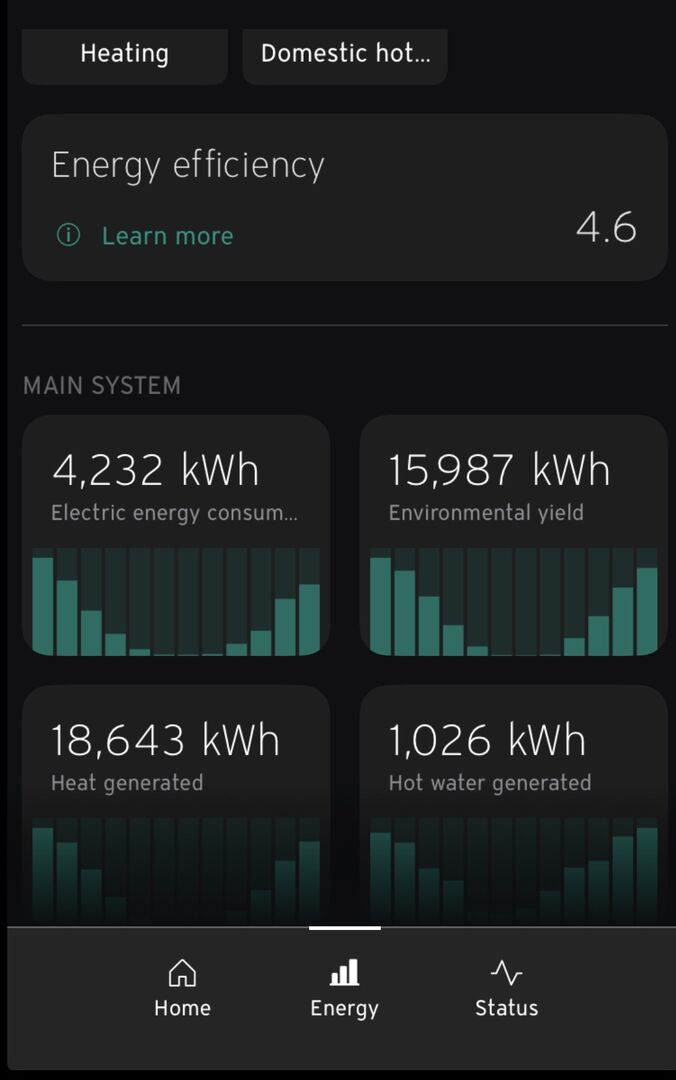
@lejamaiscontent There’s a couple of things to add. We also have a solar thermal system so the DHW varies with the season too. The electricity consumption is reasonably accurate but I think the heat might be over-reading by about 5%.
2kW + Growatt & 4kW +Sunnyboy PV on south-facing roof Solar thermal. 9.5kWh Givenergy battery with AC3. MVHR. Vaillant 7kW ASHP (very pleased with SCOP >4) open system operating on WC
Page 11 / 11
Prev
SPONSORS

Degrees of Separation
Latest Posts
-

RE: How will removing the standing charge on gas bills benefit heat pumps?
I'm not sure it makes much of a difference to heat-pump...
By Temperature_Gradient , 42 minutes ago
-
@editor Ouch, sorry to re start the tick. I had assume...
By DavidB , 1 hour ago
-
RE: Say hello and introduce yourself
@e-a-west as the good Major said, welcome to the forums...
By Mars , 3 hours ago
-
RE: New Build 3 Phase or 1Phase
We are on three phase power because it's an enormous li...
By EtchedPixels , 3 hours ago
-
RE: How much of your renewable and home setup would still work if the internet went down?
Yes I actually have a copy of a tool that whenever a ce...
By EtchedPixels , 12 hours ago
-
RE: Indevolt Batteries UK Support & Info Thread
@editor Hi, To resolve this, please tap on the A...
By Indevolt Tech , 19 hours ago
-
RE: Double or Triple Glazed Windows?
Posted by: @singlespeed With 9 years repairing windo...
By Rob of York , 1 day ago
-
@transparent we’re still running a secure version of PH...
By Mars , 2 days ago
-
RE: How quickly would you want/expect heat recovery to take from setback?
Much longer than that here. The heating isn't even on. ...
By bobflux , 2 days ago
-
RE: Passiv Smart Thermostat - Help & Forum Support
Obviously the weather is changeable but there's a defin...
By Singlespeed , 2 days ago
-
RE: The Changing Jet Stream Could Challenge UK Air Source Heat Pumps
@rob-of-york I must admit that when we had a Daikin hea...
By Toodles , 2 days ago
-
RE: Forum updates, announcements & issues
Get the Renewable Heating Hub heads-up on WhatsApp. I...
By Mars , 2 days ago
-
RE: Safety study for plug in batteries out to tender - looks like Q3 2027 at best before legal
@editor I pointed out to the one of the Fuse execs that...
By dansus , 2 days ago
-
RE: 15kw pump for 225m2 1990's house - over kill?
@seaviews As well as loft insulation, there are othe...
By Rob of York , 2 days ago


SPONSORS

