

Notifications
Clear all
Joining the Renewable Heating Hub forums is completely free and only takes a minute. By registering you’ll be able to ask questions, join discussions, follow topics you’re interested in, bookmark useful threads and receive notifications when someone replies. Non-registered members also do not have access to our AI features. When choosing your username, please note that it cannot be changed later, so we recommend avoiding brand or product names. Before registering, please take a moment to read the Forum Rules & Terms of Use so we can keep the community helpful, respectful and informative for everyone. Thanks for joining!
Energy Storage
337
Posts
23
Users
119
Reactions
47.4 K
Views

30/04/2026 3:15 pm
Is there a test(s) you'd like me to perform. Happy to do that?
In view of
In the event of a grid outage, the Powerflex activates the EPS socket and supplies it with the inverter’s full available output. That's it.
No test needed. It does what I thought it must do to be compliant. The key point is that it does not power your house wiring if there is a grid outage.
4kW peak of solar PV since 2011; EV and a 1930s house which has been partially renovated to improve its efficiency. 7kW Vaillant heat pump.
1

30/04/2026 5:17 pm
In the event of a grid outage, the Powerflex activates the EPS socket and supplies it with the inverter’s full available output. That's it.
Do you mean the EPS socket is not working continuously?
And did the kit come with any diagrams and H&S warnings?
8kW Solis S6-EH1P8K-L-PLUS hybrid inverter; G99: 8kW export; 16kWh Seplos Fogstar battery; Ohme Home Pro EV charger; Vaillant Arotherm Pro 7kW; 100Amp head, HA lab on mini PC


Topic starter
30/04/2026 10:09 pm
🔥 Britain’s Heat Pump Shitshow
How Installing a Heating System Became a National Nervous Breakdown
Free UK shipping.
📗 Heat Pumps Explained
A Jargon-Free Guide for Homeowners
Rewritten and updated for 2027
📘 From Zero to Heat Pump Hero
🛠️ Bodge Buster
New to heat pumps?
Take the Heat Pump Fundamentals course and use INTRO50 at checkout for 50% off.
02/05/2026 1:38 pm
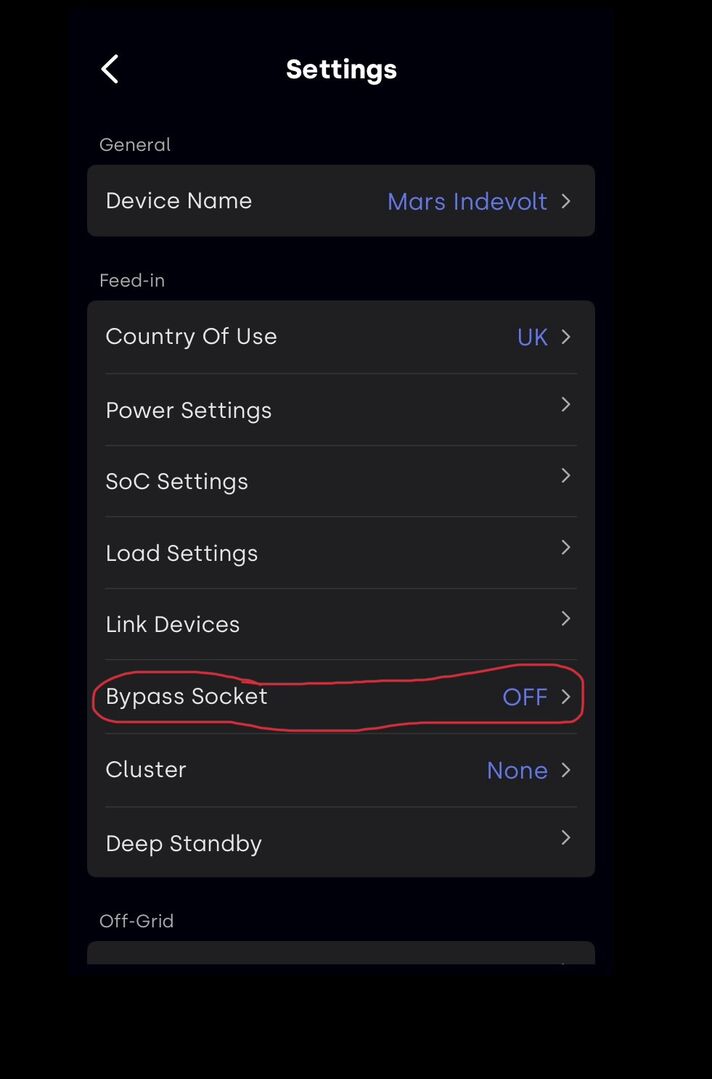
@batpred by default the socket (Indevolt call it the bypass socket) is turned off.
Maybe I am missing something but I cannot see why anyone would want if off...
8kW Solis S6-EH1P8K-L-PLUS hybrid inverter; G99: 8kW export; 16kWh Seplos Fogstar battery; Ohme Home Pro EV charger; Vaillant Arotherm Pro 7kW; 100Amp head, HA lab on mini PC
2

Topic starter
03/05/2026 10:04 am
@batpred I think it really comes down to how you’re using it.
If it’s just soaking up excess solar and feeding the house, and you’re not relying on it as a backup for anything plugged directly into it, then there’s probably no need to have that function enabled.
If and when you do need it, you can always switch it on.
🔥 Britain’s Heat Pump Shitshow
How Installing a Heating System Became a National Nervous Breakdown
Free UK shipping.
📗 Heat Pumps Explained
A Jargon-Free Guide for Homeowners
Rewritten and updated for 2027
📘 From Zero to Heat Pump Hero
🛠️ Bodge Buster
New to heat pumps?
Take the Heat Pump Fundamentals course and use INTRO50 at checkout for 50% off.
Topic starter
03/05/2026 10:07 am
As promised, my review is out:
If you don’t make it to the end of the video, it’s worth flagging this here that the unit I’ve been testing, the Powerflex 2000 Hybrid, isn’t actually the version launching in the UK later this year. That’ll be the Powerflex 3000.
Physically it’s the same form factor, same design, same expansion options, but with a higher-rated inverter at 3kW instead of 2kW. Pre-orders are expected around June or July, and I think the price will be very similar to the 2000 which is extremely good value. More on that in the weeks to come.
🔥 Britain’s Heat Pump Shitshow
How Installing a Heating System Became a National Nervous Breakdown
Free UK shipping.
📗 Heat Pumps Explained
A Jargon-Free Guide for Homeowners
Rewritten and updated for 2027
📘 From Zero to Heat Pump Hero
🛠️ Bodge Buster
New to heat pumps?
Take the Heat Pump Fundamentals course and use INTRO50 at checkout for 50% off.
03/05/2026 7:51 pm
Great review and it looks like a great product. Looking forward to actual pricing.
Well done for flagging the bidirectional RCBO risk. Frankly I doubt many will bother checking so...a question that still hasn't been answered IMHO is how great a risk is it in reality. As I understand it the problem potentially occurs when the grid fails. The inverter shuts down in (20ms? or is it 0.5s) in accordance with G98 (we now know for certain that it does not provide power to the house when the grid is not present) and the risk (as I understand it) is that in that time cycle a component in the RCBO burns out. Having burned out it no longer provides earth leakage protection either while off grid or on grid. The RCBO then becomes just an MCB/fuse.
As the IET point out, this is no worse than 17 edition regulations, to which many houses are still wired. Nevertheless we have come to assume that our mains is (almost) unconditionally safe against electric shock, which RCDs come close to achieving but MCBs/fuses certainly do not.
I have tried to find out what component it is that might fail in order to get some sense of whether it is actually likely to fail in the time it takes the inverter to shut down. The industry briefings that I have been able to find are surprisingly silent on this. Do you know or maybe @transparent knows?
Plug in is a separate case IMHO to fixed wired islanding. In a fixed wired islanding situation the potential for damage to an RCBO occurs over an extended period of operation (ie the whole time the grid is off). In plug-in it occurs only for the time (20ms?) that the inverter takes to shut down, which it is required to do by the regs
A human being is not usually damaged by the energy that passes during half a cycle, thats why an RCD/RCBO can offer protection! Maybe the RCD/RCBO is also not usually damaged in the short time kit takes for an inverter to shut down. Does anyone actually know for certain?
PS Here is the post to the original discussion about bidirectional RCBOs.
This post was modified 6 months ago 7 times by JamesPa
4kW peak of solar PV since 2011; EV and a 1930s house which has been partially renovated to improve its efficiency. 7kW Vaillant heat pump.
1

04/05/2026 5:04 am
I’m really excited for this product. I can’t wait to get it on my balcony
2
Topic starter
04/05/2026 10:31 am
@jamespa, glad you enjoyed the review.
I think you're spot on about the short shutdown window. With the Powerflex being G98 compliant (I've been told that it is) it’s supposed to disconnect in well under 20ms when the grid drops, so the reverse current exposure on a standard RCBO should only last for that tiny half-cycle moment rather than any sustained period.
Funnily enough, I spoke to my electrician about this yesterday (because we're looking at adding a wired in battery to the house that can island, which is proving to be a massive challenge) and for him the main worry is that the sensitive electronics in a normal RCBO (the bit that handles the earth leakage detection) can get damaged by current flowing the "wrong" way, even briefly, as we've all been discussing here.
Once that’s fried (as we've also already covered) you’re left with just overcurrent protection and no RCD functionality on that circuit until it’s replaced. Not the end of the world, and as you say James, plenty of older houses are still running on wiring without RCDs on every circuit. But it’s still a 'quiet' downgrade in safety that most people wouldn’t notice.
In terms of real-world failure rates, I'm not sure anyone knows.
For the Powerflex specifically, because the exposure is so short I suspect the real-world risk is low for the average grid blip, but you never know, so fitting a bidirectional RCBO is cheap insurance IMO (£30-40 and an hour of an electrician’s time on the circuit you want protected) and it removes the whole debate. If I’m spending money on the plug-in battery I’d rather not have that nagging "what if" in the back of my mind.
If @transparent or any of the sparkies have seen actual failures in similar short-duration reverse feed situations we’d love to hear it.
🔥 Britain’s Heat Pump Shitshow
How Installing a Heating System Became a National Nervous Breakdown
Free UK shipping.
📗 Heat Pumps Explained
A Jargon-Free Guide for Homeowners
Rewritten and updated for 2027
📘 From Zero to Heat Pump Hero
🛠️ Bodge Buster
New to heat pumps?
Take the Heat Pump Fundamentals course and use INTRO50 at checkout for 50% off.
04/05/2026 10:32 am
I have just read the manual for this unit and there seems to be some ambiguity over whether the output power is limited to 800W unless 'something' is changed:
1. In section 6 (which applies to the version with solar panel support it says:
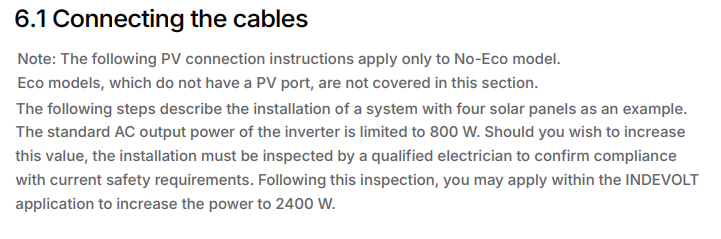
2. But then in section 9 (which applies to all models) it says

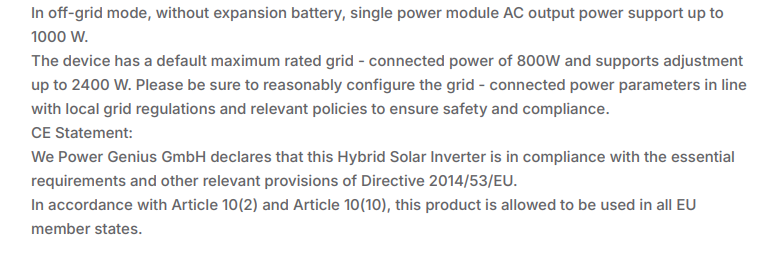
My guess, and it is only a guess, is that by default the output power is limited to 800W but you can increase it to the full 2400W. However to do so you should get an electrician to inspect and if the rules in the UK limit plug in devices to 800W (which I believe they might) then she/he will have to fail it unless it is professionally connected. Whether the app enforces this or not I cannot tell, but perhaps @editor can. The FAQs seem to confirm this guess,
Now with a 2kWh battery an 800W limit wont really matter if you are simply trying to optimise many ToU tarrifs, because there will be plenty of time to discharge the battery fully in the peak timeslot. If you were thinking of expanding the batter significantly with multiple add on modules, this limitation (if it exists) may matter.
On a separate but related matter this parameter also appears in the spec

The condition (with exp battery) is a bit strange and it doesnt say what it is without. This parameter might be more important if your cheap rate tarrif is relatively short (eg Cosy). Again with a single battery probably not a problem but with multiple expansion batteries it quite possibly matters. On the other hand since it appears that the caveat disappears with expansion battery perhaps this falls away too.
Even with these limitations its still a very exciting device!
This post was modified 6 months ago 3 times by JamesPa
4kW peak of solar PV since 2011; EV and a 1930s house which has been partially renovated to improve its efficiency. 7kW Vaillant heat pump.
04/05/2026 10:42 am
For the Powerflex specifically, because the exposure is so short I suspect the real-world risk is low for the average grid blip, but you never know, so fitting a bidirectional RCBO is cheap insurance IMO (£30-40 and an hour of an electrician’s time on the circuit you want protected) and it removes the whole debate. If I’m spending money on the plug-in battery I’d rather not have that nagging "what if" in the back of my mind.
Maybe, but if you have an older CU (like mine - about 15 years) then the components may not be available. You can get some for mine secondhand only, new components not available. Also an electrician may refuse to work on it without replacing it completely. A CU replacement is £500-£1000 which rather changes the proposition.
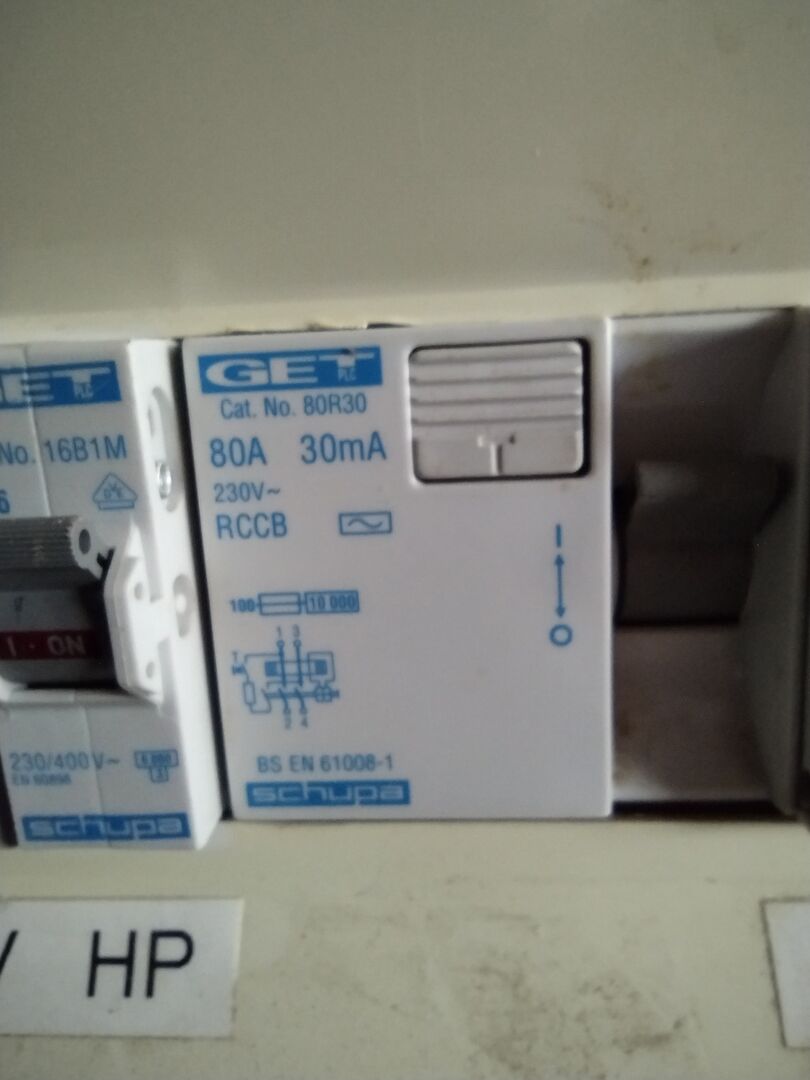
Oddly enough the (old) RCD in mine, which protects the sockets in the house but not the lighting, PV or HP circuits, looks like it might be bidirectional as it appears it may have the additional cut out that @transparent refers to , at least according to the circuit diagram on the front.
As I say I doubt many will check, if its sold they will assume its safe, so it would be good to know what the actual risk level is!
This post was modified 6 months ago 7 times by JamesPa
4kW peak of solar PV since 2011; EV and a 1930s house which has been partially renovated to improve its efficiency. 7kW Vaillant heat pump.

04/05/2026 11:53 am
@jamespa the rccb shown in your photo is a type AC.
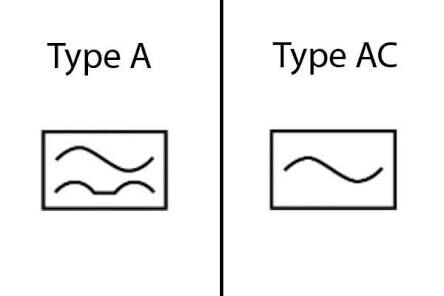
If you are looking for a device that works with EV chargers or solar PV (which requires bi-directional current flow), you would typically need a Type A or specifically designed bi-directional unit, rather than a standard Type AC RCD.
This post was modified 6 months ago by IaAck
1


SPONSORS

Degrees of Separation
Latest Posts
-

RE: How will removing the standing charge on gas bills benefit heat pumps?
I'm not sure it makes much of a difference to heat-pump...
By Temperature_Gradient , 1 hour ago
-
@editor Ouch, sorry to re start the tick. I had assume...
By DavidB , 2 hours ago
-
RE: Say hello and introduce yourself
@e-a-west as the good Major said, welcome to the forums...
By Mars , 3 hours ago
-
RE: New Build 3 Phase or 1Phase
We are on three phase power because it's an enormous li...
By EtchedPixels , 4 hours ago
-
RE: How much of your renewable and home setup would still work if the internet went down?
Yes I actually have a copy of a tool that whenever a ce...
By EtchedPixels , 13 hours ago
-
RE: Indevolt Batteries UK Support & Info Thread
@editor Hi, To resolve this, please tap on the A...
By Indevolt Tech , 20 hours ago
-
RE: Double or Triple Glazed Windows?
Posted by: @singlespeed With 9 years repairing windo...
By Rob of York , 1 day ago
-
@transparent we’re still running a secure version of PH...
By Mars , 2 days ago
-
RE: How quickly would you want/expect heat recovery to take from setback?
Much longer than that here. The heating isn't even on. ...
By bobflux , 2 days ago
-
RE: Passiv Smart Thermostat - Help & Forum Support
Obviously the weather is changeable but there's a defin...
By Singlespeed , 2 days ago
-
RE: The Changing Jet Stream Could Challenge UK Air Source Heat Pumps
@rob-of-york I must admit that when we had a Daikin hea...
By Toodles , 2 days ago
-
RE: Forum updates, announcements & issues
Get the Renewable Heating Hub heads-up on WhatsApp. I...
By Mars , 2 days ago
-
RE: Safety study for plug in batteries out to tender - looks like Q3 2027 at best before legal
@editor I pointed out to the one of the Fuse execs that...
By dansus , 2 days ago
-
RE: 15kw pump for 225m2 1990's house - over kill?
@seaviews As well as loft insulation, there are othe...
By Rob of York , 2 days ago




SPONSORS