

Notifications
Clear all
Joining the Renewable Heating Hub forums is completely free and only takes a minute. By registering you’ll be able to ask questions, join discussions, follow topics you’re interested in, bookmark useful threads and receive notifications when someone replies. Non-registered members also do not have access to our AI features. When choosing your username, please note that it cannot be changed later, so we recommend avoiding brand or product names. Before registering, please take a moment to read the Forum Rules & Terms of Use so we can keep the community helpful, respectful and informative for everyone. Thanks for joining!
Energy Storage
324
Posts
23
Users
110
Reactions
42.7 K
Views


Topic starter
28/04/2026 10:26 pm
@jamespa and @colinc to my understanding, the way a plug-in unit like the Powerflex achieves simultaneous connection to your house wiring and disconnection from the grid during island mode is through an internal transfer switch built into the inverter itself.
When it detects grid loss, an internal relay opens on the grid-facing side, breaking the connection between the incoming supply and the inverter’s output circuit, while simultaneously switching the inverter output to feed from the battery.
So the physical break from the grid does exist. It’s just internal rather than external.
I guess the bigger question is whether that internal switching constitutes adequate isolation under regs.
How regulators ultimately choose to treat the internal transfer switch of a plug-in unit versus an external island mode isolator will define whether this whole category of product can legally deliver full house island mode here, or whether it’s confined to the dedicated off-grid socket only.
🔥 Britain’s Heat Pump Shitshow
How Installing a Heating System Became a National Nervous Breakdown
Free UK shipping.
📗 Heat Pumps Explained
A Jargon-Free Guide for Homeowners
Rewritten and updated for 2027
📘 From Zero to Heat Pump Hero
🛠️ Bodge Buster
New to heat pumps?
Take the Heat Pump Fundamentals course and use INTRO50 at checkout for 50% off.

29/04/2026 8:44 am
@jamespa and @colinc to my understanding, the way a plug-in unit like the Powerflex achieves simultaneous connection to your house wiring and disconnection from the grid during island mode is through an internal transfer switch built into the inverter itself.
When it detects grid loss, an internal relay opens on the grid-facing side, breaking the connection between the incoming supply and the inverter’s output circuit, while simultaneously switching the inverter output to feed from the battery.
So the physical break from the grid does exist. It’s just internal rather than external.
I guess the bigger question is whether that internal switching constitutes adequate isolation under regs.
How regulators ultimately choose to treat the internal transfer switch of a plug-in unit versus an external island mode isolator will define whether this whole category of product can legally deliver full house island mode here, or whether it’s confined to the dedicated off-grid socket only.
Sorry but that makes no sense. One of us has a serious misunderstanding
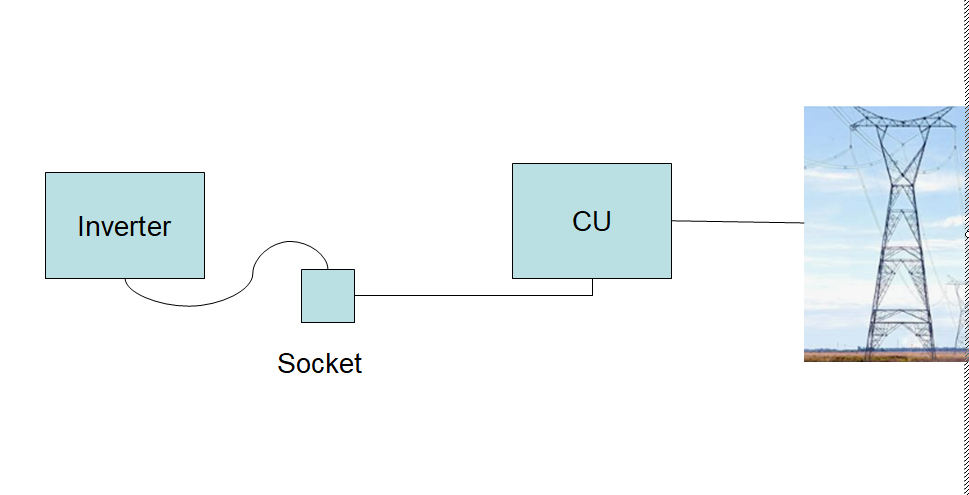
If the inverter is connected to the house wiring (which it must be if it is powering the house during islanding) and the house wiring is connected to the grid (which is unless the user breaks the link) then the inverter is connected to the grid. Nothing internal to the inverter can change this. The break needs to occur in the CU or between CU and grid if the inverter is powering the house.
Can you please clarify what you think happens?
4kW peak of solar PV since 2011; EV and a 1930s house which has been partially renovated to improve its efficiency. 7kW Vaillant heat pump.
1
29/04/2026 8:54 am
Along similar lines ( forgive the pun) concerning our great british housing stock, we recently ripped out our kitchen and utility room as part of a major renovation.
All the copper was duly earth bonded, in all the usual plumbing and heating places throughout the property. However, the main water supply from the roadside to the indoor stop-cock is MDPE (basically plastic). This property was built in 01/02. Granted, grid earth is present.
I pointed this out to our PV/Battery installer. The electrian said they carry out earth connection checks as a matter of course; especially where a Gateway (Sigen in our case) is part of the system. The need for an earth rod is quite common; and in our install it is, from memory, 16mm x1.8m.
MDPE feeds and plastic pipes are legitimate. The IET has articles about the requirements here and here. Suffice it to say that it is a myth (one from which I also suffered until I read the IET articles) that all metal pipework in a house needs to be bonded in all cases.
4kW peak of solar PV since 2011; EV and a 1930s house which has been partially renovated to improve its efficiency. 7kW Vaillant heat pump.
Topic starter
29/04/2026 8:59 am
@jamespa I’ve slept on this, and you’re right. I’ve been turning it over and I think your logic is sound and I should have arrived at this conclusion sooner.
If the unit is plugged into the ring main, and the ring main connects through the consumer unit to the grid supply, then the inverter is connected to the grid. Nothing inside the box changes that physical reality.
The path exists regardless of what the internal electronics do. The only thing that severs that path is an external break between the consumer unit and the incoming supply, and a plug-in unit, by its very nature, cannot provide that.
So I think the honest conclusion is the one you reached… that a plug-in unit of this type cannot compliantly power house circuits in island mode under current UK regulations. The dedicated off-grid socket on the back of the unit is a different matter, as that output is genuinely separate from the ring main.
But whole-house island mode via the plug? I don’t think it stands up.
I appreciate you pushing on this and making the penny drop.
🔥 Britain’s Heat Pump Shitshow
How Installing a Heating System Became a National Nervous Breakdown
Free UK shipping.
📗 Heat Pumps Explained
A Jargon-Free Guide for Homeowners
Rewritten and updated for 2027
📘 From Zero to Heat Pump Hero
🛠️ Bodge Buster
New to heat pumps?
Take the Heat Pump Fundamentals course and use INTRO50 at checkout for 50% off.
1


29/04/2026 11:13 am
Are Indevolt reading this topic?
Can we hear from them what they mean by 'islanding'?
A diagram would be great 🙂
This could be a word which has been mistranslated, or has a different meaning in other countries.
Save energy... recycle electrons!
2
Topic starter
29/04/2026 4:20 pm
Can we hear from them what they mean by 'islanding'?
I think that the definition and what was explained may be two different things here... I'm trying to get to the bottom of it. Complicated stuff 😆
🔥 Britain’s Heat Pump Shitshow
How Installing a Heating System Became a National Nervous Breakdown
Free UK shipping.
📗 Heat Pumps Explained
A Jargon-Free Guide for Homeowners
Rewritten and updated for 2027
📘 From Zero to Heat Pump Hero
🛠️ Bodge Buster
New to heat pumps?
Take the Heat Pump Fundamentals course and use INTRO50 at checkout for 50% off.

29/04/2026 8:14 pm
The instinctive reaction from homeowners might be, "so what, worst case a breaker trips"… but the reality is far more serious.
My understanding is that proper plug in kits come with instructions. They are not meant to be just plugged in at random.
And anyone misusing a toaster or many other appliances can endanger themselves, why would this need to be safer?
8kW Solis S6-EH1P8K-L-PLUS hybrid inverter; G99: 8kW export; 16kWh Seplos Fogstar battery; Ohme Home Pro EV charger; Vaillant Arotherm Pro 7kW; 100Amp head, HA lab on mini PC
29/04/2026 11:14 pm
My reckoning from this discussion and what you can tell from their website is that it acts as a plug in home battery without islanding combined with a ups.
The ups function is only available from the sockets provided. The plug in home battery function is only available when grid is connected.
This would potentially be compliant but without actually having the hardware it's impossible to tell.
This post was modified 6 months ago 2 times by JamesPa
4kW peak of solar PV since 2011; EV and a 1930s house which has been partially renovated to improve its efficiency. 7kW Vaillant heat pump.
29/04/2026 11:20 pm
My reckoning from this discussion and what you can tell from their website is that it acts as a plug in home battery without islanding combined with a ups.
The ups function is only available from the sockets provided. The plug in home battery function is only available when grid is connected.
This would potentially be compliant but without actually having the hardware it's impossible to tell.
Yes, I imagine they will seek to have it type tested. Otherwise, it will not be plug-in, as the forms would be a real pain to fill in..
8kW Solis S6-EH1P8K-L-PLUS hybrid inverter; G99: 8kW export; 16kWh Seplos Fogstar battery; Ohme Home Pro EV charger; Vaillant Arotherm Pro 7kW; 100Amp head, HA lab on mini PC
30/04/2026 8:39 am
My reckoning from this discussion and what you can tell from their website is that it acts as a plug in home battery without islanding combined with a ups.
The ups function is only available from the sockets provided. The plug in home battery function is only available when grid is connected.
This would potentially be compliant but without actually having the hardware it's impossible to tell.
Yes, I imagine they will seek to have it type tested. Otherwise, it will not be plug-in, as the forms would be a real pain to fill in..
I hope so.
The base AC coupled model 1.7kWh is currently selling for EUR700 which I hope would translate to GBP700 (I am assuming there will be a rip off factor for non EU).
With my rates from 1 May (31.179p(day), 8.6p (night) and 12p (export)) this would save 1.7*(31.179-8.6) for half the year, and 1.7*(31.179-12) for half a year ie ~ £129 per year.
A 5 year payback starts finally to make batteries look sensible even if they don't cover for power cuts and allowing for some changes in rates. I have yet to receive a quote for a 'fitted' battery that delivers a payback of <10 years which is why I haven't bothered.
This post was modified 6 months ago by JamesPa
4kW peak of solar PV since 2011; EV and a 1930s house which has been partially renovated to improve its efficiency. 7kW Vaillant heat pump.
1
Topic starter
30/04/2026 2:33 pm
Sorry for the delayed replies but we’re in the middle of redoing the veg garden and it’s turned into a bit of a mammoth project. Nearly there now.
On the islanding point, Indevolt have clarified things, and it was a bit of a “lost in translation” situation on the "islanding" front.
In the event of a grid outage, the Powerflex activates the EPS socket and supplies it with the inverter’s full available output. That's it.
🔥 Britain’s Heat Pump Shitshow
How Installing a Heating System Became a National Nervous Breakdown
Free UK shipping.
📗 Heat Pumps Explained
A Jargon-Free Guide for Homeowners
Rewritten and updated for 2027
📘 From Zero to Heat Pump Hero
🛠️ Bodge Buster
New to heat pumps?
Take the Heat Pump Fundamentals course and use INTRO50 at checkout for 50% off.
Topic starter
30/04/2026 2:51 pm
My reckoning from this discussion and what you can tell from their website is that it acts as a plug in home battery without islanding combined with a ups.
The ups function is only available from the sockets provided. The plug in home battery function is only available when grid is connected.
This would potentially be compliant but without actually having the hardware it's impossible to tell.
Is there a test(s) you'd like me to perform. Happy to do that?
🔥 Britain’s Heat Pump Shitshow
How Installing a Heating System Became a National Nervous Breakdown
Free UK shipping.
📗 Heat Pumps Explained
A Jargon-Free Guide for Homeowners
Rewritten and updated for 2027
📘 From Zero to Heat Pump Hero
🛠️ Bodge Buster
New to heat pumps?
Take the Heat Pump Fundamentals course and use INTRO50 at checkout for 50% off.
SPONSORS
Degrees of Separation

Latest Posts
-

RE: Heat pump branding. Clever, contemporary… or a bit too much?
I think Heat Geek have done an amazing job on their bra...
By Tomtheheatingengineer , 7 hours ago
-
RE: HeatGeek vs Octopus surveys: puzzling disparity - any ideas why?
I have just had 3 heat loss surveys, one by heat geek o...
By David , 7 hours ago
-
RE: Heat Geek Zero Disrupt: Are We Sleepwalking Into Another Race to the Bottom?
I think that's the key question. After all inverter uni...
By Prunus , 9 hours ago
-
RE: battery storage without solar
As of October 1st they need specific qualifications to ...
By EtchedPixels , 10 hours ago
-
RE: How should the Boiler Upgrade Scheme be reformed?
A unit which uses water to transfer the heat/chill from...
By Temperature_Gradient , 10 hours ago
-
RE: Renewables & Heat Pumps in the News
With regards to the BUS grant raid, I gave it more thou...
By ASHP-BOBBA , 10 hours ago
-
RE: Why are ASHP installs so expensive?
The whole system seems to work on the basis of...
By ian33a , 11 hours ago
-
RE: Missing flow temperature in Heat Geek proposal
Good plan. If you can get half hourly meter readings a...
By JamesPa , 16 hours ago
-
RE: Heat Pumps Without Grants: Would You Have Installed One & Will You Now?
@editor Most certainly. The heat pump was an ideal s...
By Abernyte , 16 hours ago
-
Although regulations may well vary from country to coun...
By Majordennisbloodnok , 17 hours ago
-
RE: Does anyone have experience of a smart water meter?
Yep I caught our slow leak from a £100 bill rise 8)
By EtchedPixels , 17 hours ago
-
RE: Do You Need a Buffer Tank or Low Loss Header for Underfloor Heating in a Large Property?
@jamespa in some cases, failing the Turing test might b...
By GrahamF , 20 hours ago
-
RE: Passiv Smart Thermostat - Help & Forum Support
@energystoragetech The heat capacity of some...
By JamesPa , 22 hours ago
-
RE: tepeo ZEB UK Support & Info Thread
Sorry you are correct, I was remembering figures from t...
By JamesPa , 1 day ago




SPONSORS