

Notifications
Clear all
Joining the Renewable Heating Hub forums is completely free and only takes a minute. By registering you’ll be able to ask questions, join discussions, follow topics you’re interested in, bookmark useful threads and receive notifications when someone replies. Non-registered members also do not have access to our AI features. When choosing your username, please note that it cannot be changed later, so we recommend avoiding brand or product names. Before registering, please take a moment to read the Forum Rules & Terms of Use so we can keep the community helpful, respectful and informative for everyone. Thanks for joining!
Energy Storage
324
Posts
23
Users
110
Reactions
42.7 K
Views


Topic starter
27/04/2026 3:42 pm
@jamespa, I'm getting my head around plug-in devices (batteries and PV) and I've identified two significant problem areas. Without saying what they are, can you please share your thoughts on what areas of the regs you think they're not compliant with?
🔥 Britain’s Heat Pump Shitshow
How Installing a Heating System Became a National Nervous Breakdown
Free UK shipping.
📗 Heat Pumps Explained
A Jargon-Free Guide for Homeowners
Rewritten and updated for 2027
📘 From Zero to Heat Pump Hero
🛠️ Bodge Buster
New to heat pumps?
Take the Heat Pump Fundamentals course and use INTRO50 at checkout for 50% off.

27/04/2026 3:57 pm
@jamespa, I'm getting my head around plug-in devices (batteries and PV) and I've identified two significant problem areas. Without saying what they are, can you please share your thoughts on what areas of the regs you think they're not compliant with?
Yes. Generators (PV or battery) must disconnect from the grid when the grid goes down. This is to protect a linesman operating upstream, eg to repair the fault. When they reconnect, they must wait a random amount of time after the grid reconnects before doing so.
So the only way that it is legal to operate in island mode (powered from the battery or PV) is if there is an interrupter between the powered circuits and the grid connection. That means interposing something between the grid feed and your CU, which plug-in does not.
Thus (as I understand the regs) I cannot see how it can be lawful to operate it in island mode as a means to power your house electrics. It can be lawful to power a single device from a socket on the back provided doing so disconnects the 'plug' of the plug in.
There may be an exception to the disconnection rule for low power devices (@transparent will know) of which I was not aware.
4kW peak of solar PV since 2011; EV and a 1930s house which has been partially renovated to improve its efficiency. 7kW Vaillant heat pump.

27/04/2026 4:43 pm
During daylight hours in an outage, would the Indevolt’s island output be sufficient to bring the Solaredge PV inverter back online, effectively allowing it to keep recharging the battery from solar while the grid is down?
Aaagh!
You shouldn't have your inverters wired so as to allow that to occur.
The very fact that you're even considering it tells us the sort of 'miss-wires' which householders will attempt once plug-in solar becomes legally available.
The "always on" output from an inverter does indeed have a 50Hz signal which another inverter could synchronise to.
Thus it would be active when the grid is down.
But that "always on" port shouldn't have a facility which allows current to flow in, and thus recharge the battery.
The only port which allows a battery to be recharged from the grid is one which becomes inactive during a power-cut.
To emphasise this... an "always on" port is an output-only connection.
If the Indevolt isn't designed like this then it shouldn't be accepted onto the ENA database of G98-Approved products.
I am in direct contact with a senior DNO engineer who writes such Standards and is a representative at the ENA.
If you think the Indevolt system doesn't operate as I've described, then let's check the situation with that engineer and allow Indevolt receive that feedback.
The whole point of this G98-Approved list is to ensure that products do get accepted onto it, and that they are safe. There are no penalties for manufacturers who are trying to implement the regulations as intended.
Save energy... recycle electrons!
27/04/2026 4:48 pm
In case @editor is worried about there being a surge of queries to this Forum once Amazon, Lidl, Ikea and others start shipping plug-in solar and plug-in storage...
it's unlikely that we will need to spend much time discussing 'miss-wires' with consumers wanting to run these devices during a power-cut.
They're not going to be in a condition to submit their questions here. ⚰️
This post was modified 6 months ago by Transparent
Save energy... recycle electrons!
1

Topic starter
27/04/2026 8:35 pm
They're not going to be in a condition to submit their questions here.

I’ve spent the last two weeks digging into this (within the limits of my own understanding) and the risks are ridiculously real. I’m filming my Indevolt review tomorrow and will be highlighting some of these issues, but I’m also planning a separate piece on the wider dangers of plug-in solar and batteries. The instinctive reaction from homeowners might be, "so what, worst case a breaker trips"… but the reality is far more serious. The consequences, as you’ve pointed out, could be genuinely dangerous (and even deadly).
🔥 Britain’s Heat Pump Shitshow
How Installing a Heating System Became a National Nervous Breakdown
Free UK shipping.
📗 Heat Pumps Explained
A Jargon-Free Guide for Homeowners
Rewritten and updated for 2027
📘 From Zero to Heat Pump Hero
🛠️ Bodge Buster
New to heat pumps?
Take the Heat Pump Fundamentals course and use INTRO50 at checkout for 50% off.
27/04/2026 8:45 pm
I’ve spent the last two weeks digging into this (within the limits of my own understanding) and the risks are ridiculously real. I’m filming my Indevolt review tomorrow and will be highlighting some of these issues, but I’m also planning a separate piece on the wider dangers of plug-in solar and batteries. The instinctive reaction from homeowners might be, "so what, worst case a breaker trips"… but the reality is far more serious. The consequences, as you’ve pointed out, could be genuinely dangerous (and even deadly).
That sounds like it does allow islanding. Really? Surely that feature has to be disabled before they officially sell it.
This post was modified 6 months ago 2 times by JamesPa
4kW peak of solar PV since 2011; EV and a 1930s house which has been partially renovated to improve its efficiency. 7kW Vaillant heat pump.
Topic starter
27/04/2026 9:22 pm
@jamespa, the concern about back-feeding the grid is real and valid for any inverter running in parallel with the grid. To my understanding, the moment the Powerflex detects grid loss, it stops running in parallel... it disconnects from the grid and switches into a completely separate mode of operation. It is no longer a grid-connected device. It is, in that moment, functionally a generator that happens to be connected to your wiring.
In that island state, it is generating its own AC supply from the battery and feeding your circuits. It is not interacting with the grid in any way. There is nothing to back-feed because it has already stepped away from the grid connection entirely. It monitors the grid constantly, and the moment it detects that the grid has stabilised and returned (correct voltage, correct frequency, etc.) it resynchronises and reconnects. That reconnection isn't instant either as far as I know. There's a deliberate delay, partly to confirm the grid is genuinely back and stable, and partly to avoid reconnecting into a transient or unstable supply.
So in terms of protecting linesmen and the wider network, the mechanism is: detect loss, disconnect, island, monitor, confirm return, resynchronise. That sequence is the same whether it's a plug-in unit or a hardwired hybrid system.
Where I do have concerns is earthing during island mode. Most UK homes use PME earthing, which depends on the grid for its reference point. When the grid drops and the unit islands, that reference disappears. I'm not yet satisfied (or convinced) that a plug-in unit adequately addresses what that means for the earthing of your installation during the period it's running in island mode. I'll do my best to explain this in the video because that too is scary from a safety perspective.
How governments and regulators ultimately choose to certify and regulate these units for island mode operation is a conversation that's coming and until it does, that earthing question is the one I'd want answered first.
🔥 Britain’s Heat Pump Shitshow
How Installing a Heating System Became a National Nervous Breakdown
Free UK shipping.
📗 Heat Pumps Explained
A Jargon-Free Guide for Homeowners
Rewritten and updated for 2027
📘 From Zero to Heat Pump Hero
🛠️ Bodge Buster
New to heat pumps?
Take the Heat Pump Fundamentals course and use INTRO50 at checkout for 50% off.
28/04/2026 7:39 am
There is nothing to back-feed because it has already stepped away from the grid connection entirely.
If it's feeding your circuits how is it doing this without a switch being flicked somewhere between your circuits and the grid. Where has it broken the connection back from your circuits to the grid? A wire is a wire and this disconnection cannot happen within the unit itself unless it is positioned between the grid and your circuits, which it isn't if its plug inm.
Where I do have concerns is earthing during island mode. Most UK homes use PME earthing, which depends on the grid for its reference point. When the grid drops and the unit islands, that reference disappears
I had a long discussion about this with @transparent (in the context of wired inverters not plug in). Unless the inverter disconnects from house earth (again how?) and the grid fault is due to a broken cable between you and the nearest earth point then the earthing arrangement will be intact. If the grid fault is due to a broken cable between you and the point the grid supply is earthed, then you are correct.
If it ends up floating relative to earth (like a shaver socket) then the risk is somewhat reduced, because you have to touch both sides to get a shock.
It also occurs to me that it could (almost certainly does) detect a current difference between its own neutral and live, and disconnect if it senses a difference. This would, I think, provide an extra degree of protection, albeit not against someone wearing rubber boots touching both wires (is that likely?)
Even if this is not the case and even if the grid earth failed it would be no less safe (so far as I can see) than the millions of houses with fuses or MCBs but no RCDs, safer actually because the combination of fault conditions required to trigger a risk is much less likely to happen. Im not saying that this is OK, just pointing out that its disproportionate to worry about plug in solar when the greater risk is the existing housing stock.
Nevertheless something still isn't stacking up about island mode, I still cant see the mechanism which disconnects it from the grid given that it must connect to your circuits to supply them and your circuits are connected to the grid unless you throw the incoming switch on the CU or elsewhere.
This post was modified 6 months ago 8 times by JamesPa
4kW peak of solar PV since 2011; EV and a 1930s house which has been partially renovated to improve its efficiency. 7kW Vaillant heat pump.

28/04/2026 8:37 am
Further to the above Ive given the safety concern you have (which I can see but think is small relative to the risk posed by millions of houses with fuses or RCDs only) some more thought.
Lets suppose for a moment that the house is isolated from the grid/grid earth. Nevertheless the protective bonding will (for better or worse) still be in place between the pipework in the house and the protective conductor in the house.
To hurt a person a current must pass through the person, which means that there must be a potential difference between two things that the person is in contact with. Most commonly this is the live (phase) and earth, with the classic example being where the casing of a metal clad appliance becomes live due to a fault condition. If the inverter can detect the current it can cut out, just like an RCD does.
So if the person connects one side of the inverter supply and something at a different potential (eg the local 'earth'), then the current flowing through the live and neutral in the inverter will not be in balance. The inverter can detect this and cut out, its how RCDs work. This is by virtue of the diverted current not the presence of some sort of protective conductor/earth.
If the person connects to both sides of the inverter supply the inverter cannot detect this, its indistinguishable from a normal load. So likely the person will die or be seriously injured.
However I cant see a fault condition which would cause this circumstance to occur. The fault we worry about most is the casing of a metal appliance becoming live. But it cant simultaneously become live both tho the 'live' and 'neutral' wire. If you were to cut through a cable with a metal object you are either exposed to only one of the live and neutral or both are simultaneously connected to the metal object, and thus overcurrent will operate. Only by deliberately dismantling something could you be exposed to both live and neutral simultaneously.
My tentative conclusion (ie I invite someone to point out the fault in my logic) is that the inverter can protect the person against fault conditions even if the grid earth is absent. It cannot protect against mishandling, but nothing can.
This does not solve the grid disconnection issue and I have thought of another angle on that namely, how can a plug in device ell the difference between grid failure and being unplugged. In other words, if it does operate in island mode as a house supply, what is to stop the plug (of the plug in bit) becoming live when its disconnected, thus exposing the user to exactly the risk outlined above.
The more I think about it the more convinced I am that plug in solar/battery is safe as regards this (earthing) issue, but cannot operate in island mode as a way of supplying your house circuits (it can operate to supply a single isolated device. I acknowledge that the bidirectional RCBO risk still potentially exists, although as yet nobody has quantified this even in a hand waving sense and I also note that the IET is relatively relaxed about this risk in its discussion of the subject.
This post was modified 6 months ago 10 times by JamesPa
4kW peak of solar PV since 2011; EV and a 1930s house which has been partially renovated to improve its efficiency. 7kW Vaillant heat pump.
1
28/04/2026 10:54 am
Where I do have concerns is earthing during island mode. Most UK homes use PME earthing, which depends on the grid for its reference point. When the grid drops and the unit islands, that reference disappears
I had a long discussion about this with @transparent (in the context of wired inverters not plug in). Unless the inverter disconnects from house earth (again how?) and the grid fault is due to a broken cable between you and the nearest earth point then the earthing arrangement will be intact. If the grid fault is due to a broken cable between you and the point the grid supply is earthed, then you are correct.
Clarification needed from me I think.
PME supplies can be either TN-S or TN-CS.
In both situations the earth is provided by the DNO and the earthing point is at the local substation.
It is already the case that adding an EV charger to a PME dwelling requires a different/separate earth.
That avoids the car bodywork becoming 'live' if there is a break in the DNO's underground combined Neutral+Earth:
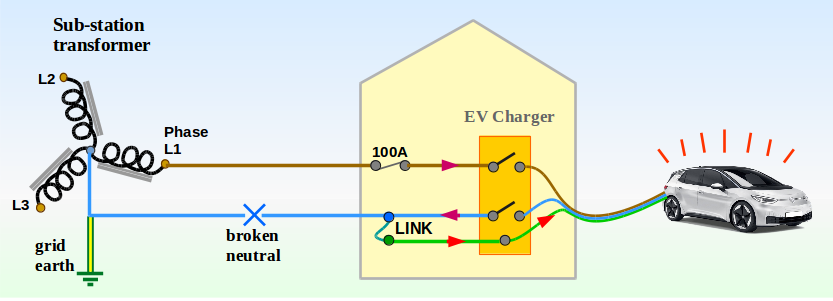
The rule is that an EV charger doesn't connect to the grid-earth, but has an independent earthing stake (or mesh) inserted into the soil.
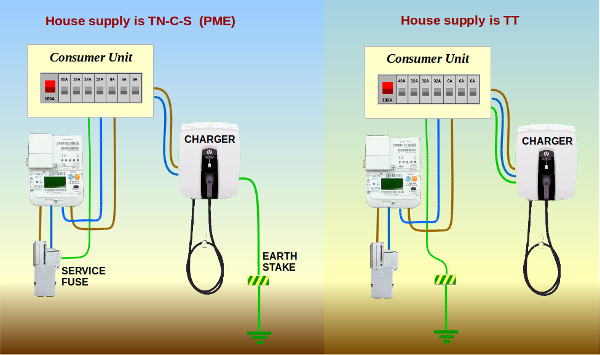
I believe that the same 'rule' must apply if the house has an off-grid (islanded) supply.
I will need help in finding where this 'rule' is, but I'm writing this now in order for our combined brains to get working on the issue.
In the last decade there has been an increasing number of Neutral Faults.
That's because we are now using more domestic devices which cause phase-imbalance at the local substation.
Phase imbalance results in current flowing through the Neutral.
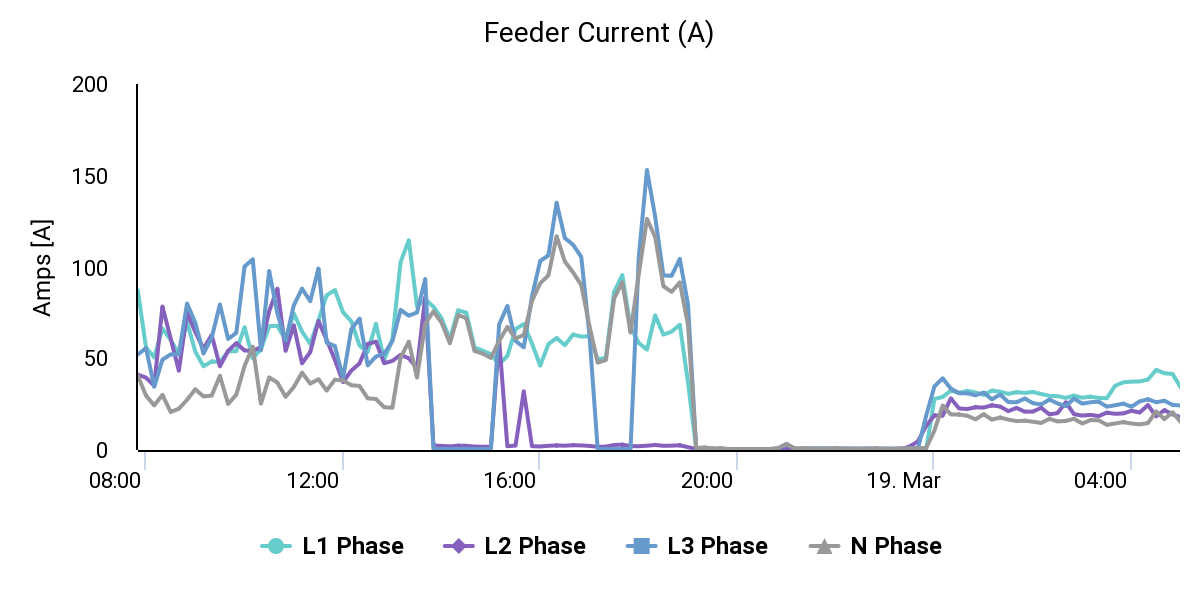
Look what happens when a single house on phase-L2 charges an EV between 00:30 - 04:30 (ie Octopus Go)
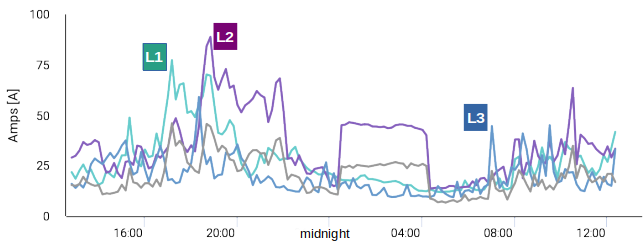
The grey Neutral current is actually above the current being supplied by phases L1 & L3.
In most overhead supplies, the Neutral wire has the same cross-sectional diameter as the three phases, and there's no overall outer sheath. Heat buildup is easily dissipated.
In the following picture the Neutral can be identified by it having a ribbed insulation.
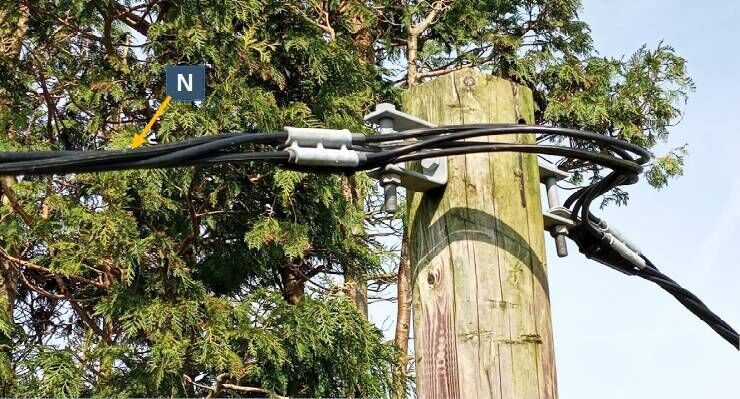
For underground cabling it has historically been the case that the Neutral is a thinner conductor, in the centre of the bundle, and the entire cable has an outer insulation sheath.
That was okay when it carried near-zero current.
The three Phases are fused at the substation. When demand exceeds the rated capacity, the fuse blows and must be replaced.
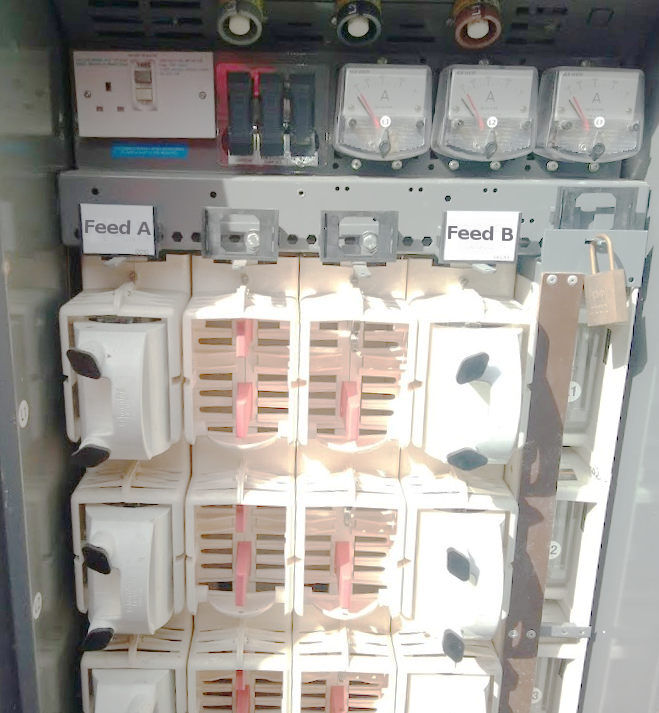
The Neutral isn't fused.
When it carries more current than its specification heat builds up, the insulation breaks down and that complete Feed suffers an outage.
The engineering team must now excavate below ground to uncover the broken neutral.
Houses supplied with a TN-CS arrangement are no longer provided with an earth reference at the substation transformer.
A broken Neutral is an increasingly common occurrence.
Indevolt cannot rely on the presence of an earth when their battery is operating in an islanded mode.
Save energy... recycle electrons!
28/04/2026 11:14 am
Indevolt cannot rely on the presence of an earth when their battery is operating in an islanded mode
I agree entirely, although we may still disagree about the consequences of the agreed non reliance, for reasons set out above.
What I'm still struggling with is how indevolt or any other plug in inverted can permit islanding at all, because I can't see how it can be simultaneously connected to your house wiring and disconnected from the grid unless the user flicks the main switch on the cu, which surely is not sufficient to meet the regs
This post was modified 6 months ago by JamesPa
4kW peak of solar PV since 2011; EV and a 1930s house which has been partially renovated to improve its efficiency. 7kW Vaillant heat pump.

28/04/2026 11:44 am
still struggling with is how indevolt or any other plug in inverted can permit islanding at all,
That's puzzling me too.
Along similar lines ( forgive the pun) concerning our great british housing stock, we recently ripped out our kitchen and utility room as part of a major renovation.
All the copper was duly earth bonded, in all the usual plumbing and heating places throughout the property. However, the main water supply from the roadside to the indoor stop-cock is MDPE (basically plastic). This property was built in 01/02. Granted, grid earth is present.
I pointed this out to our PV/Battery installer. The electrian said they carry out earth connection checks as a matter of course; especially where a Gateway (Sigen in our case) is part of the system. The need for an earth rod is quite common; and in our install it is, from memory, 16mm x1.8m.
This post was modified 6 months ago by colinc
26 Aika 480Wp PV panels, 3 Sigenstor 10 Batteries, 7kW Inverter
Viessmann Vitocal 150-a 10kW ASHP, 180l Oso Geo DHW

SPONSORS

Degrees of Separation

Latest Posts
-

RE: Heat pump branding. Clever, contemporary… or a bit too much?
I think Heat Geek have done an amazing job on their bra...
By Tomtheheatingengineer , 5 hours ago
-
RE: HeatGeek vs Octopus surveys: puzzling disparity - any ideas why?
I have just had 3 heat loss surveys, one by heat geek o...
By David , 6 hours ago
-
RE: Heat Geek Zero Disrupt: Are We Sleepwalking Into Another Race to the Bottom?
I think that's the key question. After all inverter uni...
By Prunus , 7 hours ago
-
RE: battery storage without solar
As of October 1st they need specific qualifications to ...
By EtchedPixels , 8 hours ago
-
RE: How should the Boiler Upgrade Scheme be reformed?
A unit which uses water to transfer the heat/chill from...
By Temperature_Gradient , 8 hours ago
-
RE: Renewables & Heat Pumps in the News
With regards to the BUS grant raid, I gave it more thou...
By ASHP-BOBBA , 9 hours ago
-
RE: Why are ASHP installs so expensive?
The whole system seems to work on the basis of...
By ian33a , 9 hours ago
-
RE: Missing flow temperature in Heat Geek proposal
Good plan. If you can get half hourly meter readings a...
By JamesPa , 14 hours ago
-
RE: Heat Pumps Without Grants: Would You Have Installed One & Will You Now?
@editor Most certainly. The heat pump was an ideal s...
By Abernyte , 14 hours ago
-
Although regulations may well vary from country to coun...
By Majordennisbloodnok , 15 hours ago
-
RE: Does anyone have experience of a smart water meter?
Yep I caught our slow leak from a £100 bill rise 8)
By EtchedPixels , 15 hours ago
-
RE: Do You Need a Buffer Tank or Low Loss Header for Underfloor Heating in a Large Property?
@jamespa in some cases, failing the Turing test might b...
By GrahamF , 18 hours ago
-
RE: Passiv Smart Thermostat - Help & Forum Support
@energystoragetech The heat capacity of some...
By JamesPa , 20 hours ago
-
RE: tepeo ZEB UK Support & Info Thread
Sorry you are correct, I was remembering figures from t...
By JamesPa , 1 day ago




SPONSORS
