Joining the Renewable Heating Hub forums is completely free and only takes a minute. By registering you’ll be able to ask questions, join discussions, follow topics you’re interested in, bookmark useful threads and receive notifications when someone replies. Non-registered members also do not have access to our AI features. When choosing your username, please note that it cannot be changed later, so we recommend avoiding brand or product names. Before registering, please take a moment to read the Forum Rules & Terms of Use so we can keep the community helpful, respectful and informative for everyone. Thanks for joining!
[Solved] How many people are happy with their ASHP and do you believe them?
@majordennisbloodnok could you post the actual figures, I will compare them with the ones I got from ofgem. As you say they aren't consistent which is weird. The ofgem figures were price cap rates from the point the cap was introduced, Octopus tracker claims to be based on wholesale price but I can't see that obviously explains the difference.
Of course hrst pumps aren't just about saving money or carbon. Correctly installed and operated they deliver a higher standard of comfort. However nobody talks about that for some reason.
I wonder why @deltona hasn't posted again give he asked the question.
This post was modified 5 months ago 2 times by JamesPa
4kW peak of solar PV since 2011; EV and a 1930s house which has been partially renovated to improve its efficiency. 7kW Vaillant heat pump.
I am happy I am not advising government and surely the gov of the time would have been well advised.
I admire your optimism, @batpred, and I'd love to hope you're right.
Where you are certainly right, though, is that there's a lot of overlap in what we each are saying. From my perspective, I agree that ideally the cost of fossil fuels should not just include the cost of obtaining it but also the cost of dealing with the consequences of its use. However, that's not a financial jump many people can afford to make and penalising those less well off to ease the overall public conscience is neither appropriate nor practical. If I had a strategy that could sort out that conundrum perhaps I'd run for election but I don't and I'm not. Please note, I'm not suggesting for a moment that you might be advocating any form of penalising; I'm merely laying out the fundamental disconnect between where we are now and where we want to be in the future.
105 m2 bungalow in South East England
Mitsubishi Ecodan 8.5 kW air source heat pump
18 x 360W solar panels
1 x 6 kW GroWatt battery and SPH5000 inverter
1 x Myenergi Zappi
1 x VW ID3
Raised beds for home-grown veg and chickens for eggs
"Semper in excretia; sumus solum profundum variat"
However, that's not a financial jump many people can afford to make and penalising those less well off to ease the overall public conscience is neither appropriate nor practical.
Er not sure it penalises the less well off who use less fuel.
If tt cost has to be paid it has to be paid somehow either through charges or tax or catastrophe if nothing is done. The less well off generally comes out worse from any catastrophe.
Your argument is the standard 'we can't afford it' argument which is frequently made by rich people who can (I'm not saying you are in that category, just saying that a lot of the 'we can't afford it arguments' are put forward by rich people who are immune from the consequences and can afford it, but don't want to.
This post was modified 5 months ago 2 times by JamesPa
4kW peak of solar PV since 2011; EV and a 1930s house which has been partially renovated to improve its efficiency. 7kW Vaillant heat pump.
@majordennisbloodnok could you post the actual figures, I will compare them with the ones I got from ofgem. As you say they aren't consistent which is weird. The ofgem figures were price cap rates from the point the cap was introduced, Octopus tracker claims to be based on wholesale price but I can't see that obviously explains the difference.
Of course heat pumps aren't just about saving money or carbon. Correctly installed and operated they deliver a higher standard of comfort. However nobody talks about that for some reason.
...
I agree, but in most cases I suspect those nuances aren't relevant to boiler owners who haven't experienced a heat pump serviced house. My guess is they don't know what they don't know and so are already satisfied in their ignorance*.
*Not meant to sound condescending; ignorance in its true meaning without the snide baggage.
105 m2 bungalow in South East England
Mitsubishi Ecodan 8.5 kW air source heat pump
18 x 360W solar panels
1 x 6 kW GroWatt battery and SPH5000 inverter
1 x Myenergi Zappi
1 x VW ID3
Raised beds for home-grown veg and chickens for eggs
"Semper in excretia; sumus solum profundum variat"
However, that's not a financial jump many people can afford to make and penalising those less well off to ease the overall public conscience is neither appropriate nor practical.
Er not sure it penalises the less well off who use less fuel.
If tt cost has to be paid it has to be paid somehow either through charges or tax or catastrophe if nothing is done. The less well off generally comes out worse from any catastrophe.
Your argument is the standard 'we can't afford it' argument which is frequently made by rich people who can (I'm not saying you are in that category, just saying that a lot of the 'we can't afford it arguments' are put forward by rich people who are immune from the consequences and can afford it, but don't want to.
If you have a household on the bread line and then simply hike the cost of gas with a carbon capture tax, you've backed that household into a corner they can't escape. That helps no-one.
The "we can't afford it" argument employed by many of the wealthy is, of course, a specious one since they patently CAN afford it. On the contrary, I'm not advocating we do nothing on the grounds of economics; I'm advocating that we use more carrot and less stick instead. The cost of electricity is grossly inflated at the moment, bearing little connection to the cost of production and supply, so my first inclination is towards trying to reduce the leccy cost to make a shift from fossil fuels easier for lower income families - reducing their barriers to change rather than increasing penalties to stay as they are. However, I'm painfully aware the pricing link between gas and leccy is a complex one that makes my head hurt, so it would take a better man than me to draw up an actual workable plan for put into place my preferences.
105 m2 bungalow in South East England
Mitsubishi Ecodan 8.5 kW air source heat pump
18 x 360W solar panels
1 x 6 kW GroWatt battery and SPH5000 inverter
1 x Myenergi Zappi
1 x VW ID3
Raised beds for home-grown veg and chickens for eggs
"Semper in excretia; sumus solum profundum variat"
The optimist in me thinks the extra costs on electricity are being used to fund the upgrades that will make it a credible low carbon option, even to the sceptics. Perhaps that measure was acceptable since the electricity industry will profit in the end, through increased consumption?
Gas could only dream of being decarbonised since hydrogen is not going to be available in high volumes from non carbon sources any time soon and the carbon capture is at small pilot stage. If it had legs to stand on, every gas power station would be now capturing and storing the CO2 it emits?
8kW Solis S6-EH1P8K-L-PLUS hybrid inverter; G99: 8kW export; 16kWh Seplos Fogstar battery; Ohme Home Pro EV charger; Vaillant Arotherm Pro 7kW; 100Amp head, HA lab on mini PC
If you have a household on the bread line and then simply hike the cost of gas with a carbon capture tax, you've backed that household into a corner they can't escape. That helps no-one
Benefits could go up to compensate. I'm not saying this combination is the right idea but if it does make sense for the polluter (rather than taxpayers or randomly chosen victims who happen to be in the wrong place at the wrong time) to pay then make it so and deal with the negatives by another means!
This post was modified 5 months ago 4 times by JamesPa
4kW peak of solar PV since 2011; EV and a 1930s house which has been partially renovated to improve its efficiency. 7kW Vaillant heat pump.
If you have a household on the bread line and then simply hike the cost of gas with a carbon capture tax, you've backed that household into a corner they can't escape. That helps no-one
Benefits could go up to compensate. I'm not saying this combination is the right idea but if it does make sense for the polluter (rather than taxpayers or randomly chosen victims who happen to be in the wrong place at the wrong time) to pay then make it so and deal with the negatives by another means!
Quite true. That’s certainly another way of tackling the problem.
To be frank, I don’t care how we rebalance things as long as the burden sits with those who can shoulder it and those who can’t are protected - the way I’d hope any civilised society would want to operate. That last part is my only key criterion for the method of change used.
105 m2 bungalow in South East England
Mitsubishi Ecodan 8.5 kW air source heat pump
18 x 360W solar panels
1 x 6 kW GroWatt battery and SPH5000 inverter
1 x Myenergi Zappi
1 x VW ID3
Raised beds for home-grown veg and chickens for eggs
"Semper in excretia; sumus solum profundum variat"
@majordennisbloodnok could you post the actual figures, I will compare them with the ones I got from ofgem. As you say they aren't consistent which is weird. The ofgem figures were price cap rates from the point the cap was introduced, Octopus tracker claims to be based on wholesale price but I can't see that obviously explains the difference.
This obviously begs the question 'what do we mean by electricity price anyway? I would suggest for most people the price cap rate is the appropriate one, but that only existed from 2019 onwards. My data is actually from ONS but, looking again at their figures, it may include standing charge. Needs a bit more investigation which I will do, however it may take some time as I am currently away.
This post was modified 5 months ago 2 times by JamesPa
4kW peak of solar PV since 2011; EV and a 1930s house which has been partially renovated to improve its efficiency. 7kW Vaillant heat pump.
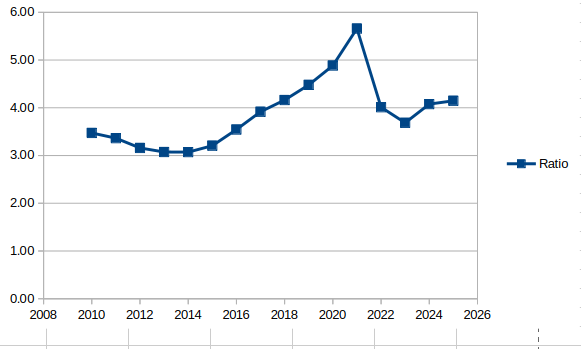
@majordennisbloodnokrdennisbloodnok I have been looking into the data and am struggling to reconcile - there are at least 3 kinds of lies. Previously I had used ONS energy inflation data, which needed some interpretation. However I have now found ONS figures for actual tarrifs (as in pence per kWh and standing charge) here. Since these require no interpretation I am now using those as the 'government' figures. Using tables 2.3.4 (Gas) and 2.3.4 (Electricity), I get this plot for the ratio of electricity unit price to gas unit price in South East
This shows the distinct rise from 2014 to 2021, but is preceeded by a fall which didn't appear in the figures derived from the inflation statistics. Given the latter involved interpretation its quite possible I made a mistake.
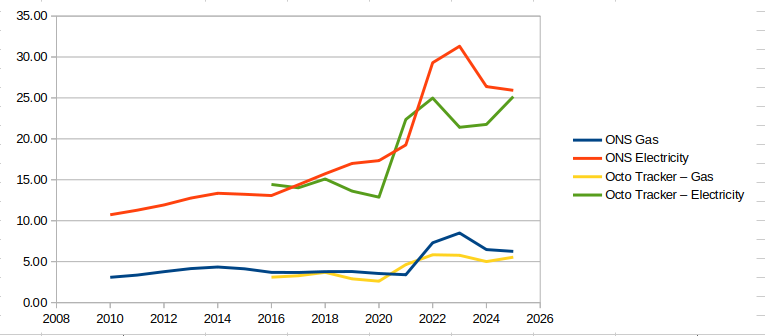
However if I plot the ONS unit price against the Octopus Tracker prices you posted I get this, showing some marked departures.
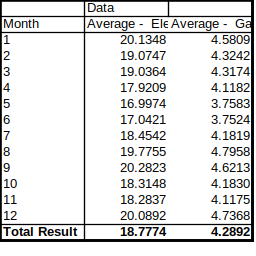
The Octopus tracker prices are of course averages of averages without (so far as I am aware) weighting variations in price according to the corresponding variations in consumption. The ONS figures may be average price per unit consumed thus taking seasonal variations into account (and daily variations would be taken into account anyway in the unit rate, because its set by suppliers to balance out the variations in daily price/demand). I did look at seasonal variations in the Octopus tracker data. There are some as you can see from the table below, but Im not sure they would account for the graph above
All in all I am mystified by the apparent discrepancy between Octopus Tracker rates and ONS unit rates. Of course it may be a function of Octopus internal commercials.
Any comment or further information you have would be welcome, full data attached.
The data I provided was downloaded from https://agilebuddy.uk/historic/download, so at least on the face of it, it’s independent of Octopus (i.e. doesn’t have Octopus marking its own homework). It may, of course, behind the scenes just be providing data provided by Octopus and therefore not be as independent as it seems. I don’t know.
However, since I chose the South East England region, the prices were purporting to be actual prices, not averaged ones. I chose the Tracker tariff purely so that it was a like for like comparison of gas and leccy (gas data only being available through the tracker tariff). Both energy types were explicitly listed on that site as prices per kWh, not per “unit”.
If all this is true, clearly it’s comparing like with like for any given day and so inflation can be ignored - it’s only the ratio that matters. You raised good point earlier about price caps and I didn’t check to see what was going on in that regard; even now i haven’t managed to find some time to do so.
It may, of course, be that Octopus put a larger markup on their leccy tracker prices than on other of their leccy tariffs so as to, for instance, subsidise some of their more popular ToU tariffs. That would certainly have the effect we’re seeing, although I’ve seen no actual evidence of that being the case so a theory like that would be pure supposition.
105 m2 bungalow in South East England
Mitsubishi Ecodan 8.5 kW air source heat pump
18 x 360W solar panels
1 x 6 kW GroWatt battery and SPH5000 inverter
1 x Myenergi Zappi
1 x VW ID3
Raised beds for home-grown veg and chickens for eggs
"Semper in excretia; sumus solum profundum variat"
However, since I chose the South East England region, the prices were purporting to be actual prices, not averaged ones
The point I was making about averages (in any region) is that the average of the half hourly, or daily, price over a year is not the same as the average price paid. If most of the consumption is when the price is highest (which is very likely the case) then the average price paid will be closer to the highest price than the unweighted average of the daily/half hourly prices.
I don't think we can, and quite possibly never will, be able to explain the divergence of the ONS price per kWh from the Octopus price per kWh. What this shows is that these things are even more difficult than i first thought.
That said my gut feeling when thinking about the politics of the spark gap is first to look at standard variable (now price capped) tarrifs because that is the default and many (probably too many) don't diverge from the default.
4kW peak of solar PV since 2011; EV and a 1930s house which has been partially renovated to improve its efficiency. 7kW Vaillant heat pump.