

Notifications
Clear all
Joining the Renewable Heating Hub forums is completely free and only takes a minute. By registering you’ll be able to ask questions, join discussions, follow topics you’re interested in, bookmark useful threads and receive notifications when someone replies. Non-registered members also do not have access to our AI features. When choosing your username, please note that it cannot be changed later, so we recommend avoiding brand or product names. Before registering, please take a moment to read the Forum Rules & Terms of Use so we can keep the community helpful, respectful and informative for everyone. Thanks for joining!

10/06/2026 9:17 pm
@tim441 to my mind, this intervention by SSE hasn't told us what we need to know.
The DNOs reading is clearly less than is being reported to you by the App. That leaves several unknowns.
Is your particular GivEnergy inverter incorrectly measuring line voltage?
Is it that incorrect reading which then causes your inverter to shut down and restart?
Ie is the inverter itself creating the high voltage reading which results in a reset?
Or is it simply measuring the voltage incorrectly?
Did you get the name of the engineer, or know which area office he operates from?
I'd like the option of following this up with him directly.
Save energy... recycle electrons!

Topic starter
11/06/2026 11:18 am
@transparent Unfortunately I did not take his name. The texts I got said "Ray" was on his way - but I can't be sure that's who came... and i think it may have been his manager. The poles team text said "Tom". The text came about 20 minutes or so prior - at a guess they came from Yeovil?
As mentioned the period monitored was generally mild and without so much solar power produced.
I have extracted some data from the GivEnergy cloud data. I took recorded Grid Data and also Inverter Data...for the last 3 weeks to capture the hot period.
Date
Highest voltage recorded
Number of records above 253v
Total number of records
Total solar produced (may help indicate if related to high prod days?)
Maybe the inverter data is less relevant? I assume the trips are based on Grid Data exceeding 253v
Or maybe i could provide you with my cloud login details?
It looks as if it records a line about every 5 minutes or so. But some days it's nearer 260 lines and other days 450 or more lines. So I guess certain events trigger an extra record?
I can't see that it records the tripping events as such - even though I would imagine its logged somewhere. I guess it would show up as plunge in pv solar produced.
This issue has been intermittently notable for several years (maybe since installation) but I'd previously ignored as I had no idea what to do about it....
Two other things to mention:
1. my neighbour to East has installed 8kw solar + Powerwall in March this year. Perhaps that contribution has added to overvoltage events?
I asked for their record of grid voltage - as attached
2. My main solar is this GivEnergy setup with 20 x 325w panels + batteries.
I also have an older Solaredge setup with just 8 x 275w panels
Listed Grade 2 building with large modern extension.
LG Therma V 16kw ASHP
Underfloor heating + Rads
8.7kw pv solar
3 x 8.2kw GivEnergy batteries
1 x GivEnergy Gen1 hybrid 5.0kw inverter
Manual changeover EPS
MG4 EV
11/06/2026 11:49 am
Thanks Tim.
As before, there's too little data to make any firm conclusions.
Your neighbour's log-file (at 15min intervals) might be showing the average grid voltage over each period. We can't tell.
Your greatest occurrence of voltages above 253v is on 30may26, and he too has voltages above 253v for the hour after 16:00.
That suggests there is something happening which affects multiple properties in the area.
But it's quite likely the two properties are on different phases anyway.
On the balance of probabilities I'd be investigating your GivEnergy inverter as the one which is causing the over-voltage readings, or else is recording voltages higher than they actually are.
In either case, the inverter ceases importing from your solar panels, and probably then recommences the start-up process.
Don't you have a log-file from the SolarEdge inverter which could be used for comparison?
Save energy... recycle electrons!
Topic starter
12/06/2026 8:16 am
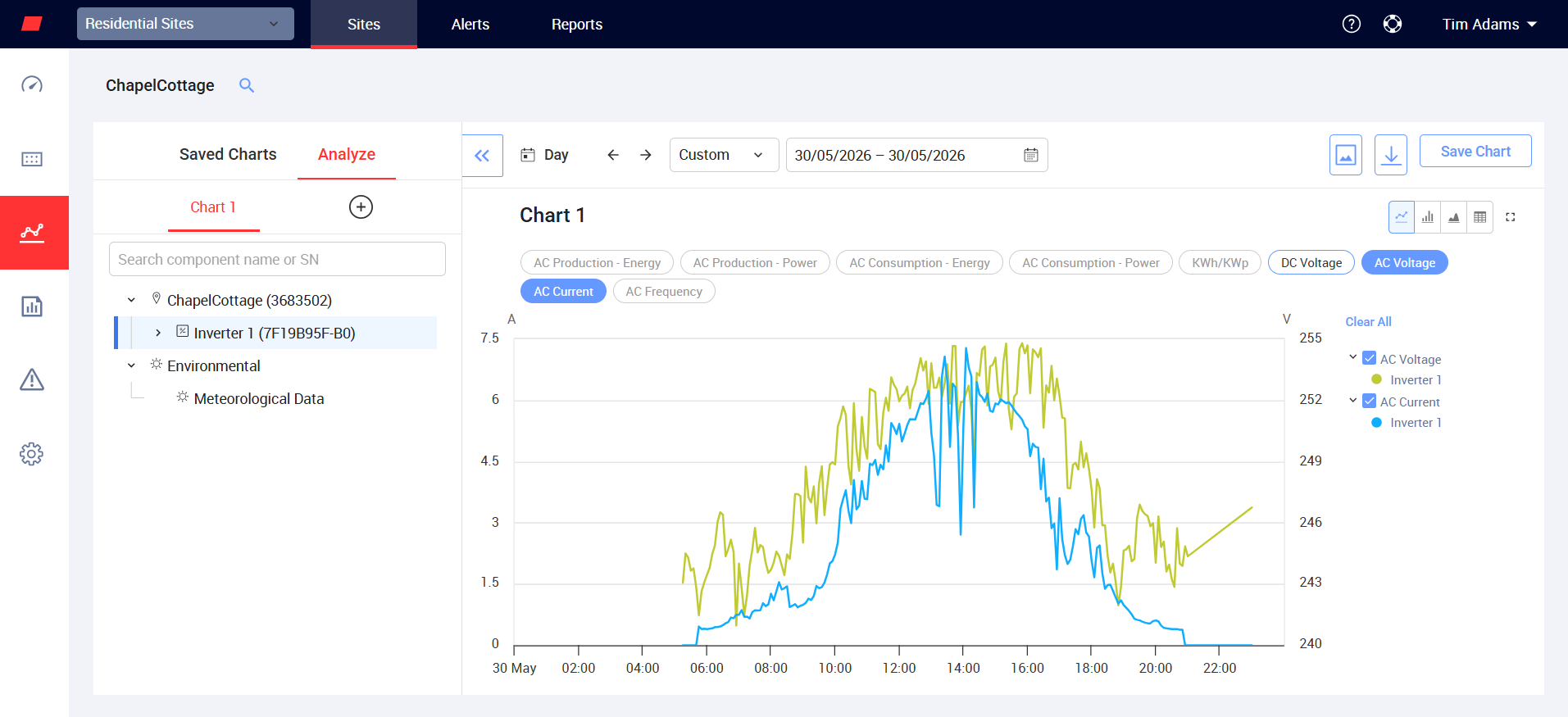
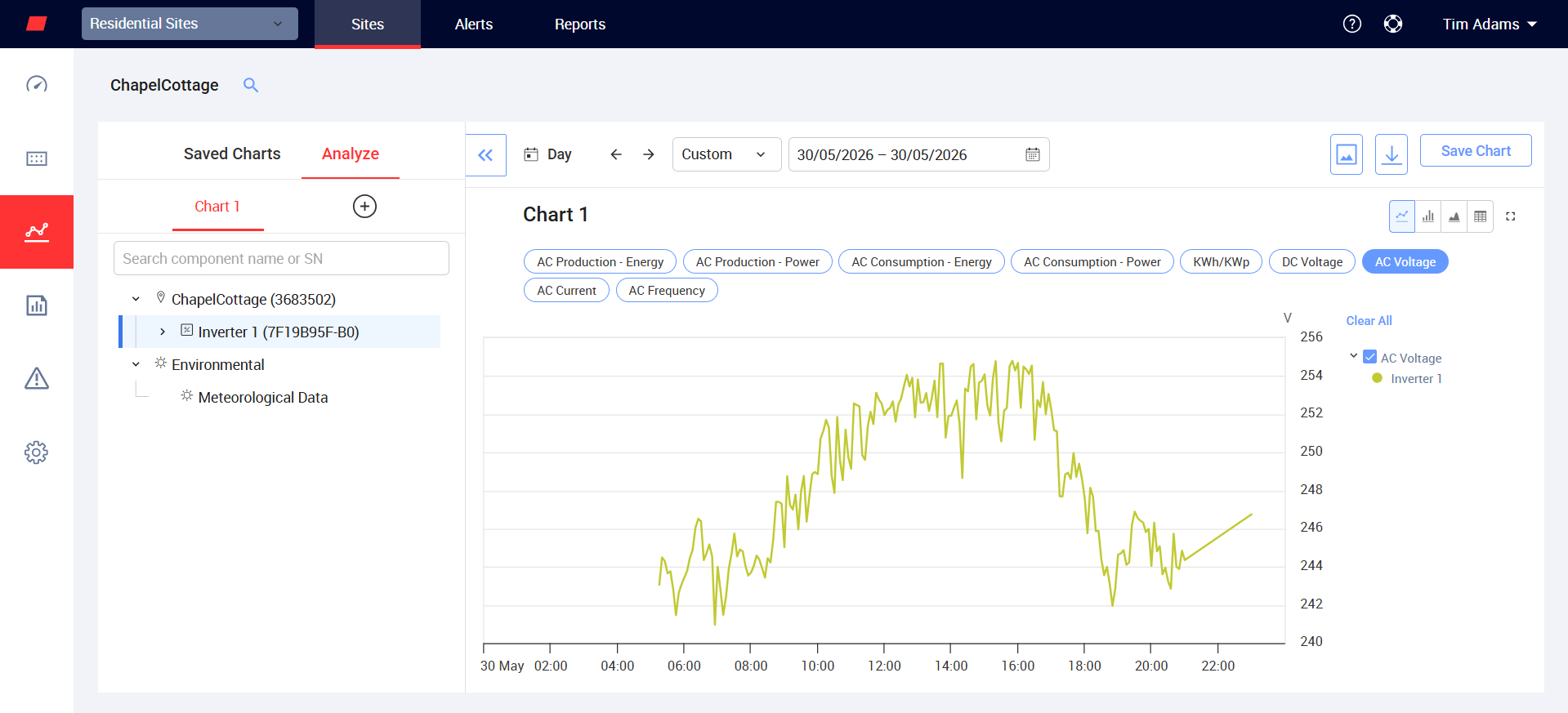
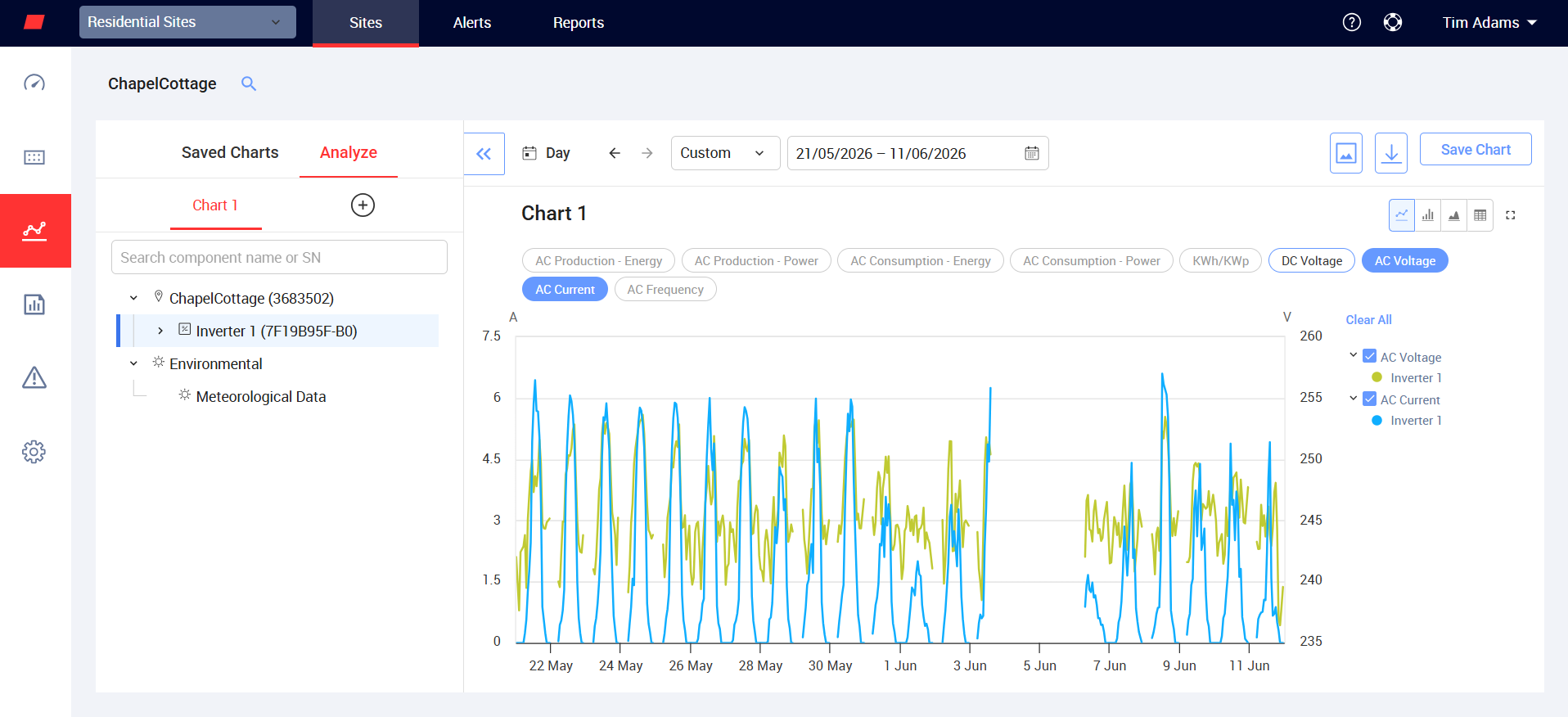
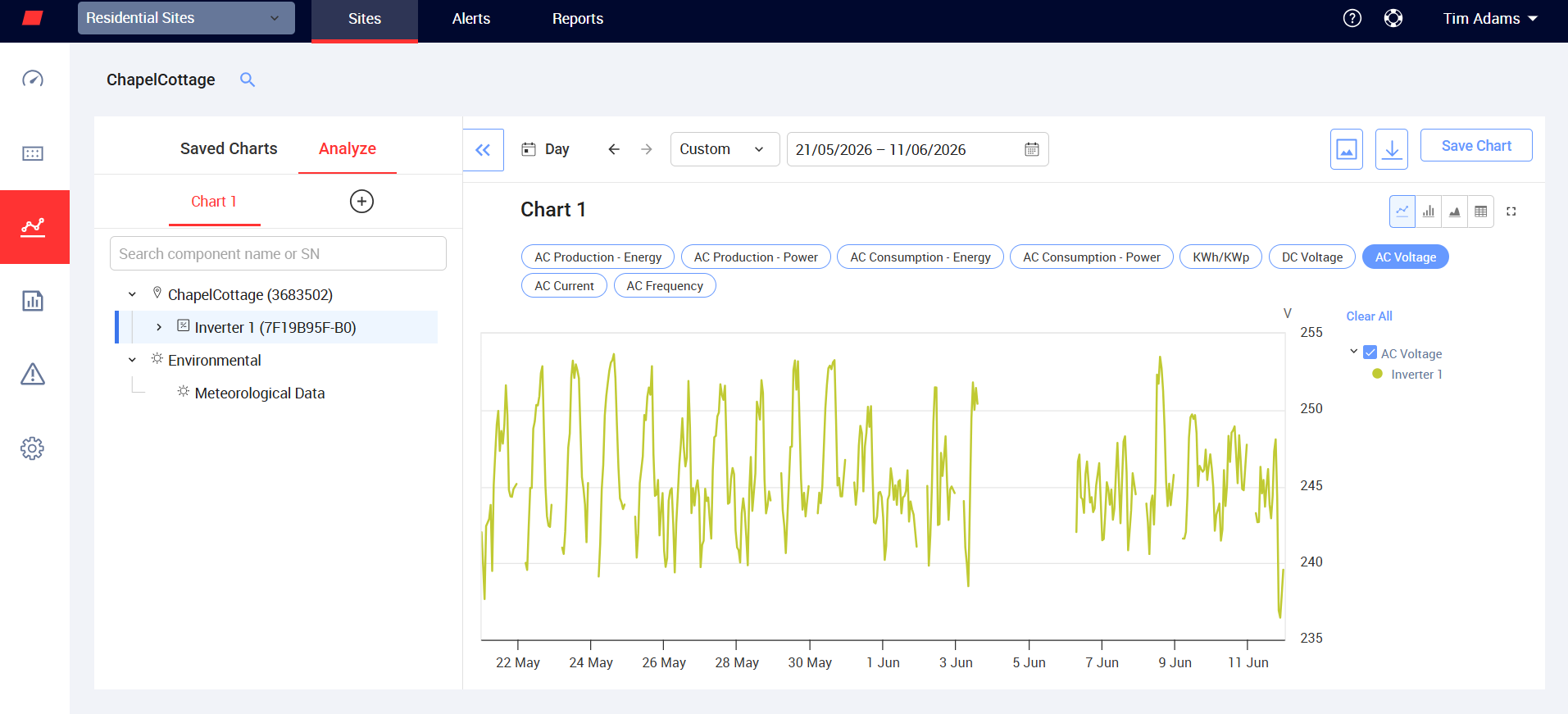
@transparent it took me some time as I've never looked at the Solaredge data! so useful learning curve. perhaps attached is useful
Listed Grade 2 building with large modern extension.
LG Therma V 16kw ASHP
Underfloor heating + Rads
8.7kw pv solar
3 x 8.2kw GivEnergy batteries
1 x GivEnergy Gen1 hybrid 5.0kw inverter
Manual changeover EPS
MG4 EV

12/06/2026 11:06 am
Thanks Tim.
That SolarEdge data also shows voltages above 253v.
But we don't know enough to tell what's happening.
Eg Is the voltage falling again because the SE Inverter knows the volts are too high, and thus ceases export?
Or is the voltage falling back below 253v because the GivEnergy system has decoupled itself from the grid?
I don't think Members here can be any more helpful if we're just seeing raw data.
It needs to be combined across your export-capable devices, and with sufficient granularity that we can identify if/when an inverter has ceased export due to HiVolts.
When I was chasing a similar issue with an inverter, the App didn't show when the inverter was re-starting, having detected a 'fault'.
But I had Watt-Metering on the solar inputs.
I could video a meter to demonstrate the current (blue) falling to zero and then picking up again.
This post was modified 4 months ago 2 times by Transparent
Save energy... recycle electrons!
Topic starter
14/06/2026 8:32 am
@transparent it might be interesting to note the early results since the phase change. Includes yesterday which was sunny with high solar production.
Notably highest recorded by Givenergy cloud is 251.5v and therefore no overvoltage events over the 5 days since the change.
I should mention the PV solar recorded is taken from same cloud data for the 6.5kw system on Givenergy inverter. Solaredge system yesterday produced an additional 11.8kw.
Batteries yesterday were generally full and unable to absorb much production - so vast majority exported.
Early days but seems encouraging. I'll continue to record for another week or 2
This post was modified 4 months ago by Tim441
Listed Grade 2 building with large modern extension.
LG Therma V 16kw ASHP
Underfloor heating + Rads
8.7kw pv solar
3 x 8.2kw GivEnergy batteries
1 x GivEnergy Gen1 hybrid 5.0kw inverter
Manual changeover EPS
MG4 EV
Topic starter
15/06/2026 9:57 am
updated and corrected excel with weekend data. No overvoltage events to date since change of phases
Listed Grade 2 building with large modern extension.
LG Therma V 16kw ASHP
Underfloor heating + Rads
8.7kw pv solar
3 x 8.2kw GivEnergy batteries
1 x GivEnergy Gen1 hybrid 5.0kw inverter
Manual changeover EPS
MG4 EV
15/06/2026 12:20 pm
the PV solar recorded is taken from same cloud data for the 6.5kw system
Isn't it ironic that the system we use to retrieve solar energy data is delivered by a cloud?!

The reason I'm particularly interested to find out how/why your inverter was able to record voltages above 253v is that this can be a trigger which causes other generation appliances to shut down.
That's can cause a Cascade Event, which is what finally took down the Iberian Grid on 28th April 2025.
It mustn't be possible for this to occur, but I'm still uncertain whether this is due to a faulty inverter, or also a more widespread issue related to the distribution grid in your area.
This post was modified 4 months ago by Transparent
Save energy... recycle electrons!
1

Topic starter
15/06/2026 12:50 pm
@transparent the inverter was installed in 2021 and afaik has worked fine.
The indications are that the grid voltage was exceeding the acceptable range on the phase used from installation.
I had noticed some tripping over the years but had no idea who to ask or where to go. However forums such as this + Facebook GivEnergy group + ChatGPT have helped encourage me to follow though.
The early numbers post phase change look encouraging for resolution of my specific issue.
The question of resilience to prevent Cascade Events is important. I guess it could be helped if:
- Batteries are increasingly used at both residential and grid level
- Helped if DNOs can have more control (by paying owners) e.g. to fill batteries in winter against low wind events or cold snaps etc especially if interconnectors unlikely to have sufficient capacity/availability ....and hold some capacity by ensuring batteries are not too full when its clear solar production is likely to be high - especially if combined with wind that may result in overload - especially if it can't be exported. DNOs then using that capacity to help balance.
This presumably needs gov, regulator, DNOs, distributors to all work together. In advance of a UK Cascade Event - not after!
Perhaps Axle Energy & Axle VPP have part of that solution?
This post was modified 4 months ago by Tim441
Listed Grade 2 building with large modern extension.
LG Therma V 16kw ASHP
Underfloor heating + Rads
8.7kw pv solar
3 x 8.2kw GivEnergy batteries
1 x GivEnergy Gen1 hybrid 5.0kw inverter
Manual changeover EPS
MG4 EV
16/06/2026 8:32 pm
The symptoms you describe can be accounted for by another neighbour having an inverter which continues to export above 253v.
1: We need storage batteries in the home, rather than scattered in containers connected to the lower-voltage levels of the grid.
The commercial approach means that power has to be transferred across the 11kV level twice. Since GB already faces capacity constraints, that is to be avoided.
2: DNOs are not permitted to own or control any generation or storage assets. It's stipulated in their Ofgem licences.
Any centralised monitoring and control system would quickly become a target for cyber attack.
The better option is to install autonomous storage controllers within the home. They only need to receive (forecast) data about the grid which supplies that local area.
Save energy... recycle electrons!
Topic starter
22/06/2026 8:05 am
Almost 2 weeks since the phase change and we have had zero overvoltage events since then. Very encouraging.
I will continue to keep a record until end June to capture the current heatwave.
Clearly the invertor measurement of grid voltage is almost certainly different to the true measurement at meter or pole - but as a close proxy is probably pretty good.
I suppose the other thing will be to see how it is in winter - whether we get undervoltage!
Listed Grade 2 building with large modern extension.
LG Therma V 16kw ASHP
Underfloor heating + Rads
8.7kw pv solar
3 x 8.2kw GivEnergy batteries
1 x GivEnergy Gen1 hybrid 5.0kw inverter
Manual changeover EPS
MG4 EV
1
Topic starter
24/06/2026 9:46 am
Since the phase change on 9 June, no grid-voltage events above 253V have been recorded despite multiple days with 42–49 kWh total solar generation.
Maximum grid voltage has reduced from approximately 254–255V before the phase change to approximately 250–252.5V afterwards. These measurements by inverter might not match SSEN Grid exactly - but clearly give a good indication.
No recurrence of inverter resets has been observed.
Listed Grade 2 building with large modern extension.
LG Therma V 16kw ASHP
Underfloor heating + Rads
8.7kw pv solar
3 x 8.2kw GivEnergy batteries
1 x GivEnergy Gen1 hybrid 5.0kw inverter
Manual changeover EPS
MG4 EV
SPONSORS

Degrees of Separation

Latest Posts
-

RE: Heat Geek installations: share your experiences
one thing i learnt from reading people’s comments and e...
By Batpred , 14 minutes ago
-
RE: Cooling/heating with one unit
"The way we use A2A on a cheap overnight EV tariff is t...
By mrkfm , 2 hours ago
-
RE: Do I add Air Con or MVHR to existing A2W ASHP?
We have ‘signed on the dotted line’ today for a Panason...
By Toodles , 3 hours ago
-
RE: Heat pump branding. Clever, contemporary… or a bit too much?
...or it was there and was lost thanks to laziness and ...
By Majordennisbloodnok , 3 hours ago
-
@bobflux Thank you for your response. I am trying to ...
By RonV. , 3 hours ago
-
This post is about how I successfully configured a buff...
By Tony.Stolz , 7 hours ago
-
The installer visited yesterday and suggested the noise...
By JamesChatz , 8 hours ago
-
RE: HeatGeek vs Octopus surveys: puzzling disparity - any ideas why?
Your house sounds a lot like mine. 2 surveyors each sp...
By JamesPa , 11 hours ago
-
RE: Heat Geek Zero Disrupt: Are We Sleepwalking Into Another Race to the Bottom?
Thats true only if you do the wrong experiment. Done c...
By JamesPa , 11 hours ago
-
RE: How should the Boiler Upgrade Scheme be reformed?
@temperature_gradient Isn't that just describing a regu...
By Prunus , 12 hours ago
-
RE: battery storage without solar
As of October 1st they need specific qualifications to ...
By EtchedPixels , 1 day ago
-
RE: Renewables & Heat Pumps in the News
With regards to the BUS grant raid, I gave it more thou...
By ASHP-BOBBA , 1 day ago
-
RE: Why are ASHP installs so expensive?
The whole system seems to work on the basis of...
By ian33a , 1 day ago
-
RE: Missing flow temperature in Heat Geek proposal
Good plan. If you can get half hourly meter readings a...
By JamesPa , 1 day ago






SPONSORS

