

Notifications
Clear all
Joining the Renewable Heating Hub forums is completely free and only takes a minute. By registering you’ll be able to ask questions, join discussions, follow topics you’re interested in, bookmark useful threads and receive notifications when someone replies. Non-registered members also do not have access to our AI features. When choosing your username, please note that it cannot be changed later, so we recommend avoiding brand or product names. Before registering, please take a moment to read the Forum Rules & Terms of Use so we can keep the community helpful, respectful and informative for everyone. Thanks for joining!

Topic starter
20/05/2026 10:42 pm
It's easy for social media to warp perception and I only know one person in real life with one. He thinks it's great because he's spent umpteen thou on it (with PV and batteries), but then shows me all the mistakes his plumber made fitting it. The house isn't very warm, install looks awful, house is uninsulated.
When you read online some say they are overjoyed. You ask how long have they had it and they say a month, that month being April.
Or that they got it for free, yesterday. It's a £500 Chinese unit with a 1yr warranty.
Maybe it cost £30k so therefore I am entitled to be happy no matter what. ROI of 20yrs by which time it'll be clapped out and need replacing and have £10k spent on servicing and other faults.
So I hit Google with 'how many are happy?' 79 to 94% came the reply which sounds very positive.
I reversed the question and got "15% to 20% of owners report being unhappy or frustrated" which is different, but not far off really.
I was sent a survey to fill in about my new install. I'd never had one.
Are the aforementioned people the ones being asked in the surveys?
I watched a video where an Irish vendor said that their customers complained their electric bills had gone up massively. He then asked about the gas bills and they said 'What gas bill? We don't have one anymore.'
So do you think that some 80% have genuinely had a better system than a new, properly specced and fitted gas combi would have given them?
I'm not interested in your opinion of your system, you form an extreme minority. What about the majority of ASHP owners? Are they really happy and how would we know? Is there a way of finding out?
I doubt it, but would be really interested to find out.


21/05/2026 9:30 am
This is an interesting post that got me thinking in relation to several different aspects of it.
Firstly, @deltona, you're right about the power of general discussion - social media in particular - to introduce assumption in a way that they are then accepted as fact. A warped portrayal of reality either way. I should point out, though, that in order to try to get past those assumptions and subjective comments, one needs to be pretty scrupulous in not introducing one's own assumptions. A case in point is
...
I'm not interested in your opinion of your system, you form an extreme minority.
...
That's also an assumption. I strongly suspect the assumption is correct, but it's an assumption nonetheless. I mention this to highlight the pitfalls, especially since quite a bit of your language in the post implies your own personal assumptions still being given pretty free rein. There's no law against it, but it could make it more difficult for you to get a solid answer to your question rather than the answer you want to hear (or at least the answer others think you want to hear).
Now to your underlying question. When we got our heat pump, we didn't know anyone else with one. However, several friends and neighbours were very interested and so once ours was installed we found quite a few people following how things progressed and, since the install, we've had two who've gone on to get heat pumps themselves. They've listened to our comments about picking a capable installer and, although neither ended up using the company we used, they have both had successful installs at sensible prices (after the grant, approximately the cost of an expensive boiler swap). Both are happy enough to be starting to evangelise themselves. One, I might add, was a first time house buyer and subsequently new parent who can most certainly not afford the high running costs of a botched install, so that gives some valuable context.
We also found, after our installation, that one of our neighbours was running an air to air system that's now about 15 years old. He was happy enough with it that he recommended the concept to another neighbour who has since moved away. That latter was considerably less than happy with their A2A installation, and now we've dug in a bit we find the design in that latter installation was not good and so doomed from the start. The 15-year-old first A2A installation, however, is still eminently practical, reliable and economical, so it's not the fault of the technology.
We've had several other friends and neighbours asking quite regularly about our experiences, so there's plenty of interest generally. The question of "can it still manage to heat the house in freezing weather" is one that keeps coming up, as is the question about noise, so the misconceptions you were talking about on social media are pretty persistent. However, the skepticism around our estimates of savings has evaporated with the independent experiences of those who've followed our lead and picked good installers, since their savings are mirroring ours.
In terms of the wider public, I think finding out a true representation of satisfaction will be hugely challenging because of the different groups of people involved. There will be plenty who simply don't know enough to judge; some will be happy with a poorly performing system because they don't know better, some will have unrealistic expectations, some will have a perfectly good system that they're running inappropriately etc. The survey you mentioned will also only have been filled out by the subset of the population who are predisposed to answer surveys, and in the widest sense there's also the truism that we only hear about the extremes - those who're in enough trouble to start complaining and those who're so satisfied as to want to tell the world.
All in all, I think anecdotal evidence and interpreting it to form a "gut feel" is about as good as you're going to get.
105 m2 bungalow in South East England
Mitsubishi Ecodan 8.5 kW air source heat pump
18 x 360W solar panels
1 x 6 kW GroWatt battery and SPH5000 inverter
1 x Myenergi Zappi
1 x VW ID3
Raised beds for home-grown veg and chickens for eggs
"Semper in excretia; sumus solum profundum variat"


21/05/2026 12:05 pm
Interesting question @deltona. I think there’s a huge difference between "I’m not actively unhappy" and "this system is operating as well as it should."
Social media definitely distorts perception. The happiest owners become advocates, the angriest become campaigners and the huge middle just gets on with life. But as I’ve been working through a very large amount of homeowner data recently, one thing that keeps jumping out at me is how many systems appear to sit in this strange average category.
The house is warm enough. The bills aren’t outrageous. Nothing is catastrophically wrong. So the homeowner assumes the system is good.
But average isn’t necessarily good.
I’ve seen plenty of systems where the owner believes everything is working properly because they’ve adapted to it. Then you look underneath and find high flow temperatures, weather compensation disabled, excessive cycling, poor controls strategy, badly configured pumps, hydraulic separation issues, immersion heaters doing heavy lifting or systems running far less efficiently than they should be.
The homeowner often has no frame of reference because they’ve never lived with a properly commissioned heat pump before. So functional early becomes interpreted as good/excellent.
And to be fair, excellent systems absolutely do exist. When they’re designed properly, commissioned properly and controlled properly, they can be superb. But heat pumps are far less forgiving than boilers as we always hammer on about. A mediocre boiler install can still broadly work. A mediocre heat pump install often leaves performance on the table without the homeowner necessarily realising it.
The survey point is interesting too. Timing matters massively. Ask somebody in April, a few weeks after an initial install, and you’ll often get a very different answer compared to after two winters, multiple defrost cycles, servicing costs and a proper cold snap.
One thing I can say from looking through years of homeowner discussion is that the volume of troubleshooting and complaint discussions has risen enormously alongside deployment growth. Even normalising against forum growth, installer and performance-related complaints increased roughly 24-fold between 2021 and 2025. That doesn’t automatically mean "most systems are bad", but it does strongly suggest the industry still has a consistency problem around design, commissioning and aftercare.
Personally, I think the better question isn’t "Are most owners happy?" it’s: "How many systems are actually operating close to their potential?" I suspect that number is considerably lower than the broad satisfaction surveys imply.
🔥 Britain’s Heat Pump Shitshow
How Installing a Heating System Became a National Nervous Breakdown
Free UK shipping.
📗 Heat Pumps Explained
A Jargon-Free Guide for Homeowners
Rewritten and updated for 2027
📘 From Zero to Heat Pump Hero
🛠️ Bodge Buster
New to heat pumps?
Take the Heat Pump Fundamentals course and use INTRO50 at checkout for 50% off.
1

21/05/2026 1:07 pm
In terms of the wider public, I think finding out a true representation of satisfaction will be hugely challenging because of the different groups of people involved. There will be plenty who simply don't know enough to judge; some will be happy with a poorly performing system because they don't know better, some will have unrealistic expectations, some will have a perfectly good system that they're running inappropriately etc. The survey you mentioned will also only have been filled out by the subset of the population who are predisposed to answer surveys, and in the widest sense there's also the truism that we only hear about the extremes - those who're in enough trouble to start complaining and those who're so satisfied as to want to tell the world.
All in all, I think anecdotal evidence and interpreting it to form a "gut feel" is about as good as you're going to get.
Absolutely agree.
We are looking to have one installed so have gone beyond what we read on in forums, talking to people living nearby that had them installed.
Whether "someone is happy or not" is a question that leads to essentially blending different sets of people. Some are happy as it is financially working, others because their fossil fuel system was not working well and it is now fixed, others becase the doomviews did not materialise and their heatpump is keeping the house warm, others because the new system did not cost them much more than fitting a new boiler.. I even found some that loved that this pushed them into installing better looking radiators! And of course, most like the fact that keeping their house warm is causing a lot less emissions.
I tend to see it as: what is valuable in the data for a specific prospective heatpump user? Assuming they really know what would make them happy.. And how much is their happiness dependent on the few days the work will take part of it vs the years while it will be working..
My particular concern is to make sure we are well equipped to enable it to work financially long term, despite electricity being 2-4 times higher than gas. My view is our policy makers are not sufficiently bold in that respect and this makes people trying to make a rational decision hesitate.
8kW Solis S6-EH1P8K-L-PLUS hybrid inverter; G99: 8kW export; 16kWh Seplos Fogstar battery; Ohme Home Pro EV charger; Vaillant Arotherm Pro 7kW; 100Amp head, HA lab on mini PC


21/05/2026 1:08 pm
I doubt it, but would be really interested to find out.
For some actual data I recommend reading the NESTA survey from 2023, this is the largest and most comprehensive independent survey I know of about 2000 heat pump owners and about 1000 boiler owners
The broad brush answer to the question is about 80% in both cases, but the heat pump owners are more polarised than the boiler owners. Of course dissatisfied heat pump owners are more likely to blame it on 'new' technology whereas dissatisfied boiler owners will more likely blame it on the plumber.
For me this tells us more about the heating industry that it tells us about either boilers or heat pumps.
Also for me 80% is too low whatever the heating technology, although that itself begs the question whether expectations are realistic, a question to which I doubt we know the answer! My suspicion, for which I have only very limited evidence principally from this forum, is that the dissatisfied are a mixture of people whose installer has done a poor job, and people who are unrealistic in their expectations. Principally the former, but definitely a sprinkling of the latter. Heating seems simple but is actually complex and individual to people and houses. Perhaps it's unrealistic, with current technology, to expect it 'just to work' in a way that suits _you_ without learning a bit about it, whether it's gas, oil, resistance electric heat pump, infra red or something else.
This post was modified 5 months ago 7 times by JamesPa
4kW peak of solar PV since 2011; EV and a 1930s house which has been partially renovated to improve its efficiency. 7kW Vaillant heat pump.
1

21/05/2026 5:52 pm
@jamespa I may well be one of those NESTA’s ‘surveyees’ and am one of the many ‘Visit a Heat Pump’ evangelists too.
Regarding the owners of Gas driven heating and Heat Pump driven systems both showing ~80% satisfaction, may I suggest that the Heat Pump users opinions might carry a higher ‘value’. I would imagine that many users of gas boilers won’t have given a great deal of thought to the efficiency / comfort / running costs - it is just a heating system that was installed to keep them warm. I feel that many Heat Pump owners may well have taken the decision after far more thought and have probably spent more time and effort to ensure that their ‘maverick’ move to a heat pump was carried out with a level of conviction not seen with gas powered boiler owners. I’m not saying that heat pump owners are a breed apart but, such a decision to choose ‘new technology (sic)’ might suggest they are more familiar and confident and as such take a greater interest in ensuring they have a well run heating system. Regards, Toodles.
Toodles, heats his home with cold draughts and cooks food with magnets.
1
21/05/2026 6:42 pm
... may I suggest that the Heat Pump users opinions might carry a higher ‘value’. I would imagine that many users of gas boilers won’t have given a great deal of thought to the efficiency / comfort / running costs - it is just a heating system that was installed to keep them warm. I feel that many Heat Pump owners may well have taken the decision after far more thought and have probably spent more time and effort to ensure that their ‘maverick’ move to a heat pump was carried out with a level of conviction not seen with gas powered boiler owners. ..
Potentially, Toodles, but given that boiler purchases were likely to include a larger number of people that did not make much effort, the fact there was a similar satisfaction level was not great (by 2023) was not a great result.
Now that the rate of installation of heatpumps went up significantly, we are probably having a different type of heat pump purchaser (and some of the pump offerings also improved).
We were never unhappy with a gas boiler (prob excluding the few months when we used an inherited 20 year old floor mounted monster). 😆
I certainly cannot see how I would be unhappy with a heat pump that keeps the house cold.. If it does not warm enough, the flow temp can be increased. And it becomes a cost problem!
8kW Solis S6-EH1P8K-L-PLUS hybrid inverter; G99: 8kW export; 16kWh Seplos Fogstar battery; Ohme Home Pro EV charger; Vaillant Arotherm Pro 7kW; 100Amp head, HA lab on mini PC

22/05/2026 10:32 am
@jamespa I may well be one of those NESTA’s ‘surveyees’ and am one of the many ‘Visit a Heat Pump’ evangelists too.
Regarding the owners of Gas driven heating and Heat Pump driven systems both showing ~80% satisfaction, may I suggest that the Heat Pump users opinions might carry a higher ‘value’. I would imagine that many users of gas boilers won’t have given a great deal of thought to the efficiency / comfort / running costs - it is just a heating system that was installed to keep them warm. I feel that many Heat Pump owners may well have taken the decision after far more thought and have probably spent more time and effort to ensure that their ‘maverick’ move to a heat pump was carried out with a level of conviction not seen with gas powered boiler owners. I’m not saying that heat pump owners are a breed apart but, such a decision to choose ‘new technology (sic)’ might suggest they are more familiar and confident and as such take a greater interest in ensuring they have a well run heating system. Regards, Toodles.
Toodles makes a valid point. How many people care about the efficiency or installation quality of their gas boiler, let alone the noise (which as we found out was a lot noiser than our HP)?
HP owners have an unbelievable amount more data available to them compared to a gas boiler, so are much more likely to be watching it religiously and therefore have an opinion. Gas owners simply don't care in the majority.
Most gas boiler owners don't even know the consumption, all they see is a direct debit going out each month and that's it.

22/05/2026 11:22 am
...
Toodles makes a valid point. How many people care about the efficiency or installation quality of their gas boiler
...
To be frank, in most cases heat pump owners don't care about efficiency either - at least directly.
Whilst a minority of us have the luxury of making environmental concerns the priority, most homeowners focus far more on how cost effective a system is rather than how efficient it is. The beauty of heat pumps, as we all know, is that they can take one unit of electrical energy and output three or four units of heat energy. The only reason most heat pump owners are watching the efficiency so closely is because one unit of input gas energy is so significantly cheaper than one unit of electrical energy that we need that multiplying effect to just break even.
Obviously, it would be unrealistic as well as immoral to attempt to increase the cost of gas to match that of electricity, and there are plenty of complications in unpicking the electrical pricing structure that links it with the cost of gas, so I can't pretend to have a magic answer. However, for as long as leccy is kept artificially more expensive than gas people will maintain a level of satisfaction with fossil fuel heating because it's keeping the home warm cost effectively. And that's irrespective of how happy heat pump owners are with their setups.
105 m2 bungalow in South East England
Mitsubishi Ecodan 8.5 kW air source heat pump
18 x 360W solar panels
1 x 6 kW GroWatt battery and SPH5000 inverter
1 x Myenergi Zappi
1 x VW ID3
Raised beds for home-grown veg and chickens for eggs
"Semper in excretia; sumus solum profundum variat"
22/05/2026 1:21 pm
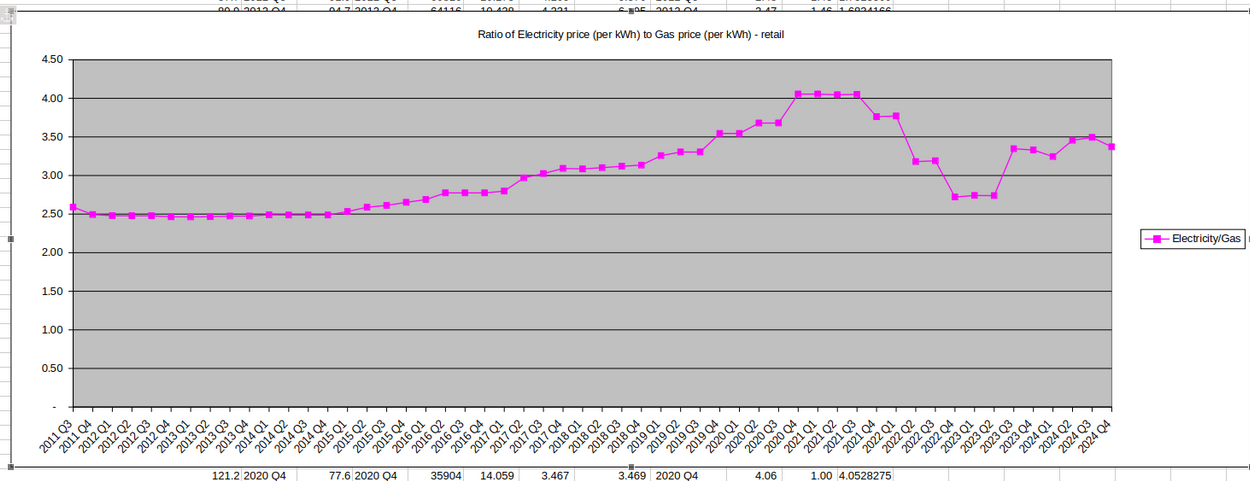
FWIW here is a plot (using data from OFGEM) of retain electricity price vs gas price in recent years. Is it just me or does it look like there was a deliberate policy between 2014 and 2021 the effect of which was to make the ratio less attractive.
This post was modified 5 months ago by JamesPa
4kW peak of solar PV since 2011; EV and a 1930s house which has been partially renovated to improve its efficiency. 7kW Vaillant heat pump.
22/05/2026 2:39 pm
@jamespa, that's a very interesting graph, but I'm getting a very different story. What I've done is to download the last 10 years of prices for both gas and electricity as given by the Octopus Tracker tariffs. Dividing the leccy price by the gas price has given a daily energy comparison ratio which I was able to graph.
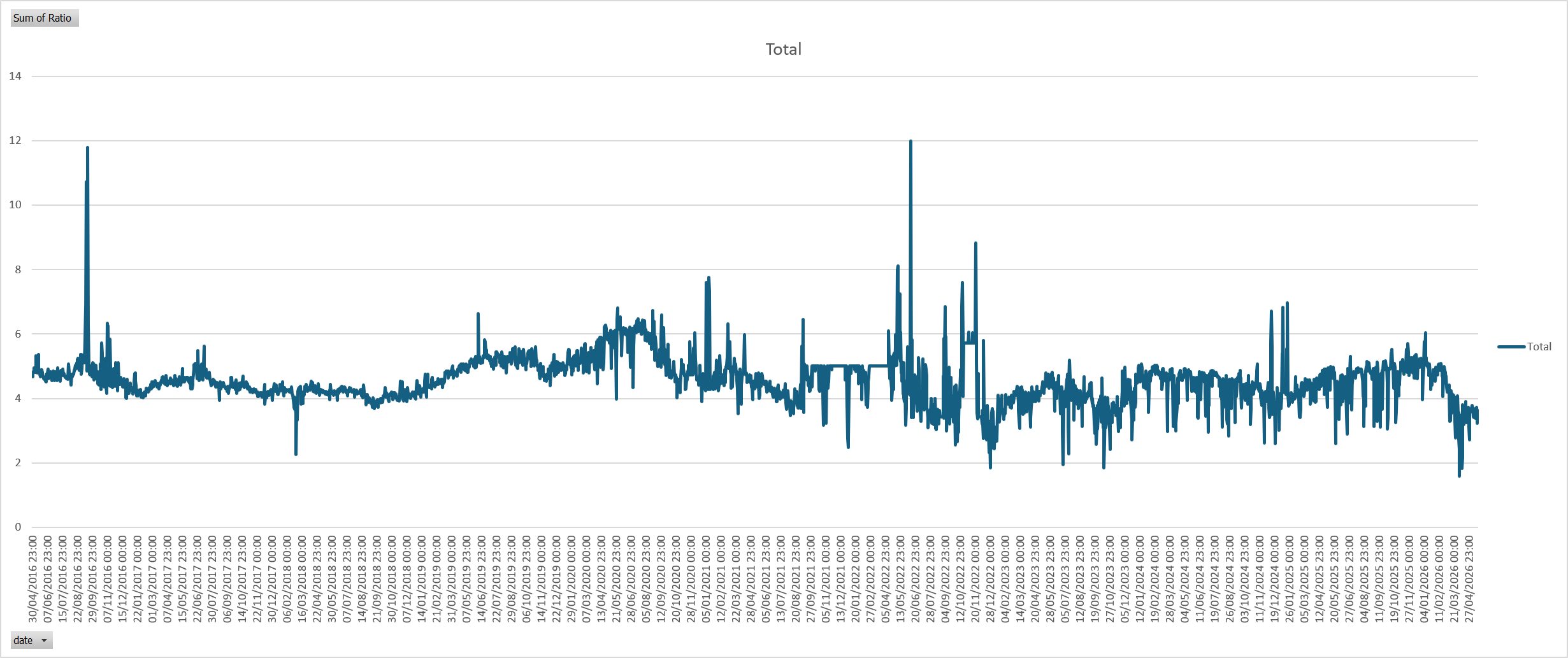
The good news is that it doesn't show the same trend yours does (albeit the time scales aren't the same so there's some interpretation needed). The bad news is that the quiescent level seems to be above 4 and generally flapping between 4 and 6 rather than reaching a maximum of 4 as indicated on your chart. I'd love to see an independent assessment on the accuracy of Ofgem's figures, not that I'm suggesting Octopus' tracker tariffs are absolutely indicative, but largely because there's such a wild apparent difference that needs to be explained.
This is particularly important since a heat pump, if well set up, can generally be expected to hit an efficiency of 350% and managing 400% is not unheard of. Under the Ofgem chart, that would mean heat pumps should be able to save a home owner money since the ratio is generally less than the efficiency. However, my chart suggests a 350-400% efficient heat pump is having to battle against 450-600% price differences and that's a hell of an uneven playing field.
The reason many of us here on the forum are still managing to save money is the combination of solar PV and time of use tariff. For me, a TOU tariff, a battery, solar panels and some scheduling logic allowed me to import at an average over the last year of 16p and, when taking into account consumption of home generated (i.e. free) leccy and the payback from exports, end up with a net average cost per kWh used of just under 10p. Since the average gas price per kWh for the same period is just under 5.5p, that's a much better ratio, so my concentrating on tweaking the energy unit cost rather than the efficiency of my heat pump has been a good use of my time and effort.
Of course, not that many home owners are inclined to or are able to play these sorts of games. Whilst the differential between gas and leccy prices is as big as it is at the moment, I'm sure we'll be seeing far fewer satisfied heat pump owners than we ought, even for no fault of the heat pump or underlying technology. I know, btw, that I'm preaching to the converted, but your graph gave a good springboard for the point I've just made.
105 m2 bungalow in South East England
Mitsubishi Ecodan 8.5 kW air source heat pump
18 x 360W solar panels
1 x 6 kW GroWatt battery and SPH5000 inverter
1 x Myenergi Zappi
1 x VW ID3
Raised beds for home-grown veg and chickens for eggs
"Semper in excretia; sumus solum profundum variat"
22/05/2026 3:19 pm
Obviously, it would be unrealistic as well as immoral to attempt to increase the cost of gas to match that of electricity, and there are plenty of complications in unpicking the electrical pricing structure that links it with the cost of gas, so I can't pretend to have a magic answer. However, for as long as leccy is kept artificially more expensive than gas people will maintain a level of satisfaction with fossil fuel heating because it's keeping the home warm cost effectively. And that's irrespective of how happy heat pump owners are with their setups.
We sort of agree, in the sense the current ratio of electricity to gas cost is not a very strong incentive for enough people to switch. Perhaps this is not so much of an issue with oil.
If I was a politician, I would argue for electricity costs to go down..
But it is essentially about making the cost of burning gas incorporate the cost to offsetting (carbon capture costs). At the moment, electricity is 50% from renewables but this will soon get to 95%. When that is the case, the cost to all of us (due to the gas related emissions) will become more obvious. Essentially electricity will have had the carbon cost incorporated and gas would be "living off a reduced carbon budget". I am happy I am not advising government and surely the gov of the time would have been well advised.
8kW Solis S6-EH1P8K-L-PLUS hybrid inverter; G99: 8kW export; 16kWh Seplos Fogstar battery; Ohme Home Pro EV charger; Vaillant Arotherm Pro 7kW; 100Amp head, HA lab on mini PC
Page 1 / 4
Next

SPONSORS

Degrees of Separation

Latest Posts
-

RE: Heat pump branding. Clever, contemporary… or a bit too much?
I think Heat Geek have done an amazing job on their bra...
By Tomtheheatingengineer , 6 hours ago
-
RE: HeatGeek vs Octopus surveys: puzzling disparity - any ideas why?
I have just had 3 heat loss surveys, one by heat geek o...
By David , 6 hours ago
-
RE: Heat Geek Zero Disrupt: Are We Sleepwalking Into Another Race to the Bottom?
I think that's the key question. After all inverter uni...
By Prunus , 8 hours ago
-
RE: battery storage without solar
As of October 1st they need specific qualifications to ...
By EtchedPixels , 8 hours ago
-
RE: How should the Boiler Upgrade Scheme be reformed?
A unit which uses water to transfer the heat/chill from...
By Temperature_Gradient , 9 hours ago
-
RE: Renewables & Heat Pumps in the News
With regards to the BUS grant raid, I gave it more thou...
By ASHP-BOBBA , 9 hours ago
-
RE: Why are ASHP installs so expensive?
The whole system seems to work on the basis of...
By ian33a , 9 hours ago
-
RE: Missing flow temperature in Heat Geek proposal
Good plan. If you can get half hourly meter readings a...
By JamesPa , 15 hours ago
-
RE: Heat Pumps Without Grants: Would You Have Installed One & Will You Now?
@editor Most certainly. The heat pump was an ideal s...
By Abernyte , 15 hours ago
-
Although regulations may well vary from country to coun...
By Majordennisbloodnok , 15 hours ago
-
RE: Does anyone have experience of a smart water meter?
Yep I caught our slow leak from a £100 bill rise 8)
By EtchedPixels , 15 hours ago
-
RE: Do You Need a Buffer Tank or Low Loss Header for Underfloor Heating in a Large Property?
@jamespa in some cases, failing the Turing test might b...
By GrahamF , 19 hours ago
-
RE: Passiv Smart Thermostat - Help & Forum Support
@energystoragetech The heat capacity of some...
By JamesPa , 20 hours ago
-
RE: tepeo ZEB UK Support & Info Thread
Sorry you are correct, I was remembering figures from t...
By JamesPa , 1 day ago


SPONSORS