Joining the Renewable Heating Hub forums is completely free and only takes a minute. By registering you’ll be able to ask questions, join discussions, follow topics you’re interested in, bookmark useful threads and receive notifications when someone replies. Non-registered members also do not have access to our AI features. When choosing your username, please note that it cannot be changed later, so we recommend avoiding brand or product names. Before registering, please take a moment to read the Forum Rules & Terms of Use so we can keep the community helpful, respectful and informative for everyone. Thanks for joining!
@etchedpixels - why would an electrical engineer be using a Sparky for connections to a battery operating at 52v nominal?
Why get a battery pre-built ?
1. Because you need the tools and to know how to do it safely. Things like gloves, no jewellery etc, correct torquing and the like.
2. Because most electrical engineers are paid more than a sparky so you can earn money to pay a sparky to do the job better and have change and time to do something else more fun.
3. You have a warranty and someone to blame if it fails
4. It's got CE/UKC and other approvals which avoids awkward questions later (eg if you want sell a house and leave it wired in).
There was a time that building your own battery was actually worth the effort. The prices have dropped and dropped and that window is mostly gone. Sure if you enjoy it then why not but otherwise it's a lot of hassle.
@etchedpixels Absolutely, I built mine as I assumed it was as simple as Fogstar made it look like. But even then, instructions were not fully up to date and it was not a pleasant experience. Fogstar was there to provide the info but when it got tough, they slowed down and I ended up liaising directly with the manufacturers..
And office banter is.. for the office
8kW Solis S6-EH1P8K-L-PLUS hybrid inverter; G99: 8kW export; 16kWh Seplos Fogstar battery; Ohme Home Pro EV charger; Vaillant Arotherm Pro 7kW; 100Amp head, HA lab on mini PC
I must admit that, even as an electrical engineer (who has spent most of his working life in micro-electronics and not power electronics) , when the idea of making my own battery was suggested, I wasn't especially keen on doing so. Like others have said, it's easier, probably safer and a lot less hassle to pay a few quid more and have somebody else take the responsibility of making the units and offering a warranty, albeit with additional cost.
However, it's great that people are kicking around ideas as we can all benefit from the debate.
Escaped to the country : central Devon - 280 sqm converted mill - 4KW Solar - 15 KWh Battery - UFH - Vaillant Arotherm V2 Plus 12KW (soon!)
The main risk in my build was following outdated leaflets and damaging any electronics.
8kW Solis S6-EH1P8K-L-PLUS hybrid inverter; G99: 8kW export; 16kWh Seplos Fogstar battery; Ohme Home Pro EV charger; Vaillant Arotherm Pro 7kW; 100Amp head, HA lab on mini PC
The other slightly concerning issue is household insurance if a claim was required - not necessarily through a battery fire.
These days, any excuse to wriggle out of a claim is almost a sport come payout time. I'd imagine that a proper installation, with all of the necessary paperwork in place as well as the permits, would be harder for an insurer to weasel out of than something that a homeowner or a group of buddies have built DIY.
But, I could be wrong!
Escaped to the country : central Devon - 280 sqm converted mill - 4KW Solar - 15 KWh Battery - UFH - Vaillant Arotherm V2 Plus 12KW (soon!)
I never thought I could claim for damage to an energy storage system through household insurance? If that’s what you mean?
Personally, I just expect it to cover us in case of water ingress or similar. But even then, we just fix things before they cost more than the insurance excess..
8kW Solis S6-EH1P8K-L-PLUS hybrid inverter; G99: 8kW export; 16kWh Seplos Fogstar battery; Ohme Home Pro EV charger; Vaillant Arotherm Pro 7kW; 100Amp head, HA lab on mini PC
Actually not - I also wouldn't claim for something minor but, let's say there was a minor event caused by an electrical incident, not an incident because of a DIY battery, but let's say that the battery made things worse and it became a total loss on the property. I can imagine that the insurers could try to limit the payout or admonish responsibility because the battery installation didn't come with the necessary paperwork and permits. Any excuse to avoid a payout.
We had to reinsure our house a couple of months ago and, because of what it is, where it is and what it is made from, the quotes are silly. I tried shopping around and a competitor came in with a lower quote but insisted that the whole house was surveyed and a full NAAPIT certificate issued. Not that we think our wiring is suspect, but the cost of having the survey done was far more than the reduction in this premium over the current one.
Not to say that all insurers play games but a race to the bottom over pricing causes corners to be cut.
Escaped to the country : central Devon - 280 sqm converted mill - 4KW Solar - 15 KWh Battery - UFH - Vaillant Arotherm V2 Plus 12KW (soon!)
However, there are pro's and con's with purchasing storage products closer to home.
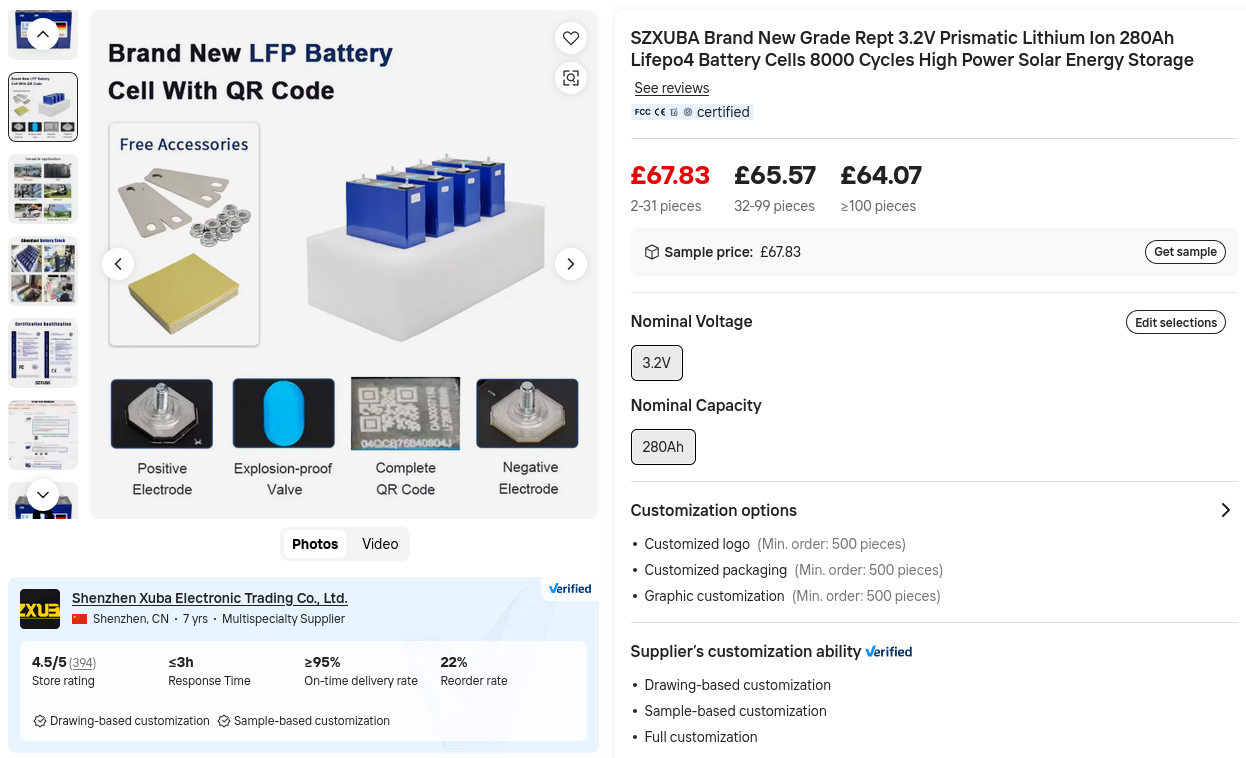
There have been cases where the cells weren't what the seller claimed. They might be B-grade or have a lower capacity than claimed.
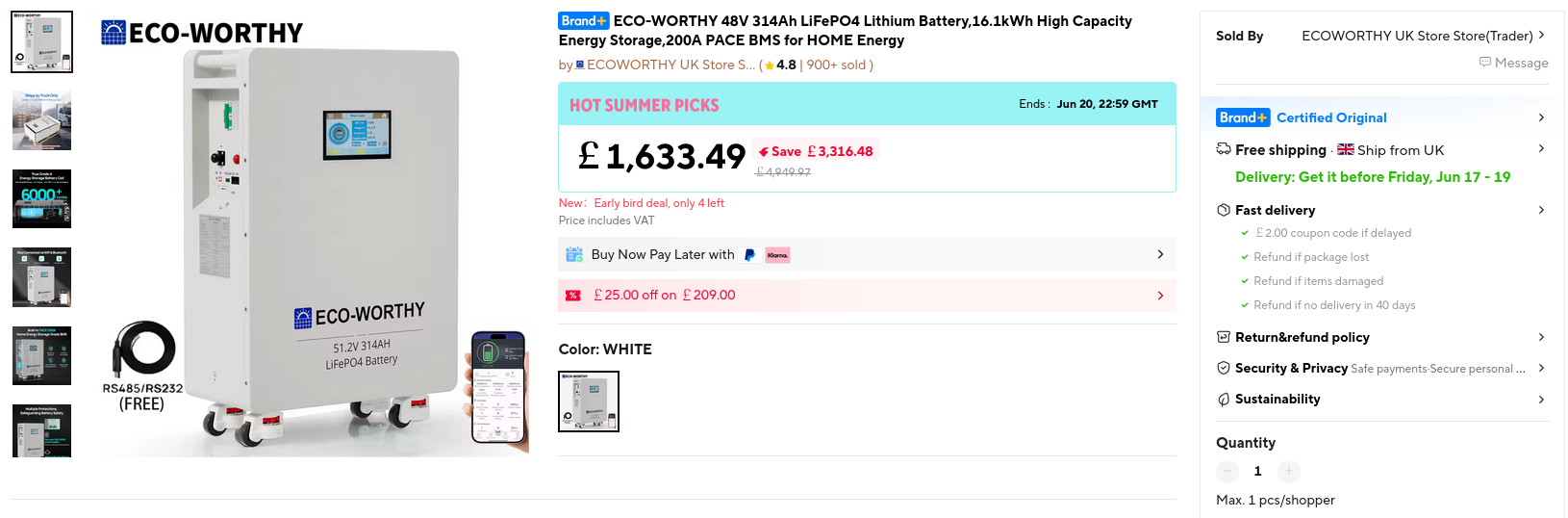
Pre-built batteries like this are intended for a particular orientation, such as floor-mounting.
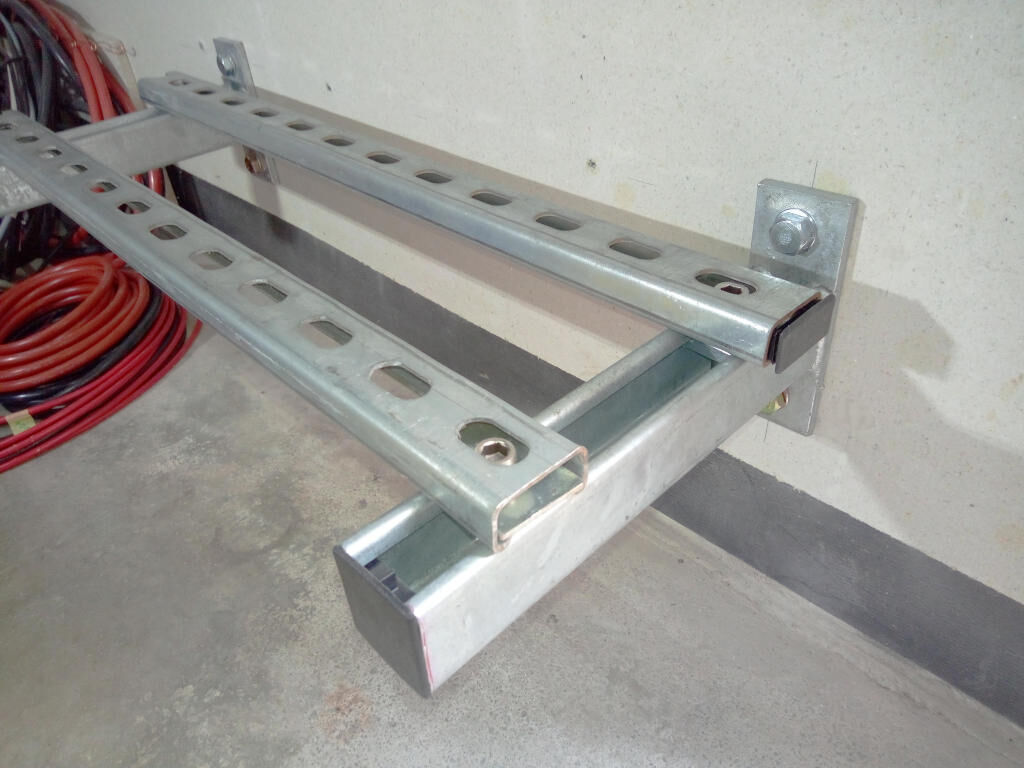
If you want wall-fixed racking which still allows access to each cell, then it's difficult to find pre-built enclosures.
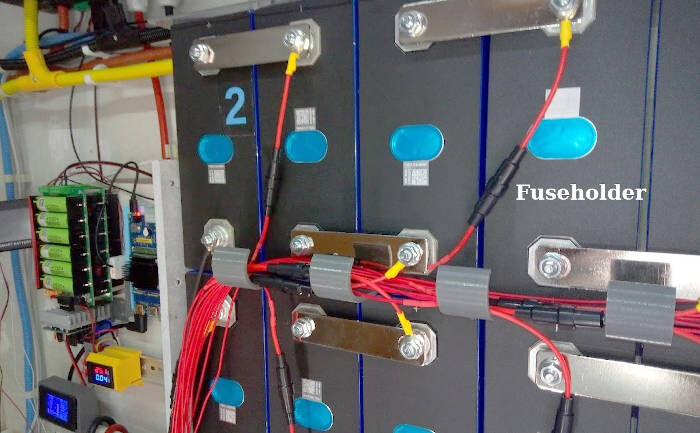
I've used Unistrutt style steel racking components and cementitious boards for a vertical arrangement:
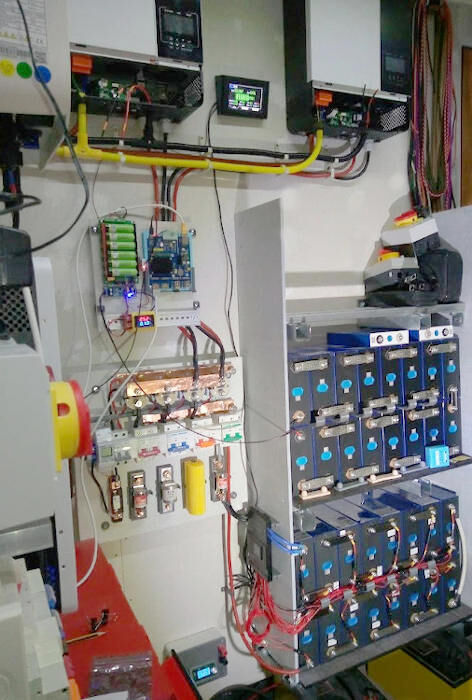
I can also add safety features which are seldom found in pre-assembled packs.
These include fuses on all wires connecting to the cells, including those used for (active) balancing
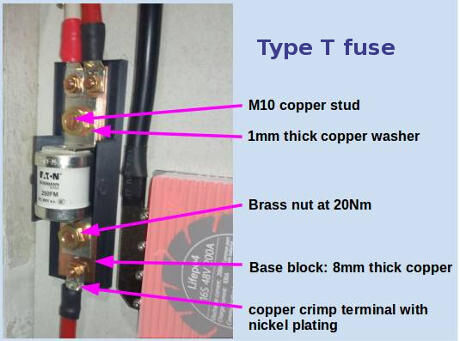
and Type-T (fast-acting) fuses for the power cables to each 16-cell battery:
The self-assembly route is well-established. Whether it's crofters in Scotland, farmers in the Australian Outback, or the American RV community on the DIY Solar Power forum, there's a wealth of practical expertise available, and free of charge.
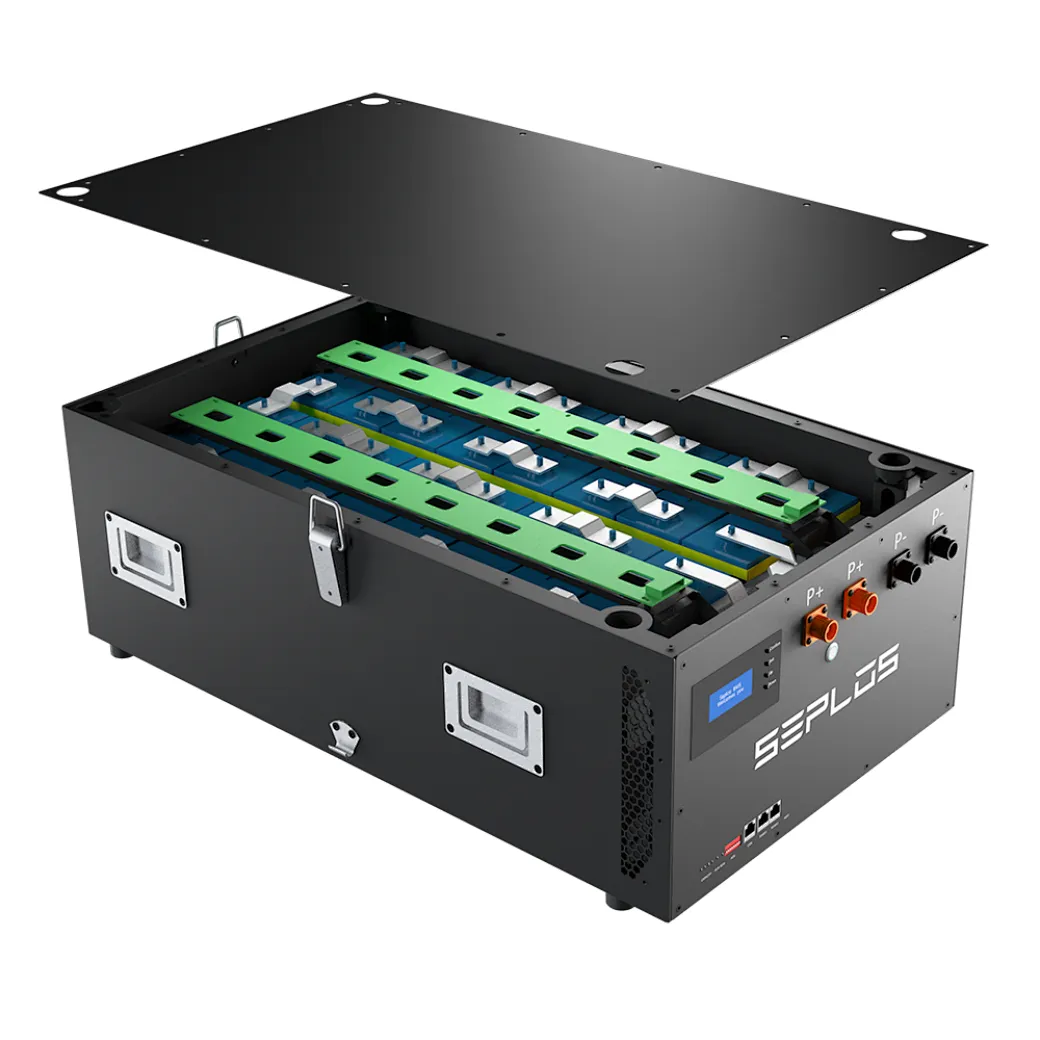
When I built my first LiFePO₄ battery, the route being taken by many others was the Mason Box, designed and sold by Seplos. These were horizontal enclosures with the uninsulated terminals and busbars pointing upwards, ready for the unwary to drop a metallic tool across them. And yet I never heard of anyone making such a blunder in the online forums.
Those DIY assemblies are the pioneers of what is being sold today.
I watched what others did, then decided to orientate my cells with the terminals sticking out at the front. A dropped tool falls away from the electrical connections. These 'vertical enclosures' are now the norm.
Unlike their commercial rivals, end-users don't suddenly get left in the lurch when their battery manufacturer or installer ceases to trade. The self-assembly knowledge-base is mature, and just as important as the product itself.
This post was modified 4 months ago by Transparent
Unlike their commercial rivals, end-users don't suddenly get left in the lurch when their battery manufacturer or installer ceases to trade. The self-assembly knowledge-base is mature, and just as important as the product itself.
That is a good point, a manufacturers can stop trading, more often the distributor or installer. It is certainly useful to be able to extend the life of a product. I suppose that can be also done even after buying a ready to use battery.
8kW Solis S6-EH1P8K-L-PLUS hybrid inverter; G99: 8kW export; 16kWh Seplos Fogstar battery; Ohme Home Pro EV charger; Vaillant Arotherm Pro 7kW; 100Amp head, HA lab on mini PC