Joining the Renewable Heating Hub forums is completely free and only takes a minute. By registering you’ll be able to ask questions, join discussions, follow topics you’re interested in, bookmark useful threads and receive notifications when someone replies. Non-registered members also do not have access to our AI features. When choosing your username, please note that it cannot be changed later, so we recommend avoiding brand or product names. Before registering, please take a moment to read the Forum Rules & Terms of Use so we can keep the community helpful, respectful and informative for everyone. Thanks for joining!
I think the big question here will be your G100/G99. AC coupling means everything gets counted together. So 3kW of FIT, plus 3kW of AC coupled inverter and you are at 6kW already. If you update it all you'll need the whole lot to be G100 compliant.
I think you've got three options to look at really
1. A much bigger inverter/battery setup (and with a heatpump and agile the fact big big batteries are now affordable is useful - you really can go to 64kWh without breaking the bank so you can ride out a long spikes or charge on all the low spots. It's about 7k for 64kWh of batteries (minus 20% the installer gets back), plus whatever the costs are for a suitable inverter plus work. You just need somewhere suitable outside where they won't sink into the ground due to the weight. As you've presumably got an MCS cert for something historic you can also probably avoid the MCS overheads 8)
2. If you can't do this then a second option is to have a non grid tied second inverter/battery that just grid/solar charges but doesn't grid tie. That steps neatly outside of the G99/G100 mess but it's much trickier to then use the power effectively as you can't just throw it back into the house. Definitely a poorer option but if (like us) you had no other choices doable.
3. Insulation and getting the size of the heatpump down. Especially with air/water systems you need to be careful what order you do things. You don't want to pay for a load of pipe and radiator upgrades and a giant heatpump then render it oversized and cycling when you insulate.
Good insulation is tricky especially with older buildings but far from impossible. Mostly it's about breathable insulation, correct air flows and understanding dew points and air exchange rates. Some stuff has a terrible reputation in the UK (EWI especially) but that's often because the UK uses the cheapest usually inappropriate materials installed by idiots paid minimum wage by grifters.
In some ways the install quality is less important than you might think. A non breathable EWI (or breathable covered in non breathable cement .. sigh) will eventually fail and will eventually cause horrible damp problems that are hard to discover before real damage is done. If it's done by a cowboy it might only take 18 months, if it's done by a pro you might get 10 but the odds are not in your favour in the UK of water staying out.
A lot of insulation though isn't hard to do right - loads of insulation in the roof is easy to do right. If you have a room in roof then even with old buildings it's quite doable (sheeps wool properly treated is wonderful stuff). Underfloor insulation for old buildings needs care the airflow is as it should be and some muppet hasn't blocked the air bricks with an extension or cowboy drive layers haven't blocked it because they couldn't be bothered to dig down before laying the drive.
Plugging all the leaks is tedious but can be a fun game and is hugely effective. You can then introduce controlled ventilation with MHVR to avoid dampness (or in many cases open all the windows for 20 minutes at 7am - even in cold winter also works).
The long term cost of power is difficult to play pricing games on. Aside from the geopolitics of gas the grid is shifting with new nuclear due eventually (but likely to be HS2 grade 'soon'), and a lot of existing and new renewables that will be freed from the grid capacity mess thanks to privatisation and under-investment for decades. That's likely to make prices more volatile even if they average downwards. Export is certainly on the downward slope, and anyone planning to spend a decade doing clever battery arbitrage is increasingly going to be up against commercial battery farms doing the same thing at scale with lower costs.
This post was modified 4 months ago by EtchedPixels
Heating oil comes with risk, not least from the likes of Trump, but also from Governments pushing a green agenda and pricing oil into unattractive territory through taxation. Obviously also, it is contrary to the green agenda and is seen as a pariah by many. That said, and ignoring the green benefits of using heat pumps, are many of us sleepwalking into another perfect storm in or around 2030 ? Is it diesel being the way forward and then, not, all over again? Food for thought, perhaps.
When our carbon budget gets tighter, would the government start to fund carbon capture out of general taxation or encourage faster phasing out of oil and gas for heating? We seem to be encouraging the free market in so many aspects but all domestic energy users seem to be protected (from having to change) by images of energy poverty. No matter how small the impact is…
8kW Solis S6-EH1P8K-L-PLUS hybrid inverter; G99: 8kW export; 16kWh Seplos Fogstar battery; Ohme Home Pro EV charger; Vaillant Arotherm Pro 7kW; 100Amp head, HA lab on mini PC
Thank you, everyone, once again, for your replies.
In terms of household insulation, ours isn't especially bad in general. It's a converted mill, the front middle bit cob, the rear bit victorian stone and the two ends are 20th century blockwork. The cob section has generally vaulted ceilings, converted about 20 years ago and I am aware that they are decently insulated. The rear victorian section has a loft. some of it has decently think insulation, some (where there are storage boards), less so. Many of the walls have dry lining, again, late twentieth or early twenty first century installed and, as claimed by the previous owner, all met building regulations at the point of conversion. There are some non dry lined walls and I have no plans to dry line over them as they part of the charm of the building and I'm unaware of internal damp and do not wish to promote the chances of it occurring. The thinner stone walls have a higher heat loss (there aren't that many) and the metre thick ones fair better and I'll accept some heat loss there. The whole house is double glazed with decent enough Low E units and they fit well. I've been over the house in great depth with an infra red camera and have dealt with any obvious heat loss locations.
The amount of re pipe work seems pretty minimal : we have UFH in most rooms and it seems to work fine with our oil boiler. The HP people are suggesting that we remove the actuators and use flow regulators instead on the manifolds - the existing system doesn't have flow meters. We have 16 UFH circuits and it's a constant battle to keep each circuit running nicely as actuators and pins fail quite regularly. The house has 10 thermal zones but I run all zones at the same temperature so, I would hope to maintain the feel that we have currently were we to substitute oil for a HP. We would like to add one decent sized radiator in our lounge as the existing method of heating is just a wood burner.
I will have a chat with the HP company tomorrow regarding additional batteries and, possibly solar. 3KWp is, obviously not enough and, because changing the solar inverter to a hybrid and adding batteries would probably kill my FIT contact, we'll have to consider other options while being aware of G99/100 restrictions. If this includes a solar array, I'll need to think about it. We have places to place additional panels and we have somewhere to put batteries. It would involve some extensive rewiring as the location is in our garage/workshop building and a wire between it and the house would need up rating.
I'm not counting on export with new batteries being a holy grail of money, more a way to fill our batteries so that we are less reliant upon grid power. Only a battery installer would be able to tell us what is and is not possible.
What starts off as a "nice idea" starts to get very pricey and I start to wonder if (ignoring the climate issue) if we will see much difference by moving to a HP. The biggest difference will be a less full wallet and if we will realise much of the financial commit back (I know, it should be about ROI .... a whole another discussion!).
Escaped to the country : central Devon - 280 sqm converted mill - 4KW Solar - 15 KWh Battery - UFH - Vaillant Arotherm V2 Plus 12KW (soon!)
You can change a lot and keep a FIT but the whole thing can get to be a bit of a nightmare and will need an installer who knows the rules and likes forms if it's going to be DC coupled. It can be done though. There's also a few other boxes of tricks that can help. Sunsynk (and I believe some Tesla) can back up an existing inverter (including faking grid power present) up to about 4kW so that your existing FIT install ends up not just AC coupled but working in an outage.
When our carbon budget gets tighter, would the government start to fund carbon capture out of general taxation or encourage faster phasing out of oil and gas for heating? We seem to be encouraging the free market in so many aspects but all domestic energy users seem to be protected (from having to change) by images of energy poverty. No matter how small the impact is…
Not a chance given the likely next government. More likely they'd "cut" energy bills by arbitrarily revoking FIT and cancelling all feed in tariffs. And yes they can do that. In the US there are constraints like the courts. In the UK parliament is sovereign so if they decree that FIT is over there is no recourse.
One of my constraints on what I do further for energy efficiency/battery at this point quite honestly is whether I might end up leaving the UK after the next election and going somewhere sane - and therefore what I could take with me.
I will have a chat with the HP company tomorrow regarding additional batteries and, possibly solar. 3KWp is, obviously not enough and, because changing the solar inverter to a hybrid and adding batteries would probably kill my FIT contact, we'll have to consider other options while being aware of G99/100 restrictions. If this includes a solar array, I'll need to think about it. We have places to place additional panels and we have somewhere to put batteries. It would involve some extensive rewiring as the location is in our garage/workshop building and a wire between it and the house would need up rating.
I'm not counting on export with new batteries being a holy grail of money, more a way to fill our batteries so that we are less reliant upon grid power. Only a battery installer would be able to tell us what is and is not possible.
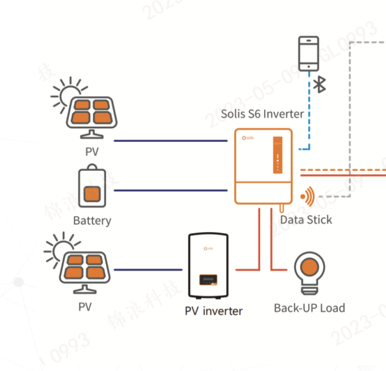
Not exactly what you seem to be looking at, but a system like the below can work even when you want to maximise internal use rather than export.
Essentially this keeps the solar inverter, but it adds a hybrid with its flexibility. Other inverter models like from sunsynk should also work similarly.
8kW Solis S6-EH1P8K-L-PLUS hybrid inverter; G99: 8kW export; 16kWh Seplos Fogstar battery; Ohme Home Pro EV charger; Vaillant Arotherm Pro 7kW; 100Amp head, HA lab on mini PC
When our carbon budget gets tighter, would the government start to fund carbon capture out of general taxation or encourage faster phasing out of oil and gas for heating? We seem to be encouraging the free market in so many aspects but all domestic energy users seem to be protected (from having to change) by images of energy poverty. No matter how small the impact is…
Not a chance given the likely next government. More likely they'd "cut" energy bills by arbitrarily revoking FIT and cancelling all feed in tariffs. And yes they can do that. In the US there are constraints like the courts. In the UK parliament is sovereign so if they decree that FIT is over there is no recourse.
You mean, no longer having the usual consultation period? 😉
I have no future crystal ball but would expect more of a compromise/deadlock situation where things will change even slower than now.
8kW Solis S6-EH1P8K-L-PLUS hybrid inverter; G99: 8kW export; 16kWh Seplos Fogstar battery; Ohme Home Pro EV charger; Vaillant Arotherm Pro 7kW; 100Amp head, HA lab on mini PC
Sunsynk (and I believe some Tesla) can back up an existing inverter (including faking grid power present) up to about 4kW so that your existing FIT install ends up not just AC coupled but working in an outage.
Sorry I missed this post.
The introduction of a hybrid inverter with backup/ups capability has been discussed before in this forum, probably relevant for @ian33a .
8kW Solis S6-EH1P8K-L-PLUS hybrid inverter; G99: 8kW export; 16kWh Seplos Fogstar battery; Ohme Home Pro EV charger; Vaillant Arotherm Pro 7kW; 100Amp head, HA lab on mini PC
I'm an electrical engineer by profession so appreciate the issues of loading. I just need one battery with some house supply capability.
Given your background, are you open to the idea of assembling your own battery on-site?
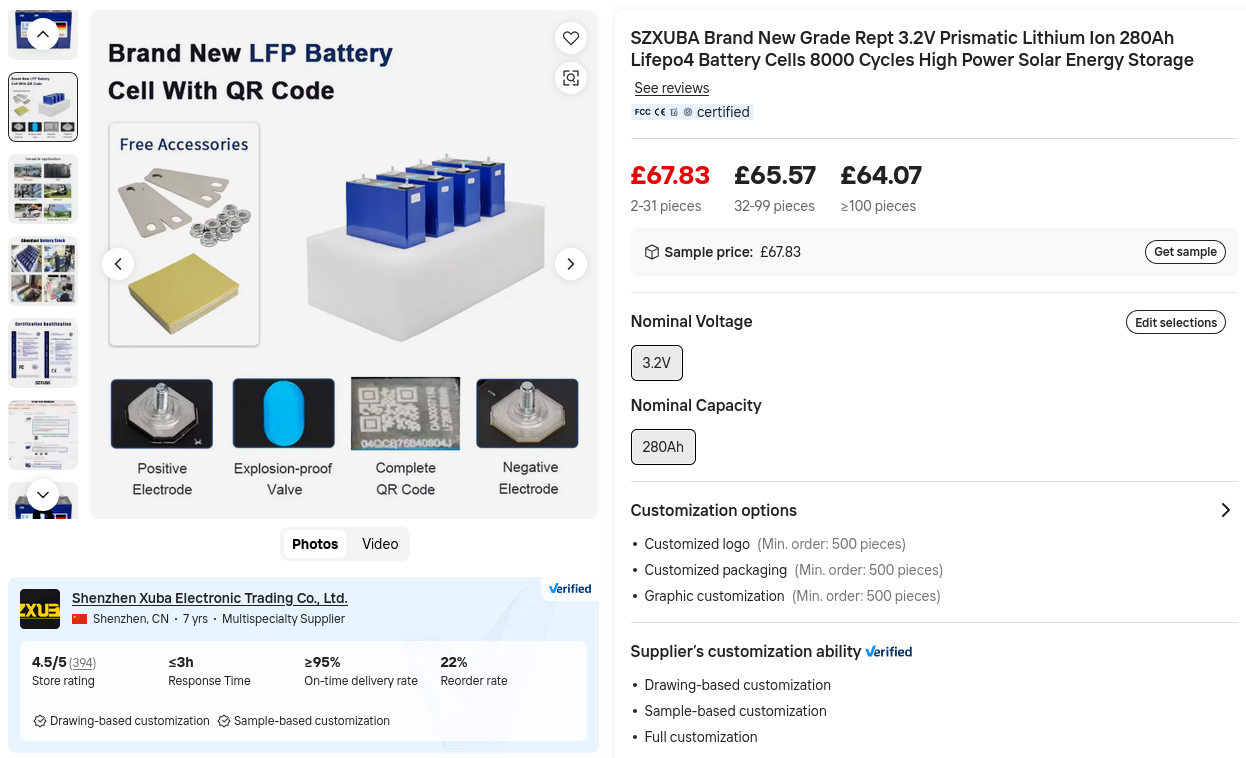
A nominal 13kWh battery would cost about £2,000 for the hardware.
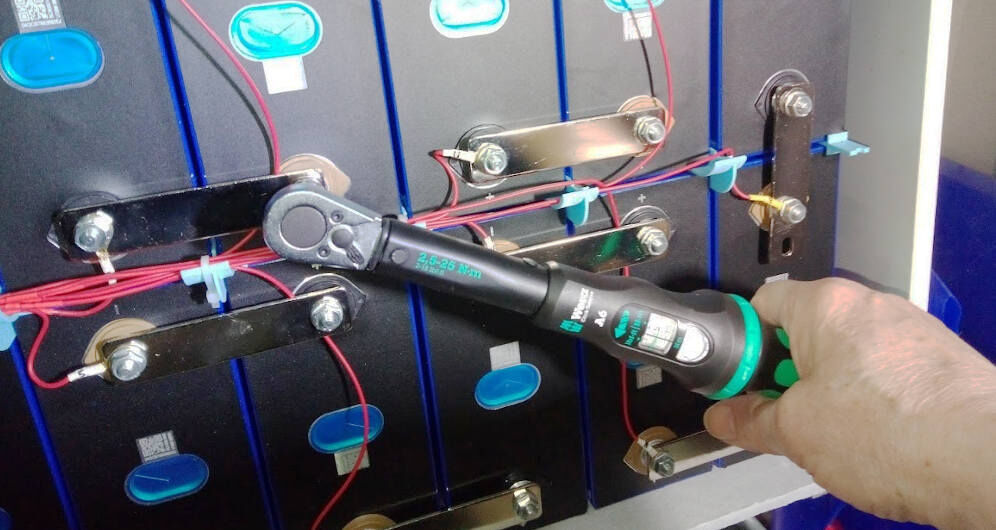
16-cells and an enclosure would weight over 120Kg, so it's expensive to buy in such a unit ready-built, and tricky to manoeuvre into place. But it's not difficult to buy the cells and connect them up yourself.
You can buy a pre-assembled 16kWh battery for about the same at this point and that's despite battery prices shooting up due to Trump (they were nearer £1600 before). You also don't then have to have the fun conversation with the sparky that goes "Can I see the certifications for the battery" "I assembled it myself" "umm.."
This post was modified 4 months ago by EtchedPixels
16-cells and an enclosure would weight over 120Kg, so it's expensive to buy in such a unit ready-built, and tricky to manoeuvre into place. But it's not difficult to buy the cells and connect them up yourself.
You probably already have most of the tools.
Just be aware of the safety risks of doing this - there's a lot of energy in those cells and a short-circuit across a cell or multiple cells, for example from one of those uninsulated inter-cell links, or from the tools, or even dropped items could potentially result in very high short-circuit currents, very significant arcing and burns to anyone nearby.
You mention the tools, but for work on these kind of batteries you would be looking at fully insulated tools, to reduce the risk of creating a short-circuit. Whilst the cell voltage is low, the high energy capacity brings its own risks.
I would argue these types of cells and batteries, because of the energy content and risks that brings, they are not DIY projects.