

Notifications
Clear all
Joining the Renewable Heating Hub forums is completely free and only takes a minute. By registering you’ll be able to ask questions, join discussions, follow topics you’re interested in, bookmark useful threads and receive notifications when someone replies. Non-registered members also do not have access to our AI features. When choosing your username, please note that it cannot be changed later, so we recommend avoiding brand or product names. Before registering, please take a moment to read the Forum Rules & Terms of Use so we can keep the community helpful, respectful and informative for everyone. Thanks for joining!

Topic starter
13/06/2026 6:55 am
We have a company visiting next week to look at the possibilities of adding a heat pump.
Given the size and fabric of our house, most likely, we will need a beefy sized HP.
A few years ago, when heat pumps were completely off the agenda, we added an AC battery to complement out solar array. The battery needed to be AC because a change to a hybrid inverter would have compromised our generation based FIT. Considering our power needs at the time we went with a 15KWh battery but it only had a 3KWp inverter fitted.
Thinking HP now, the battery may be fine in capacity but it may be compromised on charge and discharge rate if we want to load shift to support a heat pump as well as a reasonable quantity of electrical load in the house.
I very much doubt if it would be possible to swap out the inverter for a larger capacity one (Alpha ESS Smile B3 plus) so, to meet the load demand, I'm wondering if a second AC coupled battery system might be the right approach. The B3 is G100 compliant and I imagine that a second battery would also be. A second battery would also soak up a bit more solar on a good day as we find that our existing battery can get brimmed and, because of our FIT, we don't get anything more for exporting that energy.
Are there any issues with going down that route in terms of legislation or functionality?
thanks
Escaped to the country : central Devon - 280 sqm converted mill - 4KW Solar - 15 KWh Battery - UFH - Vaillant Arotherm V2 Plus 12KW (soon!)

13/06/2026 10:30 am
@ian33a Hi Ian, you may be pleasantly surprised surprised at how well your 15kWh battery does on the Cosy tariff. You just work it 2.5 cycles per day.
thanks to this forum I’ve just discovered the https://timandkatsgreenwalk.co.uk calculator it would have saved me some hours with excel working out the projected cost of our usage before buying the ashp.
Not all makes of battery are easily added to even with the same manufacturer which is despite the marketing spiel. You might need do do some investigating with fellow user if your battery make about how add-ons work in practice.
2kW + Growatt & 4kW +Sunnyboy PV on south-facing roof Solar thermal. 9.5kWh Givenergy battery with AC3. MVHR. Vaillant 7kW ASHP (very pleased with SCOP >4) open system operating on WC
Topic starter
13/06/2026 11:46 am
@judith Thanks for your reply - very interesting.
I think that what concerns me with what I may end up having is that the HP is likely 10 or 12 KW and even with a SCOP of 4, on full chat it will take all of the inverter capacity and leave nothing in reserve. What I don't know is how much modulation would likely occur where, I imagine, the power taken by the HP would be less and there would be more in reserve both for the battery and other household loads - I'm so used to the binary nature of oil.
The other concern about using Cosy is that the slots are three hours maximum. With a maximum charging rate of 3KWp on my Alpha battery, I can only ever put in around 60% of the capacity of the battery in a single recharge. At the moment we are on Agile and I charge when energy is cheaper, irrespective of the time of day (done automatically).
These two reasons were making me wonder if having two batteries may be a solution - especially as we don't have EV's and any inclination to change our cars imminently.
Already having under floor heating, albeit fed by an oil boiler, I'm used to the concept of slow but constant heating. It's just that I'm also used to an oil boiler either being on at full power or off. HP's , I think I understand, are designed to gradually replace lost heat and, maybe the modulation is gentle (so the instant power drain is lower) , and, maybe, a single battery may do the job?
So much to get my head around !
Escaped to the country : central Devon - 280 sqm converted mill - 4KW Solar - 15 KWh Battery - UFH - Vaillant Arotherm V2 Plus 12KW (soon!)

13/06/2026 12:02 pm
@ian33a FWIIW, we have a Daikin 8 kW Altherma 3 HP. (running 24/7 and providing 22.5 deg. C throughout property.) We are using Octopus Cosy and with two Powerwall 2 13.5kWh units stacked, we have never needed to use th higher rates of the Cosy Tariff at all. We are all electric with an induction hob, 2 x combination microwave cookers, an air fryer, the usual fridge/freezer and a separate freezer too. Our DHW is catered for by a Sunamp Thermino powered via a MyEnergi Eddi by solar (8.1 kWp.) or grid power. No EV but Cosy works for us. Regards, Toodles.
This post was modified 4 months ago by Toodles
Toodles, heats his home with cold draughts and cooks food with magnets.


13/06/2026 2:05 pm
The battery needed to be AC because a change to a hybrid inverter would have compromised our generation based FIT.
[...]
to meet the load demand, I'm wondering if a second AC coupled battery system might be the right approach. [...] A second battery would also soak up a bit more solar on a good day as we find that our existing battery can get brimmed and, because of our FIT, we don't get anything more for exporting that energy.
Please clarify.
If you have generation-based FIT, the amount you receive is linked to what the existing inverter outputs to the home.
It matters not whether that energy is used within the home or exported to the grid.
Is that output from the inverter being monitored?
Who sees the data from that meter apart from you?
2: Your existing 3kW inverter which supplies the 15kWh battery is presumably grid-tied.
In the event of a power-cut it won't work. Correct?
Are you considering a second inverter/battery combination which works in the same way?
Or are you wanting the inverter to also have a 'maintained' output, which can supply power to some circuits during an outage?
3: What's the output capacity of the string-inverter to which the solar panels are directly connected?
Is that commensurate with the peak rating of the solar panels?
4: Would you consider adding more solar panels in future?
Or is the available roof area (& outhouse roofing) already maxed-out?
5: I would urge caution in making any decisions based on currently-available tariffs.
Common sense tells us that the chat night-rate isn't likely to last beyond 2030.
It's under-pinned by Combined Cycle Gas Turbine (CCGT) plants which are cheaper to operate if they remain in combined-cycle mode.
The present government policy being pursued by NESO is 'decarbonisation of the grid' by 2030, which means no more gas-fired generation.
It will be interesting to see if the company representative coming to see you next week makes his/her proposals based on current tariff structures and prices. That gives rise to decisions which customers later regret...
... and that's something you have experienced already!
Save energy... recycle electrons!
Topic starter
13/06/2026 2:29 pm
Please clarify.
If you have generation-based FIT, the amount you receive is linked to what the existing inverter outputs to the home.
It matters not whether that energy is used within the home or exported to the grid.
Is that output from the inverter being monitored?
Who sees the data from that meter apart from you?
Correct, the solar array as a DC-AC inverter, rated at 4KWp - this is fed to a generation meter and forms the basis of what the FIT pays us. If we use that energy or not doesn't matter from a payment point of view. The information is held by me and provided to the people with whom the FIT contract is operating.
2: Your existing 3kW inverter which supplies the 15kWh battery is presumably grid-tied.
In the event of a power-cut it won't work. Correct?
Yes and no : it is an AC inverter, G100 compliant and it doesn't export to the grid. In the event of a power failure we have manual switches to allow us to isolate it from the grid and power the house, albeit keeping to the 3KWp capability that the unit has.
Are you considering a second inverter/battery combination which works in the same way?
Or are you wanting the inverter to also have a 'maintained' output, which can supply power to some circuits during an outage?
Not really, I'm happy to have a battery which is grid tied. I can keep the house load under 3KWp knowing that a heat pump wont work. I'm an electrical engineer by profession so appreciate the issues of loading. I just need one battery with some house supply capability.
3: What's the output capacity of the string-inverter to which the solar panels are directly connected?
Is that commensurate with the peak rating of the solar panels?
4KWp - both panels and inverter output.
4: Would you consider adding more solar panels in future?
Or is the available roof area (& outhouse roofing) already maxed-out?
It is a consideration. Trouble is, the existing panels are west facing on a garage/workshop. Additional panels would need to be east facing and I would need to uprate the cabling between the garage/workshop and the house.
5: I would urge caution in making any decisions based on currently-available tariffs.
Common sense tells us that the chat night-rate isn't likely to last beyond 2030.
It's under-pinned by Combined Cycle Gas Turbine (CCGT) plants which are cheaper to operate if they remain in combined-cycle mode.
The present government policy being pursued by NESO is 'decarbonisation of the grid' by 2030, which means no more gas-fired generation.
It will be interesting to see if the company representative coming to see you next week makes his/her proposals based on current tariff structures and prices. That gives rise to decisions which customers later regret...
... and that's something you have experienced already!
An interesting and fair perspective. Are you suggesting that, mid term, it may be cheaper to stay with oil than risk the unknowns of where electricity pricing (and spark gaps) naturally end up after 2030? I suspect that our visitor next week will base assumptions upon current pricing - that is the only defined set of variables that there are. If he mentions post 2030 will be interesting.
Post 2030 then, if unit prices of electricity no longer encourage load shifting, I wonder where the majority of the population will end up ? It's bad enough for many as it is!
Escaped to the country : central Devon - 280 sqm converted mill - 4KW Solar - 15 KWh Battery - UFH - Vaillant Arotherm V2 Plus 12KW (soon!)
Topic starter
13/06/2026 5:06 pm
@toodles Thank you for your reply. It's encouraging to know that your set up works well. Having the PowerWall is a great combination as the inverter power output is more than enough for most households. With hindsight, I should have waited and gone with a more powerful inverter but .....
Escaped to the country : central Devon - 280 sqm converted mill - 4KW Solar - 15 KWh Battery - UFH - Vaillant Arotherm V2 Plus 12KW (soon!)
13/06/2026 5:35 pm
@ian33a 😉 Toodles.
Toodles, heats his home with cold draughts and cooks food with magnets.

Topic starter
13/06/2026 6:14 pm
5: I would urge caution in making any decisions based on currently-available tariffs.
Common sense tells us that the chat night-rate isn't likely to last beyond 2030.
It's under-pinned by Combined Cycle Gas Turbine (CCGT) plants which are cheaper to operate if they remain in combined-cycle mode.
The present government policy being pursued by NESO is 'decarbonisation of the grid' by 2030, which means no more gas-fired generation.
It will be interesting to see if the company representative coming to see you next week makes his/her proposals based on current tariff structures and prices. That gives rise to decisions which customers later regret...
... and that's something you have experienced already!
Thank you, one hundred times over :
I hadn't appreciated how the decarbonisation of the grid by 2030 is set to affect the cost of electricity in quite the way that it is cited to do so. Having watched a few YouTube videos and read a bit in the past few hours it's, quite frankly, scary how electricity costs are scheduled to increase - all on the back of Governments saying that renewables are going to bring the cost of electricity down. A classic example of picking on some statistical aspects while neglecting to mention others and expecting many of us to not notice.
How on earth consumers are expected to pay for these increases escapes me. We could need rampant increases in salaries and pensions and benefits to cover these additional charges and, with economies run in the way that they are, money is migrating toward the richest and not toward the average person and Governments, as currently run, are not exactly benevolent to those on sensible incomes.
Heating oil comes with risk, not least from the likes of Trump, but also from Governments pushing a green agenda and pricing oil into unattractive territory through taxation. Obviously also, it is contrary to the green agenda and is seen as a pariah by many. That said, and ignoring the green benefits of using heat pumps, are many of us sleepwalking into another perfect storm in or around 2030 ? Is it diesel being the way forward and then, not, all over again? Food for thought, perhaps.
Escaped to the country : central Devon - 280 sqm converted mill - 4KW Solar - 15 KWh Battery - UFH - Vaillant Arotherm V2 Plus 12KW (soon!)

13/06/2026 8:26 pm
5: I would urge caution in making any decisions based on currently-available tariffs.
Common sense tells us that the chat night-rate isn't likely to last beyond 2030.
It's under-pinned by Combined Cycle Gas Turbine (CCGT) plants which are cheaper to operate if they remain in combined-cycle mode.The present government policy being pursued by NESO is 'decarbonisation of the grid' by 2030, which means no more gas-fired generation.
It will be interesting to see if the company representative coming to see you next week makes his/her proposals based on current tariff structures and prices. That gives rise to decisions which customers later regret...
... and that's something you have experienced already!
Thank you, one hundred times over :
I hadn't appreciated how the decarbonisation of the grid by 2030 is set to affect the cost of electricity in quite the way that it is cited to do so. Having watched a few YouTube videos and read a bit in the past few hours it's, quite frankly, scary how electricity costs are scheduled to increase - all on the back of Governments saying that renewables are going to bring the cost of electricity down. A classic example of picking on some statistical aspects while neglecting to mention others and expecting many of us to not notice.
How on earth consumers are expected to pay for these increases escapes me. We could need rampant increases in salaries and pensions and benefits to cover these additional charges and, with economies run in the way that they are, money is migrating toward the richest and not toward the average person and Governments, as currently run, are not exactly benevolent to those on sensible incomes.
Heating oil comes with risk, not least from the likes of Trump, but also from Governments pushing a green agenda and pricing oil into unattractive territory through taxation. Obviously also, it is contrary to the green agenda and is seen as a pariah by many. That said, and ignoring the green benefits of using heat pumps, are many of us sleepwalking into another perfect storm in or around 2030 ? Is it diesel being the way forward and then, not, all over again? Food for thought, perhaps.
Energy prices are in large part geo political.
If you are able to predict geo-politics out until 2030 (or, frankly, beyond the next month) then you don't need to worry about the cost of energy for domestic use!
That may seem like a facetious comment, but it's deadly serious.
The only certainties are (a) that dependence on fossil fuels = dependence on (largely hostile) foreign powers and (b) fossil fuels warm the planet.
Prices are almost totally unpredictable and at the whim of those that control them!
This post was modified 4 months ago by JamesPa
4kW peak of solar PV since 2011; EV and a 1930s house which has been partially renovated to improve its efficiency. 7kW Vaillant heat pump.
2

13/06/2026 9:47 pm
are many of us sleepwalking into another perfect storm in or around 2030 ?
Looks like it, but on the other hand, considering how the climate is going, perhaps you won't need heating by then 🤣
How on earth consumers are expected to pay for these increases escapes me.
That's the whole point: you're not supposed to be able to afford it. I always find it baffling that people don't get this.
That's why I put 12kW PV, 20kWh storage, and 200mm Rockwool exterior insulation on the house. The heat pump is just the cherry on top. Generally when I'm inside, I have no idea what the outside weather is before I step outside. Check the indoors/outdoors temperatures:
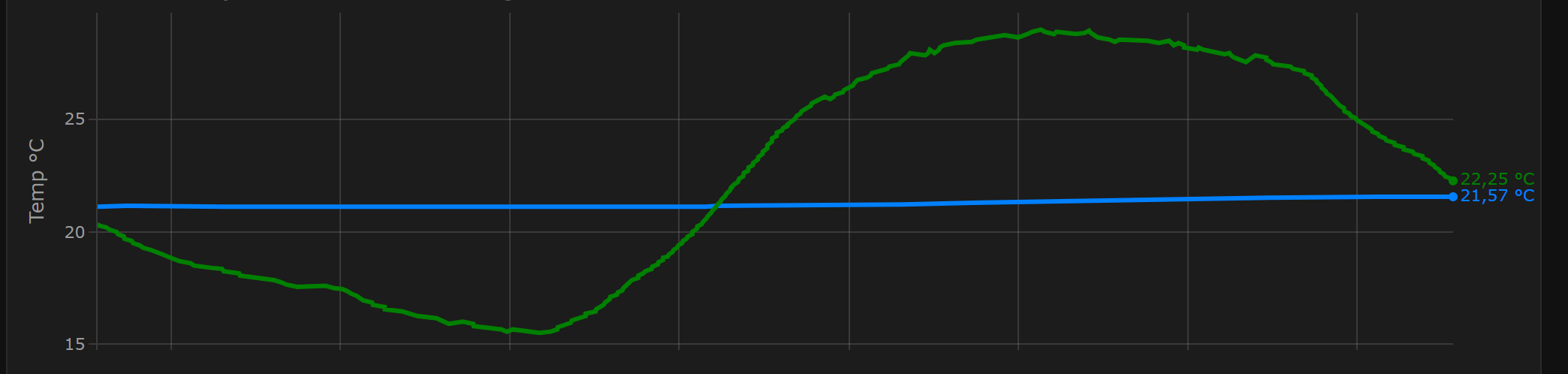
If you are worried about future trends in energy costs, an investment in insulation can be a good option, if done correctly. If done incorrectly however, it can be catastrophic, so caveat.

13/06/2026 9:47 pm
I think with any size of heat pump you are likely to break the limit on the 3kW inverter and pull from the grid. I don’t feel qualified to comment on the best approach to increasing inverter size in your scenario unfortunately. I do think that for most people an 8kW inverter would be a good fit to cover an all-electric house with ASHP with some spare capacity. Unfortunately it would seem that DNOs are being a lot more stringent on inverter size and not just export limits.
In terms of capacity, cost etc. I have 10kW solar array split East-West coupled to a 8kW inverter and 16kW battery stack and a 9kW heat pump. I run on the Octopus Intelligent Go tariff so fully charge up the batteries overnight at 7p/kWh; peak rate is 28p/kWh. Over Winter I had to pull £108 of electric at peak rate with the rest being covered by battery capacity and meagre solar generation. To cover that £108 so all my electric consumption was at off-peak would cost me approx £5k in extra battery capacity. And of course that peak rate usage would still have cost me around £27 so in fact is only an extra £80 or so. In any case, export earnings mean my bill for the year is around £35. If my inverter was only 3kW it would have a big impact on peak rate pull as my background load is around 0.5kWh continuously and coffee machine, kettle, hob, oven etc would cause the load to jump over 3kWh particularly with the heat pump running.

Page 1 / 3
Next

SPONSORS

Degrees of Separation

Latest Posts
-

RE: Heat pump branding. Clever, contemporary… or a bit too much?
I think Heat Geek have done an amazing job on their bra...
By Tomtheheatingengineer , 5 hours ago
-
RE: HeatGeek vs Octopus surveys: puzzling disparity - any ideas why?
I have just had 3 heat loss surveys, one by heat geek o...
By David , 6 hours ago
-
RE: Heat Geek Zero Disrupt: Are We Sleepwalking Into Another Race to the Bottom?
I think that's the key question. After all inverter uni...
By Prunus , 7 hours ago
-
RE: battery storage without solar
As of October 1st they need specific qualifications to ...
By EtchedPixels , 8 hours ago
-
RE: How should the Boiler Upgrade Scheme be reformed?
A unit which uses water to transfer the heat/chill from...
By Temperature_Gradient , 8 hours ago
-
RE: Renewables & Heat Pumps in the News
With regards to the BUS grant raid, I gave it more thou...
By ASHP-BOBBA , 9 hours ago
-
RE: Why are ASHP installs so expensive?
The whole system seems to work on the basis of...
By ian33a , 9 hours ago
-
RE: Missing flow temperature in Heat Geek proposal
Good plan. If you can get half hourly meter readings a...
By JamesPa , 14 hours ago
-
RE: Heat Pumps Without Grants: Would You Have Installed One & Will You Now?
@editor Most certainly. The heat pump was an ideal s...
By Abernyte , 14 hours ago
-
Although regulations may well vary from country to coun...
By Majordennisbloodnok , 15 hours ago
-
RE: Does anyone have experience of a smart water meter?
Yep I caught our slow leak from a £100 bill rise 8)
By EtchedPixels , 15 hours ago
-
RE: Do You Need a Buffer Tank or Low Loss Header for Underfloor Heating in a Large Property?
@jamespa in some cases, failing the Turing test might b...
By GrahamF , 18 hours ago
-
RE: Passiv Smart Thermostat - Help & Forum Support
@energystoragetech The heat capacity of some...
By JamesPa , 20 hours ago
-
RE: tepeo ZEB UK Support & Info Thread
Sorry you are correct, I was remembering figures from t...
By JamesPa , 1 day ago




SPONSORS