

Notifications
Clear all
Joining the Renewable Heating Hub forums is completely free and only takes a minute. By registering you’ll be able to ask questions, join discussions, follow topics you’re interested in, bookmark useful threads and receive notifications when someone replies. Non-registered members also do not have access to our AI features. When choosing your username, please note that it cannot be changed later, so we recommend avoiding brand or product names. Before registering, please take a moment to read the Forum Rules & Terms of Use so we can keep the community helpful, respectful and informative for everyone. Thanks for joining!

Topic starter
18/05/2026 9:54 pm
Hi all
This is my first post, but i've been a long-time lurker both here and watching the youtube channel etc...
I’m looking for a technical sanity check. (maybe just a sanity check)
Firstly I have deeply researched heatpumps more than I could have imagined, for what should be a straightforward install, so I’m not asking from a standing start and I am reasonably technically minded. My query is borne possibly more out of frustration.
I have a heatpump quote for supply and installation in what will be my permanent home in Puglia, southern Italy, I am still in the UK for then next year or so.
Question: for an air-to-water heat pump with fan coils in a mild southern Italian climate, should the heat pump normally stay powered and controlled, or is it technically sound to treat it as an on/off appliance?
Proposed system: Daikin Altherma 3 EBLA 16 kW, three-phase/380V, with 8 fan coil emitters for heating/cooling. Two adults, my partner and I, living there year-round.
The (native english) project manager person, who is neither a heating engineer, system designer or heatpump owner, has told me how the heatpump system will be operated, and all heatpumps are operated like this apparently:
> “You’ll use cooling in July/August.”
> “You don’t need heating April to October.”
> “So you’re not using the heat pump a lot of the year.”
> “If you want to use the heatpump, turn it on. If not, turn it off.”
> "turning it off will cut down on electricity usage, so I will be saving money in the long run anyway"
Is the on/off usage logic suggested by the Project Manager technically sound, or should the unit stay powered/controlled while schedules, thermostats and fan coils manage demand?
My due diligence tells me it is fundamentally wrong to do this as the ASHP is not a gas boiler, 'low and slow' is the preferred mode, but I'm told I do not know about these things as I am not the professional, and it works differently in Italy to how it works in the UK.
Incidentally, no room-by-room heat-loss or cooling-load calculations have been provided. I have asked and been told categorically they won't be supplied because I am not a professional in this field thus it could offend the heating engineer / plumber. (I know...I'm only the client). I did my own heatloss calcs in the end...
I am just putting this out for a sanity check, and to a community of more informed and experienced people than me.
appreciate any comments, queries etc
Many thanks and sorry in advance for wasting peoples time...
Simon
This topic was modified 5 months ago by Mars
1


18/05/2026 10:51 pm
Welcome @simon_jm, and this is not a dumb question at all. Your instincts are correct, and your project manager’s advice is, to put it plainly, wrong.
A heat pump is not a boiler. It does not respond well to being treated as an on/off appliance.
The fundamental operating principle is low and slow… the unit runs continuously or near-continuously, modulating its output through weather compensation to match the heat demand of the building at any given moment.
The colder it is outside, the harder it works. The milder it is, the gentler it runs.
That steady, modulated operation is precisely where the efficiency lives. Every time you force a cold-start by switching the unit off completely, you lose that efficiency, you stress the compressor during the ramp-up phase and you end up running at higher flow temperatures to catch up… which costs more, not less.
This is not just my opinion. The training and industry guidance used across the UK and Europe is unambiguous on the point: any form of on/off control forces the compressor to operate at or near full capacity on restart, which is the least efficient way to run an inverter-driven unit. The project manager’s logic (that switching off saves money) is the same logic that leads people to believe flooring the accelerator and stamping the brakes is more economical than cruise control. It isn’t.
Fan coils in a mild southern Italian climate could be an excellent choice for this kind of low-temperature continuous operation. They respond quickly to changes in flow temperature, making them well-suited to a modulating heat pump running on weather compensation.
Puglia winters (after a quick Google search) appear to be mild… the shoulder seasons are precisely where a well-commissioned heat pump earns its keep, running at low flow temperatures with a COP that a boiler could never match.
On the heat loss calculation, the refusal to provide one is a serious problem, and the justification offered is remarkable.
A room-by-room heat loss calculation is not a courtesy… it is the foundational document from which everything else (emitter sizing, heat pump selection, flow temperature design, etc.) is derived.
Without it, neither you nor anyone else can know whether the 16kW Daikin Altherma is correctly sized, whether the eight fan coils are adequate for each space, etc. How big is the property?
The idea that asking for this document is somehow impertinent is, to be blunt, a deflection.
You did the right thing by running your own calculation. I’d encourage you to push for the installer’s version in writing. If they are unwilling to provide one, that tells you something important about how the rest of the project will be managed.
The community here will have more to add, and I suspect this thread will develop some useful detail around the Daikin Altherma specifically in warmer climates.
🔥 Britain’s Heat Pump Shitshow
How Installing a Heating System Became a National Nervous Breakdown
Free UK shipping.
📗 Heat Pumps Explained
A Jargon-Free Guide for Homeowners
Rewritten and updated for 2027
📘 From Zero to Heat Pump Hero
🛠️ Bodge Buster
New to heat pumps?
Take the Heat Pump Fundamentals course and use INTRO50 at checkout for 50% off.
Topic starter
19/05/2026 5:22 am
Hi Mars,
Thank you so much for your response,
I really appreciate it,
Best regards
S
1

19/05/2026 11:50 pm
If they don't do heat loss, you need another installer.
For cooling in summer, there's another subtlety. In cooling mode, a fan coil unit uses a significant portion of its cooling power to condense water vapor from air into liquid water. In fact, if the weather is mildly hot but humid, you might use the AC mostly as dehumidifier.
This means there needs to be both a heat gain and a moisture ingress calculation.
To size a heat pump for cooling, you need to know both how much heat gets inside, and how much outside humid air gets inside, either via air leaks or air replacement from ventilation.
Regarding turning it on/off, it's OK to turn off the heat pump when you don't need it, ie in the months when you need neither heating nor cooling. So you'd flip the switch 4 times a year. Some badly designed installations have stuff like circulators running all the time whether the heat pump is actually operating or not, in this case it will save electricity to turn everything off when not needed. However, if what the installer meant was to use a thermostat instead of weather compensation, then then that's definitely not optimal.
If you use fan coils for cooling, you need a competent installer. Reason is, pipes carrying 7°C water need to be vapor tight insulated, otherwise they attract condensation and rot the house. Everything needs to be done properly.
1

Topic starter
20/05/2026 3:22 pm
@bobflux thanks also for your insight and the +1 ! regarding heat loss calcs and also the info about heat gain and moisture ingress calcs too, the town is a few KM inland from the sea, it does get humid there, more so in winter, so ive been told!
many thanks
s
21/05/2026 8:22 am
AH (Absolute humidity) is grams of moisture per volume (or weight) of air. One cubic meter of air weighs about 1.3kg at 20°C sea level pressure.
RH (Relative humidity) is the % of moisture in the air relative to the maximum possible moisture content, which depends on temperature.
Here's a psychrometric chart, it's about absolute/relative humidity and temperature.
Click on the point 5°C, 90%RH ("humid" winter air), you get about 5 g/kg of moisture. Now bring that air into your house and heat it to 20°C. That doesn't change the absolute humidity, so follow the horizontal arrow. You get 20°C, 35%RH air, in other words pretty dry.
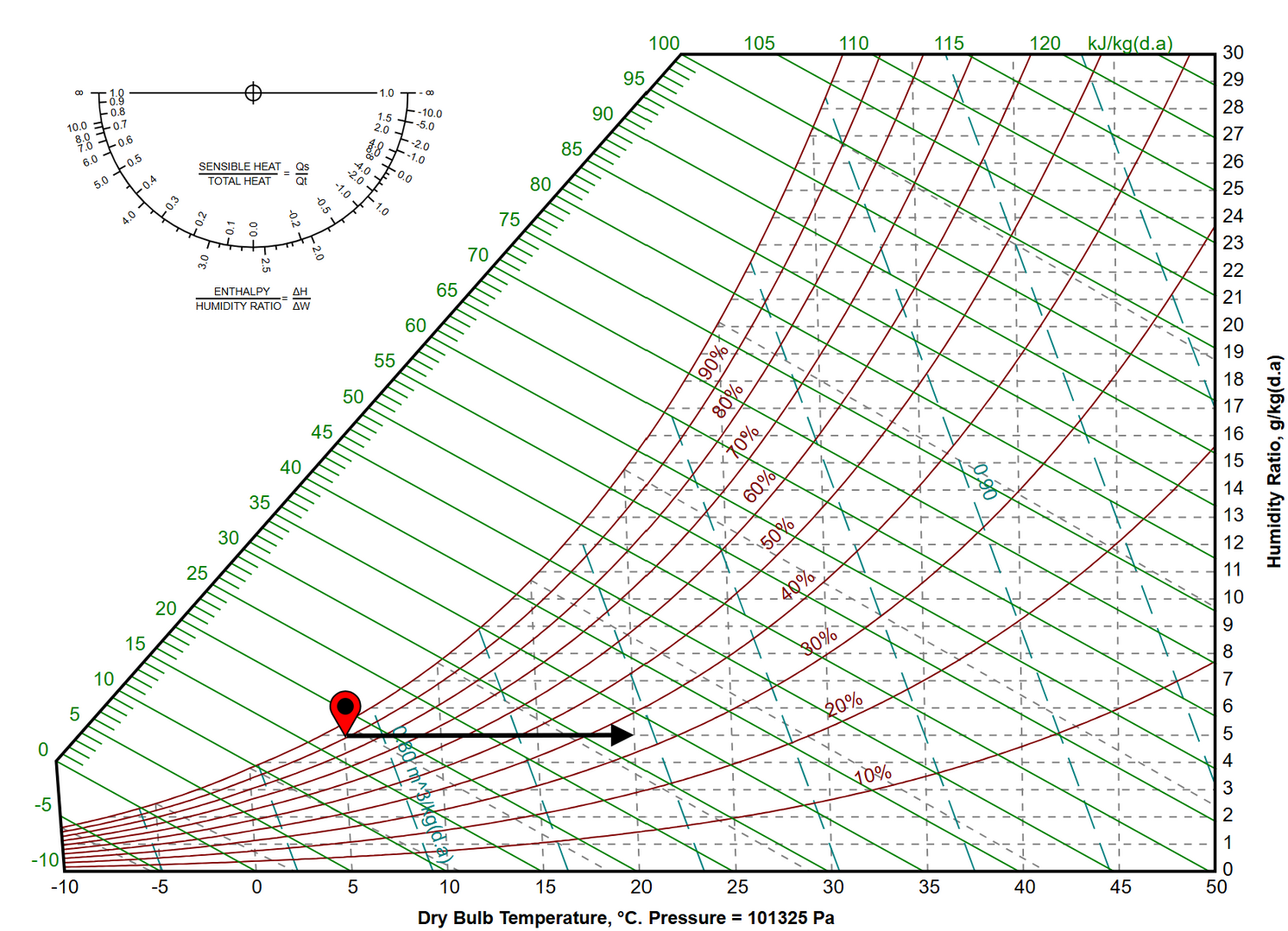
So humid outside air (ie, high RH) in winter is only a problem if the outside temperature is above 15°C.
Now how to size for cooling...
First take your heat loss, suppose you got 10kW at 20°C deltaT (indoors 20°C, outdoors 0°C) and express it in kW/°C of indoors/outdoors deltaT. However, the outdoors temperature is not necessarily the air temperature: if a the outside surface of a sun baked south facing wall reaches 50°C, then heat leaking in through this wall must be calculated with a deltaT from an outdoors temperature of 50°C. Likewise roof tile temperature will probably reach 60°C so heat gain through the loft insulation must be calculated according to temperatrue inside the loft, which may (or not) be much higher than outside air temp.
Add solar heat gain for each window. This depends on the angle between the plane of the window and the direction of sun rays. It can add up very quicky to kilowatts especially for south/west facing windows so you need to consider louvred shutters or other means of keeping heat from the sun outside. Stuff like curtains etc, being inside, catch the sun rays and turn them into heat inside the house so do nothing to keep the heat out.
Now in summer, take 35°C, 60%RH outside air, bring it into the house and cool it to 25°C: follow the back arrow.
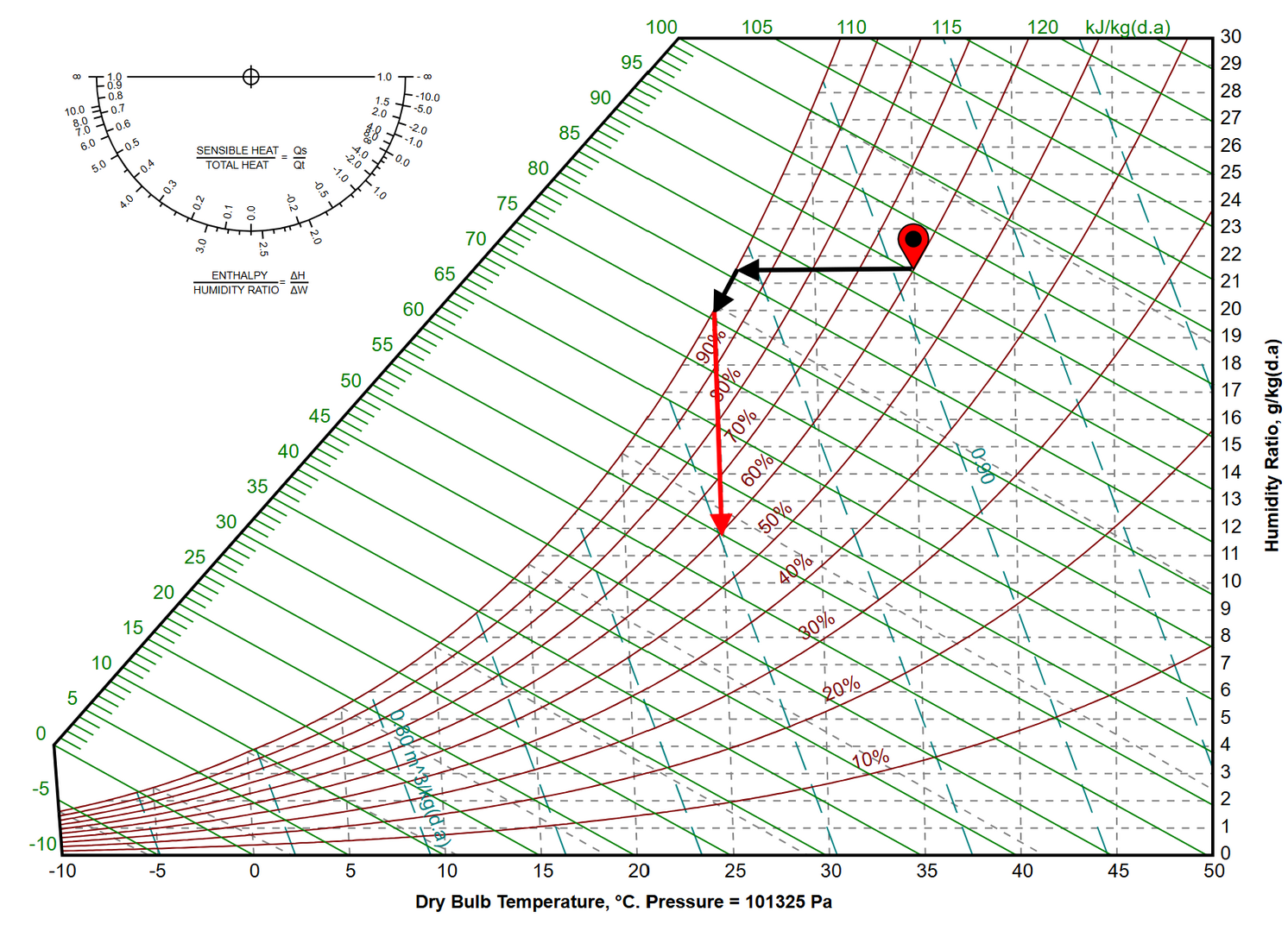
You get 25°C, 100%RH air, so sweat doesn't evaporate, even with a fan blowing it's uncomfortable, it feels like a swamp. That's what you get with a cooling system that can't dehumidify.
Now if you turn on the fan coils and drop RH to 50-60% by condensing water out of the air (red arrow), even if the temperature is exactly the same 25°C, it'll be much more comfortable.
However to achieve this each cubic meter of air (1.3 kg) needs have about 12 grams of water removed.
Water latent heat of vaporization is 2260 kJ/kg or 2.26 kJ/g so the heat pump needs to suck 27kJ of heat for each m3 of outside air that needs to be dehumidified.
For 200m3/h of air, this adds 1.5kW to the cooling load. So unintentional air leaks and air lost through ventilation and replaced by warm humid outside air must be considered.
Then you get your total cooling load. Depending on variables it may be similar or even higher to the heating load, in this case you may need a heat pump that is oversized for heating but adequate for cooling, or maybe the opposite.
Another consequence is that the flow temperature must be below the dew point to allow your fan coils to dehumidify the air, which means as said above all the pipes will be cold enough to attract condensation and must be vapor tight insulated, which is a meticulous finicky job with zero tolerance for error.
Multisplits don't have this issue because heat is transported as latent heat. If your main load is cooling, consider multisplit instead of hydronic. In fact I am surprised you're planning hydronic with fan coils only. Usually the reason to go with hydronic is an existing radiator system or radiant floors, then a few fan coils added for cooling. However if you design the system from scratch with fan coils only it would make more sense to use a multisplit...

SPONSORS

Degrees of Separation

Latest Posts
-

RE: Heat pump branding. Clever, contemporary… or a bit too much?
I think Heat Geek have done an amazing job on their bra...
By Tomtheheatingengineer , 7 hours ago
-
RE: HeatGeek vs Octopus surveys: puzzling disparity - any ideas why?
I have just had 3 heat loss surveys, one by heat geek o...
By David , 7 hours ago
-
RE: Heat Geek Zero Disrupt: Are We Sleepwalking Into Another Race to the Bottom?
I think that's the key question. After all inverter uni...
By Prunus , 9 hours ago
-
RE: battery storage without solar
As of October 1st they need specific qualifications to ...
By EtchedPixels , 10 hours ago
-
RE: How should the Boiler Upgrade Scheme be reformed?
A unit which uses water to transfer the heat/chill from...
By Temperature_Gradient , 10 hours ago
-
RE: Renewables & Heat Pumps in the News
With regards to the BUS grant raid, I gave it more thou...
By ASHP-BOBBA , 10 hours ago
-
RE: Why are ASHP installs so expensive?
The whole system seems to work on the basis of...
By ian33a , 11 hours ago
-
RE: Missing flow temperature in Heat Geek proposal
Good plan. If you can get half hourly meter readings a...
By JamesPa , 16 hours ago
-
RE: Heat Pumps Without Grants: Would You Have Installed One & Will You Now?
@editor Most certainly. The heat pump was an ideal s...
By Abernyte , 16 hours ago
-
Although regulations may well vary from country to coun...
By Majordennisbloodnok , 17 hours ago
-
RE: Does anyone have experience of a smart water meter?
Yep I caught our slow leak from a £100 bill rise 8)
By EtchedPixels , 17 hours ago
-
RE: Do You Need a Buffer Tank or Low Loss Header for Underfloor Heating in a Large Property?
@jamespa in some cases, failing the Turing test might b...
By GrahamF , 20 hours ago
-
RE: Passiv Smart Thermostat - Help & Forum Support
@energystoragetech The heat capacity of some...
By JamesPa , 22 hours ago
-
RE: tepeo ZEB UK Support & Info Thread
Sorry you are correct, I was remembering figures from t...
By JamesPa , 1 day ago




SPONSORS