

Notifications
Clear all
Joining the Renewable Heating Hub forums is completely free and only takes a minute. By registering you’ll be able to ask questions, join discussions, follow topics you’re interested in, bookmark useful threads and receive notifications when someone replies. Non-registered members also do not have access to our AI features. When choosing your username, please note that it cannot be changed later, so we recommend avoiding brand or product names. Before registering, please take a moment to read the Forum Rules & Terms of Use so we can keep the community helpful, respectful and informative for everyone. Thanks for joining!

Topic starter
29/01/2026 11:55 am
I’m sure there would be other settings that could be changed on a Vaillant to temporarily prohibit both heating and DHW, but that Holiday Mode gotcha is definitely a good spot; thanks, @judith.
105 m2 bungalow in South East England
Mitsubishi Ecodan 8.5 kW air source heat pump
18 x 360W solar panels
1 x 6 kW GroWatt battery and SPH5000 inverter
1 x Myenergi Zappi
1 x VW ID3
Raised beds for home-grown veg and chickens for eggs
"Semper in excretia; sumus solum profundum variat"

29/01/2026 12:28 pm
@ecoste i was reading the installation manual for my Cosy6 stored in manuals.lib last night. It warns not to set flow temp below 36C as it affects performance.
Big Question is why in the settings part of the App they allow you to adjust it down to 30C, contradictory to the manual.
I've got mine set to 36C and getting COP of 4.59 last week. Don’t feel inclined to tinker with the setting to see if it lowers the COP, also would need to assess any changes made with the different weather each week, how many times the doors are opened (change of air volume), solar gain (lol its January)
Topic starter
11/03/2026 9:46 pm
An off-the-wall question; has anyone come across a relatively cheap smart light for outside with PoE connectivity? The only things I’ve found are ridiculously expensive and don’t look great. In fact, they’re costlier than PoE security cameras with lighting integrated, and all I want is the light bit.
105 m2 bungalow in South East England
Mitsubishi Ecodan 8.5 kW air source heat pump
18 x 360W solar panels
1 x 6 kW GroWatt battery and SPH5000 inverter
1 x Myenergi Zappi
1 x VW ID3
Raised beds for home-grown veg and chickens for eggs
"Semper in excretia; sumus solum profundum variat"

12/03/2026 10:44 am
I'm unsure what you're wanting by having a PoE connection @majordennisbloodnok
Is that just a way of getting power to the outside light?
It's relatively easy to assemble your own smart-light, especially if you're a contributor to a Tinkerers' Corner. 😉
The RCWL-0516 is a microwave presence detector which can be installed within any (non-metallic) external enclosure. It triggers an output if a human approaches within a range of around 5-8m.
There are a couple of pads on a corner of the PCB which allows you to add an LDR light-sensor. The presence detector output will then be prohibited from operation in daylight.
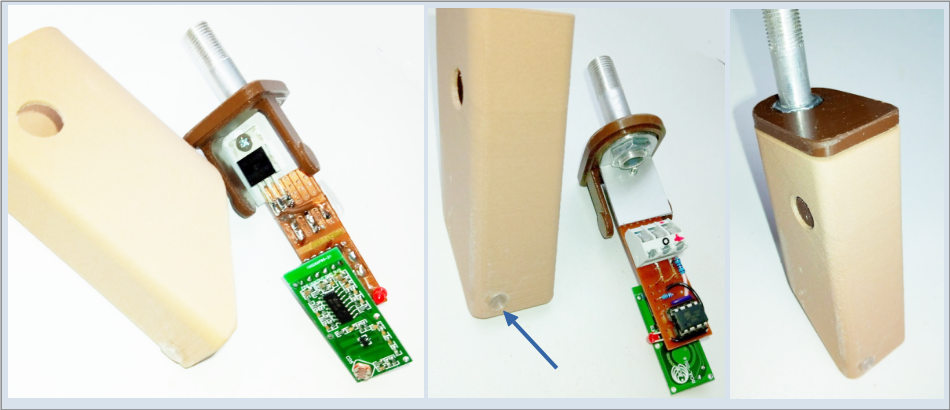
In the above example I've added an AT-Tiny-85 microcontroller and a 'logic-level' mosFET to control the brightness of the LED (porch) light, which is mounted separately.
My enclosure is 3D-printed, and includes a transparent window (arrowed) which allows in enough daylight to trigger the LDR.
In my case the method of operation is for the porch light to come on at 20% brightness at dusk.
If a human approaches, then it fades up to 70% within a second.
It will remain at that higher level for 1-minute after the microwave sensor is no longer being triggered, then fade down to 20% over 5 seconds.
This post was modified 7 months ago by Transparent
Save energy... recycle electrons!

Topic starter
12/03/2026 11:53 am
Thanks, @transparent.
The reason I want PoE is twofold. Firstly, it’s a lot easier to run some cat6 cable than wire in a new mains socket, especially for more remote places. The second is that I don’t want motion detection so much as the ability to control it from Home Assistant, and I’d far prefer to do that over a wired connection than wifi.
I am starting to think I may need to do something DIY with an esp32 board and an RJ45 socket to build my own but if there’s something already available I’d love to see it.
105 m2 bungalow in South East England
Mitsubishi Ecodan 8.5 kW air source heat pump
18 x 360W solar panels
1 x 6 kW GroWatt battery and SPH5000 inverter
1 x Myenergi Zappi
1 x VW ID3
Raised beds for home-grown veg and chickens for eggs
"Semper in excretia; sumus solum profundum variat"
12/03/2026 12:15 pm
Yes, I too use LAN cabling from a PoE router to supply power to remote places.
In my case that (Netgear) PoE Router is itself supplied with a nominal 50-52v DC from my LiFePO₄ storage battery 🙂
Unlike you, I don't have Home Assistant, and I prefer each light to have integral autonomous control.
I don't like the thought of having a single point of failure which could lose control of everything at the same time.
This post was modified 7 months ago by Transparent
Save energy... recycle electrons!

12/03/2026 12:50 pm
Yes, I too use LAN cabling from a PoE router to supply power to remote places.
I hear that can work very well. It is probably easier to keep secure than the average wifi repeater..
I use my Home assistant more like a lab, so will never be the most reliable. But when it comes operating smart plugs, using HA does not stop them from being operated via their own apps, so it is not difficult to make sure that it is not single point of failure (SPF) for those simpler routines.
Since I try to prevent SPF, I end up with multiple points of control. And when some issue crops up, that can make it more difficult to troubleshoot. So no simple answer?
I have to admit that I generally underestimate the effort involved in keeping every bit updated and tuned to work as my needs change.
8kW Solis S6-EH1P8K-L-PLUS hybrid inverter; G99: 8kW export; 16kWh Seplos Fogstar battery; Ohme Home Pro EV charger; Vaillant Arotherm Pro 7kW; 100Amp head, HA lab on mini PC
Topic starter
12/03/2026 5:06 pm
@batpred, you’re quite right; it does work well. I don’t have any repeaters and I don’t have a mesh network. I do, of course, have wifi but that’s via physical access points cabled back to the central switch (and PoE over the same cable, meaning no need to compromise on siting just to be able to plug it in).
Anything I care about is wired so that the connection is as secure as it can be. You’re right that single points of failure exist, but in my case I’m comfortable the time to recover is an acceptable timeframe; it is, after all, only a domestic setting. You are also right that all my smart kit will continue operating with sensible defaults whilst uncontactable, and that is why I’d prefer a ready made solution for the PoE outside lighting. It’s only an extra to augment what we have already, though, so it’s not the end of the world if it became unavailable for a while.
One thing I have done to cope with the extra complexity of the installation I have is to install the BookStacks addon and create a home Wiki for documenting everything. The HA server is backed up regularly to the cloud, so a quick restore to another HA box would give me all my documentation immediately. And yes, I have tested it in practice. 🙂
This post was modified 7 months ago by Majordennisbloodnok
105 m2 bungalow in South East England
Mitsubishi Ecodan 8.5 kW air source heat pump
18 x 360W solar panels
1 x 6 kW GroWatt battery and SPH5000 inverter
1 x Myenergi Zappi
1 x VW ID3
Raised beds for home-grown veg and chickens for eggs
"Semper in excretia; sumus solum profundum variat"

Topic starter
19/05/2026 5:24 pm
OK, here's a rather off-the-wall discovery I've made that might be of interest to anyone running Home Assistant.
Within HACS is a downloadable and installable integration called "DVLA Vehicle Enquiry Service for Home Assistant". It seems that the DVLA have made their vehicle enquiries available via an API as well as a normal web form, and that someone has written an integration for HA to make use of that API. It does require you to register with the DVLA to get an API key, but that's free. I've done this and now I'm able to use HA to display the tax and MOT status for both my vehicles, and to notify me if either status for either vehicle is getting anywhere near expiry. Now there are no visible tax discs in use any more, it's a useful way for me not to forget these important dates.
It also, as it happens, tells me other information (CO2 emissions, colour, engine capacity, fuel type, type approval, wheelplan, my inside leg measurement and the 37 character pass code to each of the hangars at Area 51) that I'm sure I'll never need, but I'm a bit of a geek so I'm presenting that to HA too. I haven't checked, but it might help make the tea too.
N.B. Not all of what I've told you is entirely accurate, but the dates and statuses are. Experiment and enjoy.
105 m2 bungalow in South East England
Mitsubishi Ecodan 8.5 kW air source heat pump
18 x 360W solar panels
1 x 6 kW GroWatt battery and SPH5000 inverter
1 x Myenergi Zappi
1 x VW ID3
Raised beds for home-grown veg and chickens for eggs
"Semper in excretia; sumus solum profundum variat"
2
23/05/2026 11:29 am
The Smart & Secure Electricity Systems workgroup within DESZ have announced an amendment to the Energy Act (2023) describing a data format in which (domestic) Energy Suppliers must deliver tariff information to 3rd party Agents.
SSES is driving forward a national mechanism to allow licensed Agents to remotely turn off heat pumps during periods of high demand. The Householder would sign up for this service and receive compensation directly into their electricity account.
The Tariff Interoperability Data Item Catalogue is published as a PDF, and lists the required data format.
It's unclear to me if this Tariff Data Format is to be made available solely to licensed 3rd-party Agents, or whether Energy Suppliers are being asked to make tariffs available to their customers using this format via an API.
The latter would be of obvious interest to readers here. I've previously communicated with the SSES Staff using this email address. Now would be a good time to comment on their proposals and point out that there exists an enthusiastic band of geeks who use tariff data to monitor and control their household energy usage. This may not yet be appreciated by DESNZ.
Save energy... recycle electrons!
23/05/2026 3:33 pm
SSES is driving forward a national mechanism to allow licensed Agents to remotely turn off heat pumps during periods of high demand. The Householder would sign up for this service and receive compensation directly into their electricity account.
I will soon be struggling. Admittedly it is the summer, but £30 a month including EV charging (without PV) is not a bad ad to how people can make renewables work.
If on top of that, we start getting payments for not running the pump (that will most likely be oversized), I feel we will struggle to find a way to spread the good word. 😁
I wonder whether the gas band is that cricket in the old tale. Come reckoning time, they will be asking themselves why they could neither find a way to invest in hydrogen production nor in carbon capture.
Now seriously, thank you, I will take a look..
I suspect that home assistant could gain an integration to enable activation of that shiny new mini slot machine.. 😉
This post was modified 5 months ago 2 times by Batpred
8kW Solis S6-EH1P8K-L-PLUS hybrid inverter; G99: 8kW export; 16kWh Seplos Fogstar battery; Ohme Home Pro EV charger; Vaillant Arotherm Pro 7kW; 100Amp head, HA lab on mini PC
Page 8 / 8
Prev
SPONSORS

Degrees of Separation

Latest Posts
-

RE: Heat pump branding. Clever, contemporary… or a bit too much?
I think Heat Geek have done an amazing job on their bra...
By Tomtheheatingengineer , 7 hours ago
-
RE: HeatGeek vs Octopus surveys: puzzling disparity - any ideas why?
I have just had 3 heat loss surveys, one by heat geek o...
By David , 7 hours ago
-
RE: Heat Geek Zero Disrupt: Are We Sleepwalking Into Another Race to the Bottom?
I think that's the key question. After all inverter uni...
By Prunus , 8 hours ago
-
RE: battery storage without solar
As of October 1st they need specific qualifications to ...
By EtchedPixels , 9 hours ago
-
RE: How should the Boiler Upgrade Scheme be reformed?
A unit which uses water to transfer the heat/chill from...
By Temperature_Gradient , 10 hours ago
-
RE: Renewables & Heat Pumps in the News
With regards to the BUS grant raid, I gave it more thou...
By ASHP-BOBBA , 10 hours ago
-
RE: Why are ASHP installs so expensive?
The whole system seems to work on the basis of...
By ian33a , 10 hours ago
-
RE: Missing flow temperature in Heat Geek proposal
Good plan. If you can get half hourly meter readings a...
By JamesPa , 15 hours ago
-
RE: Heat Pumps Without Grants: Would You Have Installed One & Will You Now?
@editor Most certainly. The heat pump was an ideal s...
By Abernyte , 16 hours ago
-
Although regulations may well vary from country to coun...
By Majordennisbloodnok , 16 hours ago
-
RE: Does anyone have experience of a smart water meter?
Yep I caught our slow leak from a £100 bill rise 8)
By EtchedPixels , 16 hours ago
-
RE: Do You Need a Buffer Tank or Low Loss Header for Underfloor Heating in a Large Property?
@jamespa in some cases, failing the Turing test might b...
By GrahamF , 19 hours ago
-
RE: Passiv Smart Thermostat - Help & Forum Support
@energystoragetech The heat capacity of some...
By JamesPa , 21 hours ago
-
RE: tepeo ZEB UK Support & Info Thread
Sorry you are correct, I was remembering figures from t...
By JamesPa , 1 day ago


SPONSORS
