Joining the Renewable Heating Hub forums is completely free and only takes a minute. By registering you’ll be able to ask questions, join discussions, follow topics you’re interested in, bookmark useful threads and receive notifications when someone replies. Non-registered members also do not have access to our AI features. When choosing your username, please note that it cannot be changed later, so we recommend avoiding brand or product names. Before registering, please take a moment to read the Forum Rules & Terms of Use so we can keep the community helpful, respectful and informative for everyone. Thanks for joining!
If you are looking for a device that works with EV chargers or solar PV (which requires bi-directional current flow), you would typically need a Type A or specifically designed bi-directional unit, rather than a standard Type AC RCD.
Thanks and noted (but did you mean battery rather than EV, EV is currently unidirectional - or was the comment meant to refer to possible pulsating DC current with EV?).
Here we are looking at the specific case of plug in batteries/solar, where the unit is supplied for DiY 'installation and cuts out if the grid fails (no islanding).
The question we are trying to answer is, is there actually a risk that the wrong type of RCD/RCBO will fail. There is speculation that this risk exists but no quantification of that risk. Are you able to quantify it or explain further?
This post was modified 6 months ago 4 times by JamesPa
4kW peak of solar PV since 2011; EV and a 1930s house which has been partially renovated to improve its efficiency. 7kW Vaillant heat pump.
@jamespa, that’s a fair point, and we’re actually in a very similar position. Our consumer unit is about 9 years old, so a full replacement isn’t really on the table for us either... once you’re into four figures, it completely changes the economics of a plug-in battery. Thankfully, we can swap out the RCBO on the specific circuit we plan to use, which feels like a much more proportionate approach.
Your point about parts availability and electricians being reluctant to touch older boards is a good one, though... that’s going to be a real-world blocker for a lot of people, and not something most manufacturers are talking about.
And I completely agree with you: most people simply won’t check. If it’s sold as a plug-and-play product, the assumption will be that it’s universally safe to plug in anywhere.
The actual risk level is the key unanswered question. My instinct is the same as yours... for short-duration export events like the Powerflex, the probability of an issue is likely low in normal conditions. But low probability doesn’t mean zero, and without clear manufacturer guidance or UK-specific compliance detail, people will be left to make personal judgement calls.
I'm going to be fascinated to see how the regs are drawn up around this.
The actual risk level is the key unanswered question. My instinct is the same as yours... for short-duration export events like the Powerflex, the probability of an issue is likely low in normal conditions. But low probability doesn’t mean zero, and without clear manufacturer guidance or UK-specific compliance detail, people will be left to make personal judgement calls.
As I understand it the part that would fail is a solenoid coil and the failure mechanism is getting too hot because its energised for too long.
If the inverter cuts out in 30ms or less then I cant see it can possibly fail, because that's the disconnect time in a fault condition and the coil must obviously to survive that otherwise its not fit for its original purpose. I would guess that it must survive this by a fair margin.
So, it seems to me, that an inverter that doesn't support islanding and disconnects on grid failure in a time comparable to 30ms poses (probably) zero risk.
I dont actually know what the required or actual disconnect time is but funding that out might be the next step.
PS. It looks like the required disconnection time depends on the grid state, up to 20s for under-frequency, much less for other faults. There are also specs for minimum time before disconnect in the case of underfrequency (presumably to accommodate grid frequency fluctuations).
Obviously it takes time to detect a small under (or over)-frequency (you need several cycles), so this makes sense. However one could detect serious undervoltage/underfrequency (ie a power cut) outside normal grid limits much more quickly (certainly within 40ms). I cant immediately think of a reason why an inverter couldn't do this, whether any particular inverter does is another matter.
This post was modified 6 months ago 3 times by JamesPa
4kW peak of solar PV since 2011; EV and a 1930s house which has been partially renovated to improve its efficiency. 7kW Vaillant heat pump.
if you have an older CU (like mine - about 15 years) then the components may not be available.
You can of course, have any manufacturers' trips installed. They don't need to be the same as those you already have.
Sometimes the 'height' of the live-input at the bottom of the trip is slightly different from the existing trips. But an electrician can use a pair of pliers to put a slight S-bend into the copper busbar as required.
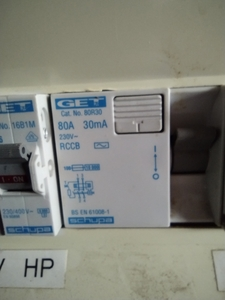
the (old) RCD in mine, which protects the sockets in the house but not the lighting, PV or HP circuits, looks like it might be bidirectional as it appears it may have the additional cut out
It is bi-directional.
That's because it's an RCD rather than an RCBO 😉
The question of uni-directional and bi-directional devices only occurs when an RCBO is being referred to.
For the sake of clarity, an RCBO is a protection device which combines two features
earth-leakage detection (also called 'residual current' detection: is the current the same between Live and Neutral?
over-current detection: is the current more than the trip is rated for?
I really don't mind how many times I have to repeat this description. Anyone reading this who still isn't clear on the issue should ask again.
It's a Safety matter, and this Forum will continue to explain this as many times as requested.
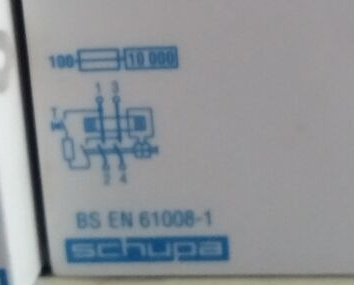
@jamespa - the diagram you're referring to is that for an RCD. The 'third' connection wire you're looking at, on the left of the circuit, is the 'test loop' which makes it trip out when you press the button.
Yes I know that, but I thought the problem you described was caused by the RCD function of an RCBO (ie if it fails it continues to operate as an MCB but not as an RCD). I therefore presumed, perhaps incorrectly, that the same problem might occur with an RCD on the basis that it (presumably) uses similar circuitry for the RCD part of its function.
Are you saying that all RCDs (but not RCBOs) are bidirectional as well as all MCBs, so the problem is specific to RCBOs only and not to either RCDs or MCBs (even though an RCBO combines the two functions)?
@jamespa - the diagram you're referring to is that for an RCD. The 'third' connection wire you're looking at, on the left of the circuit, is the 'test loop' which makes it trip out when you press the button.
If you look carefully at the diagram there is a symbol for a 'test' (marked 'T') with a breaker to the right of it - ie the actual switch corresponding to the symbol for the button, and then three further breakers in a line which I presume are operated by the solenoid.
You can of course, have any manufacturers' trips installed. They don't need to be the same as those you already have.
Only if the electrician will do this, which many, I am told, wont, citing (I am told) the instructions of many CU boxes which say (for some unfathomable reason) you must only use the components from the same manufacturer.
This post was modified 6 months ago 14 times by JamesPa
4kW peak of solar PV since 2011; EV and a 1930s house which has been partially renovated to improve its efficiency. 7kW Vaillant heat pump.
Therefore the solenoid itself gets de-energised and can't burn out.
Thanks, that makes sense - sort of - although since the test button disconnects the supply surely the same could have been achieved (with one less component) by taking the supply to the test button from the other side of the main breakers hence why I was querying its purpose (occams razor!).
Yes I know that [its an RCD], but I thought the problem you described was caused by the RCD function of an RCBO (ie if it fails it continues to operate as an MCB but not as an RCD). I therefore presumed, perhaps incorrectly, that the same problem might occur with an RCD on the basis that it (presumably) uses similar circuitry for the RCD part of its function.
Are you saying that all RCDs (but not RCBOs) are bidirectional as well as all MCBs, so the problem is specific to RCBOs only and not to either RCDs or MCBs (even though an RCBO combines the two functions)?
This post was modified 6 months ago 4 times by JamesPa
4kW peak of solar PV since 2011; EV and a 1930s house which has been partially renovated to improve its efficiency. 7kW Vaillant heat pump.
You can of course, have any manufacturers' trips installed. They don't need to be the same as those you already have.
Only if the electrician will do this, which many wont, citing (I am told) the instructions of many CU boxes which say (for some unfathomable reason) you must only use the components from the same manufacturer.
There are reputable sellers of 'old' trips here in UK.
You can of course, have any manufacturers' trips installed. They don't need to be the same as those you already have.
Only if the electrician will do this, which many wont, citing (I am told) the instructions of many CU boxes which say (for some unfathomable reason) you must only use the components from the same manufacturer.
There are reputable sellers of 'old' trips here in UK.
Both companies buy stock from electrical companies who cease trading as well as second-hand stock.
Yes I know. Obviously you only speak to helpful electricians. Some of those I have spoken to would use the 'old cu - no parts available' excuse notwithstanding that they are!
(Yes I know that [its an RCD]), but I thought the problem you described was caused by the RCD function of an RCBO (ie if it fails it continues to operate as an MCB but not as an RCD). I therefore presumed, perhaps incorrectly, that the same problem might occur with an RCD on the basis that it (presumably) uses similar circuitry for the RCD part of its function.
Are you saying that all RCDs (but not RCBOs) are bidirectional as well as all MCBs, so the problem is specific to RCBOs only and not to either RCDs or MCBs (even though an RCBO combines the two functions)?
Are you saying that all RCDs (but not RCBOs) are bidirectional as well as all MCBs, so the problem is specific to RCBOs only and not to either RCDs or MCBs (even though an RCBO combines the two functions)?
I can say that all RCDs are bi-directional.
MCBs for AC circuits are normally OK to use bi-directionally, but the trip-time might not be within spec. Most MCBs have both thermal and electro-mechanical trip systems within the device. The trip-time is defined with the current passing through the thermal contact first.
MCBs for DC circuits are always uni-directional, and will have terminals marked plus and minus.
Yes, the problem we're now looking at for the DIY installation of plug-in storage (and plug-in solar) is only due to the use of RCBOs, usually to save space in a Consumer Unit.
Yes, the problem we're now looking at for the DIY installation of plug-in storage (and plug-in solar) is only due to the use of RCBOs, usually to save space in a Consumer Unit.
OK thats an important qualification. The BEEMA technical bulletin seems to suggest that both RCDs and RCBOs could be affected, but the IET write up hints that 2 module RCDs are not affected, presumably because of the type of construction.
So to confirm we are looking at a problem which occurs in RCBOs only, not RCDs even though an RCBO includes the functionality of an RCD.
MCBs for AC circuits are normally OK to use bi-directionally, but the trip-time might not be within spec.
Is this an issue and if so when? As I understand it MCBs protect the cable only and functionally replace fuses, so the trip time is presumably not a particular issue so long as a cable is unlikely to set fire during that time. Does it specifically relate to plug in solar or is this a separate observation
Sorry for asking lots of questions but as you say this relates to safety so precision in understanding is important!
This post was modified 6 months ago 2 times by JamesPa
MCBs for AC circuits are normally OK to use bi-directionally, but the trip-time might not be within spec.
Is this an issue and if so when? As I understand it MCBs protect the cable only and functionally replace fuses, so the trip time is presumably not a particular issue so long as a cable is unlikely to set fire during that time. Does it specifically relate to plug in solar or is this a separate observation
Well it's enough of an issue that both B-curve and C-curve MCBs are readily available.
The choice of the trip-time curve isn't related to the cable, but rather to the apparatus being supplied on that circuit.
I have C-curve protective devices on circuits where there are (large) motors. I don't want the trip to operate merely due to switch-on surges and back-EMF. The well-pump and the (mechanical) workshop are my best examples. The workshop has a fixed table saw, radial-arm saw and a TIG-welder.