

Notifications
Clear all
Joining the Renewable Heating Hub forums is completely free and only takes a minute. By registering you’ll be able to ask questions, join discussions, follow topics you’re interested in, bookmark useful threads and receive notifications when someone replies. Non-registered members also do not have access to our AI features. When choosing your username, please note that it cannot be changed later, so we recommend avoiding brand or product names. Before registering, please take a moment to read the Forum Rules & Terms of Use so we can keep the community helpful, respectful and informative for everyone. Thanks for joining!
Energy Storage
337
Posts
23
Users
119
Reactions
47.4 K
Views

04/05/2026 2:04 pm
MCBs for AC circuits are normally OK to use bi-directionally, but the trip-time might not be within spec.
Is this an issue and if so when? As I understand it MCBs protect the cable only and functionally replace fuses, so the trip time is presumably not a particular issue so long as a cable is unlikely to set fire during that time. Does it specifically relate to plug in solar or is this a separate observation
Well it's enough of an issue that both B-curve and C-curve MCBs are readily available.
The choice of the trip-time curve isn't related to the cable, but rather to the apparatus being supplied on that circuit.
I have C-curve protective devices on circuits where there are (large) motors. I don't want the trip to operate merely due to switch-on surges and back-EMF. The well-pump and the (mechanical) workshop are my best examples. The workshop has a fixed table saw, radial-arm saw and a TIG-welder.
OK thanks thats clear now, but not an issue that particularly relates to plug in solar then and not particularly a safety issue, more an issue of functionality in relation to the equipment requirements.
The key learning from this exchange, at least for me, is that the 'bidirectional issue' applies only to RCBOs not RCDs. This is different, so far as I read it, to what BEEMA imply (but do not expressly state), but not so different from what the IET says, albeit that I don't think either of these is entirely clear!.
Considering its a safety issue its rather disappointing that neither the IET nor BEEMA are clear (at least to my reading) and that it needed you to clarify it. For reference (because someone is bound otherwise to challenge it) are you able to quote your source or rationale for the conclusion?
This post was modified 6 months ago 6 times by JamesPa
4kW peak of solar PV since 2011; EV and a 1930s house which has been partially renovated to improve its efficiency. 7kW Vaillant heat pump.
1


Topic starter
04/05/2026 2:40 pm
I might create some more diagrams if that would help others to better understand what we're discussing.
I think visual aids would definitely help here!
🔥 Britain’s Heat Pump Shitshow
How Installing a Heating System Became a National Nervous Breakdown
Free UK shipping.
📗 Heat Pumps Explained
A Jargon-Free Guide for Homeowners
Rewritten and updated for 2027
📘 From Zero to Heat Pump Hero
🛠️ Bodge Buster
New to heat pumps?
Take the Heat Pump Fundamentals course and use INTRO50 at checkout for 50% off.
04/05/2026 3:18 pm
@editor would Indevolt like to comment on the shut down time of their inverter in the case of mains failure/very severe undervoltage and/or the risk to unidirectional RCBOs. If they can tell us its <30ms then I cant personally see that there is any risk, unless someone can explain otherwise.
4kW peak of solar PV since 2011; EV and a 1930s house which has been partially renovated to improve its efficiency. 7kW Vaillant heat pump.

04/05/2026 3:55 pm
For reference (because someone is bound otherwise to challenge it) are you able to quote your source or rationale for the conclusion?
Not easily.
Almost 5-years ago I had an email exchange with a couple of Chinese trip manufacturers.
That was instigated by me needing to understand how DC-approved MCBs operated. But their explanations also included details of the the thermal and electro-magnetic overload detection mechanisms, which was helpful.
Then in April/May '24 I was communicating with a senior manager at Proteus. They're a UK-based trip manufacturer who were already selling bi-directional RCBOs well before BEAMA alerted the IET of the problem with solenoid coils burning out.
Thus I have a great deal of respect for Proteus, and would certainly buy their products in future.
Although I went on to explore how RCBO's initiated the firing of the solenoid, this got complex. Each manufacturer has their own electronic circuit, and aren't wanting to openly state how it operates.
I was merely able to conclude that the electronics could stay 'live' in a uni-directional RCBO once the main contacts had opened. There's no contact which opens to remove power from that internal pcb.
The overall message is "Be prepared to talk directly with a manufacturer".
Save energy... recycle electrons!

Topic starter
04/05/2026 4:40 pm
@editor would Indevolt like to comment on the shut down time of their inverter in the case of mains failure/very severe undervoltage and/or the risk to unidirectional RCBOs. If they can tell us its <30ms then I cant personally see that there is any risk, unless someone can explain otherwise.
At @indevolt-uk, when you get a moment, please can you clarify this?
🔥 Britain’s Heat Pump Shitshow
How Installing a Heating System Became a National Nervous Breakdown
Free UK shipping.
📗 Heat Pumps Explained
A Jargon-Free Guide for Homeowners
Rewritten and updated for 2027
📘 From Zero to Heat Pump Hero
🛠️ Bodge Buster
New to heat pumps?
Take the Heat Pump Fundamentals course and use INTRO50 at checkout for 50% off.
04/05/2026 8:56 pm
For reference (because someone is bound otherwise to challenge it) are you able to quote your source or rationale for the conclusion?
Not easily.
Almost 5-years ago I had an email exchange with a couple of Chinese trip manufacturers.
That was instigated by me needing to understand how DC-approved MCBs operated. But their explanations also included details of the the thermal and electro-magnetic overload detection mechanisms, which was helpful.
Then in April/May '24 I was communicating with a senior manager at Proteus. They're a UK-based trip manufacturer who were already selling bi-directional RCBOs well before BEAMA alerted the IET of the problem with solenoid coils burning out.
Thus I have a great deal of respect for Proteus, and would certainly buy their products in future.
Although I went on to explore how RCBO's initiated the firing of the solenoid, this got complex. Each manufacturer has their own electronic circuit, and aren't wanting to openly state how it operates.
I was merely able to conclude that the electronics could stay 'live' in a uni-directional RCBO once the main contacts had opened. There's no contact which opens to remove power from that internal pcb.
The overall message is "Be prepared to talk directly with a manufacturer".
That all makes sense thanks, albeit that it is not exactly a quotable reference which is no fault of yours.
Presumably somewhere in this you also spoke with them about RCDs and concluded that the trip circuits for these are different to RCBOs and thus immune from the problem.
IET (unlike BEMA) seem to be fairly sure that two module RCDs are immune, but less clear about single module RCDs. Its all a bit messy really and has an air of manufacturers hiding the facts possibly even to sell more kit!
4kW peak of solar PV since 2011; EV and a 1930s house which has been partially renovated to improve its efficiency. 7kW Vaillant heat pump.
1
05/05/2026 8:12 am
As I understand it the part that would fail is a solenoid coil and the failure mechanism is getting too hot because its energised for too long.
If the inverter cuts out in 30ms or less then I cant see it can possibly fail, because that's the disconnect time in a fault condition and the coil must obviously to survive that otherwise its not fit for its original purpose. I would guess that it must survive this by a fair margin.
So, it seems to me, that an inverter that doesn't support islanding and disconnects on grid failure in a time comparable to 30ms poses (probably) zero risk.
I dont actually know what the required or actual disconnect time is but funding that out might be the next step.
PS. It looks like the required disconnection time depends on the grid state, up to 20s for under-frequency, much less for other faults. There are also specs for minimum time before disconnect in the case of underfrequency (presumably to accommodate grid frequency fluctuations).
Obviously it takes time to detect a small under (or over)-frequency (you need several cycles), so this makes sense. However one could detect serious undervoltage/underfrequency (ie a power cut) outside normal grid limits much more quickly (certainly within 40ms). I cant immediately think of a reason why an inverter couldn't do this, whether any particular inverter does is another matter.
OK so thinking about this further, a compliant plug in inverter (as distinct from one that is permanently wired) must shut down on loss of mains within a very short period of time like 30ms because, if it didn't, someone pulling the plug could get a shock from the exposed pins.
This being the case I would venture to suggest that the potential failure mode of a unidirectional RCBO which is being discussed in this thread does not apply to plug in inverters! Obviously if the shut down mechanism fails then it could, but in that case anyone pulling the plug is at immediate risk of electrocution, so there are bigger fish to fry in safety terms if that is at all likely.
I invite @transparent, @mars, @indevolt-uk to comment.
This post was modified 6 months ago 2 times by JamesPa
4kW peak of solar PV since 2011; EV and a 1930s house which has been partially renovated to improve its efficiency. 7kW Vaillant heat pump.

05/05/2026 1:36 pm
@editor Thank you for raising the question.
Our inverters are all designed and developed in strict compliance with local grid-connection regulations, and are equipped as standard with compliant anti-islanding protection.
Regarding the conditions you mentioned, such as a mains power outage or severe undervoltage, these will not cause impact, nuisance tripping, or any long-term safety hazard to the upstream single-direction RCBO. Under normal and compliant installation and use, there is no related safety risk in these scenarios.
In addition, our equipment is fitted with an EPS emergency power supply switching function, which enables an ultra-fast switching response of 10 ms.
1

Topic starter
05/05/2026 10:31 pm
Thanks @indevolt-uk… that’s a really useful clarification, and the 10ms EPS switching figure is the number that I think @jamespa was looking for.
To pick up on James’ logic, which I think is sound, any plug-in inverter that shuts down in 10ms is well inside the window that probably matters most here from a safety perspective.
The concern around unidirectional RCBOs appears to be sustained reverse current energising a solenoid coil for long enough to cause thermal damage. At 10ms, that scenario shouldn’t arise because the inverter is off before the RCBO is even aware there’s a problem.
What this exchange has actually confirmed, and it’s worth flagging for anyone reading this thread later, is that the RCBO bidirectionality question is more nuanced than BEAMA’s guidance makes it appear. The risk is real in some configurations (particularly with permanently wired, non-compliant or islanding-capable inverters), but for a plug-in device with fast anti-islanding shutdown, the practical risk appears to be negligible. It’s a remarkably complex subject.
That said, I’d still encourage anyone installing any battery or solar kit to specify bidirectional RCBOs as standard. The cost difference is marginal and it removes the question entirely.
@transparent’s point about going direct to manufacturers when the guidance is unclear is also well taken.
🔥 Britain’s Heat Pump Shitshow
How Installing a Heating System Became a National Nervous Breakdown
Free UK shipping.
📗 Heat Pumps Explained
A Jargon-Free Guide for Homeowners
Rewritten and updated for 2027
📘 From Zero to Heat Pump Hero
🛠️ Bodge Buster
New to heat pumps?
Take the Heat Pump Fundamentals course and use INTRO50 at checkout for 50% off.
06/05/2026 1:01 am
Thanks @editor , @indevolt-uk Subject to any comments from @transparent I think we have made some great progress in understanding this issue.
Regarding functionality, I note that there is no current transformer/energy meter included in the standard pack but there is reference to an Indevolt energy meter and a Shelley EM. Obviously such a device would be needed if you want to try to balance house load for (eg) zero import/export for a period during the day. I have read the manual to try to understand what it can do and my question is
With the addition of either a Shelly EM or the indevolt meter, is it possible to set it up to
- discharge at a sufficient rate just to balance house demand (or net demand if there is a totally separate PV system AC coupled in via the consumer unit) - obviously only within the max discharge capability of the unit and whilst there is charge left
- charge at a sufficient rate just to balance excess generation (if there is a totally separate PV system AC coupled in via the consumer unit) - obviously only within the max charge capability of the unit and whilst there is battery capacity left
- do either (1) or (2) as appropriate, with the unit deciding real time whether to charge or discharge and at what rate (to deal with clouds/days when solar is intermittant)
- Force charge/discharge at a specific time of day whilst doing 1/2/3 at other times of day
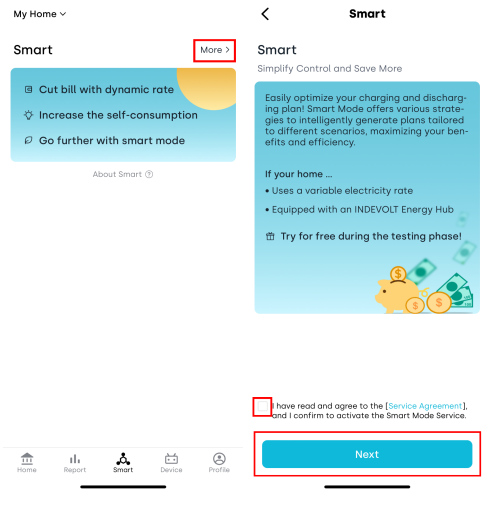
I think that all of this functionality is described in the app manual but cant be sure without a device in front of me because its all in the app which presumably doesnt work unless there is a battery and energy meter connected. Its also unclear whether the various operations above can be combined (it seems to require a combination of 'self consumed prioritized' and 'charge discharge schedule').
Also is this all free/cloud independent. There is a screenshot in the manual which suggests some features require a subscription. Clarity on what you get 'out of the box' is important here. If the above isn't free/cloud independent, is it possible to clarify what features are?
I suspect this is a very common use case. I have a nighttime tarrif that is less than my export tarrif which in turn is less than the daytime tarrif (Octopus Go/Outgoing Octopus). So the obvious operating mode is to force charge at night, then discharge during the day to match demand until the battery is exhausted, but if there is excess PV, recharge from the excess PV for discharge later in the evening (so in Summer I would get 2 cycles, in winter only 1). This requires a combination of 1-4 above allowing for the intermittency of PV.
This post was modified 6 months ago 10 times by JamesPa
4kW peak of solar PV since 2011; EV and a 1930s house which has been partially renovated to improve its efficiency. 7kW Vaillant heat pump.
1

06/05/2026 1:37 pm
@indevolt-uk Keen to know more about the pricing and when this would be available in the UK.
16 * 435 watts PV
13 kWh Growatt battery
1 EV - Mercedes EQB
6 kW Aira Heat Pump
Bosch Induction Hob
Pod Point Solo 3 charger
07/05/2026 11:38 am
I think that all of this functionality is described in the app manual but cant be sure without a device in front of me because its all in the app which presumably doesnt work unless there is a battery and energy meter connected.
Can @editor please clarify:
Does the Indevolt App communicate locally with their storage battery (via Bluetooth for example),
or is the Powerflex sending data to an Indevolt server somewhere, and the App then retrieves that data via the internet?
What continues to operate in the absence of the internet?
Regarding the conditions you mentioned, such as a mains power outage or severe undervoltage, these will not cause impact, nuisance tripping, or any long-term safety hazard to the upstream single-direction RCBO. Under normal and compliant installation and use, there is no related safety risk in these scenarios.
That's a fair overview-type of response, but it doesn't give me sufficient technical detail to understand how this functional compliancy would operate in the presence of a fault.
1: Full mains power outage. What happens when the power is restored?
Does the Powerflex wait a random period of time before its mains connection commences export?
At what moment in this sequence does the EPS socket cease exporting?
Is there another 10mS switching time back to normal operation?
2: severe undervoltage. G98 requires generation and storage devices to work within the voltage envelope of 216.4v – 253v.
That range is derived from the target LV of 230v, -6% to +10%
During sustained undervoltage, the device must cease export before the grid voltage drops to 184v.
That's tricky to detect because the device itself actually raises the voltage on its grid-connection when exporting.
That's why current flows from the G98 Device and into the home.
A fault condition would be the consequence of Indevolt's software failing to operate within these voltage and timings parameters.
The more plug-in solar and plug-in storage devices which are installed, the more likely it is that we see grid-voltages descending from 216.4v to 184v over a period of several seconds, rather than there being an instantaneous outage which affects an area.
Each storage device which ceases export will reduce the voltage further. We get a cascade effect as G98-connected apparatus sequentially detect an undervoltage and 'decide' that it is sufficiently 'sustained' that they should also cease export.
Testing each individual generation/storage device for G98 compliancy may create a 'pass' which is not a good indication of what might occur within an area where there is a high number of installations.
Both the UK Outage on 9th August 2019, and the Iberian total grid collapse of 28th April 2025 occurred due to hundreds of embedded generation/storage devices ceasing to operate in a Cascade Effect. The voltage point and timing of a device ceasing to export shouldn't be arbitrary decisions by each manufacturer. Randomisation and voltage envelopes need considering even tho' they aren't (yet) stipulated in G98 specifications.
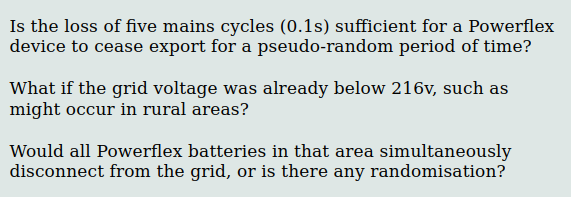
3: Now that plug-in solar and plug-in storage are both available (albeit not yet legal in UK) isn't it more likely that households will buy at least one of each product?
In a grid-outage situation, how could a Powerflex battery know that the grid is 'down' and that the 50Hz it sees isn't actually coming from a plug-in solar device?
What could prevent that plug-in solar device remaining 'live' because it detects the 50Hz output from a Powerflex device?
If a (unidirectional) RCBO detects a live/neutral imbalance as the grid goes down, it should open its contacts of course. But the plug-in solar and plug-in storage devices could fool each other into remaining live long enough to burn out the solenoid coil in that RCBO.
Is that a fault condition?
After all, each device could have passed G98 certification parameters separately.
What about the plug-in solar devices which have already been sold into the UK market?
What about those which export more than 800w?
What happens if a tested & certified Powerflex unit finds itself on the same circuit as plug-in solar devices which haven't got G98 approval?
This post was modified 6 months ago by Transparent
Save energy... recycle electrons!
1

SPONSORS
Degrees of Separation
Latest Posts
-

@editor Ouch, sorry to re start the tick. I had assume...
By DavidB , 38 minutes ago
-
RE: Say hello and introduce yourself
@e-a-west as the good Major said, welcome to the forums...
By Mars , 2 hours ago
-
RE: New Build 3 Phase or 1Phase
We are on three phase power because it's an enormous li...
By EtchedPixels , 2 hours ago
-
RE: How much of your renewable and home setup would still work if the internet went down?
Yes I actually have a copy of a tool that whenever a ce...
By EtchedPixels , 11 hours ago
-
RE: How will removing the standing charge on gas bills benefit heat pumps?
The shoulder months are very difficult to judge COP on ...
By scrchngwsl , 12 hours ago
-
RE: Indevolt Batteries UK Support & Info Thread
@editor Hi, To resolve this, please tap on the A...
By Indevolt Tech , 19 hours ago
-
RE: Double or Triple Glazed Windows?
Posted by: @singlespeed With 9 years repairing windo...
By Rob of York , 1 day ago
-
@transparent we’re still running a secure version of PH...
By Mars , 2 days ago
-
RE: How quickly would you want/expect heat recovery to take from setback?
Much longer than that here. The heating isn't even on. ...
By bobflux , 2 days ago
-
RE: Passiv Smart Thermostat - Help & Forum Support
Obviously the weather is changeable but there's a defin...
By Singlespeed , 2 days ago
-
RE: The Changing Jet Stream Could Challenge UK Air Source Heat Pumps
@rob-of-york I must admit that when we had a Daikin hea...
By Toodles , 2 days ago
-
RE: Forum updates, announcements & issues
Get the Renewable Heating Hub heads-up on WhatsApp. I...
By Mars , 2 days ago
-
RE: Safety study for plug in batteries out to tender - looks like Q3 2027 at best before legal
@editor I pointed out to the one of the Fuse execs that...
By dansus , 2 days ago
-
RE: 15kw pump for 225m2 1990's house - over kill?
@seaviews As well as loft insulation, there are othe...
By Rob of York , 2 days ago




SPONSORS

