

Notifications
Clear all
Joining the Renewable Heating Hub forums is completely free and only takes a minute. By registering you’ll be able to ask questions, join discussions, follow topics you’re interested in, bookmark useful threads and receive notifications when someone replies. Non-registered members also do not have access to our AI features. When choosing your username, please note that it cannot be changed later, so we recommend avoiding brand or product names. Before registering, please take a moment to read the Forum Rules & Terms of Use so we can keep the community helpful, respectful and informative for everyone. Thanks for joining!
Solar Photovoltaic (PV)
2
Posts
2
Users
1
Reactions
793
Views

Topic starter
26/04/2026 3:35 pm
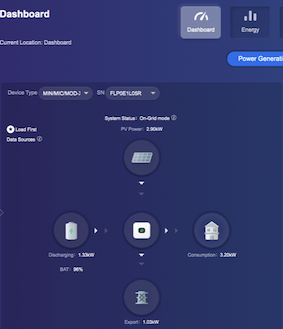
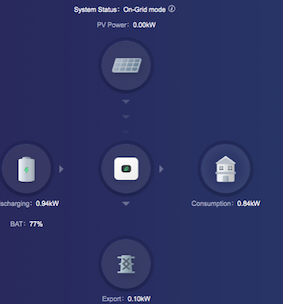
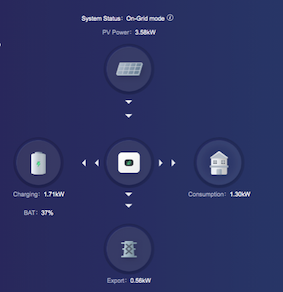
I am seeing an increasing number of occasions when my Growatt inverter appears to be exporting power when logically it should be either contributing to consumption or charging the battery.
Is this likely to be a real situation or is it something to do with the latency in the data logger?
Examples:
342sq m "Upside down" house in Algarve. Portugal
Mitsubishi PUHZ-120YUK 12kW ASHP
12 Solar Panels Growatt Inverter
2 x Growatt 7.5kW Batteries
Fronius EV Charger
Kia e- Niro 64kW

30/04/2026 12:26 pm
We don't have time-stamps on those screenshots, nor do we know the parameters you've configured to set the times for charging from solar or grid.
Very low 'export to grid' readings can be due to a number of different reasons.
Sometimes inverter manufacturers deliberately keep the system at a low export current in order to operate correctly with pre-payment meters. That involves setting the inverter output voltage a volt or two above the grid potential, thereby preventing any demand being applied to the household incomer.
There will also be inaccuracies associated with measuring the current via a CT Clamp.
Typically a CT-clamp outputs the reading with max-current defined as a 50mA signal (AC).
That is rectified and fed across a 100Ω resistor at the input of an Analogue to Digital Converter, which might have 12-bit accuracy.
In theory, if the CT-clamp has a 100A max current rating, the inverter is presented with a reading within 20mA, which is about ±5watts for a 240v output.
In practice a CT clamp is unlikely to be better than 0.5% accurate, resulting in the inverter knowing the export current within 500mA, or ±120w (0.12kW).
To avoid any import from the grid, the inverter output voltage is set at least 0.5% above the 240v. That brings the measurement error to +240W (0.24kW), which isn't very different to what you're seeing.
Save energy... recycle electrons!
1

SPONSORS

Degrees of Separation

Latest Posts
-

RE: Heat Geek Zero Disrupt: Are We Sleepwalking Into Another Race to the Bottom?
@editor In principal I agree with most of what you s...
By JamesPa , 17 minutes ago
-
RE: Air-to-Air Heat Pumps & Air Conditioning: UK Heating and Cooling Q&A
Our latest Homeowners’ Q&A episode has just dropped...
By Mars , 25 minutes ago
-
RE: Vaillant ecoTEC Plus with sensoCOMFORT and weather compensation
Yes, its described in the sensocomfort manual. Its als...
By JamesPa , 54 minutes ago
-
RE: Heat Geek installations: share your experiences
My summary, highlighting the oddities.
By Batpred , 2 hours ago
-
RE: Missing flow temperature in Heat Geek proposal
That makes sense, even if few people would have a highe...
By Batpred , 3 hours ago
-
RE: Renewable Heating Hub Homeowners' Q&A Podcast
What a day yesterday! Two podcasts recorded, brilliant ...
By Mars , 22 hours ago
-
RE: Tesla Powerwall (2) Calibration Cycles
@davesoa I’m rather a Luddite, but when I was running I...
By Papahuhu , 23 hours ago
-
RE: Adding additional Solar Panels to a DC coupled battery system
I too use AI when researching online. It's able to co...
By Transparent , 1 day ago
-
RE: Getting closer to a finished Haier system
Theres comprehensive instalation and service manuals (I...
By Singlespeed , 2 days ago
-
RE: Indevolt Batteries UK Support & Info Thread
There is now a new Secretary of State for Energy Securi...
By Transparent , 2 days ago
-
RE: Do I add Air Con or MVHR to existing A2W ASHP?
@rob-of-york Looks like an impressive bit of kit. Just ...
By Batpred , 2 days ago
-
RE: DIY Heat Pump Installations: Navigating Legal and Regulatory Hurdles
The idealist in me says pioneers in this space should b...
By Batpred , 2 days ago
-
RE: How should the Boiler Upgrade Scheme be reformed?
Ah, that makes sense when a combi is in place. The boil...
By Batpred , 3 days ago
-
RE: Replacing Storage Heaters with a Heat Pump in a Stone Cottage
@bobflux Thanks, that gives me something to check the i...
By Paul1098 , 3 days ago
-
Over the years, due to the non barrier PEX underfloor h...
By bobflux , 4 days ago


SPONSORS

