

Notifications
Clear all
Joining the Renewable Heating Hub forums is completely free and only takes a minute. By registering you’ll be able to ask questions, join discussions, follow topics you’re interested in, bookmark useful threads and receive notifications when someone replies. Non-registered members also do not have access to our AI features. When choosing your username, please note that it cannot be changed later, so we recommend avoiding brand or product names. Before registering, please take a moment to read the Forum Rules & Terms of Use so we can keep the community helpful, respectful and informative for everyone. Thanks for joining!

Topic starter
04/08/2026 7:29 pm
Hello All,
I'm not really after starting an argument, but I am about to take a first step into heat pump ownership 🙂 I come from a boiler R&D background so I have 'some previous' in heating design, appliances and controls but I noticed something strange being stated when I started looking for a suitable heat pump.
The background, we have just bought a ±200 year old cottage with 75cm solid walls and probably a real thirst for energy as winter get down to -15°C. There is no gas in the village so it currently has a three phase 12kW electric boiler. We have thrown some decent controls at the system, corrected some mistakes, balanced the system so it is running well turned down to a lower maximum rate and at lower flow temperatures, but clearly the boiler needs to go.
The heat loss (as always) will be a guess because of the fabric, but I can see the current radiators are delivering 21°C at around 20% of their 75/65/20 output with an outside temperature 5°C, so from some weather curves (if you believe them) they should meet design heat loss at a flow temp of 55°C but I will upgrade them and lower the temperatures further. The biggest issue I currently see is the secondary plumbing, I absolutely cannot get to the pipework to achieve the flow rates needed for a DeltaT of 5°C. This seemed to be a no-brainer, fit a buffer tank! - it adds essential system volume and was always the correct solution to achieve a neutral point in mixed hydronic systems, but then I saw in the UK (I am English BTW) they seem to be viewed as the work of the Devil based on 'distortion'.
From what I can see the argument is based on an assumption that radiators are sized to a 5°C DeltaT and an efficient flow temperature, then a buffer is fitted afterwards, the DeltaT increased back with a boiler flow rate and the room gets cold. A higher DeltaT is obviously going to reduce the average radiator temperature. A lower temperature will reduce radiator output, and this in turn means the flow temperature needs to be higher. No issue with that what-so-ever, it is correct, but that is emitter under-sizing issue, not an evil buffer changing/mixing flows and temperatures in some spooky way. It would be exactly the same if the under-sized radiator are in the primary circuit. A long time ago but I was taught that buffers and low loss headers are used to prevent flow distortion in systems, when did this change and more to the point why?
I'm happy to accept the argument that buffers increase radiator sizes, but that should be on the heat pump list already. When I have spoken to R&D departments they welcomed system designs with buffers as it prevent system and commissioning issues affecting appliance reliability and lifetime.
Mind you, poor internet.... buffering, I don't like that. Okay I agree, buffers are bad sometimes.
Regards AtM


04/08/2026 8:45 pm
@AndyTheMinion, welcome to the forums. You have certainly chosen one of our less contentious subjects for your first post. 🙂
My view is that buffers have acquired such a bad reputation because they are routinely fitted to straightforward domestic systems whether they are needed or not. They add another pump, more controls and another opportunity for the heat pump to produce hotter water than the radiators actually receive. In most ordinary homes, a direct system with the required water volume and flow seems the cleaner option.
Where I think your case may be different is that you have identified a specific problem the buffer would be there to solve. If the existing distribution pipework genuinely cannot carry the flow required by the heat pump, and cannot realistically be replaced, then separating the heat pump circuit from the radiator circuit may be a reasonable compromise rather than an automatic design habit.
I don’t think the concern is solely that the radiators were sized at the wrong delta T, though. If the flow on the heat pump side and the flow on the radiator side do not match, water moves through the buffer in ways that can alter the temperatures each circuit sees. You can end up mixing cooler return water into the radiator flow (distortion) or sending some hot flow directly back towards the heat pump. Neither is mysterious, but both can cost efficiency unless the design has properly allowed for them.
That doesn’t make the buffer inherently wrong. It means the designer needs to know what flow each side will actually run at, what temperature will reach the radiators and what return temperature the heat pump will see. If the emitters are then sized for those real conditions, rather than for an idealised direct system, the case for it sounds much stronger. Problem is, designers and installers can't be bothered to work any of this out.
The existing electric boiler may also give you better evidence than a conventional heat loss guess. Do you have any cold weather electricity data, particularly during a steady period close to the local design temperature? A 12kW boiler maintaining the house at a known indoor temperature could tell you quite a lot about the actual demand, although hot water use would need separating out.
How large is the cottage, what pipe sizes can you see, and what flow rate or flow/return difference are you achieving with the present system? It would also be useful to know which heat pump and output you are also considering.
🔥 Britain’s Heat Pump Shitshow
How Installing a Heating System Became a National Nervous Breakdown
Free UK shipping.
📗 Heat Pumps Explained
A Jargon-Free Guide for Homeowners
Rewritten and updated for 2027
📘 From Zero to Heat Pump Hero
🛠️ Bodge Buster
New to heat pumps?
Take the Heat Pump Fundamentals course and use INTRO50 at checkout for 50% off.

04/08/2026 10:25 pm
The biggest issue I currently see is the secondary plumbing, I absolutely cannot get to the pipework to achieve the flow rates needed for a DeltaT of 5°C. This seemed to be a no-brainer, fit a buffer tank! - it adds essential system volume and was always the correct solution to achieve a neutral point in mixed hydronic systems, but then I saw in the UK (I am English BTW) they seem to be viewed as the work of the Devil based on 'distortion'.
You don't have to run the heat pump with a deltaT of 5°C, you can just run it at deltaT 10 or more, with lower flow rate. 5°C is a bit more efficient, but it isn't mandatory.
For the average temp of the radiators to be the same, higher deltaT means higher flow temperature and lower return temperature. For example 50/45°C is deltaT 5°C average 47.5, and 52.5/42.5 is deltaT 10 average 47.5°C. There is a small COP penalty due to the higher flow temp, but as long as the heat pump doesn't shut down with a "flow too low error" it'll work fine.
Now you could put in a buffer, run the radiators on 52.5/42.5 (deltaT 10 average 47.5°C) and the heat pump on 52.5/47.5 (deltaT 5 due to it handling twice the flow) and it would recirculate hot water in the buffer. Result should be about the same, except now you have to pay extra for the buffer which brings no advantage compared to running the heat pump on deltaT 10 in the first place.
2

05/08/2026 8:20 am
Rather than upgrading the existing pipework, could you bypass it via a different route with bigger pipes, or could you at least replace the primary pipework? From your initial post, I assume this is also impossible.
The design you have proposed will be significantly less efficient than the ideal system. Firstly, as you point out, the higher delta T at the radiators will reduce their average temperature. The second reason, is that the flow temperature on the secondary circuit will be lower than the flow temperature from the heat pump, due to mixing in the buffer tank.
In gas systems, this does not matter too much, because efficiency is not very sensitive to flow temperature. However, in heat pump systems, the efficiency reduction with higher flow temperature is much greater - typically 2-3% per degree C. Your proposed design could lose as much as 20-30% efficiency.
I discussed the 4 port buffer design with a friend who is a chemical engineer. Hydronic design is a key part of his job. He was horrified by it. He said: "If you really need hydronic separation, then use a plate heat exchanger. That does give you complete hydronic separation. It avoids the turbulence in the buffer tank, and the pumps fighting each other, which reduces efficiency."
Grant Aerona 290 15.5kW, Grant Smart Controller, 2 x 200l cylinders, hot water plate heat exchanger, Single zone open loop system with TRVs for bedrooms & one sunny living room, Weather compensation with set back by room thermostat based load compensation
2


05/08/2026 8:33 am
From what I can see the argument is based on an assumption that radiators are sized to a 5°C DeltaT and an efficient flow temperature, then a buffer is fitted afterwards, the DeltaT increased back with a boiler flow rate and the room gets cold. A higher DeltaT is obviously going to reduce the average radiator temperature. A lower temperature will reduce radiator output, and this in turn means the flow temperature needs to be higher. No issue with that what-so-ever, it is correct, but that is emitter under-sizing issue, not an evil buffer changing/mixing flows and temperatures in some spooky way. It would be exactly the same if the under-sized radiator are in the primary circuit. A long time ago but I was taught that buffers and low loss headers are used to prevent flow distortion in systems, when did this change and more to the point why?
I'm happy to accept the argument that buffers increase radiator sizes, but that should be on the heat pump list already. When I have spoken to R&D departments they welcomed system designs with buffers as it prevent system and commissioning issues affecting appliance reliability and lifetime.
The principal argument against buffers is in essence nothing to do with radiator size. Its to do with:
- if poorly designed, poorly set up, or poorly controlled, which almost invariably they are when used by heat pump fitters in the UK, then the resulting system distortion (mixing) means that, to supply any given FT to the radiators, the HP has to operate at a higher FT
- their introduction increases system complexity and complexity of fault diagnosis
- they arent needed in most domestic systems
applying occams razor, as any good engineer does, means that, in the vast majority of domestic systems, they should not be fitted.
Their principal purpose in the UK domestic market is, so far as I can see, liability separation. By putting a buffer in an installer can largely avoid any hint of liability for what is downstream, particularly an existing UFH system which they will be reluctant to touch. That's great from the installers POV, not so great from the householder's POV
Avoid unless they are fixing a real problem that cant be fixed by some other means.
From your post your problem appears to be pipework, can you tell us a bit more (approx load (presumably <12kW?, bores, lengths), perhaps we can come up with solutions additional to the one @bobflux has already suggested. Remember that pipework can get smaller as it divides.
This post was modified 2 months ago 6 times by JamesPa
4kW peak of solar PV since 2011; EV and a 1930s house which has been partially renovated to improve its efficiency. 7kW Vaillant heat pump.
05/08/2026 11:12 am
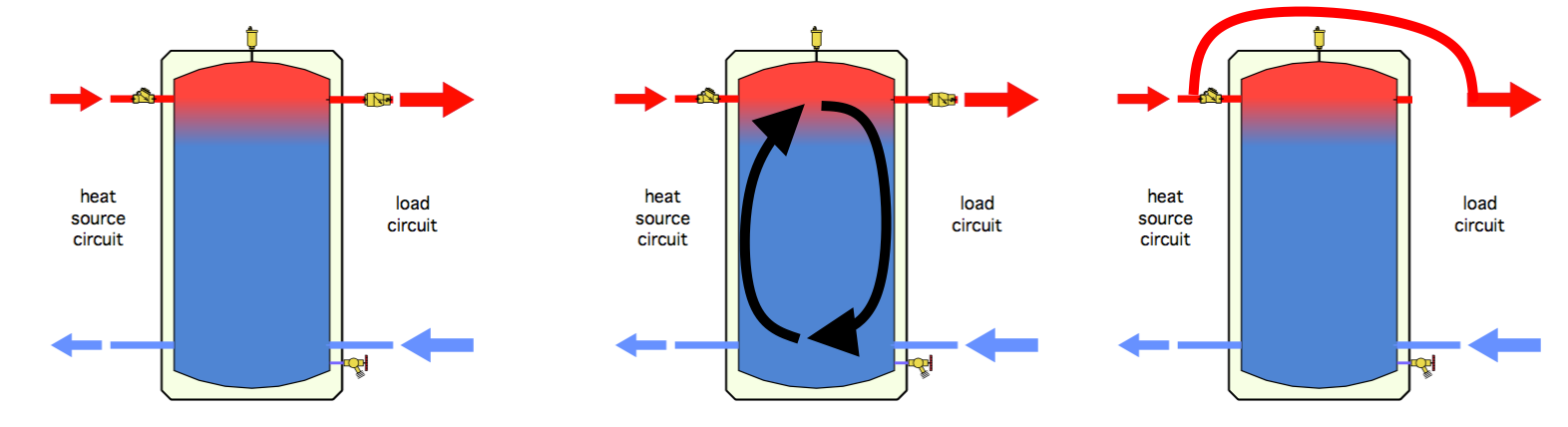
Assume flow from the heat source is higher than flow to the load.
1- Left is what happens "in theory on paper".
2- Middle is what actually happens: water jets from the inlets stir water inside the tank, so the outlet to the load ingests a mix of hot and cold water, reducing flow temperature, and that requires cranking it up on the heat pump and wasting efficiency. My old buffer tank did exactly that.
3- Right is a possible fix, ie using it as three port buffer. In this case, flow from heat pump goes directly to load, so the load gets the same flow temperature and it is no longer necessary to crank it up on the heat pump. The tank is still being stirred, so it won't be stratified at all, but at least no mixing occurs on the flow side as long as flow from the heat pump is higher than flow to the radiators.
4- It's also possible to pipe it as 2 port by connecting the load return on the left side.
In all cases, mixing does occur on the heat pump return side, so the heat pump will work at a higher average temperature than necessary. But at least in cases 3-4 flow temperature is the same on heat pump side and radiator side.
Their principal purpose in the UK domestic market is, so far as I can see, liability separation.
Absolutely.
Thermal storage is overrated. Most buffer tanks are way too small for that, and besides, you want to run the heat pump at the lowest possible temperature... but to store heat in a tank you need to heat it (increase its temperature)... and these two contradict each other.

07/08/2026 8:01 pm
My view is that buffers have acquired such a bad reputation because they are routinely fitted to straightforward domestic systems whether they are needed or not. They add another pump, more controls and another opportunity for the heat pump to produce hotter water than the radiators actually receive. In most ordinary homes, a direct system with the required water volume and flow seems the cleaner option.
Is that such a problem with a 3-pipe buffer tank, where the radiators receive a direct feed from the heat pump? They should be receiving the highest possible flow temperature. Although that configuration still seems something of a novelty here.
I'm not a heating or mechanical engineer, but from what I read I would think the buffer makes the system design more robust to changes on the secondary distribution side. For example, if the homeowner wants to use TRVs to have different temperatures in different rooms, shut off heating to rooms or parts of the house or operate just a few radiators in bathrooms, towel rails during summer and so varying the effective water volume in circulation, restricting the maximum flow rates through the distribution system all of which is a problem without a buffer to provide that separation.
The other potential benefit, #is if a buffer provides better comfort during defrosts. Without a buffer, the flow temperature can drop quite low and cool the radiators. With a decent sized buffer, that cooled flow can mix in the buffer, or with some better controls, shut-off the secondary circulation pump and use the buffer for the defrost.
07/08/2026 9:37 pm
Not a good idea to use just a towel rail during summer for two reasons:
1) Pipes will still radiate heat, either wasting power or making the house too hot in summer
2) To avoid constant short cycles you need an enormous buffer tank
07/08/2026 10:20 pm
I'm not a heating or mechanical engineer, but from what I read I would think the buffer makes the system design more robust to changes on the secondary distribution side. For example, if the homeowner wants to use TRVs to have different temperatures in different rooms
Dont, just adjust the LSVs to get different temperatures. Doing something bad to fix something bad is not good engineering! Having a small percentage of rads with TRVs is unlikely to do any harm even without a buffer if there is a good reason to do that.
The other potential benefit, is if a buffer provides better comfort during defrosts. Without a buffer, the flow temperature can drop quite low and cool the radiators. With a decent sized buffer, that cooled flow can mix in the buffer, or with some better controls, shut-off the secondary circulation pump and use the buffer for the defrost.
When you reverse the heat pump for defrost you rob the system of an amount of energy, thats how defrost occurs! A buffer cant change that, all it can do is spread the effect over time. A volumiser, or just adequate system volume, will do that too without the downsides. Anyway its not a problem that is likely to occur in practice because the time frame for defrost (say 10 mins) is so much smaller than the time for the house temperature to fall significantly (typically hours!).
Is that such a problem with a 3-pipe buffer tank, where the radiators receive a direct feed from the heat pump? They should be receiving the highest possible flow temperature. Although that configuration still seems something of a novelty here.
Only if the rate of flow through the rads is less than the rate of flow from the heat pump, otherwise some of the rad water must recirculate and dilute the flow temperature. If you have introduced a buffer tank to deal with TRVs shutting down, as you suggest (or if the heat pump modulates its water pump speed according to load, which some do), this may well happen.
For sure however a 3 port tank (which as you say is unusual in the UK) is likely better than a 4 port tank, but no tank at all is better still unless there is a real reason to have one that cannot be solved by other means.
Its really not the case that buffer tanks are inherently bad, its just that they don't, in the vast majority of domestic situations, solve a real problem and they do, in a high proportion of installations where they are fitted, introduce a problem (or several). If someone who really knows what they are doing designs a system to include a correctly specified and correctly controlled buffer tank to solve an identified problem that's fine, unfortunately its the people who dont really know what they are doing that mostly fit them!
This post was modified 2 months ago 2 times by JamesPa
4kW peak of solar PV since 2011; EV and a 1930s house which has been partially renovated to improve its efficiency. 7kW Vaillant heat pump.

SPONSORS

Degrees of Separation

Latest Posts
-

RE: Getting closer to a finished Haier system
Apart from sealing the external Primary Pro joints and ...
By Singlespeed , 52 minutes ago
-
RE: Missing flow temperature in Heat Geek proposal
@majordennisbloodnok I think the reason for my frust...
By Jo2255 , 2 hours ago
-
tepeo ZEB UK Support & Info Thread
Heat batteries offer another way to electrify home heat...
By Mars , 4 hours ago
-
RE: Are We Sleepwalking Into Another Race to the Bottom?
@jamespa Hope someone tries it! As a consumer, I woul...
By Batpred , 21 hours ago
-
RE: Air-to-Air Heat Pumps & Air Conditioning: UK Heating and Cooling Q&A
Our latest Homeowners’ Q&A episode has just dropped...
By Mars , 1 day ago
-
RE: Vaillant ecoTEC Plus with sensoCOMFORT and weather compensation
Yes, its described in the sensocomfort manual. Its als...
By JamesPa , 1 day ago
-
RE: Heat Geek installations: share your experiences
My summary, highlighting the oddities.
By Batpred , 1 day ago
-
RE: Renewable Heating Hub Homeowners' Q&A Podcast
What a day yesterday! Two podcasts recorded, brilliant ...
By Mars , 2 days ago
-
RE: Tesla Powerwall (2) Calibration Cycles
@davesoa I’m rather a Luddite, but when I was running I...
By Papahuhu , 2 days ago
-
RE: Adding additional Solar Panels to a DC coupled battery system
I too use AI when researching online. It's able to co...
By Transparent , 2 days ago
-
RE: Indevolt Batteries UK Support & Info Thread
There is now a new Secretary of State for Energy Securi...
By Transparent , 3 days ago
-
RE: Do I add Air Con or MVHR to existing A2W ASHP?
@rob-of-york Looks like an impressive bit of kit. Just ...
By Batpred , 3 days ago
-
RE: DIY Heat Pump Installations: Navigating Legal and Regulatory Hurdles
The idealist in me says pioneers in this space should b...
By Batpred , 3 days ago
-
RE: How should the Boiler Upgrade Scheme be reformed?
Ah, that makes sense when a combi is in place. The boil...
By Batpred , 4 days ago
-
RE: Replacing Storage Heaters with a Heat Pump in a Stone Cottage
@bobflux Thanks, that gives me something to check the i...
By Paul1098 , 4 days ago




SPONSORS
