

Notifications
Clear all
Joining the Renewable Heating Hub forums is completely free and only takes a minute. By registering you’ll be able to ask questions, join discussions, follow topics you’re interested in, bookmark useful threads and receive notifications when someone replies. Non-registered members also do not have access to our AI features. When choosing your username, please note that it cannot be changed later, so we recommend avoiding brand or product names. Before registering, please take a moment to read the Forum Rules & Terms of Use so we can keep the community helpful, respectful and informative for everyone. Thanks for joining!

Topic starter
24/03/2026 4:13 pm
Well done for setting this up. Thank you very much.
We did a barn conversion in the Brecon Beacons National Park in 2010 and installed a ground source heat pump from IVT. In an attempt to learn about it, I used a proprietary interface on a Raspberry Pi to populate a Home Assistant (HA) database with the metrics from the heat pump. (We did have an excellent heat pump engineer to install it at the time.) We had the RHI payments from it whilst we were there.
In 2010 we moved to Carmarthenshire into a house which already had a GSHP installed. Although badged as Worcester Bosch, I was pleased to see that it used the same controller as I was used to and had the same functionality as the IVT heat pump so linked it to HA again.
I had set up HA to alert us via text messages if the controller detected an alarm condition and also if "Additional Heat" was requested.
A few weeks ago we were surprised to see the Additional Heat alert in the middle of a fairly mild morning with nobody at home. When I returned, I interrogated the heat pump to find that the compressor was not working even though HA detected that it had been activated. Also, there was no alarm condition recorded.
Some research led me to the soft-start unit and the capacitor which had blown its top - literally. Gel all over the inside of the unit. On the Saturday I managed to obtain a replacement which I duly fitted. I used the engineer service menu to manually start the compressor to test it. When the thing made startup noises, I cheered, punched the air and walked to the other side of the garage for a celebratory beer - as the final match of the Six Nations was about to start. I touched the beer bottle then BANG! Damn new capacitor has blown due to knackered compressor.
By the way, this heat pump was never registered for RHI so we did not receive those payments.
I have disabled the compressor on the heat pump and tweaked it so it just produces DHW (at a lower temp than normal). Lucky we have a logburner. I have spent days splitting logs the last couple of weeks. Also lucky I can borrow my neighbour's hydraulic logsplitter which fits the back of my tractor.
It seemed sensible to obtain a very similar but newer GSHP which would fit in the rather complex plumbing here: Big buffer tank, 250l cylinder, hot water solar panels, zone valves galore. House was only built in 2010 so has UFH throughout. (GSHP is/was a Greenstore 11kW system.)
I see a lot has changed in the past 16 years. Some GSHP producers now only sell ASHP. There is no compatible GSHP for the rest of the kit that I can see. By the way, ground loop is in excellent condition with no leak since we have been here. There is always at least a 4c difference between the in and out temperatures.
The ASHP's have come on in leaps and bounds and are now much more efficient than they were. I assume a lot of the research effort has gone that way as GSHP needs a pile of ground work. We may just blank off the ground loop and go ASHP instead.
I don't suppose we can even get a grant for the new one. Wife is doing the calcs on whether we just to go a cheaper oil boiler and do the sums based on a "normal" oil price and not the silly price it is now.
Any advice would be gratefully received.
Thank you.

26/03/2026 9:58 am
Since nobody more knowledgeable has replied so far, I will give it a shot!
Several things come to mind, in no particular order and a bit random until I know more about your thinking and system:
- Have you tried to get the compressor replaced. Replacing compressors in heat pumps is quite normal and its most unlikely that they used a 'special' so it may be available still if you have the compressor model number. Dont assume you need a GSHP specialist, the guy who installed my heat pump (very well) also installs boilers and repairs GSHPs, the components are the same once you get past the ground loop heat exchanger. Maybe @editor can suggest someone in your area.
- Not sure why you want zone valves galore and a big buffer tank, would you consider simplifying. Open loop, 24x7 operation on weather compensation is almost always the way to go for max comfort and min running cost. If you havent tried this you should, its a revelation in comfort.
- GSHPs are certainly rarer than ASHPs because of the need for a ground loop, but several manufacturers do them so I cant quite see why you couldnt get a replacement,
- Now would be a good time to check the consumption records to find out if you really need 11kW. Im guessing your barn was converted to high standards of insulation and, unless its very large (which of course it may be) 11kW is a lot.
- A modern GSHP or ASHP will come with much better controls, I dont know if yours has weather compensation but thats a bit of a game changer in terms of comfort.
- I wouldnt assume that oil prices will drop back, they have actually been historically low in recent years. Anyway it would be a great shame to go backwards in this way.
- If you do need to replace its surely a simple swap of the heat source, you already have the heating infrastructure (albeit that you might want to simplify how you use it). I would have thought its max a 1-2 day job tops provided its thought through. You could even do it yourself if you were so inclined.
If I were in your position I would be
1. Checking fully that repair wasn't an option
2. Checking the consumption records to determine the actual loss
3. Actively considering drastically simplifying the system/the way the system is operated and removing the buffer (subject to a more detailed assessment of the hydraulics)
4. Considering both GSHP and ASHP options, discounting Oil
I might even think about DiY!
Just first thoughts.
This post was modified 7 months ago 4 times by JamesPa
4kW peak of solar PV since 2011; EV and a 1930s house which has been partially renovated to improve its efficiency. 7kW Vaillant heat pump.
1

26/03/2026 10:25 am
@taffonthetaff - I agree with James.
I'd prefer to stick with the GSHP, and repair or replace the compressor. It will almost certainly be a generic unit, bought in from a factory in the Far East.
Have a look at this magazine article about the different compressors used in GSHPs.
Do you know which type yours is?
Can you see any model markings on the compressor itself?
If so, then just enter it into Google and see what turns up.
Although there are professional companies doing HP repairs in Carmarthenshire, you might just as easily come across a family business on Ebay who import HP components from China or Indonesia. The tricky bit might be to employ an F-gas registered operator to attend on site and handle the refrigerant exchange part of the process. Do you know what refrigerant is in the duff unit?
Save energy... recycle electrons!


26/03/2026 10:53 am
@taffonthetaff, I wouldn’t be rushing to abandon that ground loop.
What you’ve got is the hardest, most expensive part of a GSHP system already paid for and, by the sound of it, performing OK. A consistent 4C delta across the loop suggests it’s doing exactly what it should... steady heat extraction, no obvious degradation. The failure you’ve described is plant-side, not source-side.
The mistake I see people make at this point is treating the heat pump as a 'sealed appliance' rather than part of a system. In reality, what you’ve got is a failed compressor on an otherwise very valuable system. IMO, swapping to an ASHP means throwing away your best asset and starting again with a weather-dependent source.
Yes, ASHPs have improved massively, but GSHPs haven't become obsolete. It’s just been commercially sidelined because it’s harder to sell and install. From a physics point of view, a stable ground source still gives you better operating conditions than cold winter air, especially with UFH like yours.
The compatibility issue you’re running into is a bit overstated IMO. You don’t need a like-for-like replacement... you need a unit that can integrate hydraulically with what you’ve got. There are also loads of good new units out there and I can connect you with Stiebel Eltron who can probably advise on a replacement if you want to go down that route.
On oil, personally, I’d see that as a backward step unless this becomes a purely short-term stopgap. We've been forced back to oil this winter because of a failed heat pump and with no protection on kerosene the bills can be brutal. I think you’d be swapping a repairable system with a free heat source for ongoing fuel exposure and volatility. The maths might look tempting on paper, but it’s a different risk profile entirely.
If it were me, I’d be exploring:
- replacing the GSHP unit only, keeping the loop
- potentially simplifying the system design at the same time
The one thing I wouldn’t do is make a rushed switch to an ASHP or oil just because the original unit has failed.
You’re actually sitting on a very good foundation... it just needs the right next move rather than a reset.
🔥 Britain’s Heat Pump Shitshow
How Installing a Heating System Became a National Nervous Breakdown
Free UK shipping.
📗 Heat Pumps Explained
A Jargon-Free Guide for Homeowners
Rewritten and updated for 2027
📘 From Zero to Heat Pump Hero
🛠️ Bodge Buster
New to heat pumps?
Take the Heat Pump Fundamentals course and use INTRO50 at checkout for 50% off.

Topic starter
26/03/2026 12:55 pm
Thank you very much for the responses!
Regarding swapping out the compressor, there are signs of the GSHP not going to last too long. For example, a few years ago we installed a Magnetite filter which we cleaned out after a year. The next year I attempted to loosen the filter housing but another joint started to leak. Even gripping the pipe quite hard wouldn't let me undo the housing. There are also signs of corrosion in quite a few places. We are next to an estuary but I cannot see salt spray getting in the garage.
I have been told that the refrigerant used is no long allowed! Even a quote we had for a replacement had a refrigerant (R407C) which is being phased out.
The refrigerant in the potential replacement ASHP is propane. Never thought that would be used as a refrigerant when it powers our cooker!
I think the old GSHP is now in a state of some of my old cars. Fix something and something else will go kaput soon.
My own gut feeling was just to replace the compressor originally but even when not kicking in additional heat that is a thirsty bit of kit. Some modern GSHP's have variable speed compressors which would be more energy efficient.
Regarding zone valves. I had an interesting debate with a decent heat pump engineer when he first came to look at it. He suggested taking the three valves out (one for each floor) and letting the heat pump sort it out with weather compensation. (By the way, originally it had a internal temp sensor fitted but that was disconnected after it was seen to be competing with room set-back thermostats!)
However, this is a sizeable house in a windy area and has no airlocks and the like. Also, the basement has a self-contained flat which we would not wish to heat if unused.
The quote for a new GSHP is much more than the equivalent ASHP which I can understand. The COP is also much higher. I also understand how the ground temp will always be higher and more stable than the air temp in the winter.
By the way, it makes me wonder about the IVT we installed in Bannau Brycheiniog (as The Brecon Beacons is now known). That is 16 years old too.
We are currently supplementing the log burner with multiple electric heaters. An outside temp of 6c resulted in a bedroom temp of 12c this morning. It would be much, much colder in The Beacons!
We have discounted using oil as that would be a very backward step and dependent on various overseas factors!
Thanks again for the quick and informative replies. If anyone has any information on the Grant Aerona 290 ASHP, I would like to see it...
https://www.grantuk.com/products/air-source-heat-pumps/r290/
Bye for now,
Gerald.
26/03/2026 2:54 pm
Regarding zone valves. I had an interesting debate with a decent heat pump engineer when he first came to look at it. He suggested taking the three valves out (one for each floor) and letting the heat pump sort it out with weather compensation. (By the way, originally it had a internal temp sensor fitted but that was disconnected after it was seen to be competing with room set-back thermostats!)
However, this is a sizeable house in a windy area and has no airlocks and the like. Also, the basement has a self-contained flat which we would not wish to heat if unused.
The heat pump engineer was almost certainly right. The key to operating heat pumps efficiently (ie cheaply) is to keep the flow temperature low, and you do that by keeping it on 24x7 and, unless the house is a funny shape or there is insulation between rooms that is as good as the insulation to the outside world, heating all of the house. The savings in energy lost from the house by not heating part time and/or only heating part of the house are much smaller than most people think - houses continue to lose heat when the heating is switched off and that heat must be replaced when you switch it back on. This saving is usually more than outweighed by the efficiency gains from operating at a lower temperature, and the house is more comfortable. I strongly recommend you try it!
Several here have the Grant ASHP, but not me so I cant comment.
4kW peak of solar PV since 2011; EV and a 1930s house which has been partially renovated to improve its efficiency. 7kW Vaillant heat pump.
1

26/03/2026 3:32 pm
GSHP are quite similar to ASHP, differences being mostly the heat exchanger on the air or loop side, the fan, and software.
In fact GSHP should be cheaper due to being smaller and easier to ship, but due being low quantity "boutique" products they are ridiculously priced.
My parent's house had a Leroy Somer GSHP from 1988 running on R22 and groundwater open loop. It lasted 45 years, with two compressor swaps and two coaxial heat exchangers, the latter because the groundwater here is a bit acidic so it corrodes copper heat exchangers. On this kind of machine, it was possible to replace pretty much any part and keep it running, because it had no electronics at all. Just a compressor, pressure regulator, two heat exchangers, a bunch of 1980's era contactors that still worked fine, and pipes. It could probably run for 100 years if spare parts and R22 were available, which was no longer the case as Leroy Somer went under and R22 was banned.
Modern heat pumps contain lots of electronics and plate heat exchangers which are both nice to have but much more vulnerable and hard or impossible to fix. In particular plate heat exchangers are quite vulnerable to corrosion so if you have magnetite and other crap in your heating circuit you should investigate that first.
These machines are "throwaway devices": they must be bought at a price such that they pay for themselves over their warranty period(5 years) compared to a cheaper to buy but more expensive to run heat generator like a boiler. After this, they run for as long as they run, then they die, you get another. Considering this, there are almost no circumstances where a 30k heat pump makes sense. I'm talking about the price of the machine. Installation and piping work is a different matter: the pipes last a lot longer.
On the other hand, R290 is propane. This has one drawback: it is explosive. This also has one massive advantage: the bureaucratic eggheads cannot ban it and cannot mandate F-gas certification to buy it. This means R290 machines are infinitely more repairable than R32 or R410, including black market repairs. You can also install a unit yourself without need for F-gas certification, because it does not contain any regulated high global warming gases.
You can also buy it used, or new old stock. When the Leroy Somer heat pump died, I bought the replacement heat pump used for about 300€ from a guy whose underground loops were leaking.
I spotted one Stiebel at half price, OK it's a bit far from where you live, but new in its cardboard box at half price, worth it to spend a bit of time looking for it.
If you don't want to pay a lot, there are some on aliexpress too, no warranty obviously...
Note if you install an inverter (variable speed) GSHP it can be a good idea to change the loop circulator to variable speed too, that depends how much power it draws, as it can be a significant part of the total when running at low power.
2
Topic starter
26/03/2026 9:11 pm
@bobflux 45 years! Bloody wow!
We thought that we were pioneering when we installed the GSHP in the Beacons. I can remember a discussion with a very scientific mate of mine, in the context that we lived about 28 years on the south coast of England...
Me: "But Simon, it is even cold in July here - usually a good 5c colder than Cardiff on any single day." (We did have the effect of altitude too - around 1000 ft.)
Simon: "Gerald, if it is warmer than zero Kelvin, there is heat in there."
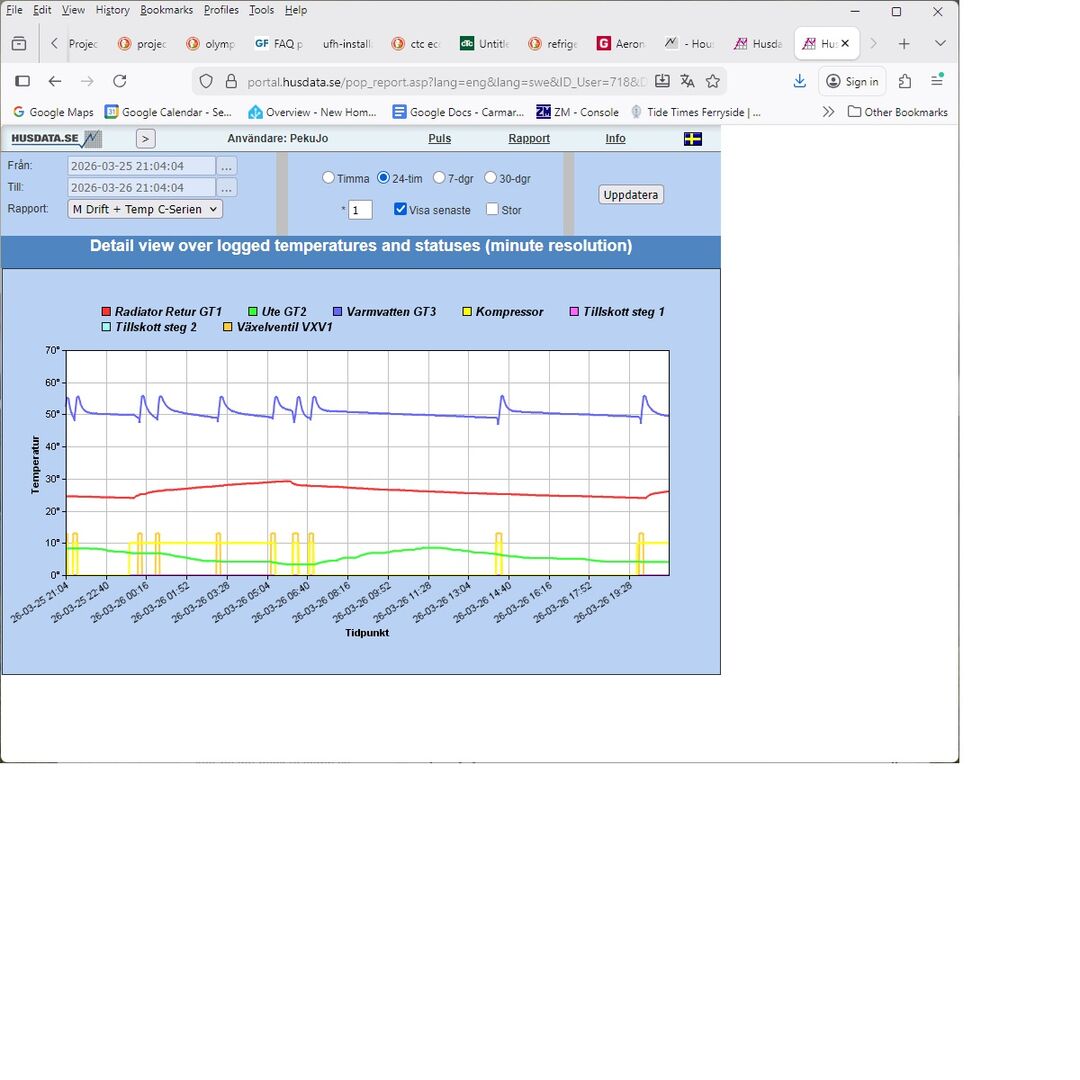
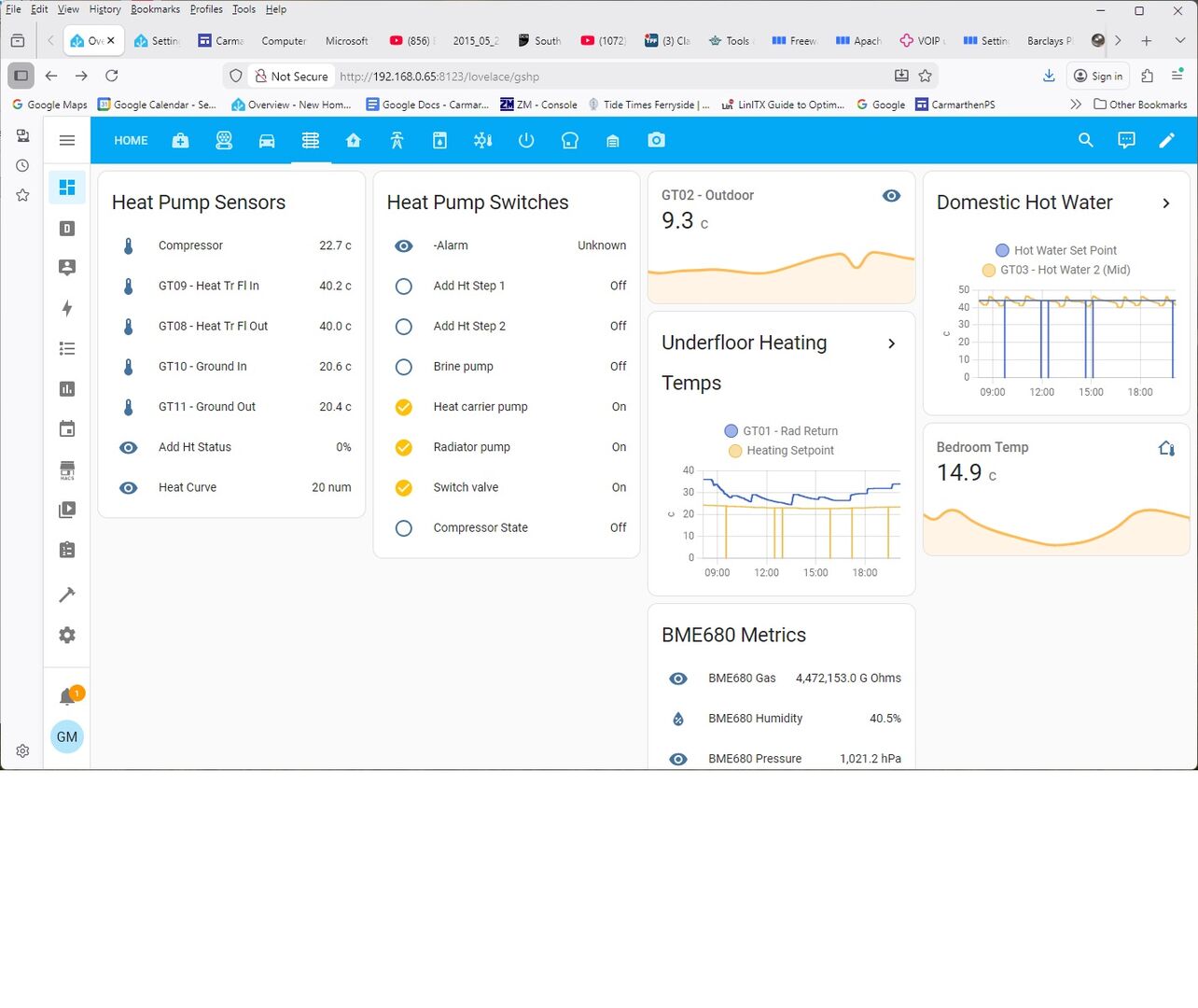
Thank you so much for the detail in your response. At least the outside temp has increased this evening and the strong north-westerly has gone. One think I shall miss is the Home Assistant interface on the Raspberry Pi. They have their own publicly visible portal. Here is an example from a similar heat pump installed in Finland in 2008.I wonder how many compressors they have had.
And here is the HA screenshot of our knackered one...
1

27/03/2026 12:17 pm
I'm very much in agreement with @bobflux on this.
Whether you change the entire GSHP or just the compressor, you're still retaining the valuable parts of the installation. Those are the ground-loop and the in-home pipework.
I'd certainly be looking online for a cut-price offer online... or considering Alibaba. I have several years experience of using Alibaba/AliExpress and can offer more advice if you'd like. It's now common for Sellers on Alibaba to hold stocks in Europe. Poland or Turkey are favourites. They use spare capacity in containers to pare carriage costs to the bone.
That means you don't wait 6-weeks or so for an item to travel by ship. Instead it gets picked up by a national carrier such as DHL who use their own logistics and tracking to deliver it to you.
There are some guarantees inbuilt to the Alibaba purchase system. They hold your money in Escrow. It doesn't get released to the seller until you acknowledge that you've received what you paid for. For many products there's also a 30-day or 90-day Returns process if the item proves to be unsatisfactory.
Save energy... recycle electrons!

05/05/2026 8:27 pm
Cool Energy in Grimsby sell ground source heat pumps and they are not expensive. If I were you I'd bung one of them in and simplify your system as mentioned by a previous poster.

08/05/2026 10:56 pm
On old (non inverter) compressors there’s sometimes a ‘start’ capacitor thats briefly put in series with a secondary coil, to encourage the compressor to start correctly. This circuit is switched out when the compressor has started - perhaps by a timer relay, or a PTC resistor. If the cap were left in circuit too long, it might well fail as it’s not rated to be left on.
The above is certainly true of our gshp which uses a Secop compressor with a plug in relay to disconnect the 80uF start cap after maybe 1/2s from turn on.
Worth a look perhaps, maybe you’ll be lucky?
SPONSORS

Degrees of Separation

Latest Posts
-

RE: Heat pump branding. Clever, contemporary… or a bit too much?
I think Heat Geek have done an amazing job on their bra...
By Tomtheheatingengineer , 5 hours ago
-
RE: HeatGeek vs Octopus surveys: puzzling disparity - any ideas why?
I have just had 3 heat loss surveys, one by heat geek o...
By David , 6 hours ago
-
RE: Heat Geek Zero Disrupt: Are We Sleepwalking Into Another Race to the Bottom?
I think that's the key question. After all inverter uni...
By Prunus , 7 hours ago
-
RE: battery storage without solar
As of October 1st they need specific qualifications to ...
By EtchedPixels , 8 hours ago
-
RE: How should the Boiler Upgrade Scheme be reformed?
A unit which uses water to transfer the heat/chill from...
By Temperature_Gradient , 8 hours ago
-
RE: Renewables & Heat Pumps in the News
With regards to the BUS grant raid, I gave it more thou...
By ASHP-BOBBA , 9 hours ago
-
RE: Why are ASHP installs so expensive?
The whole system seems to work on the basis of...
By ian33a , 9 hours ago
-
RE: Missing flow temperature in Heat Geek proposal
Good plan. If you can get half hourly meter readings a...
By JamesPa , 14 hours ago
-
RE: Heat Pumps Without Grants: Would You Have Installed One & Will You Now?
@editor Most certainly. The heat pump was an ideal s...
By Abernyte , 14 hours ago
-
Although regulations may well vary from country to coun...
By Majordennisbloodnok , 15 hours ago
-
RE: Does anyone have experience of a smart water meter?
Yep I caught our slow leak from a £100 bill rise 8)
By EtchedPixels , 15 hours ago
-
RE: Do You Need a Buffer Tank or Low Loss Header for Underfloor Heating in a Large Property?
@jamespa in some cases, failing the Turing test might b...
By GrahamF , 18 hours ago
-
RE: Passiv Smart Thermostat - Help & Forum Support
@energystoragetech The heat capacity of some...
By JamesPa , 20 hours ago
-
RE: tepeo ZEB UK Support & Info Thread
Sorry you are correct, I was remembering figures from t...
By JamesPa , 1 day ago




SPONSORS