Joining the Renewable Heating Hub forums is completely free and only takes a minute. By registering you’ll be able to ask questions, join discussions, follow topics you’re interested in, bookmark useful threads and receive notifications when someone replies. Non-registered members also do not have access to our AI features. When choosing your username, please note that it cannot be changed later, so we recommend avoiding brand or product names. Before registering, please take a moment to read the Forum Rules & Terms of Use so we can keep the community helpful, respectful and informative for everyone. Thanks for joining!
I got a pdf from GivEnergy (after doing a search) on how to disconnect the batteries, remove the cover and attach the leads to the correct positive and negative
Good. That's the right approach.
If the PSU (power supply unit) is only capable of delivering 5A, then your connecting leads need be no bigger than 0.75mm². That's the size of flex used for a table lamp.
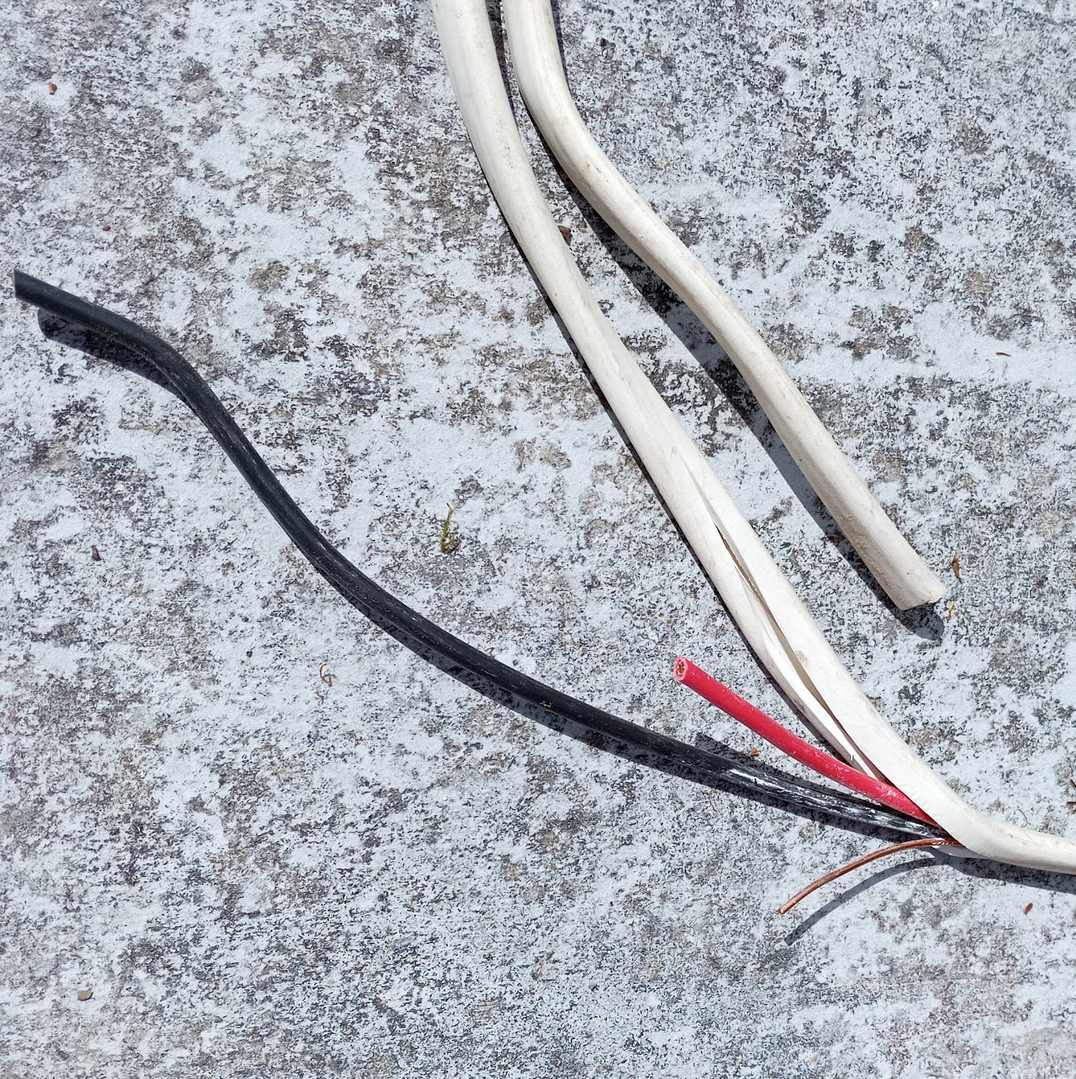
I tend to use spare pieces of (solid-core) household wire which I strip out of cable for a lighting circuit (1.5mm²) or power circuit (2.5mm²). The "old" wiring is great because it gives me a red and a black. 🙂
Set the PSU to deliver an output of 50v to start with, and leave the Amps as high as they'll go.
If you want guidance on making the connection at the battery end, post a photo here so we can see what you're presented with.
The connections need to be 'firm' in order to allow maximum current to flow. Dodgy connections have greater resistance, which will show up on the PSUs ammeter as low-current.
did contact Premium GE last night and they did reply, saying this is a known issue with these batteries and only solution is to bring the voltage up - but only an electrician should do this.
That's not a legal requirement for apparatus which operates below 75v. It's designated ELV (Extra Low Voltage).
But they're right to urge caution. You must take care not to cause a short circuit across the battery.
The installer has stone walled us and they recently had their MSC certification removed. Everything has worked really well up until that stage. We had an electrician check and do a full shut down and restart but nothing helped.
Sorry to hear.
I am actually somewhat surprised that MCS removed a certification. Probably they are seeing a very large number of complaints? But probably too little too late to reduce impact to prospective customers.
8kW Solis S6-EH1P8K-L-PLUS hybrid inverter; G99: 8kW export; 16kWh Seplos Fogstar battery; Ohme Home Pro EV charger; Vaillant Arotherm Pro 7kW; 100Amp head, HA lab on mini PC
@transparent Thank you and appreciate your timely reply. Will open up the battery and check as well as the battery charger. It looks like it comes with cables to connect on to.
So it seems subscription day has finally arrived for Givenergy. My mobile app updated today making me more determined to get Home Assistant working reliably.
5 Bedroom House in Cambridgeshire, double glazing, 300mm loft insulation and cavity wall insulation
Design temperature 21C @ OAT -2C = 10.2Kw heat loss, deltaT = 8 degrees
Bivalent system containing:
12Kw Samsung High Temperature Quiet (Gen 6) heat pump
26Kw Grant Blue Flame Oil Boiler
4.1Kw Solar Panel Array
34Kwh GivEnergy Stackable Battery System
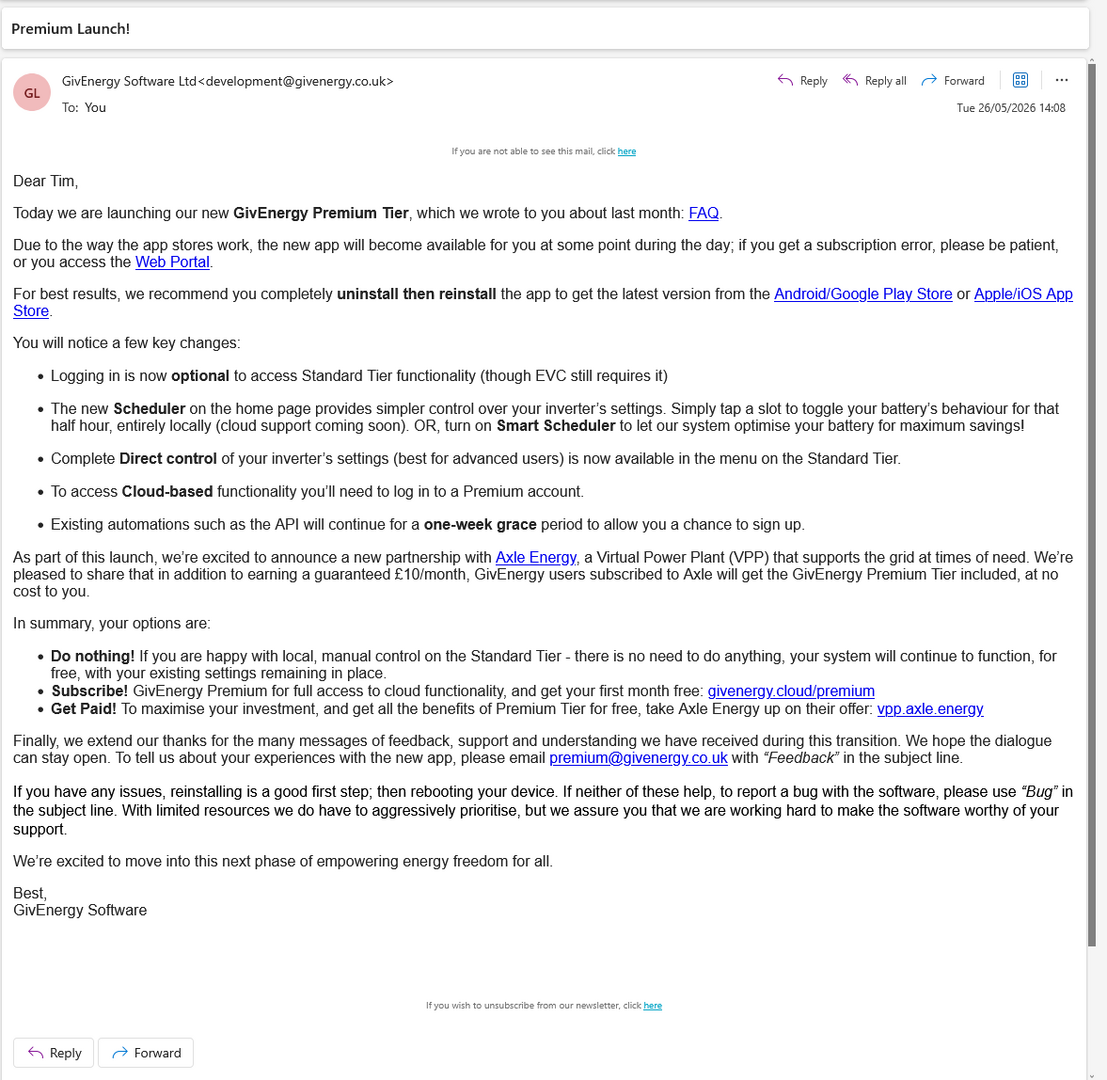
The above is a screenshot of GivEnergy Software's latest email regarding their Premium Tier Launch. The pricing for the Premium Tier is approx £5/month - so £60 a year isn't all that much to retain full control and information via their cloud account.
However, if you don't want to pay this & want to try out the Standard Tier, then you will have to do so using their new version of the GivEnergy App.
In that App, the Home Dashboard provides a direct link to your inverter & gives a Battery schedule where you can tell the battery to either charge/use/buy/sell/pause in half-hour slots ove a 24 hour period. It also has an option to use their Smart Scheduler.
Using the drop down menu you can then also go to Direct Control, where you can set-up various time slots for doing the same things & also set various %'s. There is a large degree of control that Direct Control offers, but you need to have a bit of technical savvy to use it.
I was intending to to opt out of Premium however having seen what it offers, of rather doesn't, I have decided to opt in.
Aha, but by signing up to Axle the Premium fee is paid, so I have gone down that route and I'll see where it leads. Oh, and I used a referral code so I have £25 in credit slready. Happy days so far.
I use MyEO for scheduling and it works well, but it needs remote access to the inverter.
I must say I have been impressed by GE Software so far. They have communicated clearly what they intend to do, and have followed through on time.
I think £5 pm is a small price to (hopefully) ensure the continued operation of my expensive hardware.
Mitsubishi Zubadan 14kW with Mixergy 210l DHW in 220m2 barn property. 24 solar panels = 9kWp with GivEnergy 5.0kW Hybrid inverter and 19kWh GivE batteries. Jaga Strada fan-assisted rads throughout. Landvac vacuum glazing/triple glazed windows.
Yes, the hardware is out of support - so if I was starting again GivEnergy wouldn't be a supplier I would be looking at.
However, I can't alter the past & I have quite a large capital investment in place to get value out of - so that's what I am going to do & deal with any future problems as & when they appear.
I tend to keep things for quite a long time - I have computers going back to the 60's, my main vehicle (a Renault Espace) is 26 years old & I have a classic (45+ years) Porsche 924.
Let's see if the GivEnergy batteries can outlast me (Oh, I'm 81, by the way)
@drei yes I am well aware of that. But my installation is 3 years old and i am hoping fairly well bedded in by now. famous last words!
Mitsubishi Zubadan 14kW with Mixergy 210l DHW in 220m2 barn property. 24 solar panels = 9kWp with GivEnergy 5.0kW Hybrid inverter and 19kWh GivE batteries. Jaga Strada fan-assisted rads throughout. Landvac vacuum glazing/triple glazed windows.
BTW anyone signing up to the Axle deal can get an immediate £25 credit using the garydoessolar.com/Axle referral code. Other referral codes are available I suspect.