

Notifications
Clear all
Joining the Renewable Heating Hub forums is completely free and only takes a minute. By registering you’ll be able to ask questions, join discussions, follow topics you’re interested in, bookmark useful threads and receive notifications when someone replies. Non-registered members also do not have access to our AI features. When choosing your username, please note that it cannot be changed later, so we recommend avoiding brand or product names. Before registering, please take a moment to read the Forum Rules & Terms of Use so we can keep the community helpful, respectful and informative for everyone. Thanks for joining!

14/05/2026 3:05 pm
@cathoderay many thanks for sharing the analysis of your heating data, in particular with respect to the night-time temperature set-point reduction, aka setback. Very interesting results indeed, and since I do not have a heat-pump installed yet, your findings are quite interesting to me too.
In preparation to specifying a heat pump for our house I have taken historical external temperature and gas consumption data combined with a simple thermal model of our house to work out the power/energy expenditure as a function of control algorithms, e.g. operate like a gas boiler, constant set-point temperature, or night-time set-back to various degrees. Simulation runs also confirmed that a modest set-back by about one degree seems to be the optimum; too little, and energy is wasted unnecessarily, too much and the COP suffers when bringing the temperature back up.
That said, I wondered if with all the wealth of data you have over two years, you could create a rather sophisticated multiple-input-multiple-output dynamic model for your heating system and house and use the data for system parameter identification; then you could run any controller in a closed loops simulation using all extrinsic data (external temperature, appliances, occupancy, etc), show the effects of control strategy (including magnitude of setback), and finally validate the empirical findings. Just a thought.
Kind regards,
peter
Topic starter
14/05/2026 6:59 pm
@peterwurmsdobler — thank you for your positive comments.
You are certainly taking a diligent and sensible approach to assessing your own needs. The first important thing to get right is actual heat loss, and with detailed (hourly, daily) gas use data, and sensible assumptions about boiler efficiency, you should be able to determine your actual heat loss. In summary (you may well already know this!), with the IAT in steady state (which means the heat loss is the heat input), plot (hourly or daily) mean OAT against energy out (delivered to the house). You should get a well correlated straight line, read up from your design OAT to the line, and where it crosses the energy out is your design heat loss.
Interestingly it seems as though weather compensation (leaving water/flow temp set depending on OAT) is missing from your experimental control algorithms. It is almost always the best way to run a heat pump. I think from remarks @jamespa has made in the past some gas boilers can do weather compensation, it is just here in the UK we don't do that. Might be worth a try if you have time, bearing in mind the warmer (at least supposed to be warmer) months are not the best time to do these experiments.
You may have gathered from some or indeed many of my posts I am very much an empirical person. Indeed I have even been known to claim that all modelling (derived from theoretical models) is nothing more than at best harmless, at worst highly dangerous, whatiffery. This is, as I hope most people now appreciate, something of a devil's advocate position adopted to guard against over-obsession with and being in awe of modelling (which can go spectacularly wrong, as certain recent events have shown), and to observe that, in general, empirical evidence, decently collected, not over-wrangled and properly reported, is what it is, evidence. One of the key things about studying domestic heating systems is that by and large we have no way of controlling the important variables, they are either fixed, at least in the short term, or out of our control, making the studies at best so-called natural experiments, or more accurately, observational studies. In essence the recent analysis I did is an observational study, which I attempted to improve by using matched controls, ie days with the same OAT, so that I could compare one sample (setback running) with another sample (no setback running), and attempt to answer the question are both samples from the same population, meaning no difference, or more likely from two different populations, ie there is a difference.
All that said, I hold @jamespa and the work he has done and is doing in the very highest regard. Indeed in my view this is how it should be, empirical evidence and underlying theory coming together to produce a coherent understanding of what is going on.
That said, I wondered if with all the wealth of data you have over two years, you could create a rather sophisticated multiple-input-multiple-output dynamic model for your heating system and house and use the data for system parameter identification; then you could run any controller in a closed loops simulation using all extrinsic data (external temperature, appliances, occupancy, etc), show the effects of control strategy (including magnitude of setback), and finally validate the empirical findings. Just a thought.
I think that means multiple logistic regression, or at least something along the same lines! Practically, I don't think a single system in a single house would generate enough data points, and there is also the problem of how to record all the independent variables eg when the kettle was boiled, or a toaster or oven used and how long and at what setting?), who was and wasn't present Maybe one had a fever?) etc etc. I also think the current evidence, until someone produces something solid to the contrary, points towards weather compensation ideally tweaked by some form of auto adaption ie shift the weather compensation curve if the actual room temp strays too far from the desired room temp, as being the control approach that both minimises costs and achieves greatest comfort. The question then arises as to whether such an approach can be tweaked still further by the use of setbacks to achieve extra savings without compromising comfort. We may at long last be getting closer to an answer, provisionally yes, but the effects are modest, and may not apply across the entire heating OAT range. And although it is at least a real system in the real world, we still have the same n=1 problem: all the data comes from one system in one domestic property. I like to think it may be generalisable to similar properties (old leaky buildings running a heat pump), but can it be generalised to more modern better insulated properties? But I still think it is worth doing the study. Some data, and some conclusions are better than no data and no conclusions, or worse, the cacophony of megaphone science.
Midea 14kW (for now...) ASHP heating both building and DHW
Topic starter
14/05/2026 7:54 pm
@jamespa — the 0900 2100 IAT/OAT data is now in R and as a starter for ten I have distinguished between setback and setback and hour, 0900 and 2100, by colour characteristics. The setback hours are orange/yellow, the no setback hours are blue, 0900 hours are paler, 2100 hours are darker. Not my prettiest or clearest plot ever but hopefully it does the job:
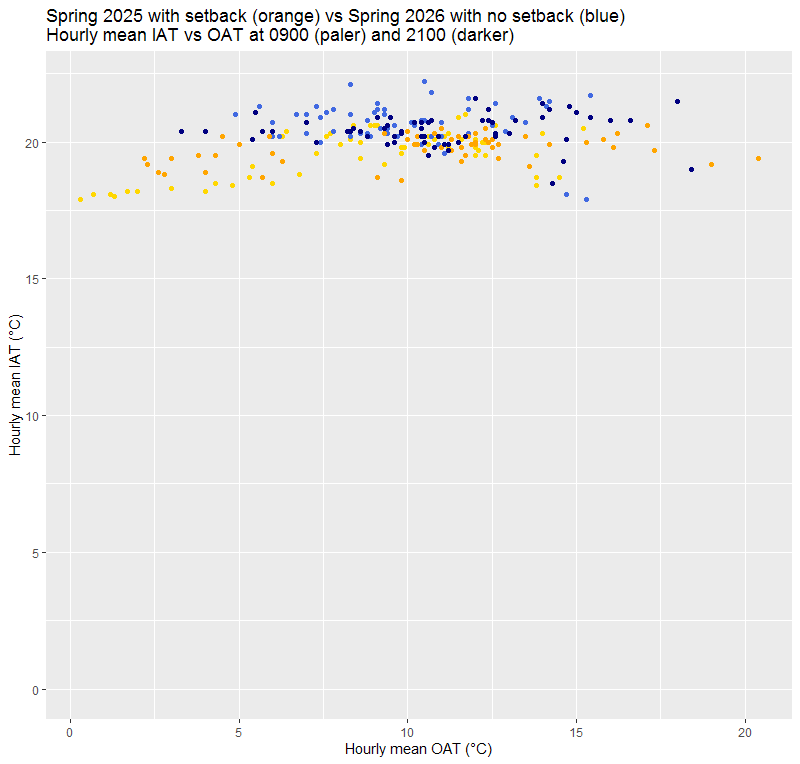
Unsurprisingly the setback 0900 obs are more prominent bottom left. But even there, the deficit is not great, less than 1.5°C below desired IAT (19°C).
Let me know if there are any other plots you would like me to do.
Midea 14kW (for now...) ASHP heating both building and DHW
Topic starter
14/05/2026 7:57 pm
Midea 14kW (for now...) ASHP heating both building and DHW


15/05/2026 7:53 am
@cathoderay - thats great.
Is there any possibility to do your clever trend line/statistical analysis on these. Eyeballing I would guess the two blue populations show little difference but the two yellow ones do. Maybe either trend line vs OAT at the two different times (probably not enough data for this - but you never know), or just a whole set average for each population at the two different times?
Also can you briefly describe your recovery algorithm?
From these pieces of information I am hoping its possible to construct a comparison which takes into account the 'comfort' penalty (if any - I guess there is at breakfast time but not at tea time) and is reasonably explained by the physics (or at least is not obviously inexplicable from the physics). My gut feel it is and that we finally can reach some conclusions from the experiments which can be tolerably explained and therefore might have a more general applicability.
4kW peak of solar PV since 2011; EV and a 1930s house which has been partially renovated to improve its efficiency. 7kW Vaillant heat pump.
Topic starter
15/05/2026 9:57 am
Is there any possibility to do your clever trend line/statistical analysis on these.
Yes, see below. They are just standard regression lines, just as in any spreadsheet, but in R you have more control and more options, but as I have said before, just because you have an option, it doesn't mean you should use it. It should only be used if it makes sense to use it. You also have access to residuals (posted previously) and other assumption checks eg the Breusch–Pagan test to test for heteroskedasticity (surely a word from hell, what it means is non-constant variance of Y in relation to X). Somewhat to my surprise, because eyeballing the data suggests the variance of Y does change with X (more scatter at higher OATs) ie there is heteroskedasticity, my data passed this test (sb = setback, nosb = no setback):
> bptest(model_sb)

	studentized Breusch-Pagan test

data:  model_sb
BP = 2.9244, df = 2, p-value = 0.2317


> bptest(model_nosb)

	studentized Breusch-Pagan test

data:  model_nosb
BP = 0.51917, df = 2, p-value = 0.7714
Since the p-values are greater than 0.05, we can conclude heteroskedasticity is not present. The reason why this matters is because if heteroskedasticity is present, then it can bias the standard error estimates, which in turn will bias the confidence bands, the grey shaded areas either side of the regression lines.
Here is the IAT vs OAT plot with regression lines for each of the four data sets added. I have done them as two plots (one for am, 0900, and one for pm, 2100) because putting them all on one gets far too busy. The regression lines are simple linear ones, y = a +b(x), not polynomial:
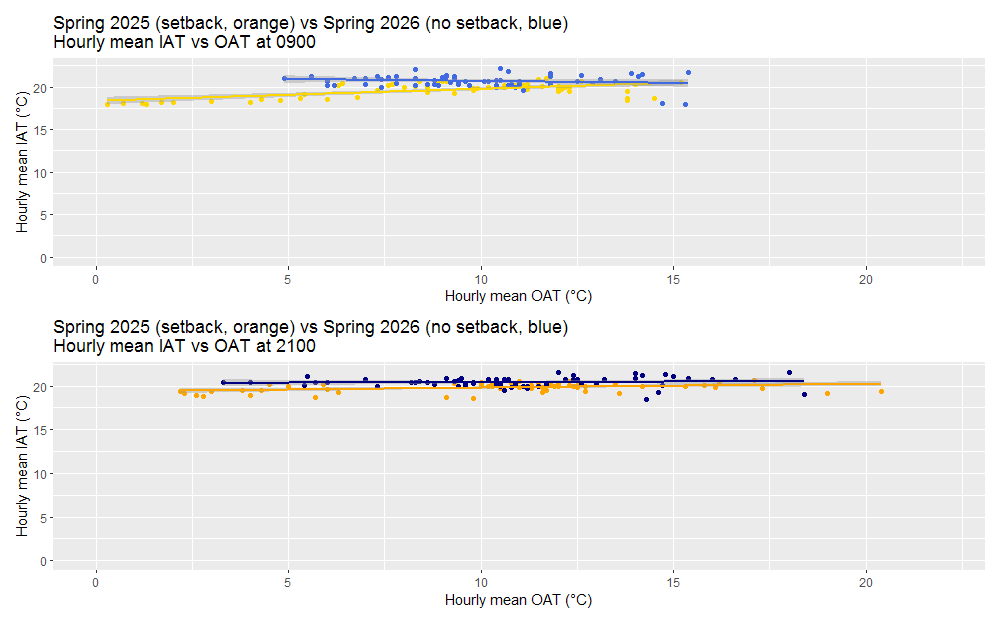
By the bye, it occurs to me these plots are a way of checking whether your WCC is set up right. The line should be pretty much horizontal, as it is in all four apart from the upper plot orange line, which is the morning IAT after setback. But that is probably just pointless statology, the Mark 1 Human Comfort Sensor is the best way of checking whether the WCC is set up right.
Also can you briefly describe your recovery algorithm?
Weather compensation plus my auto-adapt script, which temporarily moves the WCC up or down when the IAT is higher or lower than it should be. The IAT check and WCC adjustment if needed is done hourly, and the increments are one degree ie IAT one degree under, WCC goes one degree up etc, up to a maximum of three degrees either way. The recovery periods will thus be boosted by the auto-adapt script, depending on how far the IAT has dropped during the setback.
Midea 14kW (for now...) ASHP heating both building and DHW
15/05/2026 10:15 am
@cathoderay Thanks for your detailed response.Just two points:
1. As it happens we currently have a Viessman Vitodens 222-F with weather compensation, and that for the past 15 years; I never would have imagined a boiler not to have weather compensation, such an obvious and easy method of feed-forward compensation for a measurable disturbance variable that takes a way a lot of work from the feedback part of any controller. That said, my eyes are now on the Viessmann Vitocal 151-A which includes a very neat self-contained internal unit and could be a drop-in replacement to the current floor standing boiler.
2. I quite like to combine data analysis and first principle models, in an iteration that converges to something that represents a real world system to an accuracy sufficient for the task. I would start with static analysis (like you did I think), but like to extend to a simple dynamic model; a first order model for a thermal system appears to be sufficient I would think as a start. This is what I did for a series of articles on medium.com such as Quantitative Analysis of Heat Pump Operation for Space Heating and Domestic Hot Water .
Kind regards, peter
Topic starter
15/05/2026 12:21 pm
I quite like to combine data analysis and first principle models, in an iteration that converges to something that represents a real world system to an accuracy sufficient for the task.
I agree, and that is in effect what @jamespa and I have been doing!
This is what I did for a series of articles on medium.com such as Quantitative Analysis of Heat Pump Operation for Space Heating and Domestic Hot Water .
That's for the link and it seems I have been teaching grandmothers to suck eggs. You are clearly already very well versed in this subject, and even have a Cheshire cat to prove it! I rather suspect the Mark 1 Cat Comfort Sensor is even more sensitive that the Mark 1 Human Comfort Sensor.
Midea 14kW (for now...) ASHP heating both building and DHW

15/05/2026 2:02 pm
@cathoderay thanks for your kind response; our cat does like the comfort of a warm home and seeks out the best places in the house.
Among other problems with my analysis is the availability of data. Unfortunately, I could not obtain the half-hourly meter readings from my energy supplier, or not easily as in a CSV download; that would have been helpful. I also don't have any precise indoor temperature readings for several rooms, nor external temperature other that what the Viessman boiler displays. And, ideally I would like to have a record of flow and return temperatures of the boiler, perhaps not for every radiator, but at least at the boiler (who has the information). New versions of that boiler have a WiFi bridge and it should be possible to get that information.
Perhaps I am going to instrument my home with more sensors in preparation for the next winter and also switch to an energy provider that allows me to get access to my consumption data; then I should be able to refine the thermal model for our house and do another round of heat pump control and performance simulation, trying out all sorts of algorithms.
Kind regards, peter
Topic starter
15/05/2026 7:27 pm
Unfortunately, I could not obtain the half-hourly meter readings from my energy supplier, or not easily as in a CSV download; that would have been helpful.
@transparent may have something useful to add here, he knows a lot about smart meters.
Perhaps I am going to instrument my home with more sensors in preparation for the next winter
My initial thought is do you actually need this level of detail (room and rad temps for every room etc)? It might be fun to collect it (and doing something just because it is fun (as long as it is also harmless) in the great British eccentric tradition is fine by me), but at the moment you are missing some key variables: short interval energy use, flow and return temps, central living area IAT (I use a modbus temp sensor for that) and possibly OAT (depends how the Viessman measures it). Is there any way you can hack your boiler to get some data from it without blowing it up?
Midea 14kW (for now...) ASHP heating both building and DHW

15/05/2026 8:38 pm
Unfortunately, I could not obtain the half-hourly meter readings from my energy supplier, or not easily as in a CSV download; that would have been helpful.
@transparent may have something useful to add here, he knows a lot about smart meters.
Even if we knew which Energy Supplier, I'm not sure any of us could assist with getting your half-hourly readings.
I don't think we know enough detail about how each Supplier extracts the Smart Meter readings from their Billing System Software to display on your customer page.
I should perhaps point out that there are two different ways in which Suppliers obtain the usage statistics from your Smart Meter.
That's because the Electricity Smart Meter Equipment (ESME) has an inbuilt Randomised Offset to the Tariff Table. It's a whole number of seconds between 1 and 1799 (just short of a half-hour).
This offset was designed into the original specification (back in 2013) so that there wouldn't be surge demands on the grid when everyone simultaneously started a cheap-rate period. The Offset is injected into each ESME at the time of manufacture, creating a delay before each meter starts the next half-hour period.
It's not a linear function. For a notional set of 4000 meters, the delay looks like this if I display the number of Period-Starts in each minute:
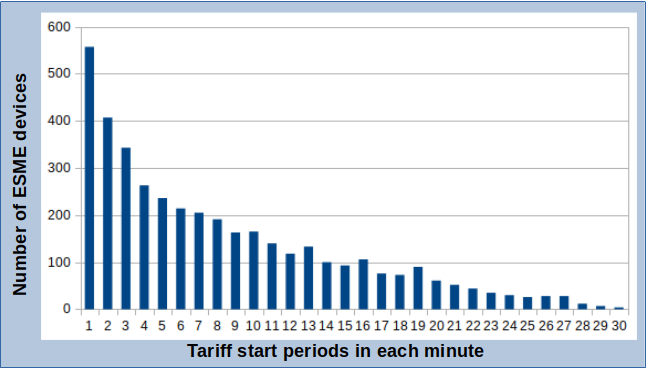
Thus, by the end of the 8th minute, only half the ESMEs have entered the new Tariff Period.
However, either because the programmers for each Supplier didn't understand the concept, or in order to make billing a simpler affair, this Randomised Offset isn't implemented by every Supplier for every Tariff.
As an example, Octopus Go doesn't use the Offset. Each period starts and ends according to universal time (UTC).
That obviously results in surges on the grid, but NESO seems to have coped with those so far.
Since hardly any consumers know that the Randomised Offset exists, let alone if their particular tariff uses it, they can't know if the Half-Hour readings they are presented with can be correlated with readings derived from apparatus within the home.
I'm going to stop at that point because we risk going wildly off-topic.
Save energy... recycle electrons!

15/05/2026 10:05 pm
I do lean to the idea that the main way setbacks save energy is by lowering the daily mean IAT. With careful timing, my setbacks start at 2100 which is a bit before bedtime, but unnoticeable in comfort, and end at 0300, which allows time for recovery, plus my auto-adapt script which can boost recovery when needed, this reduction in daily mean IAT can happen without compromising comfort.
TBH I'm not sure saving energy has been proven yet (see below) but maybe in your data there is proof. As always there is an n=1 aspect to this, it might work for you and your house, but how possible it might be to have a setback that doesn't compromise comfort is dependant on the household requirements (times and temperatures) and the house's thermal properties.
It is happenstance (when I happened to choose to run with a setback or no setback) which determined the periods included in the study, and they do not include the coldest months. This is a gap in the data which I can fill next winter, by running with a setback then, with this last winter (2025/2026) as the comparator, but it does mean we should be very careful about extrapolating from the current study to lower OATs. In particular, there are no periods of regular defrosts in the current data set. From previous discussions, we know that the effects of defrosts on energy use can be interesting and thought provoking.
In our previous discussion about defrosts the data suggests that they do not increase consumption noticeably and the effect on IAT over multiple defrosts is also minimal, but more data would be useful.
That said, and going against what I have just said (don't extrapolate!), we can compare the mean energy use over a range of OATs and speculate on what might happen at lower OATs.
Extrapolating your temperature plots shouldn't be overly controversial as the direction of travel of the regression lines is quite clear, it's unlikely that the setback line will become an S shape without an alteration to the system (e.g. control change to boost flow temp or reduce length of setback). Also, your hourly mean IAT vs OAT chart at 09:00 clearly shows the progressive divergence at lower OATs.
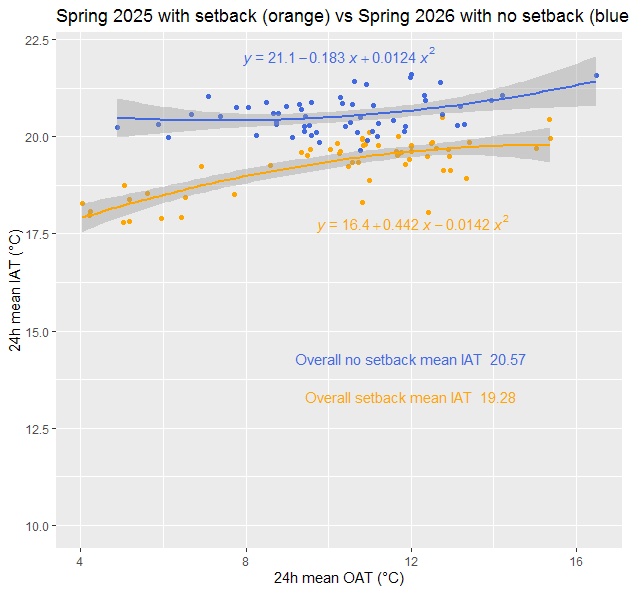
The mean IAT with setback is only ~18.5C at 5C OAT and from the no setback values you seem to like an IAT of about 20.5C.
This is more happenstance again, rather than I like an OAT of 20.5°C. The design temp for the living rooms is 19°C, anything above that is fine, and I can tolerate IATs down to about 17.5 to 18°, below that I start to notice the chill. What this means in practice is that I am comfortable at anything at or over 19°C, and variations of a degree or so either way go unnoticed.
If the target IAT is ~19C then why are almost all no setback IAT data points above this in both your 24 hour mean IAT vs OAT and 09:00 and 21:00 IAT charts? Reflected in: "the mean IAT for ... the no setback period it was 20.57°C", why when running with no setback wasn't the WC curve lowered to achieve the target IAT?
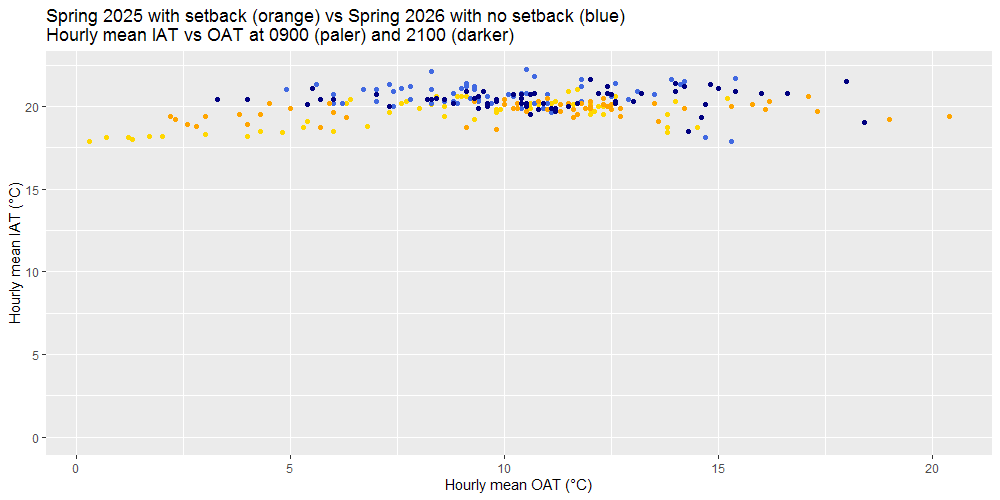
The 09:00 chart shows a clear pattern of lower IAT values after a setback at lower OATs when compared to your target IAT or the no setback IAT. Which indicates that 6 hours after the setback ended the IAT has not yet recovered to a truly comfortable temperature (target IAT) and only to a tolerable temperature (compromising comfort). Would you be able to do a similar chart for 07:00 and 19:00, as these times more closely represent breakfast and tea/supper times that are key times in the day for comfortable temperatures for most households? Unfortunately, this suggests something of an apples vs oranges comparison, the no setback data has an average IAT ~1.5C above your target IAT, while the setback IAT is still below your target IAT even 6 hours after the setback (and after most household's breakfast time) at lower OATs.
It is based on a comparison between the Midea reported energy use, as calculated from the volts/amps in, and the energy use reported on a dedicated kWh meter that only supplies the heat pump. The latter is what the heat pump uses in total, but it is manual read only (there is a modbus version available, but I have never got round to getting one and fitting it), meaning the comparison periods are relatively long (days. weeks and more) which means the 1.18 correction factor is the long term average, even if over shorter time periods it does vary.
Thanks for describing how the 1.18 correction factor was obtained and that it is a long term average based on manual readings.

SPONSORS

Degrees of Separation
Latest Posts
-

RE: Replacing Storage Heaters with a Heat Pump in a Stone Cottage
All very true. Personally I also put a fair amount of w...
By cathodeRay , 1 hour ago
-
RE: tepeo ZEB UK Support & Info Thread
OK so ZEB is basically a variant on a storage heater, b...
By JamesPa , 17 hours ago
-
RE: PV and battery long payback - sense check query
@energystoragetech it's highly improbable that @davidb ...
By Transparent , 23 hours ago
-
RE: Heat Geek installations: share your experiences
@editor I suspect that the Heat Geek online quote is a ...
By AndrewJ , 23 hours ago
-
RE: Adding additional Solar Panels to a DC coupled battery system
Ah, yes. Thanks for clarifying.
By Transparent , 23 hours ago
-
RE: Vaillant ecoTEC Plus - Flow Temp and Set Up
@trebor12345 I have been meaning to get home assista...
By Batpred , 1 day ago
-
RE: Indevolt Batteries UK Support & Info Thread
SunSynk hybrid inverters also have the capability to as...
By Transparent , 2 days ago
-
RE: Is This Initial Free Quote From Octopus Trusted Partner Reasonable?
If you've got a sash window or a door you can remove th...
By EtchedPixels , 2 days ago
-
RE: Are We Sleepwalking Into Another Race to the Bottom?
Roughly how most air/air is done except that step 3 doe...
By EtchedPixels , 2 days ago
-
RE: Nook batteries from Octopus
@batpred If your energy use is low enough that just get...
By EtchedPixels , 2 days ago
-
RE: Missing flow temperature in Heat Geek proposal
I suspect 4 yrs ago, their approach had not got to this...
By Batpred , 2 days ago
-
RE: battery storage without solar
Also don't forget that in you may not be able to use th...
By JamesPa , 2 days ago
-
RE: Tesla Powerwall (2) Calibration Cycles
One practical safeguard is to separate the calibration ...
By EnergyStorageTech , 2 days ago
-
RE: Getting closer to a finished Haier system
Apart from sealing the external Primary Pro joints and ...
By Singlespeed , 3 days ago


SPONSORS
