

Notifications
Clear all
Joining the Renewable Heating Hub forums is completely free and only takes a minute. By registering you’ll be able to ask questions, join discussions, follow topics you’re interested in, bookmark useful threads and receive notifications when someone replies. Non-registered members also do not have access to our AI features. When choosing your username, please note that it cannot be changed later, so we recommend avoiding brand or product names. Before registering, please take a moment to read the Forum Rules & Terms of Use so we can keep the community helpful, respectful and informative for everyone. Thanks for joining!
Solar Photovoltaic (PV)
15
Posts
6
Users
3
Reactions
2,159
Views

Topic starter
22/04/2026 2:01 pm
*Note to admin, I wasn't sure whether to post here, in storage or in tariffs as it applies to all three*
I've had 4.4kW Solar PV (South Facing Main roof) and a Gen 1 GE inverter + 2 x 2.6kWh Gen 1 GE batteries for just over 4 years now. I've also had an ASHP for just a little longer, it has worked great in tandem with the PV and batteries and Octopus Cosy tariff (had Flux that first Summer in 2023 when the prices made sense, but hasn't been worth it since for the system size).
My batteries only charge/discharge at 2.5kW and we have managed, but I'd like to upgrade to a 12kW inverter and start with a 10kWh battery (pretty sold on Sigenergy, I know a few others in the forum are not sure, but I like the look of it more over a Tesla PW3). We still cook with gas, but will be going electric and on cold days will need a higher discharge rate to run the ASHP and the kitchen at the same time.
If I wasn't on Cosy, say the Intelligent Go tariff, to cover the coldest days in winter I would need a lot more battery storage and I'm not sure that it would stack up financially.
I'm also considering more Solar PV, we can get 4 panels on a lower south facing roof, 14 or 16 on the north facing and some on the west facing wall.
What are the current options for arbitrage, isn't IOF closed now to new applicants? Axle energy? Is it worth it to get additional PV?
Mitsubishi Ecodan 8.5kW
4.4kW Solar PV
5.2 kWh Battery Storage
1983 build, 300mm loft insulation, cavity wall insulation (beads)

22/04/2026 2:27 pm
@trbob, don't worry about where to house the thread; we're not keen on it being posting in multiple locations (which you haven't done) but definitely not too fussy about which single location you pick.
A couple of questions first, if you don't mind:
- How much extra space have you got if you did decide to get more panels?
- You mentioned the 10kWh SigEnergy battery and from what I can see that's normally available at about £3,700 including the vodka and tonic. Is that the one you mean?
- Is your export under G98 or G99 approval (i.e. are you capped at 3.68kW or higher)?
- How do you currently manage any scheduling/automation/integration? Is it using the manufacturers' apps, manually or with something like Home Assistant? Same question also applies with how you'd like to manage any scheduling/automation/integration in the future with any new kit.
105 m2 bungalow in South East England
Mitsubishi Ecodan 8.5 kW air source heat pump
18 x 360W solar panels
1 x 6 kW GroWatt battery and SPH5000 inverter
1 x Myenergi Zappi
1 x VW ID3
Raised beds for home-grown veg and chickens for eggs
"Semper in excretia; sumus solum profundum variat"
1

22/04/2026 2:42 pm
12kw is a bit of a monster inverter!
We are an all electric household, including some legacy electric underfloor heating, heat pump, electric heater in the detached garage and a few children...
Our inverter can discharge/charge at 6.5kw sustained.
We do go above this, but only briefly normally around dinnertime. Remember the cooker will only switch on for a couple ofi minutes and when up to temperature then switch off for a while until it cools again.
With a very small amount of consideration, i.e run the heater in the garage, use the washing machine and tumble dryer outside of cooking time etc, you probably will very very rarely need 12kw that often.
Storage capacity for us was far more important, that is where the energy savings come from. We used the solar budget to buy more storage instead.
We always use around 15-20kwh everyday and in the colder darker months up to 40kwh a day. If it is really cold we'd probably run out of storage, However investing in another battery would probably take far too long to recover the upfront cost when it will rarely be needed.
Better to pay another £20 a year than invest a whole load more!
This post was modified 6 months ago by Bash
1
Topic starter
22/04/2026 8:41 pm
@trbob, don't worry about where to house the thread; we're not keen on it being posting in multiple locations (which you haven't done) but definitely not too fussy about which single location you pick.
A couple of questions first, if you don't mind:
- How much extra space have you got if you did decide to get more panels? Plenty of space on the lower south facing roof for 4 panels, between 14 and 16 on the north facing roof and the west facing wall is 8m wide, although the ducting for my ASHP runs up to the loft on one side of it, not sure how offset the panels on their frame can be. I could fit a further 2 or 4 on my main south facing roof, when I queried why my original installer hadn't done so, 'he forgot to ask the scaffolders for the side barriers', one of many shortcomings, but that's another story. It would be too much hassle and expense to move them now for the sake of another kW or two.
- You mentioned the 10kWh SigEnergy battery and from what I can see that's normally available at about £3,700 including the vodka and tonic. Is that the one you mean? Yes, I've had a few quotes but they're for inverter/battery only or the former with solar.
- Is your export under G98 or G99 approval (i.e. are you capped at 3.68kW or higher)? G98, yes this does all hinge on getting DNO approval via the G99 which my chosen installer will apply for, I acknowledge that it's not a given.
- How do you currently manage any scheduling/automation/integration? Is it using the manufacturers' apps, manually or with something like Home Assistant? Same question also applies with how you'd like to manage any scheduling/automation/integration in the future with any new kit. My GE inverter only has a single memory slot, so I use a third party app that's running on an old phone in the kitchen to handle the scheduling, handily it also means that I can see what the system is doing at any given time. From what I can tell, the Sigenergy software offers a lot more scope for automation, and will integrate with Octopus and Axle.
Thanks, I've replied inline.
12kw is a bit of a monster inverter! I searched through my data for winter and my house load has spiked up to 10kW on cold days, it's all about future proofing, also the cost is not that much more as you go up through the inverter sizes, not like say batteries where double the capacity is double the cost.
We are an all electric household, including some legacy electric underfloor heating, heat pump, electric heater in the detached garage and a few children...
Our inverter can discharge/charge at 6.5kw sustained.
We do go above this, but only briefly normally around dinnertime. Remember the cooker will only switch on for a couple ofi minutes and when up to temperature then switch off for a while until it cools again.
With a very small amount of consideration, i.e run the heater in the garage, use the washing machine and tumble dryer outside of cooking time etc, you probably will very very rarely need 12kw that often.
Storage capacity for us was far more important, that is where the energy savings come from. We used the solar budget to buy more storage instead.
We always use around 15-20kwh everyday and in the colder darker months up to 40kwh a day. If it is really cold we'd probably run out of storage, However investing in another battery would probably take far too long to recover the upfront cost when it will rarely be needed. Yes I'm close to 40kWh on cold days, and that's without using an electric cooker/hob. I like the idea of V2H chargers and compatible EVs, apparently it's coming pending regulatory approval, although the charger will be ~£2500. So not sure whether to get some more storage or wait and go the V2H route.
Also if I ended up constrained to a smaller inverter by the DNO, then it may make more sense to get some more storage instead and forego the extra panels.
Better to pay another £20 a year than invest a whole load more!
This post was modified 6 months ago 2 times by TRBob
Mitsubishi Ecodan 8.5kW
4.4kW Solar PV
5.2 kWh Battery Storage
1983 build, 300mm loft insulation, cavity wall insulation (beads)


22/04/2026 9:29 pm
We are an all electric household
Does that include vehicles?
Electric cars just slurp energy on an entirely new level. When I put in 11kW of inverter power I wondered if I was over designing it, but... ended up maxing it out anyway.

22/04/2026 10:31 pm
Electric cars just slurp energy on an entirely new level. When I put in 11kW of inverter power I wondered if I was over designing it, but... ended up maxing it out anyway.
FWIW The standard single phase domestic EV charger is 7.2kW. You can get three phase ones if your vehicle is capable and you have a 3 phase supply, 22kW. Fast chargers such as you find at service stations etc are typically 50-300kW but increasing.
If you fill up with petrol you can put 100l, roughly 1000kWh, in perhaps 3 minutes. Thats roughly 20,000kW!
Why would you charge an EV (ie a battery) from a battery, other than in exceptional circumstances?
This post was modified 6 months ago 2 times by JamesPa
4kW peak of solar PV since 2011; EV and a 1930s house which has been partially renovated to improve its efficiency. 7kW Vaillant heat pump.
23/04/2026 10:23 am
@trbob, don't worry about where to house the thread; we're not keen on it being posting in multiple locations (which you haven't done) but definitely not too fussy about which single location you pick.
A couple of questions first, if you don't mind:
- How much extra space have you got if you did decide to get more panels? Plenty of space on the lower south facing roof for 4 panels, between 14 and 16 on the north facing roof and the west facing wall is 8m wide, although the ducting for my ASHP runs up to the loft on one side of it, not sure how offset the panels on their frame can be. I could fit a further 2 or 4 on my main south facing roof, when I queried why my original installer hadn't done so, 'he forgot to ask the scaffolders for the side barriers', one of many shortcomings, but that's another story. It would be too much hassle and expense to move them now for the sake of another kW or two.
- You mentioned the 10kWh SigEnergy battery and from what I can see that's normally available at about £3,700 including the vodka and tonic. Is that the one you mean? Yes, I've had a few quotes but they're for inverter/battery only or the former with solar.
- Is your export under G98 or G99 approval (i.e. are you capped at 3.68kW or higher)? G98, yes this does all hinge on getting DNO approval via the G99 which my chosen installer will apply for, I acknowledge that it's not a given.
- How do you currently manage any scheduling/automation/integration? Is it using the manufacturers' apps, manually or with something like Home Assistant? Same question also applies with how you'd like to manage any scheduling/automation/integration in the future with any new kit. My GE inverter only has a single memory slot, so I use a third party app that's running on an old phone in the kitchen to handle the scheduling, handily it also means that I can see what the system is doing at any given time. From what I can tell, the Sigenergy software offers a lot more scope for automation, and will integrate with Octopus and Axle.
Thanks, I've replied inline.
There's quite a lot to unpick there already, and I'm no expert, but just a few thoughts to start.
Firstly, it looks to me as if there's some scope for more panels but not that much; I wouldn't even consider a north facing aspect without a compelling reason. To me, therefore, adding more panels would feel like an extra to chuck in if it's easy and cheap to do but otherwise ignore.
Secondly, the battery. Both the Tesla and the SigEnergy from what I can see are fairly expensive for what you get. Admittedly sold out and therefore with a long lead time, a Fogstar unit at £6k (less than double the SigEnergy) will provide 64kWh. Alternatively, a 10kWh Fogstar unit is about £1,600. Both of those are IP65 rated ones and so suitable for being fitted outside; internal only units can go cheaper. I'm not, I hasten to add, recommending Fogstar; just making the point that if you look wider than Tesla and SigEnergy you can find solutions that are far cheaper per kWh whilst still being well respected and reliable units.
Thirdly the DNO approval issue. As long as you plump for an inverter with an export-limiting config the DNO will accept, you don't necessarily need the dependency on the G99 approval. This will obviously limit your ability to import cheap and then export later, but it would certainly mean you could get the size of inverter you want to service your home's needs. I must admit I agree with @bash that 12kW is a big old beast but that's for you to decide.
Finally, the control. Given you're a GivEnergy customer, I'd've expected you to be very wary of a supplier-specific automation strategy, and yet Tesla and SigEnergy are, as far as I'm aware, two of the most active suppliers in trying to make you dependent on using their proprietary services. It is, of course, entirely up to you, but if you were to pick an inverter with an RS485 port (i.e. the ability to talk modbus), you have a plan B built into your system. That doesn't stop you from using the supplier's cloud services and app, but if they went the way of GivEnergy or if you decided you wanted to control things locally instead then you have a ready alternative. I happen to use a modbus connection to my inverter so I can do all the automation and monitoring from within Home Assistant and that most certainly allows for integrating with Octopus. All I'm suggesting is that you don't trust that the new supplier you choose will both remain in business indefinitely and at the same time keep their app/services free to use.
105 m2 bungalow in South East England
Mitsubishi Ecodan 8.5 kW air source heat pump
18 x 360W solar panels
1 x 6 kW GroWatt battery and SPH5000 inverter
1 x Myenergi Zappi
1 x VW ID3
Raised beds for home-grown veg and chickens for eggs
"Semper in excretia; sumus solum profundum variat"

23/04/2026 12:21 pm
We are similar - have a Tesla PW3, ASHP and run Octopus Cosy recharging 3 times per day in winter as required.
My batteries only charge/discharge at 2.5kW and we have managed, but I'd like to upgrade to a 12kW inverter and start with a 10kWh battery (pretty sold on Sigenergy, I know a few others in the forum are not sure, but I like the look of it more over a Tesla PW3). We still cook with gas, but will be going electric and on cold days will need a higher discharge rate to run the ASHP and the kitchen at the same time.
Absolutely agree. Inverter size is critical here. Our background usage with heating on in winter is 1.2-1.5kW. Add in the 2.7kW electric oven, turn on the 3kW kettle and maybe the air fryer or microwave and you can easily find yourself drawing 8-10kW. You can manage things by turning the oven down before turning the kettle on, but it's a pain so get an appropriately sized inverter if you can. I note DNOs are starting to become more restrictive on inverter ratings, and they may not want to approve an inverter rating above your solar kWp rating which would be limiting in terms of meeting peak house load. This is a situation that is only going to get worse in the short to medium term IMHO, so the earlier you apply and the more that is approved, the better. I see no advantage in waiting or looking to add more later.
If I wasn't on Cosy, say the Intelligent Go tariff, to cover the coldest days in winter I would need a lot more battery storage and I'm not sure that it would stack up financially.
Same here. Looking at our data, we can comfortably sustain 40kWh/day total usage in winter at the Cosy cheap rate with a PW3. We could probably push that to 50kWh if we maxed out grid usage in the 8h of cheap rate. We try to do that as much as possible, using the battery only for heating on the very coldest of days. The evening peak rate period from 4-10pm is most problematic as there's no solar to help and on the very coldest of days there's only really sufficient battery capacity to provide heating, so we do find ourselves planning our evening meals around the outside temperature - we will prepare oven based meals on warmer days and wok based (gas) means on the very coldest evenings. All easy the manage with a bit of thought, and only really affects a handful of days per year for us so I guess you could say our battery is perfectly sized for our needs.
I'm also considering more Solar PV, we can get 4 panels on a lower south facing roof, 14 or 16 on the north facing and some on the west facing wall.
I have never heard of anyone regretting adding more solar. Even in the winter months we generate a meaningful 200kWh plus per month, and the excess export in summer pays the bills in winter.
What are the current options for arbitrage, isn't IOF closed now to new applicants? Axle energy? Is it worth it to get additional PV?
As you say IOF is currently closed. We had planned on running Cosy for 6 months over winter and IOF for the summer 6 months so this has scuppered our plans. We are still on Cosy with 12p SEG for export. Last year we were earning an average 26p for export on IOF, so a large drop. We are effectively off grid from April to September as we generate more than we consume, and our PW3 capacity perfectly matches our daily consumption in summer so as long as it doesn't rain heavily for two or more days, we don't need to import electricity.
In almost any scenario extra solar is going to be beneficial. Unless export rates (SEG) drop to zero, there will be benefit. Even if SEG rates do drop, I think we are more likely to move to a system of paid export at peak times which will benefit battery owners who can discharge to the grid during the morning peak, recharge and self consume during the day and discharge stored excess again during the evening peak. In winter you can generally self-consume what you generate having an ASHP so export rates become irrelevant.
Finally, adding more solar may help justify that larger inverter (see my comments about DNO approvals above).
Samsung 12kW gen6 ASHP with 50L volumiser and large radiators. 7.2kWp solar (south facing), Tesla PW3 (13.5kW). Net Zero
1

23/04/2026 12:35 pm
Why would you charge an EV (ie a battery) from a battery, other than in exceptional circumstances?
When it's cheaper than charging from the grid.
It's not just charging "from a battery" - it may be charging from excess solar during the day that you are not allowed to export, so use it or lose it, and will become more common as DNOs become more restrictive in export approvals.
Samsung 12kW gen6 ASHP with 50L volumiser and large radiators. 7.2kWp solar (south facing), Tesla PW3 (13.5kW). Net Zero
23/04/2026 2:48 pm
Yes, although I charge the car overnight.
I do sometimes use the home battery to charge the car when it has been used heavily and I need a bit more mileage the next day.
It seems a bit weird charging your car battery with another battery, but why not if you need to on the odd occasion!
23/04/2026 2:51 pm
I was initially a little concerned our inverter discharge rate of 6.5kw would be a bit limiting, especially during peak cooking time, however our consumption only peaks for a short period and this has had a very minimal impact on peak electricity import cost, like less than 1% per month.
23/04/2026 2:53 pm
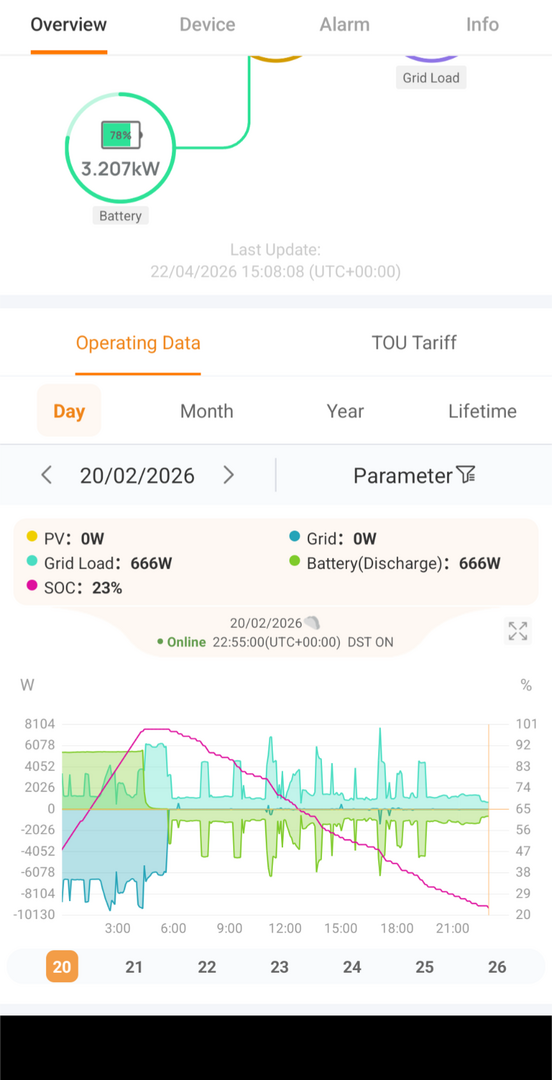
This was a reasonably cold day with the heat pump running quite hard. We got close to exhausting our 45kwh storage, with only a tiny amount of peak needed when consumption ran over the inverter limit.
Looking at the bill for that day we consumed 48.14kwh off peak, 0.49kwh peak.
This post was modified 6 months ago 3 times by Bash
Page 1 / 2
Next
SPONSORS

Degrees of Separation

Latest Posts
-

RE: Heat Geek Zero Disrupt: Are We Sleepwalking Into Another Race to the Bottom?
@editor In principal I agree with most of what you s...
By JamesPa , 50 minutes ago
-
RE: Air-to-Air Heat Pumps & Air Conditioning: UK Heating and Cooling Q&A
Our latest Homeowners’ Q&A episode has just dropped...
By Mars , 58 minutes ago
-
RE: Vaillant ecoTEC Plus with sensoCOMFORT and weather compensation
Yes, its described in the sensocomfort manual. Its als...
By JamesPa , 1 hour ago
-
RE: Heat Geek installations: share your experiences
My summary, highlighting the oddities.
By Batpred , 3 hours ago
-
RE: Missing flow temperature in Heat Geek proposal
That makes sense, even if few people would have a highe...
By Batpred , 3 hours ago
-
RE: Renewable Heating Hub Homeowners' Q&A Podcast
What a day yesterday! Two podcasts recorded, brilliant ...
By Mars , 23 hours ago
-
RE: Tesla Powerwall (2) Calibration Cycles
@davesoa I’m rather a Luddite, but when I was running I...
By Papahuhu , 24 hours ago
-
RE: Adding additional Solar Panels to a DC coupled battery system
I too use AI when researching online. It's able to co...
By Transparent , 1 day ago
-
RE: Getting closer to a finished Haier system
Theres comprehensive instalation and service manuals (I...
By Singlespeed , 2 days ago
-
RE: Indevolt Batteries UK Support & Info Thread
There is now a new Secretary of State for Energy Securi...
By Transparent , 2 days ago
-
RE: Do I add Air Con or MVHR to existing A2W ASHP?
@rob-of-york Looks like an impressive bit of kit. Just ...
By Batpred , 2 days ago
-
RE: DIY Heat Pump Installations: Navigating Legal and Regulatory Hurdles
The idealist in me says pioneers in this space should b...
By Batpred , 2 days ago
-
RE: How should the Boiler Upgrade Scheme be reformed?
Ah, that makes sense when a combi is in place. The boil...
By Batpred , 3 days ago
-
RE: Replacing Storage Heaters with a Heat Pump in a Stone Cottage
@bobflux Thanks, that gives me something to check the i...
By Paul1098 , 3 days ago
-
Over the years, due to the non barrier PEX underfloor h...
By bobflux , 4 days ago





SPONSORS

