

Notifications
Clear all
Joining the Renewable Heating Hub forums is completely free and only takes a minute. By registering you’ll be able to ask questions, join discussions, follow topics you’re interested in, bookmark useful threads and receive notifications when someone replies. Non-registered members also do not have access to our AI features. When choosing your username, please note that it cannot be changed later, so we recommend avoiding brand or product names. Before registering, please take a moment to read the Forum Rules & Terms of Use so we can keep the community helpful, respectful and informative for everyone. Thanks for joining!

Topic starter
05/08/2026 7:59 am
Our second car died last week and has been replaced with a 2015 Leaf. As part of the planning I have been investigating using time of use tarrifs, PV and battery storage. I now have a full proposal from an installer which suggests a payback of 15 years! Initially I suspected this was based on the PV output only but was assured it included using the 9.6kW battery benefits. While I can ask to fine tune the numbers, 15 years to show a theoretical profit suggests I just pack the idea away and continue to use my standard tarrif. My reason for raising the topic is to seek the guidance of this very experienced community to sense check if that is a reasonable conclusion?
Some numbers may help
Annual usage of about 6000kWhrs including a small added allowance for the EV.
Peak daily usage of roughly 30kWhrs but that figure varies significantly but is in the region of 15kWhrs during the winter. Our meter only went smart in late February.
The proposal is for 8 PV panels (4 west facing and 4 east), 10kW battery and 3.6 inverter. The EV will be charged using a dedicated 13amp socket and the vehicle systems used to control charging etc. The suggestion is an Octopus tarrif from Oct 25 of 7p for 6 hrs and 30p.
Have I got something significantly wrong?

05/08/2026 9:39 am
"10kW battery"
That to me is odd. It's 400 quid more for a 16kWh battery retail, so why would anyone push a battery that small. The 3.6kW also smells like an installer wanting to avoid the paperwork of a G99. Was G99 discussed or did they just armwave a 3.6kW inverter ? What sort of prices/equipment are they talking about ?
The big issue tends to be the fixed overheads. To put 8 panels on your roof (at 60 quid a panel, maybe 30 in mounts) requires scaffolding, building reg calcs (not that most installers ever do them), all the wiring, insurance etc etc. That is all a fairly fixed cost so small installs don't work well compared with big ones where the other costs don't shift much.
If you have only a small amount of viable roof for solar then solar on the roof tends to have a terrible payback once scaffolders and electricians are involved, and especially once the MCS is involved. This is why solar people tend to advise you cover every surface you sensibly can with panels. If you really only have a small amount of roof and no usable fence/garden/walls then solar may simply not make sense due to all the regulatory overhead and fixed costs involved, although plug in solar in the garden might once it's legal especially if you are low utilisation apart from the EV (remembering you'd overnight charge the car off an EV tariff like Go)
So to me it seems a bit odd but not necessarily. For solar only a 3.6kW inverter for 4kW of panels would make sense, for battery not so much. If you've only got 8 panels of usable roof and no wall or garden you can use to boost it then that will push RoI up.
Other option if most of the cost is coming from scaffolding (as should be the case) would be to go battery only and save solar for later if need be. As it's about 3 grand for 16kWh of battery and a 3.6kW inverter off the shelf plus a grand of other bits plus electrician time and all minus vat that can be a much better approach than trying to put a tiny array on the roof. Then you save the solar until you've got to put scaffolding up anyway to fix the roof some year in the future.
Another option is that you wait a bit and install plug in kit once plug in battery is legal and get the fixed costs down hopefully.
It's not looking like waiting is going to make battery prices go up at this point.

05/08/2026 10:45 am
@davidb, it would be helpful if we had some ballpark ideas of the breakdown of the quote; it's all a bit hypothetical without knowing at least very roughly the scale of the costs.
I agree with @etchedpixels' breakdown of where your money goes in installation, and in particular his assertion that scaffolding is a one-off fixed cost so the more panels you can fit the lower the final per-panel net cost. On the flip side, a PV/battery installation is more valuable the more it can be used, so it makes sense to combine such an installation with a push to throw everything electric you can at it.
As an example:
- Our home uses about 9-10 kWh per day on residual energy consumption - everything not involved in heating, hot water or EV. That's about average and gives us a residual annual consumption of about 5,500 kWh - pretty close to your estimate.
- We used to have an oil boiler and used about 2,000 litres of oil a year, but we changed to a heat pump which on its own saved us perhaps £100-ish on running costs. However, since a heat pump is electric and we can use battery and solar power to run it some of the time, the overall savings over the past nearly 5 years is about £870 per year.
- Like you, we moved from an ICE car to an EV. Being able to compare fuel costs per litre with electricity cost per kWh for the same mileage (i.e. we'd've made the journey anyway), the 9,000 or so miles we make in the EV save us about £960 per year.
- Totting up what our actual electricity bills are and what we would have had to pay in electricity, oil and diesel if we hadn't made the change we can see we can see we save around £2,200 per year, so that means an extra £370 from a combination of what we export back to the grid and what we gain from being clever with time of use tariff.
For context, our heat pump after RHI came to about £4,000 and our solar PV and battery install came to about £7,500. Given our savings to date, from an installation date around Christmas 2021/January 2022, our current break even date is mid June next year. Bear in mind that this is with a 6.5 kWh battery.
Now looking at your installation, it would make very little sense to charge your EV from your battery, so that 10 kWh battery is only being installed to service your home's 10 kWh daily residual load (or, to put it another way, allow you to operate your home apart from EV entirely on cheap rate electricity). That means there is a good argument in at least considering an inverter and battery installation without any solar panels at all at this stage. Perhaps more importantly, it means you can look at the cost of battery/inverter installation and the cost of solar panel installation as separate items and weigh up the financial benefit and ROI of each on its own merits.
As far as the EV is concerned, using a 3 pin granny charger is perfectly acceptable but does mean charging takes quite some time. With a time of use tariff, you've only a fairly short window of cheap rate so you ideally want to use it to its best by piling as much into your EV battery as you can to fit within that window. That's why a dedicated EV wall box is a good idea if you can manage it in your location.
I should also say that playing the time of use tariff game can provide significant benefits but it does need you to have the means to automate it; no-one wants to stay up into the small hours to press a button manually. As a result, understanding what you can and can't do with the tools provided as standard and understanding what you could do with a few extra tools if you have the will and inclination to install them is essential to making non standard tariff work for you.
Looping back to your original post, a suggestion of 15 years' payback time feels odd. It suggests either that the installer is estimating badly or overcharging you (or both, of course), but a lot hangs on the substance of the quote. As I said, any more details you can provide would be useful.
105 m2 bungalow in South East England
Mitsubishi Ecodan 8.5 kW air source heat pump
18 x 360W solar panels
1 x 6 kW GroWatt battery and SPH5000 inverter
1 x Myenergi Zappi
1 x VW ID3
Raised beds for home-grown veg and chickens for eggs
"Semper in excretia; sumus solum profundum variat"
1

05/08/2026 5:38 pm
@davidb Why only 8 panels? With 6000kWh annual usage, ideally you'd be doubling that to around 16 panels. Is 8 panels the maximum you can fit on your roof space? Generally it is accepted you should max out your available roof space.
We use around 6500kWh per year, and with 7.2kWp solar panel array (16x450W panels) and PW3 we have a negative electricity bill. A decent installer should be able to offer a 7.2kWp solar system with 13.5kWh Tesla Powerwall 3 for around £12k. We were previously spending between £2,500-3000 per year on electricity and oil before our electrification (we also now have a heat pump), so at £3k per year saving, that's a 4 year pay back for the solar + battery installation.
This post was modified 3 months ago by Old_Scientist
Samsung 12kW gen6 ASHP with 50L volumiser and large radiators. 7.2kWp solar (south facing), Tesla PW3 (13.5kW). Net Zero

Topic starter
05/08/2026 6:51 pm
@old_scientist I have now drafted 2 replies - both have got lost during upload. More than a little discouraged. I won’t add anymore now as it’s likely to get lost. Hopefully this short acknowledgement will get through.
1
Topic starter
09/08/2026 4:03 pm
Apologies for the delay in my reply. I got home to no water (we are on a private supply) and fixing that has been the absolute priority.
As I have a history of seeming to loose posts, can anyone please let me know if there is a way of holding text as a draft? If my recent words had been in a draft folder, maybe I might not have to start again. Any help on this topic would be just great. I get disheartened when having to start again due to a technical hitch.
Before I get back into responding to the group, I have just been reading an article re plug in solar with 2 panel sets reported as likely to go on sale soon at a price of £350. If that is correct it’s a useful benchmark. I asked to have the solar element of my £11,000 quote removed and the reduction was £4000. That is £1000 for the equivalent of the plug-in package…..
i will post this now and hopefully all will be well and I will follow this starter with the information requested. More to follow.
09/08/2026 4:51 pm
…
As I have a history of seeming to loose posts, can anyone please let me know if there is a way of holding text as a draft?
…
If you look at the line just below the “Add reply” button, you’ll see “Preview”, “0 (or 1, 2 or 3) revisions” and “Save Draft”. Clicking on the “revisions” link will show you a list of up to three previously saved drafts of your post, even if your browser crashes and you have to come back later. Above each revision are options to restore or delete that revision.
If you “save draft”, that will obviously create a revision but the site will autosave anyway every few minutes.
105 m2 bungalow in South East England
Mitsubishi Ecodan 8.5 kW air source heat pump
18 x 360W solar panels
1 x 6 kW GroWatt battery and SPH5000 inverter
1 x Myenergi Zappi
1 x VW ID3
Raised beds for home-grown veg and chickens for eggs
"Semper in excretia; sumus solum profundum variat"
09/08/2026 5:44 pm
So if it helps I was recently quoted about 8 grand for a battery only installation with partial home backup, splitting the consumer unit to account for that with 40kWh of Fogstar battery and a 5 or 6kW Sunsynk inverter (depending upon what G99 that property could get).
There are complications sometimes mixing AC coupled solar with batteries separately as you would be doing with current plug in solar. The G98/G99 rules count the theoretical worst cast maximum export so if you have a 5kW inverter on a battery and a pair of 800W microinverters then that's 6.8kW. On the other hand if you have 5kW of inverter and the panels directly connected via DC then your G98/99 requirement is only 5kW.
Some of that will depend where you are and if you are only some creaky ancient rural grid.
I note your info says you are on the Isle of Arran so I imagine that does drive costs up when it comes to shipping battery stacks. However it also means you are in the one bit of the UK that has sensible solar regulations so you can ground mount or fence mount solar rather than slap it on a roof assuming you have the space. If you can then that's often cheaper and it also makes maintenance much much simpler, as well as knocking snow off them.
If you are seriously rural you might also want to look at the inverter proposed and see if it has a generator input. Some do.

Topic starter
11/08/2026 9:21 am
@majordennisbloodnok Thanks for the clarity. As it happens I thought I had saved a short response to you and saved it. When I logged back on I couldn’t workout how to open the saved draft. Maybe i hadn’t saved it correctly - although it seems straight forward. I seem to be learning the hard way so apologies.
One of the posts which evaporated was some “facts” re G98, 99 and 100 from the company who initially quoted. The starting position was I could only get a G98. I asked about how to power our 10kW electric pumped shower from storage. Initially he said I was limited to 3.6kW so the balance of 6.4 would have to come from the grid. He then came back and said they could apply for a G100 so I could have a larger inverter but be limited to 3.6 export. For this he wanted £500. He also said that there is an almost blanket refusal of a G99 in my area of Scotland. Apparently this was introduced fairly recently - possibly over the past year or so. Another local supplier said he would have to check and this was news to him. I asked as I had considered if V2H or G might make sense in relation to an EV and additional battery capacity for the house. That is now behind us as we have just acquired a 2015 Leaf. If G99 are just not available then V2G for this area is a non starter even if I was inclined to buy new Chinese through Octopus - which I am not!
Is my understanding of the various G applications and limitations along the right lines?
Thanks for any assistance. You are obviously much further down the renewables road than I am and your time in any reposes really appreciated.
11/08/2026 9:42 am
@majordennisbloodnok Thanks for the clarity. As it happens I thought I had saved a short response to you and saved it. When I logged back on I couldn’t workout how to open the saved draft. Maybe i hadn’t saved it correctly - although it seems straight forward. I seem to be learning the hard way so apologies.
...
You have absolutely nothing to apologise for at all, @davidb. This forum's software is pretty intuitive but definitely not perfect and one person's straightforward isn't everyone's - until you know how to do it, of course.
...
One of the posts which evaporated was some “facts” re G98, 99 and 100 from the company who initially quoted. The starting position was I could only get a G98. I asked about how to power our 10kW electric pumped shower from storage. Initially he said I was limited to 3.6kW so the balance of 6.4 would have to come from the grid. He then came back and said they could apply for a G100 so I could have a larger inverter but be limited to 3.6 export. For this he wanted £500. He also said that there is an almost blanket refusal of a G99 in my area of Scotland. Apparently this was introduced fairly recently - possibly over the past year or so. Another local supplier said he would have to check and this was news to him. I asked as I had considered if V2H or G might make sense in relation to an EV and additional battery capacity for the house. That is now behind us as we have just acquired a 2015 Leaf. If G99 are just not available then V2G for this area is a non starter even if I was inclined to buy new Chinese through Octopus - which I am not!
Is my understanding of the various G applications and limitations along the right lines?
Thanks for any assistance. You are obviously much further down the renewables road than I am and your time in any reposes really appreciated.
Others are better placed than me to tell you about the ins and outs of G98, 99 and 100. However, those certificates are all about what you can export to the grid, not limits on your inverter per se. The link, however, is that the DNO has to be able to rely that your inverter will abide by the rules. There are plenty of inverters that can deal with far more than 3.6 kW but have a configurable software limit on how much they will throw at the grid. However, in order for your DNO to allow your inverter to be connected to the grid, that inverter has to be certified, and the list of software-limitable inverters that are compliant is smaller.
Nonetheless, assuming you were to get a fairly chunky compliant inverter - let's say a 12 kW inverter - my understanding is that it would be acceptable for the DNO to issue a G98 certificate on the understanding the inverter was limited to a maximum of 3.6 kW export to the grid. If you fired up your shower, you'd still be able to draw 10 kW from battery and/or solar without touching the grid and if you were generating more than 3.6 kW solar PV (and the shower was off) you could pile all that energy into your battery up to the inverter's maximum capabilities of 12 kW.
At this point I'm going to call on other forum members - not least of all @transparent - to check my homework.
105 m2 bungalow in South East England
Mitsubishi Ecodan 8.5 kW air source heat pump
18 x 360W solar panels
1 x 6 kW GroWatt battery and SPH5000 inverter
1 x Myenergi Zappi
1 x VW ID3
Raised beds for home-grown veg and chickens for eggs
"Semper in excretia; sumus solum profundum variat"
11/08/2026 9:48 am
Oh, and as for V2G, it's still early days. My personal feeling is that, even once it is better adopted and rolled out than it is now, V2X is a more flexible variation. My home gets most of its savings from minimising grid import rather than maximising grid export, so if I were able to look at my car as just another portable battery that would help a lot. Obviously I do export and get paid for it but I don't import cheap and then export later when it's beneficial; I can get plenty of savings from buying cheap and then powering the heat pump. If I could fill up my car when it's really cheap and then power my home from leccy stored in the car, that's just an extension of what I'm doing already.
105 m2 bungalow in South East England
Mitsubishi Ecodan 8.5 kW air source heat pump
18 x 360W solar panels
1 x 6 kW GroWatt battery and SPH5000 inverter
1 x Myenergi Zappi
1 x VW ID3
Raised beds for home-grown veg and chickens for eggs
"Semper in excretia; sumus solum profundum variat"

11/08/2026 10:01 am
Thanks @majordennisbloodnok
Let me clarify.
G98 isn't something you apply for.
G98 certification is something which already applies to the equipment you wish to install. The manufacturer will have undertaken the tests for G98 compliance, and that allows the device to be included in the ENA online database, Connect Direct.
Only devices which have the potential to export to the grid require G98 approval. Thus my SunSynk inverters are G98 approved... although the firmware actually restricts export to zero!
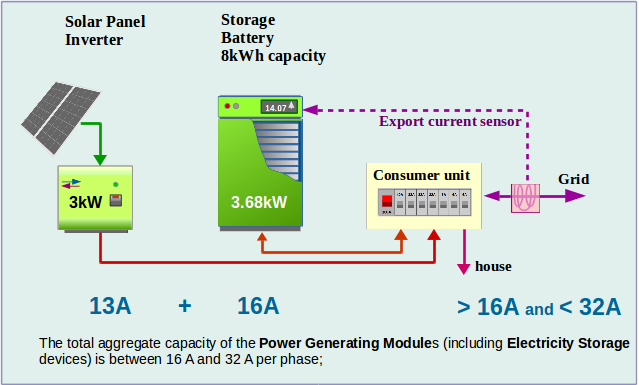
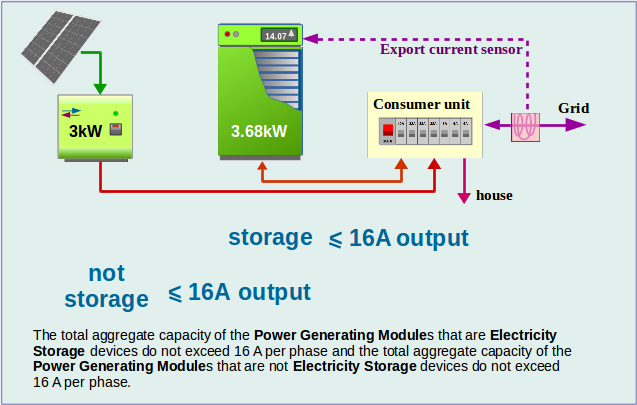
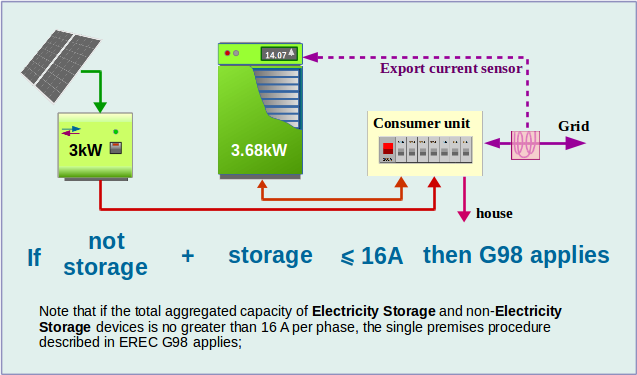
If you have more than one G98-certified device or you wish to export above 16A (per phase), then you apply to your DNO for G99 approval.
The wording of the G99 technical requirements can be complex. In each of the following graphics, I've put the technical wording at the bottom, and displayed it as a diagram above:
Save energy... recycle electrons!
1
Page 1 / 3
Next
SPONSORS

Degrees of Separation
Latest Posts
-

RE: The Changing Jet Stream Could Challenge UK Air Source Heat Pumps
There are a collection of tools around on the internet ...
By EtchedPixels , 5 hours ago
-
RE: 15kw pump for 225m2 1990's house - over kill?
@seaviews I have read you latest response re buffer ...
By JamesPa , 6 hours ago
-
RE: How will removing the standing charge on gas bills benefit heat pumps?
The BUS grant funding for 2026/27 will run out at the c...
By Rob of York , 17 hours ago
-
-
@editor Ouch, sorry to re start the tick. I had assume...
By DavidB , 2 days ago
-
RE: Say hello and introduce yourself
@e-a-west as the good Major said, welcome to the forums...
By Mars , 2 days ago
-
RE: How much of your renewable and home setup would still work if the internet went down?
Yes I actually have a copy of a tool that whenever a ce...
By EtchedPixels , 3 days ago
-
RE: Indevolt Batteries UK Support & Info Thread
@editor Hi, To resolve this, please tap on the A...
By Indevolt Tech , 3 days ago
-
RE: Double or Triple Glazed Windows?
Posted by: @singlespeed With 9 years repairing windo...
By Rob of York , 4 days ago
-
@transparent we’re still running a secure version of PH...
By Mars , 4 days ago
-
RE: How quickly would you want/expect heat recovery to take from setback?
Much longer than that here. The heating isn't even on. ...
By bobflux , 4 days ago
-
RE: Passiv Smart Thermostat - Help & Forum Support
Obviously the weather is changeable but there's a defin...
By Singlespeed , 4 days ago
-
RE: Forum updates, announcements & issues
Get the Renewable Heating Hub heads-up on WhatsApp. I...
By Mars , 5 days ago
-
RE: Safety study for plug in batteries out to tender - looks like Q3 2027 at best before legal
@editor I pointed out to the one of the Fuse execs that...
By dansus , 5 days ago


SPONSORS

