

Notifications
Clear all
Joining the Renewable Heating Hub forums is completely free and only takes a minute. By registering you’ll be able to ask questions, join discussions, follow topics you’re interested in, bookmark useful threads and receive notifications when someone replies. Non-registered members also do not have access to our AI features. When choosing your username, please note that it cannot be changed later, so we recommend avoiding brand or product names. Before registering, please take a moment to read the Forum Rules & Terms of Use so we can keep the community helpful, respectful and informative for everyone. Thanks for joining!
Energy Storage
324
Posts
23
Users
110
Reactions
42.7 K
Views

20/07/2026 1:34 am
I think its 800W unless you fit an expansion battery in which case its 3kW.
Two 2kWh or one 4kWh expansion to enable 3kW.
1

20/07/2026 11:01 am
We already do this - non grid tie self installed panels plugged into self installed battery/inverter stacks running the main air/air heatpumps. All directly connected, no house wiring except the battery charging side for winter. Doesn't count on our G99 (which is why we did it originally).
For the benefit of others who come across this discussion later, allow me to expand on that advice from @etchedpixels
You only need G98/G99 consent if the inverter/battery system can export to the grid.
If you arrange a solar inverter so that it only supplies a battery, a heat-pump and (optionally) other priority devices, then you can do so without obtaining permission from the DNO. In simplified diagrammatic form it might look like this:
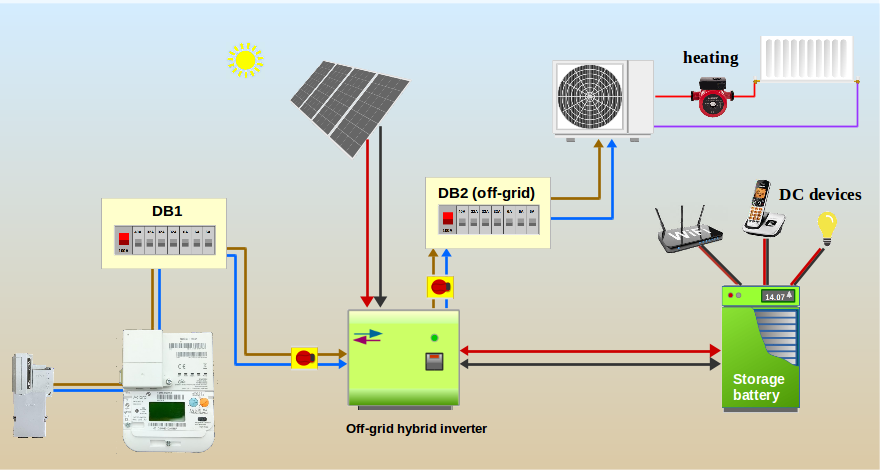
If the inverter and its battery are only going to supply the heat-pump, and no other mains appliances, then you don't require Distribution Board 2.
The inverter can still import from the grid in order to top-up the battery when solar-input has been low.
The heat-pump and priority devices will continue to operate during a power-cut, whilst there is charge remaining in the battery.
This approach is particularly "grid friendly". It's unlikely that you will be recharging from the grid during peak-demand periods. That allows other homes to share the available capacity of the network.
Equally, since you're not exporting, your home doesn't contribute to losses due to phase imbalance at the local substation.
This post was modified 3 months ago 4 times by Transparent
Save energy... recycle electrons!

21/07/2026 10:27 am
I can't quite get my head around part 7 in the Indevolt manual regarding AC coupling to an existing inverter. Could someone break it down in very simple terms?


Topic starter
22/07/2026 6:01 pm
@indevolt-tech can you please assist @blizzardgreen.
🔥 Britain’s Heat Pump Shitshow
How Installing a Heating System Became a National Nervous Breakdown
Free UK shipping.
📗 Heat Pumps Explained
A Jargon-Free Guide for Homeowners
Rewritten and updated for 2027
📘 From Zero to Heat Pump Hero
🛠️ Bodge Buster
New to heat pumps?
Take the Heat Pump Fundamentals course and use INTRO50 at checkout for 50% off.
Topic starter
24/07/2026 11:54 am
@BlizzardGreen I’m not an expert in inverter wiring, so please treat this as my interpretation rather than installation advice, but I think the manual is making something fairly simple sound complicated.
Normally, solar panels connected to the Indevolt go directly into its DC solar inputs. Section 7 describes an alternative for panels that already feed a micro-inverter.
In very simple terms:
Solar panels produce DC electricity.
The existing micro-inverter converts that into AC electricity.
Instead of plugging the micro-inverter directly into a normal house socket, its AC output is connected to the Indevolt’s Backup Terminal.
The Indevolt then sits between the micro-inverter and the house, allowing that solar electricity to be used by the connected load and, presumably, managed as part of the Indevolt system.
Before doing this, I think that the backup socket has to be changed in the app to "micro-inverter coupling mode". The manual also says the Indevolt will disconnect the micro-inverter if its output exceeds the limit, which is stated as 2,400W and can be adjusted in the app.
The important caveat IMO is that the manual repeatedly says micro-inverter. I would not assume this automatically applies to an existing conventional string inverter mounted beside the consumer unit. Those are electrically different arrangements, and the manual doesn’t clearly say that any existing grid-tied inverter can simply be connected this way.
So my reading is this is primarily a way of adding Indevolt storage to a small plug-in or balcony solar system that already uses a micro-inverter. It is not necessarily a universal retrofit connection for every existing rooftop PV inverter.
I’d still like @indevolt-tech and @indevolt-uk to confirm two things: whether solar entering through that AC-coupled connection can charge the battery as well as supply loads, and whether section 7 supports only micro-inverters or also conventional string inverters. The current wording and diagram leave both points less clear than they should be.
🔥 Britain’s Heat Pump Shitshow
How Installing a Heating System Became a National Nervous Breakdown
Free UK shipping.
📗 Heat Pumps Explained
A Jargon-Free Guide for Homeowners
Rewritten and updated for 2027
📘 From Zero to Heat Pump Hero
🛠️ Bodge Buster
New to heat pumps?
Take the Heat Pump Fundamentals course and use INTRO50 at checkout for 50% off.
1

24/07/2026 12:09 pm
The Government has now announced that plug in solar will be fully legal from 27th August 2026. As I understand it this does not include anything with battery storage and thus does not currently include the Indevolt 3000 which is available for pre-order. @indevolt-uk can you comment on this interpretation and, if my understanding is correct, do you have any knowledge of when battery equipped units might be legal?
4kW peak of solar PV since 2011; EV and a 1930s house which has been partially renovated to improve its efficiency. 7kW Vaillant heat pump.
2

24/07/2026 1:09 pm
@jamespa Are batteries not legal already? or just certain types?
Plug in batteries aren't fully legal, just like plug in solar. The position with plug in solar changes on 27th aug.
The established industry has been running a campaign to stop or delay both, even though they have been legal in several EU countries for some while. Milliband eventually got fed up with the fillibustering, declared that plug in solar would be legalised notwithstanding the industry objections, and has published a report which dismisses the spurious safety concerns raised by the industry. Most if not all of it is also applicable to battery systems but expediency (see discussion elsewhere on the forum) dictated that govt go ahead with plug in solar and follows up with batteries a bit later
This post was modified 3 months ago 3 times by JamesPa
4kW peak of solar PV since 2011; EV and a 1930s house which has been partially renovated to improve its efficiency. 7kW Vaillant heat pump.
3

24/07/2026 1:25 pm
@jamespa Are batteries not legal already? or just certain types?
Plug in batteries aren't fully legal, just like plug in solar. The position with plug in solar changes on 27th aug.
To clarify that statement a little, a plug-in battery that is only able to draw power from the grid (charge up) is legal, and it can have 3-pin sockets to plug in appliances to draw the power from the battery. What is not (yet) legal is for plug-in batteries that can feed the power back through the wall socket to power house loads. So your typical portable powerbank type batteries are currently legal.
Samsung 12kW gen6 ASHP with 50L volumiser and large radiators. 7.2kWp solar (south facing), Tesla PW3 (13.5kW). Net Zero
2
Topic starter
24/07/2026 2:27 pm
It's been a hectic few months for me so not kept up with what's happening in the world of plug-ins, but the new regs appear to create a narrow route for compliant plug-in solar without battery storage. The final specification seems to limit qualifying products to 800VA, requires a manufacturer-supplied UK plug and currently allows only one unit per household under G98. It excludes both plug-in battery systems and plug-in solar products incorporating batteries.
So I think @Old_Scientist has described the distinction well. A portable power station that charges from a wall socket and then powers appliances through its own isolated sockets is perfectly legitimate. It is essentially functioning as a rechargeable appliance and does not feed electricity back into the house wiring.
The unresolved category is a battery that charges through a normal socket and later pushes its stored electricity back through that same socket to supply other household loads. That is precisely the arrangement the new plug-in solar rules do not yet cover.
That does not mean domestic batteries generally are illegal. Properly installed battery systems can already be connected under the established electrical and DNO procedures, with storage treated as demand while charging and generation while discharging. The problem is specifically the new consumer-installed, plug-and-backfeed route.
This is obviously relevant to the Indevolt PowerFlex 3000 and future iterations. Therefore, even though its household feed-in can be limited to 800W, it does not appear to satisfy the new solar-only definition because it is specifically designed to import electricity, store it and later discharge it into the home. That's how I read it anyway.
At the same time, that does not necessarily make the PowerFlex 3000 unlawful in every possible configuration. It may be capable of being hardwired and commissioned under the existing battery-storage connection rules. What it apparently cannot do is rely upon the new 27 August plug-in-solar exemption to charge and discharge through an ordinary three-pin socket.
On that note, like others, I have not found any confirmed government date for extending the framework to plug-in batteries. The official documents repeatedly say the initial change applies to solar without storage. A battery framework may logically follow, as James suggests, but at present that appears to be an expectation rather than a published commitment or timetable.
Having said all of that, something must be brewing, and manufacturer expectations must be high, because just this week alone I've been contacted by two Chinese plug-in manufacturers asking if I'd like to review their new offerings.
🔥 Britain’s Heat Pump Shitshow
How Installing a Heating System Became a National Nervous Breakdown
Free UK shipping.
📗 Heat Pumps Explained
A Jargon-Free Guide for Homeowners
Rewritten and updated for 2027
📘 From Zero to Heat Pump Hero
🛠️ Bodge Buster
New to heat pumps?
Take the Heat Pump Fundamentals course and use INTRO50 at checkout for 50% off.
1

SPONSORS

Degrees of Separation

Latest Posts
-

RE: Heat pump branding. Clever, contemporary… or a bit too much?
I think Heat Geek have done an amazing job on their bra...
By Tomtheheatingengineer , 7 hours ago
-
RE: HeatGeek vs Octopus surveys: puzzling disparity - any ideas why?
I have just had 3 heat loss surveys, one by heat geek o...
By David , 7 hours ago
-
RE: Heat Geek Zero Disrupt: Are We Sleepwalking Into Another Race to the Bottom?
I think that's the key question. After all inverter uni...
By Prunus , 9 hours ago
-
RE: battery storage without solar
As of October 1st they need specific qualifications to ...
By EtchedPixels , 9 hours ago
-
RE: How should the Boiler Upgrade Scheme be reformed?
A unit which uses water to transfer the heat/chill from...
By Temperature_Gradient , 10 hours ago
-
RE: Renewables & Heat Pumps in the News
With regards to the BUS grant raid, I gave it more thou...
By ASHP-BOBBA , 10 hours ago
-
RE: Why are ASHP installs so expensive?
The whole system seems to work on the basis of...
By ian33a , 11 hours ago
-
RE: Missing flow temperature in Heat Geek proposal
Good plan. If you can get half hourly meter readings a...
By JamesPa , 16 hours ago
-
RE: Heat Pumps Without Grants: Would You Have Installed One & Will You Now?
@editor Most certainly. The heat pump was an ideal s...
By Abernyte , 16 hours ago
-
Although regulations may well vary from country to coun...
By Majordennisbloodnok , 16 hours ago
-
RE: Does anyone have experience of a smart water meter?
Yep I caught our slow leak from a £100 bill rise 8)
By EtchedPixels , 16 hours ago
-
RE: Do You Need a Buffer Tank or Low Loss Header for Underfloor Heating in a Large Property?
@jamespa in some cases, failing the Turing test might b...
By GrahamF , 20 hours ago
-
RE: Passiv Smart Thermostat - Help & Forum Support
@energystoragetech The heat capacity of some...
By JamesPa , 21 hours ago
-
RE: tepeo ZEB UK Support & Info Thread
Sorry you are correct, I was remembering figures from t...
By JamesPa , 1 day ago




SPONSORS