

Notifications
Clear all
Joining the Renewable Heating Hub forums is completely free and only takes a minute. By registering you’ll be able to ask questions, join discussions, follow topics you’re interested in, bookmark useful threads and receive notifications when someone replies. Non-registered members also do not have access to our AI features. When choosing your username, please note that it cannot be changed later, so we recommend avoiding brand or product names. Before registering, please take a moment to read the Forum Rules & Terms of Use so we can keep the community helpful, respectful and informative for everyone. Thanks for joining!
Energy Storage
337
Posts
23
Users
118
Reactions
47.4 K
Views

14/07/2026 9:24 am
Some wired in systems have the functionality built in (eg Sunsynk), others have a limited version of it built in (eg some of the Solis and other kit that supports a couple of sockets of backed up power). For some systems that feature is sold as another add on box - often called a "gateway".
At minimum though, you would need a transfer switch, a suitable grounding arrangement and a generator input if you wanted to use an existing grid forming battery box to power the house by being able to switch between the two. That's not often done in the UK - in part because grid tie has advantages and export rates are good, but it isn't uncommon in the USA for example.
Thank you, I am learning!
With these plug in set-ups like the Indevolt P3000 what is actually happening with the power generated by the PV? The PV is generating power, does it charge the batteries first, then feed excess into the house and only then any surplus back to the Grid?
Or is it : Batteries first, Excess to the grid - but when Nat grid is down only then the backup socket becomes live.
A next question would be: When there is too little sun, does it charge the batteries automatically through the Grid?

14/07/2026 1:31 pm
With these plug in set-ups like the Indevolt P3000 what is actually happening with the power generated by the PV? The PV is generating power, does it charge the batteries first, then feed excess into the house and only then any surplus back to the Grid?
Each could be different and there will be some level of configuration in each. If energy from the PV cells is not harvested, it is lost, that is handled via MPPT.
They all include an inverter. My hybrid inverter can be set to prioritise consumption or to prioritise export and this impacts the way it manages the battery, whether it charges from the grid, etc. You would be right to expect most plug in systems to have less flexibility.
8kW Solis S6-EH1P8K-L-PLUS hybrid inverter; G99: 8kW export; 16kWh Seplos Fogstar battery; Ohme Home Pro EV charger; Vaillant Arotherm Pro 7kW; 100Amp head, HA lab on mini PC

14/07/2026 2:16 pm
With these plug in set-ups like the Indevolt P3000 what is actually happening with the power generated by the PV? The PV is generating power, does it charge the batteries first, then feed excess into the house and only then any surplus back to the Grid?
It depends on how you configure it via the app. The manual gives an overview.
4kW peak of solar PV since 2011; EV and a 1930s house which has been partially renovated to improve its efficiency. 7kW Vaillant heat pump.

17/07/2026 12:20 pm
Yesterday the UK Government published its response to the public consultation on plug-in solar and an accompanying Interim Product Specification (IPS).
The Government Response PDF is here.
There were 466 replies to the Consultation with around half being from private individuals. Interestingly I can detect what DESNZ thought of what I wrote because their Report singles out particular technical concerns I'd raised!
However... this forum topic is about plug-in storage products, for which the Government wrote:
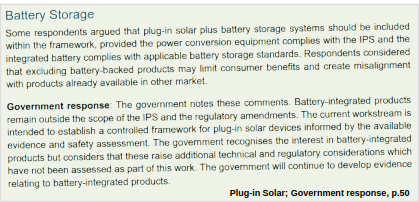
I had hoped that DESNZ might've understood the need to address both plug-in solar and plug-in storage as a single issue, requiring only one change of the relevant legislation. But they haven't.
As you will have read elsewhere on the Solar - No thanks topic, there have been significant instability problems with the British electricity supply over the past few weeks due to so much solar generation being exported to the grid. Adding yet more solar to the energy-mix is counterintuitive when it could just as readily be stored in a domestic battery rather than exported.
As I write, a new Prime Minister is giving his acceptance speech, and we may soon have a change of the Secretary of State for ESNZ. There's nothing to prevent Indevolt and others from continuing to make their case to Government.
Save energy... recycle electrons!
1

17/07/2026 12:51 pm
I had hoped that DESNZ might've understood the need to address both plug-in solar and plug-in storage as a single issue, requiring only one change of the relevant legislation. But they haven't.
I suspect they have understood but don't want to derail getting solar sorted because further delay would give industry another opportunity to raise unjustifiable objections. They have to follow a process and cannot suddenly expand the scope to include batteries, particularly since the industry has raised objections on safety grounds.
Once solar is sorted they can use this as a precedent and deal only with the (very few) additional issues related to batteries. If they delay introduction of solar then the industry will drag up more irrelevant objections in an attempt to sabotage the whole endeavour.
In the situation desnz is in I would do exactly what they have done. DESNZ, it seems to me, have behaved with integrity and direction. The industry certainly has behaved with direction (IE block it if we possibly can, whatever half truths we have to tell)!
This post was modified 3 months ago 6 times by JamesPa
4kW peak of solar PV since 2011; EV and a 1930s house which has been partially renovated to improve its efficiency. 7kW Vaillant heat pump.
1

17/07/2026 3:03 pm
So to confirm, at this time plugin battery systems do not / will not have approval within the current plugin solar framework, and the government will continue to collect evidence and may choose to look at plugin battery systems at some undetermined point in the future.
Where does this leave Indevolt, and others like them who are currently supplying systems in the UK without the necessary regulatory approval?
Rhetorical - Will such suppliers accept a return on the basis they were mis-sold as plug and play systems without the proper regulation, or will they pay the additional cost to have them installed by a qualified electrician?
Samsung 12kW gen6 ASHP with 50L volumiser and large radiators. 7.2kWp solar (south facing), Tesla PW3 (13.5kW). Net Zero

17/07/2026 3:05 pm
The updated draft seems to be fairly good although I think if someone with enough lawyers was bothered, flawed enough to drag it out for ages (it requires G98, G98 requires BS7671, BS7671 says no plugin in). Seems a bit of a drafting screwup.
The rest of the changes look pretty sensible. They've addressed the whole nailing panels to tall flammable building problem, added guidance requirements on planning permission, and some other important stuff. Punting on the whole landlord permission bit is understandable but has merely kicked a can of worms down the line a bit.
Battery though is a load of additional complexity because of the whole PAS v BS7671 v sanity debate that's already got to be resolved between people who know about buildings and fire and people who know about electrickery. That alone I can understand leaving them punting it to get stuff out ASAP. There's a whole second wonderful world of "this device has sockets on it that remain active when the grid goes down" and "ok how exactly does grounding work when that happens ??"
17/07/2026 3:28 pm
There's a whole second wonderful world of "this device has sockets on it that remain active when the grid goes down" and "ok how exactly does grounding work when that happens ??"
I have always assumed, perhaps incorrectly, that the backup socket on a plug in battery (as opposed to a permanently connected one) isnt grounded at all so just floats, like a shaver socket. If so you would need to touch both 'live' and 'neutral' to receive a shock, which is unlikely and anyway is, I think, a risk that exists with RCD protected mains connected circuits. Maybe I'm wrong in which case please feel free to correct me.
UPS devices have existed for decades, I have one in fact for my computer and network gear. I haven't heard of anyone getting electrocuted. This problem has a known solution!
This post was modified 3 months ago 3 times by JamesPa
4kW peak of solar PV since 2011; EV and a 1930s house which has been partially renovated to improve its efficiency. 7kW Vaillant heat pump.

17/07/2026 3:40 pm
So to confirm, at this time plugin battery systems do not / will not have approval within the current plugin solar framework, and the government will continue to collect evidence and may choose to look at plugin battery systems at some undetermined point in the future.
Where does this leave Indevolt, and others like them who are currently supplying systems in the UK without the necessary regulatory approval?
Rhetorical - Will such suppliers accept a return on the basis they were mis-sold as plug and play systems without the proper regulation, or will they pay the additional cost to have them installed by a qualified electrician?
Those are very good questions and indeed ones I was asking myself. Indevolt is on 12 weeks preorder so they may be betting it will be sorted by then and/or that they can either offer a full refund or extend the pre order period until the regs are at least clear. They may have inside info that desnz intends to move quickly on the second half of the matter. The latter is pure speculation but quite plausible IMHO.
4kW peak of solar PV since 2011; EV and a 1930s house which has been partially renovated to improve its efficiency. 7kW Vaillant heat pump.

18/07/2026 8:35 am
@jamespa Indevolt will likely do what Ecoflow have done.
Just ship the product with a non-terminated A/C cable. The customer can have it fully installed...or they can just wire a plug on the end. It's none of their business once the product is sold!
2
18/07/2026 12:41 pm
@jamespa Indevolt will likely do what Ecoflow have done.
Just ship the product with a non-terminated A/C cable. The customer can have it fully installed...or they can just wire a plug on the end. It's none of their business once the product is sold!
Which breeches the Plugs and Sockets (Safety) Regulations 1994.
https://www.legislation.gov.uk/uksi/1994/1768/contents/made
I understand all this stuff is difficult and that legislation needs updating, but they must still follow the law until the regulations can be updated.
Samsung 12kW gen6 ASHP with 50L volumiser and large radiators. 7.2kWp solar (south facing), Tesla PW3 (13.5kW). Net Zero
18/07/2026 12:54 pm
does it (if accompanied with an instruction that it is intended to be wired in permanently eg to a fused cable outlet?
4kW peak of solar PV since 2011; EV and a 1930s house which has been partially renovated to improve its efficiency. 7kW Vaillant heat pump.

SPONSORS

Degrees of Separation
Latest Posts
-

At this point, whenever someone mentions our heat pump,...
By Mars , 10 minutes ago
-
RE: Say hello and introduce yourself
@e-a-west as the good Major said, welcome to the forums...
By Mars , 31 minutes ago
-
RE: New Build 3 Phase or 1Phase
We are on three phase power because it's an enormous li...
By EtchedPixels , 45 minutes ago
-
RE: How much of your renewable and home setup would still work if the internet went down?
Yes I actually have a copy of a tool that whenever a ce...
By EtchedPixels , 10 hours ago
-
RE: How will removing the standing charge on gas bills benefit heat pumps?
The shoulder months are very difficult to judge COP on ...
By scrchngwsl , 11 hours ago
-
RE: Indevolt Batteries UK Support & Info Thread
@editor Hi, To resolve this, please tap on the A...
By Indevolt Tech , 17 hours ago
-
RE: Double or Triple Glazed Windows?
Posted by: @singlespeed With 9 years repairing windo...
By Rob of York , 1 day ago
-
@transparent we’re still running a secure version of PH...
By Mars , 2 days ago
-
RE: How quickly would you want/expect heat recovery to take from setback?
Much longer than that here. The heating isn't even on. ...
By bobflux , 2 days ago
-
RE: Passiv Smart Thermostat - Help & Forum Support
Obviously the weather is changeable but there's a defin...
By Singlespeed , 2 days ago
-
RE: The Changing Jet Stream Could Challenge UK Air Source Heat Pumps
@rob-of-york I must admit that when we had a Daikin hea...
By Toodles , 2 days ago
-
RE: Forum updates, announcements & issues
Get the Renewable Heating Hub heads-up on WhatsApp. I...
By Mars , 2 days ago
-
RE: Safety study for plug in batteries out to tender - looks like Q3 2027 at best before legal
@editor I pointed out to the one of the Fuse execs that...
By dansus , 2 days ago
-
RE: 15kw pump for 225m2 1990's house - over kill?
@seaviews As well as loft insulation, there are othe...
By Rob of York , 2 days ago




SPONSORS