

Notifications
Clear all
Joining the Renewable Heating Hub forums is completely free and only takes a minute. By registering you’ll be able to ask questions, join discussions, follow topics you’re interested in, bookmark useful threads and receive notifications when someone replies. Non-registered members also do not have access to our AI features. When choosing your username, please note that it cannot be changed later, so we recommend avoiding brand or product names. Before registering, please take a moment to read the Forum Rules & Terms of Use so we can keep the community helpful, respectful and informative for everyone. Thanks for joining!
11/09/2026 10:58 am
I would expect the air being pulled past the temp sensor to have a cooling effect.
Here's my heat pump running with a steady mildish 'OAT' over three hours last April:

The unit is doing its usual Midea cycling thing, and as you see, when it it running (LWT rising), the 'OAT drops by one degree. I'm inclined to think this is more than just pure wind chill, it is the cooler exhaust air when it is running contributes to the air intake, and that has a cooling effect.
Here it is over three cold hours in January this year, running regular defrost cycles:

This time, there are probably two things going on. When running outside the defrost cycles, the exhaust air is cooler than the true OAT, and so lowers the local OAT. During the defrost cycles, the unit pushes warmer air through the unit, which has the effect of raising the local OAT. These spikes peak at about 4° above the baseline OAT.
Don't any ASHPs have a connector on an internal control board to which a completely separate sensor can be connected?
Not that I know of on Midea units, though I do have the option (not as yet implemented) of adding an independent OAT sensor connected by modbus to my monitoring setup. I haven't done it yet because (a) I can't work out where to put the sensor and (b) I don't really need to know the true OAT, if there is such a thing. What if it differs between the sunny and shaded side of the house, which one is correct? Probably the shaded side, but that isn't a reflection of what is going on on the sunny side.
Surely manufacturers must've contemplated a situation where sunlight will affect the readings from a sensor which is physically attached to their own product?!
I wouldn't be so sure!
Midea 14kW (for now...) ASHP heating both building and DHW

Topic starter
12/09/2026 2:59 pm
It wouldn't be my first go-to suggestion for most people, @batpred, but given your history with Home Assistant I'd say you might want to consider the eBUS Adapter Shield C6 Stick configured to talk MQTT to Mosquitto on HA. It would take a bit of research to see if that setup would allow you to override OAT from the Vaillant sensor with a temperature from your own third party sensor, but if you could then you could site your own sensor wherever you want.
Hardware cost is abou5 EUR30, so not a big risk but definitely something to research before buying. If you do get it, you'll obviously then end up with local control of your Arotherm.
Good suggestion. I did think about that when I had the Vaillant boiler. The new anthracite Arotherms use modbus between pump and heatpump interface board, but I have not looking into tapping into it. Vaillant still use eBus between controller and thermostat, etc.
But given that the system is under performance guarantee from Heat pump, if I had not found the root cause, I would delay tinkering for a few years.
8kW Solis S6-EH1P8K-L-PLUS hybrid inverter; G99: 8kW export; 16kWh Seplos Fogstar battery; Ohme Home Pro EV charger; Vaillant Arotherm Pro 7kW; 100Amp head, HA lab on mini PC
Topic starter
12/09/2026 3:12 pm
Yes. Vaillant for example has a wireless oat sensor (not sure if there is also a wired version) which can be suitably located. I would imagine that they are not unique.
Yes, our system is wired, so the OAT sensor and the internal thermostat do not have battery points of failure 😉 . We could wait for the installer to move the OAT, but I mounted a shield temporarily and the chart seems to confirm the early morning sun as the cause! I added lighting and cloud coverage to help the diagnosis.
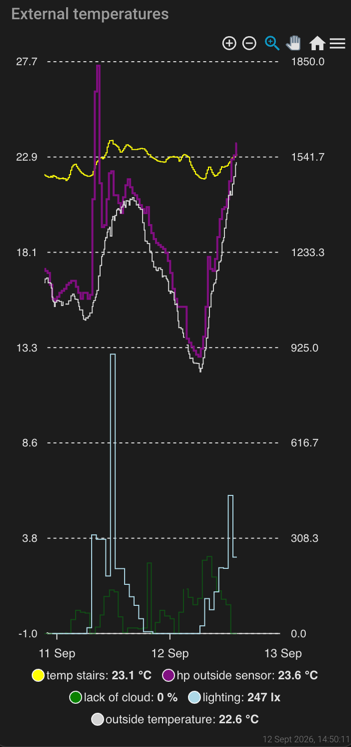
The fact a shield handles this makes me wonder why the manufacturers do not design the sensors to measure temperature without so much interference from direct sunlight?
8kW Solis S6-EH1P8K-L-PLUS hybrid inverter; G99: 8kW export; 16kWh Seplos Fogstar battery; Ohme Home Pro EV charger; Vaillant Arotherm Pro 7kW; 100Amp head, HA lab on mini PC

12/09/2026 7:07 pm
The fact a shield handles this makes me wonder why the manufacturers do not design the sensors to measure temperature without so much interference from direct sunlight?
The answer is going to depend on what characteristic of "direct sunlight" their particular OAT sensor is picking up.
Is it sensitive to the photons in the infra-red region?
Or is the sun warming the material which encapsulates the sensor, and it's the excitation of molecules which is being recorded as temperature?
Do you think the temperature sensor is a thermistor, and it's the resistance which is being measured?
Or is it possibly a digital device like the Dallas 18B20 ?
Save energy... recycle electrons!
1

Topic starter
12/09/2026 7:42 pm
I just meant why do they not just have something similar to a shield as part of the casing. But the design would also include selecting the best sensor for the job..
Essentially the quality of the design becomes obvious when a homeowner patches it up so easily.
That I could not find clear instructions on sitting it could be down to me not having access to the professional documents. Hopefully not because they missed that detail!
This post was modified 1 month ago by Batpred
8kW Solis S6-EH1P8K-L-PLUS hybrid inverter; G99: 8kW export; 16kWh Seplos Fogstar battery; Ohme Home Pro EV charger; Vaillant Arotherm Pro 7kW; 100Amp head, HA lab on mini PC

12/09/2026 7:54 pm
I just meant why do they not just have something similar to a shield as part of the casing.
Because not everyone needs it and to be effective it would need to be not joined too much and not trap air, both to avoid heat transmission by conduction, which would make it flimsy.
Easier and cheaper for the installer to look for a suitable place, particularly if you make it wireless.
I can see logic both ways.
This post was modified 1 month ago 2 times by JamesPa
4kW peak of solar PV since 2011; EV and a 1930s house which has been partially renovated to improve its efficiency. 7kW Vaillant heat pump.

12/09/2026 8:02 pm
Do you think the temperature sensor is a thermistor, and it's the resistance which is being measured?
It's pretty much always a thermistor.
It has to be installed with standard electrical cable, usually two wires... nothing fancy, thermistor has no polarity, it's simple and costs 5 cents...
1
Topic starter
12/09/2026 8:19 pm
Easier and cheaper for the installer to look for a suitable place, particularly if you make it wireless.
yes, it would have been easy to place it in permanent shade.
Hopefully our installers were not swayed by us suggesting it would just go where the previous sensor was, as we know the muppet that installed our boiler would have given it no thought whatsoever..
8kW Solis S6-EH1P8K-L-PLUS hybrid inverter; G99: 8kW export; 16kWh Seplos Fogstar battery; Ohme Home Pro EV charger; Vaillant Arotherm Pro 7kW; 100Amp head, HA lab on mini PC
1

12/09/2026 9:35 pm
Hopefully our installers were not swayed by us suggesting it would just go where the previous sensor was, as we know the muppet that installed our boiler would have given it no thought whatsoever..
Its really good to have real-world confirmation that muppets install boilers as well as heat pumps. I thought that was the case, and the independent evidence from NESTA suggests it is (according to their survey, and judging solely by results, roughly the same proportion of boilers are installed by muppets as are heat pumps). For some reason people rarely talk about it though!
This post was modified 1 month ago 3 times by JamesPa
4kW peak of solar PV since 2011; EV and a 1930s house which has been partially renovated to improve its efficiency. 7kW Vaillant heat pump.
2
12/09/2026 9:53 pm
The outside air temperature sensor, which as you say is used for weather compensation, is actually inside the the heat pump, near the air intake, so in reality it measures the air intake temperature, which is not the same as the wider OAT
I would expect the air being pulled past the temp sensor to have a cooling effect.
I agree. However I would also (primarily) expect that the recorded value was more accurate when the fan was running than when it isn't. There is no such thing wind chill unless the item in question is wet, because wind chill is due to evaporation.
Basically I would expect the sensor to be heated due to proximity of the (dormant but recently active) heat pump, then cooled back to something very close to OAT when the fan turns on. Of course thats a broad brush view and may depend on the location of components within the heat pump.
That said when condensation is occurring, eg early after a midwinter sunny day, as it cools quickly, wind chill could be a factor in which case the AIT sensor could just possibly register a lower temperature than the true OAT.
The relationship may be more complex than first meets the eye! I think its fair to say that on daily average it will probably track the OAT, possibly with an offset, but on shorter term average or on some days particularly when its around zero or has sharp falls, it may not. Good enough for WC very likely, given the thermal time constant of a building. Also good enough for other purposes that the heat pump needs. However geeks who are trying to use it for purposes not intended should be wary!
This post was modified 1 month ago by JamesPa
4kW peak of solar PV since 2011; EV and a 1930s house which has been partially renovated to improve its efficiency. 7kW Vaillant heat pump.
13/09/2026 8:09 am
There is no such thing wind chill unless the item in question is wet, because wind chill is due to evaporation.
I am not so sure about that. Certainly if the item is damp, it increases the effect, but what it an item at 20°C has a 10°C wind blowing across it? Isn't that why we blow on roast chestnuts before trying to peel them? Isn't it also the way a car radiator works?
I think the answer to what happens to a Midea AIT/OAT sensor is in the chart I posted earlier. here it is again for ease of reference:
It looks to me like the AIT gets lowered by 1°C when the compressor is running. But it is a moot point whether this matters for weather compensation. Mine seems to just work, and the Set LWT in the chart above remains pretty much the same throughout, stable OAT, stable set LWT.
Midea 14kW (for now...) ASHP heating both building and DHW
13/09/2026 9:08 am
I am not so sure about that. Certainly if the item is damp, it increases the effect, but what it an item at 20°C has a 10°C wind blowing across it? Isn't that why we blow on roast chestnuts before trying to peel them? Isn't it also the way a car radiator works?
OK perhaps my original statement was badly worded if applied outside the narrow context in which it was intended (Heat pump thermistors).
Wind blowing across something hot will of course increase the rate of conduction away (and if its cold it will increase conduction to). However wind blowing across something at the same temperature makes no difference to the conduction, because there is none. Thermistors are essentially passive devices and would not expect to warm up in use, they should be at the temperature of the surrounding air..
Wind chill is an effect experienced by humans (and presumably other animals) arising from the fact that our bodies are hotter than the ambient air, amplified by the latent heat of evaporation when we sweat and the sweat evaporates.
It looks to me like the AIT gets lowered by 1°C when the compressor is running. But it is a moot point whether this matters for weather compensation. Mine seems to just work, and the Set LWT in the chart above remains pretty much the same throughout, stable OAT, stable set LWT.
Very unlikely that it matters IMHO, which is why they do it.
4kW peak of solar PV since 2011; EV and a 1930s house which has been partially renovated to improve its efficiency. 7kW Vaillant heat pump.


SPONSORS

Degrees of Separation
Latest Posts
-

RE: New Build 3 Phase or 1Phase
Main issue with 3 phase at low power (16A per phase) is...
By bobflux , 1 hour ago
-
RE: How will removing the standing charge on gas bills benefit heat pumps?
I'm not sure it makes much of a difference to heat-pump...
By Temperature_Gradient , 10 hours ago
-
@editor Ouch, sorry to re start the tick. I had assume...
By DavidB , 11 hours ago
-
RE: Say hello and introduce yourself
@e-a-west as the good Major said, welcome to the forums...
By Mars , 12 hours ago
-
RE: How much of your renewable and home setup would still work if the internet went down?
Yes I actually have a copy of a tool that whenever a ce...
By EtchedPixels , 22 hours ago
-
RE: Indevolt Batteries UK Support & Info Thread
@editor Hi, To resolve this, please tap on the A...
By Indevolt Tech , 1 day ago
-
RE: Double or Triple Glazed Windows?
Posted by: @singlespeed With 9 years repairing windo...
By Rob of York , 2 days ago
-
@transparent we’re still running a secure version of PH...
By Mars , 2 days ago
-
RE: How quickly would you want/expect heat recovery to take from setback?
Much longer than that here. The heating isn't even on. ...
By bobflux , 3 days ago
-
RE: Passiv Smart Thermostat - Help & Forum Support
Obviously the weather is changeable but there's a defin...
By Singlespeed , 3 days ago
-
RE: The Changing Jet Stream Could Challenge UK Air Source Heat Pumps
@rob-of-york I must admit that when we had a Daikin hea...
By Toodles , 3 days ago
-
RE: Forum updates, announcements & issues
Get the Renewable Heating Hub heads-up on WhatsApp. I...
By Mars , 3 days ago
-
RE: Safety study for plug in batteries out to tender - looks like Q3 2027 at best before legal
@editor I pointed out to the one of the Fuse execs that...
By dansus , 3 days ago
-
RE: 15kw pump for 225m2 1990's house - over kill?
@seaviews As well as loft insulation, there are othe...
By Rob of York , 3 days ago




SPONSORS
