

Notifications
Clear all
Joining the Renewable Heating Hub forums is completely free and only takes a minute. By registering you’ll be able to ask questions, join discussions, follow topics you’re interested in, bookmark useful threads and receive notifications when someone replies. Non-registered members also do not have access to our AI features. When choosing your username, please note that it cannot be changed later, so we recommend avoiding brand or product names. Before registering, please take a moment to read the Forum Rules & Terms of Use so we can keep the community helpful, respectful and informative for everyone. Thanks for joining!

Topic starter
10/09/2026 8:41 pm
So I have been very happy with the pump doing hot water. Did a bit of cooling but no heating, of course...
But as an obsessive engineer, the thing is quite thoroughly "instrumented", lots of monitoring around it and something is odd with the sensors. Discussion in the family gets to "but is it causing a problem now?"...
But having just read Mars great sh*tshow book, the house at number 58 is what comes tomind. This is where, despite all the best efforts and all the certifications and logos, the ASHP never worked as as reasonably expected. It took a few years with the MCS circus causing havoc to progress "the diagnosis". Our goal is to sort it before it causes more than an odd chart..
The chart below plots the external temperature sensor with the weather temperature (plus a temperature sensor that we move around the home). All being well, we would expect the two external temperature lines to move along roughly in sync. But they do not.
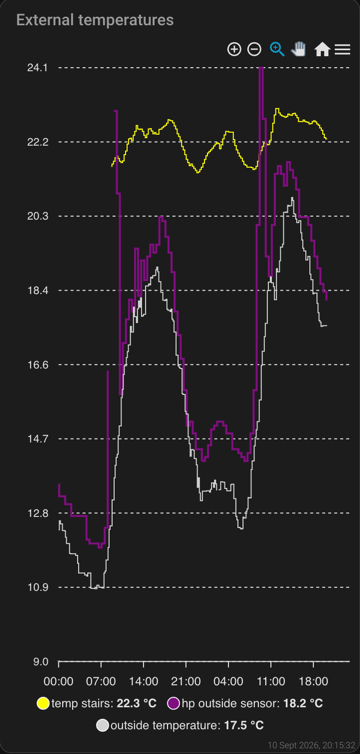
So the best hypothesis is that the neighbours boiler is doing a lot of hot water around 9am (and by the looks of it, not getting into condensing mode). When winter comes, the boiler will do heating when it feels like and play havoc with our sensor a few meters away (and that is expected to drive the weather compensation..).
I checked the Arotherm Appliance Interface instructions and it clearly does not say much about locating the external temperature sensor, apart from the odd manual that goes as far as saying it should be below 2.5m high... So this seems a case of "all good and according to all instructions"..
8kW Solis S6-EH1P8K-L-PLUS hybrid inverter; G99: 8kW export; 16kWh Seplos Fogstar battery; Ohme Home Pro EV charger; Vaillant Arotherm Pro 7kW; 100Amp head, HA lab on mini PC

10/09/2026 10:24 pm
Is the sensor exposed to direct sunlight in the morning?
Topic starter
10/09/2026 11:30 pm
Is the sensor exposed to direct sunlight in the morning?
I think not but have now added the cloud coverage weather graph, just in case.
Potentially the temperature sensor could be shielded temporarily, to see if it makes a difference…
8kW Solis S6-EH1P8K-L-PLUS hybrid inverter; G99: 8kW export; 16kWh Seplos Fogstar battery; Ohme Home Pro EV charger; Vaillant Arotherm Pro 7kW; 100Amp head, HA lab on mini PC

11/09/2026 8:16 am
North facing wall out of direct sunlight atcall times of day and yes not exposed to next doors flue.
I suppose you could put it in a Stevenson screen!
4kW peak of solar PV since 2011; EV and a 1930s house which has been partially renovated to improve its efficiency. 7kW Vaillant heat pump.

11/09/2026 8:22 am
All being well, we would expect the two external temperature lines to move along roughly in sync. But they do not.
This is a Midea problem as well. The outside air temperature sensor, which as you say is used for weather compensation, is actually inside the the heat pump, near the air intake, so in reality it measures the air intake temperature, which is not the same as the wider OAT (outside air temperature). My heat pump has adequate ventilation, but when running it, as it should, pushes out colder air, some of which finds its way round to the back of the unit, and so gets sucked into the air intake. This then appears as small changes in the AIT (air intake temperature) when can be seen on my monitoring charts. These become more noticeable when the heat pump starts using defrosts, when it starts pumping out warmer air.
Does this matter? Perhaps not. As long as the AIT is in proportion to the OAT, then the AIT can act as a proxy for the OAT. But the real question is does my heat pump's weather compensation work as it should and the answer is yes, so the AIT is an adequate proxy for the OAT. I just have to remember when looking at the line labelled OAT on my charts that it isn't the true OAT.
By the way, all charts should have the Y axis start at zero (except on very rare occasion, and when that happens it should be made very explicit that the axis does not start at zero). Not starting at zero produces what are known as gee-whizz charts, beloved of marketing types and other racketeers, because they visually exaggerate the apparent effect, gradient, difference, growth in the value of your investment, number of extra tractors produced etc. The real world starts at zero, the visual human brain starts from zero, and charts should do the same thing, start at zero.
Example: growth of 1%, from £100 to £101 over a decade:
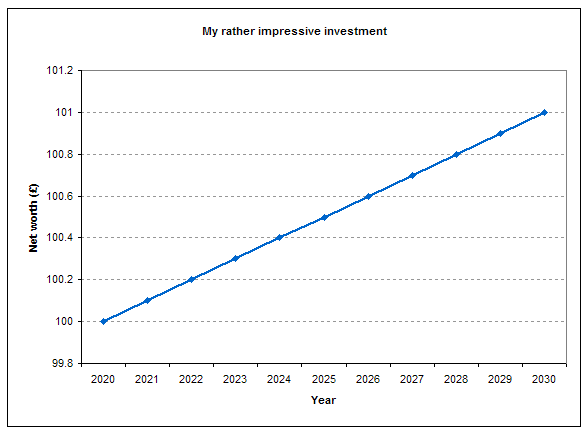
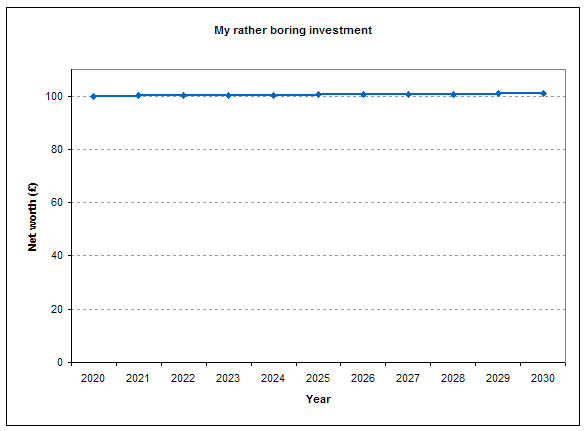
Both charts show exactly the same data, only the Y axis has been changed. The gee whizz chart on the left looks most impressive, but it is a distortion of reality. The one on the right, far less impressive, is what actually happened.
Midea 14kW (for now...) ASHP heating both building and DHW
1
Topic starter
11/09/2026 8:48 am
I suppose you could put it in a Stevenson screen!
That’s what we will potentially do. But i did have a close look this morning and @bobflux is right, the wall is not completely north facing and the morning sun does reach it..
I am now less concerned as it seems the boiler flue is unlikely to interfere. I will ideally find a uv safe shield matching the wall paint and leave the sensor where it is…
From a quick glance at the manuals, I think the arotherm also has an air intake sensor, which would work better in our case, but I doubt it is configurable..
8kW Solis S6-EH1P8K-L-PLUS hybrid inverter; G99: 8kW export; 16kWh Seplos Fogstar battery; Ohme Home Pro EV charger; Vaillant Arotherm Pro 7kW; 100Amp head, HA lab on mini PC
11/09/2026 9:39 am
From a quick glance at the manuals, I think the arotherm also has an air intake sensor, which would work better in our case, but I doubt it is configurable..
Mine certainly does.
My oat sensor is tucked under the eves of a north facing garage which ensures sun never gets to it.
4kW peak of solar PV since 2011; EV and a 1930s house which has been partially renovated to improve its efficiency. 7kW Vaillant heat pump.
11/09/2026 9:39 am
From a quick glance at the manuals, I think the arotherm also has an air intake sensor, which would work better in our case, but I doubt it is configurable..
Mine certainly does.
My oat sensor is tucked under the eves of a north facing garage which ensures sun never gets to it.
4kW peak of solar PV since 2011; EV and a 1930s house which has been partially renovated to improve its efficiency. 7kW Vaillant heat pump.

11/09/2026 9:52 am
It wouldn't be my first go-to suggestion for most people, @batpred, but given your history with Home Assistant I'd say you might want to consider the eBUS Adapter Shield C6 Stick configured to talk MQTT to Mosquitto on HA. It would take a bit of research to see if that setup would allow you to override OAT from the Vaillant sensor with a temperature from your own third party sensor, but if you could then you could site your own sensor wherever you want.
Hardware cost is abou5 EUR30, so not a big risk but definitely something to research before buying. If you do get it, you'll obviously then end up with local control of your Arotherm.
105 m2 bungalow in South East England
Mitsubishi Ecodan 8.5 kW air source heat pump
18 x 360W solar panels
1 x 6 kW GroWatt battery and SPH5000 inverter
1 x Myenergi Zappi
1 x VW ID3
Raised beds for home-grown veg and chickens for eggs
"Semper in excretia; sumus solum profundum variat"

11/09/2026 10:23 am
The outside air temperature sensor, which as you say is used for weather compensation, is actually inside the the heat pump, near the air intake, so in reality it measures the air intake temperature, which is not the same as the wider OAT
I would expect the air being pulled past the temp sensor to have a cooling effect.
Don't any ASHPs have a connector on an internal control board to which a completely separate sensor can be connected?
Surely manufacturers must've contemplated a situation where sunlight will affect the readings from a sensor which is physically attached to their own product?!
Save energy... recycle electrons!
11/09/2026 10:34 am
Don't any ASHPs have a connector on an internal control board to which a completely separate sensor can be connected?
Yes. Vaillant for example has a wireless oat sensor (not sure if there is also a wired version) which can be suitably located. I would imagine that they are not unique.
4kW peak of solar PV since 2011; EV and a 1930s house which has been partially renovated to improve its efficiency. 7kW Vaillant heat pump.
11/09/2026 10:51 am
the wall is not completely north facing and the morning sun does reach it..
Had the same problem. I ended up with a Zigbee sensor stuck to the trunk of a tree 🤣
What the sensor is mounted on matters: if it has high thermal mass, for example a wall, then its temperature will change much slower than air temperature and that will influence the sensor. Ideally it should be in free air and not exposed to sunlight.

Page 1 / 3
Next

SPONSORS

Degrees of Separation
Latest Posts
-

RE: Indevolt Batteries UK Support & Info Thread
@editor Hi, To resolve this, please tap on the A...
By Indevolt Tech , 2 hours ago
-
RE: How will removing the standing charge on gas bills benefit heat pumps?
@toodles GIGO always stands! My Cosy 6, as you can...
By Watcher , 11 hours ago
-
RE: How much of your renewable and home setup would still work if the internet went down?
Interestingly we had an internet outage about a month a...
By Rob of York , 17 hours ago
-
RE: Double or Triple Glazed Windows?
Posted by: @singlespeed With 9 years repairing windo...
By Rob of York , 18 hours ago
-
@transparent we’re still running a secure version of PH...
By Mars , 21 hours ago
-
RE: How quickly would you want/expect heat recovery to take from setback?
Much longer than that here. The heating isn't even on. ...
By bobflux , 2 days ago
-
RE: Passiv Smart Thermostat - Help & Forum Support
Obviously the weather is changeable but there's a defin...
By Singlespeed , 2 days ago
-
RE: The Changing Jet Stream Could Challenge UK Air Source Heat Pumps
@rob-of-york I must admit that when we had a Daikin hea...
By Toodles , 2 days ago
-
RE: Forum updates, announcements & issues
Get the Renewable Heating Hub heads-up on WhatsApp. I...
By Mars , 2 days ago
-
RE: Safety study for plug in batteries out to tender - looks like Q3 2027 at best before legal
@editor I pointed out to the one of the Fuse execs that...
By dansus , 2 days ago
-
RE: 15kw pump for 225m2 1990's house - over kill?
@seaviews As well as loft insulation, there are othe...
By Rob of York , 2 days ago
-
RE: BT cuts you off, Plusnet blames Openreach... welcome to “seamless” broadband switching
Both of which (in most cases) use Openreach for the las...
By JamesPa , 2 days ago
-
RE: Renewables & Heat Pumps in the News
Yes, this is a swiss and german standard I believe, Vai...
By Batpred , 2 days ago
-
RE: Octopus Cosy 12 Heat Pump Regret: Incredibly Loud, Poor Heating & Constant Hum - Help!
@editor FWIW my problem was resolved, eventually, after...
By BigFish , 3 days ago





SPONSORS