

Notifications
Clear all
Joining the Renewable Heating Hub forums is completely free and only takes a minute. By registering you’ll be able to ask questions, join discussions, follow topics you’re interested in, bookmark useful threads and receive notifications when someone replies. Non-registered members also do not have access to our AI features. When choosing your username, please note that it cannot be changed later, so we recommend avoiding brand or product names. Before registering, please take a moment to read the Forum Rules & Terms of Use so we can keep the community helpful, respectful and informative for everyone. Thanks for joining!
Solar Photovoltaic (PV)
128
Posts
35
Users
85
Reactions
49.6 K
Views

05/03/2026 10:24 am
@mk4 Charge to 100%, discharge down to 10%.
Since you seem to quite thoroughly investigate every step you take, how did you choose these levels? I am trying to understand what are the optimal levels to preserve battery health and lifespan.
Sungrow (our battery) documentation suggests a 10%-90% range. We are able to fully charge our 9.6kwh almost every day and now that we have the ASHP, we can also easily drain it on a daily basis. Thank you.

05/03/2026 1:40 pm
Pylontech US5000 stores about 4.3 kWh accounting for inverter losses and costs 1000€. Over 3000 cycles this means one kWh going through the battery costs 7.7c ; half that for 6000 cycles. Much cheaper than drawing from the grid (about 0.20€/kWh) even if I run them into the ground they will pay for themselves nicely. And the more I use them, the more they pay for themselves.
I did some research, but unlike NMC which are special delicate snowflakes, LFPs just don't seem to care about anything except heat (the most important), the usual overcharge/discharge (which the BMS should prevent) and cycling near full charge.
There's this study which says "Cycling near the top of charge (75%–100% SOC) is detrimental to LFP/graphite cells." However, charging the battery instead of using the energy directly is also detrimental to the bottom line because the inverters have 10-15% losses on the roundtrip... So using the energy in real time is both more efficient and saves wear on batteries. In other words, priority to the EV charger and other stuff, battery charging comes last.
There seems to be a linear relationship between total energy cycled and aging, no matter the SOC span of the cycles, except the point mentioned above. So with half-cycles, they will last twice as many cycles... but if I only use half the capacity, then I need to buy 2x as many batteries, so why bother?
They report losing 1% SOH per year which is in line with manufacturer specs. With lots of care and cuddling, the cells will probably last longer than the BMS lol.
Pylontech says do not go below 5% SOC so I set it to 10% to be safe. I will probably add 1-2 more and set it to 30% to have some juice in case of blackout.
I set max SOC to 100% so the BMS can do its balancing. They do age faster at 100% but they don't stay there for long...
I put them in the cellar, the internal sensor reports temperatures around 20°C idle to 30°C at end of charge.
Max charge power is about 10kW so 0.5C, but this only occurs if nothing else wants power. If the car is plugged in, or there are other loads running, home batteries will of course charge slower or just wait for their turn.
1
26/03/2026 8:41 pm
Thank you for the detailed explanation!
I just came across an article stating that things are moving with plug in panels in the UK! The source is Bloomberg. The link has the english translation of said article.


04/05/2026 11:39 am
Installed in May 2011: 16*Sharp 245 W monocrystalline panels in 2 strings feeding 2* Sunny Boy 1700 Inverters, together with new Main Consumer Unit (Fuseboard). The 2 strings were used to minimise a shadowing problem.
Since then the system has generated 33726kWh, with the panels having to be re-wired once due to a pigeon problem.
This power generation has given an income of £19,213 from the UKGov FIT scheme as well, of course, as the savings on grid power usage.
This post was modified 5 months ago 4 times by txmartyn
3

07/05/2026 10:45 am
3.84kWp of solar on our main South-East facing roof, installed back in 2020. Fitted with Tigo optimisers to account for the neighbours 150 year old oak tree that gets in the way!
Recently added 1kW of solar to our south-facing shed connected to an Ecoflow Stream. This allows us to catch more of the late afternoon/evening sun. Not plug in / balcony - I got a friendly electrician to wire in a fused spur and change the RCB to bi-directional. Self-installed the panels to keep costs down.
12kWh of Pylontech batteries and a Sofar Hybrid inverter complete the set-up.
1

08/09/2026 10:12 pm
Our PV set-up has moved over time. Warning this is a shaggy dog story.
Originally we had 17 Sharp panels on South facing roof giving 3.98kW of power with a Sunnyboy 4kW inverter, in 2012(?) at a cost of £13k (even then the scaffolding was expensive) with the original full FIT tariff. The panels have degraded a bit ~10% (no exact measurements) and the Sunnyboy still works fine.
As an aside.
We also had a solar thermal vacuum tube system installed, but never got the government RHH subsidy on that because the time window for back dated claims was limited. It has been very reliable and since we never knew it would benefit from an occasional service it got its first after 12years. It now warms the lower coil on our water cylinder and reduces the electrical power needed from the heat pump from DHW over the months of February to November. It gets to 63C in the tank on a warm sunny June day, with no need for ASHP.
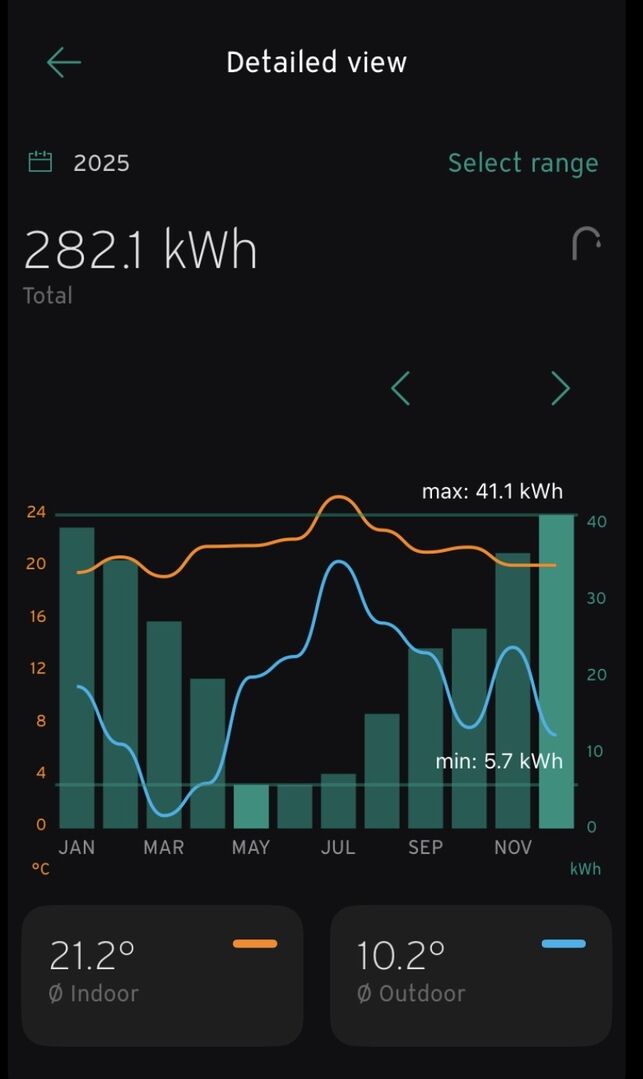
This is electrical energy used on our ASHP throughout 2025 for DHW.
Looking at the columns and assuming we use a similar amount of hot water summer and winter and with some hand waving on better COP in the summer and warmer incoming water we get up to half (ish) of our DHW from solar. Our ASHP installer said nearly all of the pumps they were installing were for people who had a solar thermal vacuum tube system already.
Back to solar PV
In 2022 we wanted a battery of size 12kWh+, and the Tesla matched well, but the delivery time went back and back, so we agreed to have a GivEnergy 9.5kW system. To not pay VAT on the battery we had the gaps filled on the roof with 5 more PV panels which now with mono silicon give 2kW, a large efficiency improvement over 10years. We didn't disturb the FIT system (obviously) so the extra system was separate with a 2kW Growatt inverter and the battery inverter is the GivEnergy 3kW AC version. The LFP battery is installed outside has an insulated cupboard which fits around it for winter with a canopy over it. That cover comes off in spring and the site is shaded all year.
GivEnergy has gone bankrupt so I have lost previous historical PV data and battery control is now done with the Android Monitor application.
The payback time was 7years for the original system and the FIT payment covered the heating bills or allowed saving in advance for battery/ASHP cost (take your pick). When we installed battery plus extra 2kW we calculated another 7years to payback that extra equipment, the benefit was mainly due to PV.
We now use Octopus Cosy for incoming power and fixed export on solar. We stopped using deemed export late 2025 after a back of envelope calculation. We were rewarded with a record solar production in 2025, making it a no-brainer to keep on the export tariff.
Next steps: plug-in solar on house wall (DIY no scaffolding) to help winter PV production on low level low angled light. Possibly another battery setup sometime if the battery fails since the GivEnergy warranty no longer exists.
Snags: all our neighbours have beautiful large trees all with TPOs and 14years ago we had no shading at 8am to 8pm from the spring equinox throughout mid summer, less in early evening after mid August but trees grow and now we loose some morning light before 10am. In winter we loose lots from the trees, but so what, there’s not much there anyway.
2kW + Growatt & 4kW +Sunnyboy PV on south-facing roof Solar thermal. 9.5kWh Givenergy battery with AC3. MVHR. Vaillant 7kW ASHP (very pleased with SCOP >4) open system operating on WC

09/09/2026 5:06 pm
We have a 6.56kW solar PV system (16x 410W panels) installed in March 2023. It uses a LuxPower 5kW hybrid inverter, which can provide up to 8kW output in total via DC to the batteries and a maximum of 5kW AC to the house / grid. The batteries are 3 x 3.2 kWh Hanchu ESS, which use LFP chemistry.
The DNO would only allow a maximum of 5.7kW export, probably because we live a long way from the nearest substation on a 1970's housing estate, and hence their wiring is likely not great. Occasionally, the voltage hits 250V+ on sunny days, so I think they were right to be concerned about lots of export raising the local voltage levels.
For the past couple of years, we have had the system configured to charge the battery from the grid on cheap rate overnight electricity, and discharge only when needed for consumption that is not covered directly by the solar PV output. We charge the batteries to 100% every 4 or 5 days to keep the BMS happy and able to track SOC correctly and then force discharge to 75% SOC the following morning. On other days we just charge to 70% overnight.
The reason we keep the batteries at a moderate SOC is two-fold. Firstly, for battery life, and secondly it allows the inverter to dump any excess power above 5kW that it cannot send to the grid or house directly into the batteries. This avoids any "clipping" losses. On cool spring days with lots of sunshine, this extra output can top the batteries back up to near 100%. At times we see over 7.2kW peak output from what are ostensibly 6.56kW panels. This is likely due to "cloud bounce" which happens when the panels receive the full effects of direct sunlight and reflected light from nearby clouds. On those occasions we are glad that the inverter can deal with up to 8kW.
We avoid any arbitrage, i.e. charging the batteries at overnight rates and then discharging them specifically to earn extra export as the economics don't work for us once the approx 6p/kWh cost in used up battery cycles is considered. We want the batteries to last as long as possible. We similarly don't use solar to charge the batteries except for recovering what would otherwise be clipping, the economics are better to just export the solar PV output and fill the batteries from the grid overnight. Our daily average electricity consumption is just under 7kWh and the batteries easily cover that (9.6kWh nominal and about 8.64kWh usable) along with direct electricity use from solar PV output.
We recently had the EPS backup power output of the inverter connected to some additional sockets and the downstairs lighting circuit, so we now have a 13A 240V uninterruptible power supply to those sockets and some lights that don't go out in a power cut. This involved having independent earths added, since the safety regulations assume that on a power cut the main earth may become disconnected.
We are fortunate that the orientation of our roof is near perfect for solar PV, close to south facing and a 30-degree slope. The best daily output so far was 48.7 kWh, and the total for 2025 was over 7500 kWh.
The system was fitted by a very good local installer who took pride in their work making sure that all of the little things were done well.
With insulation upgrades lowering the heat loss, two air-to-air heat pumps (AC system) that have an achieved efficiency of 5.2 on heating, a gas boiler that runs weather compensation, and a lot of kWhs export from the solar PV system, our annual energy bill is now at almost exactly the same level as the standing charges.

Page 11 / 11
Prev

SPONSORS

Degrees of Separation

Latest Posts
-

RE: Safety study for plug in batteries out to tender - looks like Q3 2027 at best before legal
I think it may depend how much of the world is on fire ...
By EtchedPixels , 3 hours ago
-
RE: Air-to-Air Heat Pumps & Air Conditioning: UK Heating and Cooling Q&A
I hope it's not the same people who make the awful TV s...
By EtchedPixels , 3 hours ago
-
RE: Why are ASHP installs so expensive?
ECO4 is classic British idiocy, "save" money by requiri...
By EtchedPixels , 4 hours ago
-
RE: Renewables & Heat Pumps in the News
We need more building inspectors anyway and less self-s...
By EtchedPixels , 4 hours ago
-
RE: Jokes and fun posts about heat pumps and renewables
According to today's Guardian article, ministers are re...
By Mars , 7 hours ago
-
RE: Does anyone have experience of a smart water meter?
@majordennisbloodnok That is my thinking precisely, I s...
By Toodles , 12 hours ago
-
RE: Replacing Storage Heaters with a Heat Pump in a Stone Cottage
I found some interesting data about the price of heat p...
By Rob of York , 18 hours ago
-
RE: PV and battery long payback - sense check query
Thanks for all the comments. I finally got to the bott...
By DavidB , 20 hours ago
-
RE: Indevolt Batteries UK Support & Info Thread
People following this thread who are hoping that plug i...
By JamesPa , 1 day ago
-
RE: Passiv Smart Thermostat - Help & Forum Support
By Singlespeed , 1 day ago
-
RE: Help me keep the faith with my air source heat pump installation
just had Vaillant over to service the HP and asked abou...
By AdamK , 1 day ago
-
RE: tepeo ZEB UK Support & Info Thread
OK so ZEB is basically a variant on a storage heater, b...
By JamesPa , 2 days ago
-
RE: Heat Geek installations: share your experiences
@editor I suspect that the Heat Geek online quote is a ...
By AndrewJ , 3 days ago
-
RE: Adding additional Solar Panels to a DC coupled battery system
Ah, yes. Thanks for clarifying.
By Transparent , 3 days ago






SPONSORS
