

Notifications
Clear all
Joining the Renewable Heating Hub forums is completely free and only takes a minute. By registering you’ll be able to ask questions, join discussions, follow topics you’re interested in, bookmark useful threads and receive notifications when someone replies. Non-registered members also do not have access to our AI features. When choosing your username, please note that it cannot be changed later, so we recommend avoiding brand or product names. Before registering, please take a moment to read the Forum Rules & Terms of Use so we can keep the community helpful, respectful and informative for everyone. Thanks for joining!
Air-to-Air Heat Pumps & Air Conditioning
20
Posts
6
Users
7
Reactions
1,079
Views

Topic starter
18/08/2026 9:34 am
I have a traditional 2 bed terraced house built in 1911. I have seen in a few places comments that the layout is not well suited to air to air heating. I'm beginning to think that's back to front. Maybe my problem is there's not currently any equipment suited to a house like mine?
Given there are nearly 7 million terraced houses in the UK maybe this is a missed opportunity.
With high ceilings and a layout which doesn't encourage sharing heat or cooling between rooms my ideal set up is a five port mini-split system. That gives indoor units in every room, i.e. the living room, kitchen, both bedrooms and even the bathroom. I'm lucky with the pipe runs and I've had a quote for such a system. The main downside was cost. To be fair I had an air to water quote that was higher, and that was after the £7,500 BUS grant.
I think in a way that's because the equipment available is just too powerful for my modest and well insulated house. My heat loss is calculated at about 5kW with the living room having the highest demand, roughly 1kW for 21C when it's -3C outside. However the best available system was a 9kW outdoor unit, indoor units would be ~3kW in the living room and ~2.4kW for all the other rooms.
I would certainly be able to let room cool when not in use and bring them up to temperature very quickly. Especially as with internal brick walls mean things actually cool very slowly. I wonder if there would be any problems associated with running the equipment so much under capacity?
I think the minimum output was about 3kW so I expect the outdoor unit would have to stop and start a lot, particularly when demand is low i.e. October, November, possibly December, March and April. Does anyone know if that would shorten its lifespan?
I think what I need is about a 5kW outdoor unit with indoor units in the 1-2kW range. I suspect the only reasons they aren't on the market are historical ones where most of the demand is commercial. I'd be happy to learn differently.
One of my main objectives for a long time has been low running costs. Hence the insulation. Plus heating only when and where I need to or, in the jargon, zoning and set-backs. My yearly gas consumption for heating is about 3,000kWh. Which suggests with the actual temperatures I've been living comfortably with my heat loss is more like 2kW.
Last November I ran my gas combi heating like an air to water system to see what that's like. While it was indeed comfortable my total energy consumption was roughly 50% higher than my usual 'extreme thrift' strategy. I doubt any gain in SCOP can offset that.
Which leads to another question. Would running an air to air system so much under capacity adversely affect the SCOP?
Actually I imagine not. I'm very impressed with the inherent efficiency of air to air systems. Its pure heat pumping, using phase changes and latent heat to full advantage. In part it's my physics background that rebels against air to water systems. What does a water heating circuit bring to the party? It's as if back in the 1950s when everyone kept food cool in a pantry someone said, "There's this great new thing called a refrigerator. Just stand this box in the kitchen and you can run a water circuit from it to cool down your pantry." Or you could put the food straight into the box. Not entirely fair I know.
Still one of the attractions of an air to air system for me is being able to rip out all the radiators.

18/08/2026 10:10 am
Ther are many on here who are very knowledgable about A2A and some of the questions you ask are better answered by them. I will offer the following.
I think in a way that's because the equipment available is just too powerful for my modest and well insulated house.
True I think. As you say A2A systems are principally used for commercial cooling (typically a small number of large rooms) and I suspect that they have not yet evolved fully for domestic heating (typically a large number of small rooms). Plus there may be a natural limit on how small a capacity its practical to make.
What does a water heating circuit bring to the party?
A largely silent energy transport mechanism which, in a retrofit, already exists. Also we in the UK have a bit of an aversion to blown air, although I suspect that could be overcome in time. Nothing more and nothing less so far as I can see.
Personally I expect A2A to grow in popularity, particularly with the trend towards well insulated open plan.
This post was modified 2 months ago by JamesPa
4kW peak of solar PV since 2011; EV and a 1930s house which has been partially renovated to improve its efficiency. 7kW Vaillant heat pump.
1
Topic starter
18/08/2026 10:42 am
Thanks @jamespa. I share an aversion to blown hot air. I finally found a good YouTube video on how to site the indoor units so I'm less worried now Mini Split Location.

18/08/2026 10:43 am
I'm very impressed with the inherent efficiency of air to air systems. Its pure heat pumping, using phase changes and latent heat to full advantage. In part it's my physics background that rebels against air to water systems. What does a water heating circuit bring to the party? It's as if back in the 1950s when everyone kept food cool in a pantry someone said, "There's this great new thing called a refrigerator. Just stand this box in the kitchen and you can run a water circuit from it to cool down your pantry." Or you could put the food straight into the box. Not entirely fair I know.
Still one of the attractions of an air to air system for me is being able to rip out all the radiators.
We have experience with an aircon unit that doubles in as a heatpump. As it is 20 years old (R410!), we do not have any monitoring data on consumption, etc. Essentially a mono split for a medium size flat. We use an immersion heater for hot water.
Installers in the UK familiar with A2A have usually been mostly working with commercial heating/aircon systems and some have posted in this forum. I would run a search as this was discussed a month or so ago.
My take on why they are not too popular and why A2W is typically being installed for domestic:
- the concept of continuing to use the rads is appealing, even if often some rads typically need replacing to maximise SCOP
- able to also provide hot water
- the regulation scheme has until very recently not tried to cover A2A (and this is still WIP by MCS)
I agree with others that given the often lower cost of installation, A2A is likely to grow faster then A2W.
8kW Solis S6-EH1P8K-L-PLUS hybrid inverter; G99: 8kW export; 16kWh Seplos Fogstar battery; Ohme Home Pro EV charger; Vaillant Arotherm Pro 7kW; 100Amp head, HA lab on mini PC
18/08/2026 11:13 am
Ofgem have a very good help line for home owners and can answer your question directly
Useful advice from an expert in A2A ...
8kW Solis S6-EH1P8K-L-PLUS hybrid inverter; G99: 8kW export; 16kWh Seplos Fogstar battery; Ohme Home Pro EV charger; Vaillant Arotherm Pro 7kW; 100Amp head, HA lab on mini PC

18/08/2026 11:43 am
In part it's my physics background that rebels against air to water systems. What does a water heating circuit bring to the party?
- Comfort and silence (for heating)
- Heat storage with radiant slabs
- Can be maintained, modified, upgraded DIY
- All the tech and regulatory complexity is contained in one plug and play box outside the house, than can be replaced with another when it dies
On the other hand, water sucks for:
- Corrosion
- Flow temperature issues, etc
- Cooling
Basically it's about the logistics of heat transport. Air to air splits use refrigerant all the way, which means refrigerant pipes have to be installed... which brings a regulatory hazard: when/if all the refrigerants that aren't propane get outlawed, and the A2A reaches end of life, what happens?
There used to be a French manufacturer SOFATH who had a genius (at the time) idea: the UFH radiant heating was done with refrigerant directly in thin copper pipes in the slab. On paper that's great, it gives maximum COP. It was in the 1980's, so it ran on R22. When the heat pumps broke down, people who installed it were pretty much screwed.
1
Topic starter
19/08/2026 5:46 am
Thanks @bobflux that's pretty comprehensive.
Regulation of refrigerants is a new one on me. I'd imagine that's hard to predict.
I was looking into second hand VW EV's for a friend the other week. When it came finding out if the optional heat pump was fitted you look under the bonnet at the R number. Air conditioning uses R1234Y but the heat pump uses R744 also known as CO2.
19/08/2026 7:41 am
Yeah refrigerants are complicated. They need to have the right characteristics (enthalpy, pressure, temperature at the vapor/liquid transition) and also, preferably, non flammable, non toxic, and non environmentally hazardous... First ones were stuff like ammonia (toxic, flammable, corrosive) and ether (highly flammable).
Then CFCs (chloro fluoro carbon) were invented, which everyone loved since they were non toxic and non flammable, so we got R22 (Chlorodifluoromethane).
However, CFCs destroyed the ozone layer so they were banned and replaced with HFC (hydro fluoro carbon) like R407, 410, R32 (difluoromethane).
Then HFC cause global warming so they're in the process of being banned... Gave us hilarious stuff like the commercial brochure of the heat pump saying "R32 environmentally friendly refrigerant of the future" while it's already on phase out lmao
Okay, not so many candidates remaining... time to drop some requirements!
So we get HFOs like various isomers of tetrafluoropropene (R1234yf, R1234ze, etc) which are perfectly safe*, barely flammable*, non toxic*
*may catch fire and release highly toxic products if you crash your car, *may decompose into really uncivilized stuff if released into the atmosphere, *also a PFAS (the now famous "forever chemical pollutants") so meh, at least they don't cause global warming (in theory)!...
They'll find arguments to ban these, then we're pretty much at the end of the list: propane, water, ammonia, and CO2. So what will we use to heat/cool our homes...
Ammonia is too toxic for residential use.
Water is great for high temperature industrial heat recovery heat pumps but doesn't work below 0°C.
CO2 is nice but it requires enormous pressure, it's great for monobloc systems: everything can be custom designed for it, pipes are short... but for splits, it would get complicated with the liquid line at 60 bar of pressure.
Which leaves... propane. Which, ironically, is a superb refrigerant for a heat pump, even and especially for A2A splits, high performance, non toxic... It would work as retrofit for old R32 splits too, by changing the indoor and outdoor units and keeping the pipes.
I'm sure the bureaucrats will be very very sad about not being able to ban it outright, so my guess is you'll get a mandatory yearly leak test or something of the sort to increase running costs, because as we all know propane is perfectly safe in the rusty camping stove that's been in the garage for 10 years but horribly dangerous when used in a heat pump...
1
Topic starter
19/08/2026 8:39 am
Not to mention the 50+ year old copper pipes connected to a limitless supply of methane. 1kg of propane? Run for your lives!
1
19/08/2026 8:47 am
I'm sure the bureaucrats will be very very sad about not being able to ban it outright, so my guess is you'll get a mandatory yearly leak test or something of the sort to increase running costs, because as we all know propane is perfectly safe in the rusty camping stove that's been in the garage for 10 years but horribly dangerous when used in a heat pump
I strongly suspect that it's industry lobbying which drives the bureaucrats to mandate annual maintenance and the like. Great money for not a lot of very straightforward work!
4kW peak of solar PV since 2011; EV and a 1930s house which has been partially renovated to improve its efficiency. 7kW Vaillant heat pump.
2

19/08/2026 9:59 am
...
I was looking into second hand VW EV's for a friend the other week. When it came finding out if the optional heat pump was fitted you look under the bonnet at the R number. Air conditioning uses R1234Y but the heat pump uses R744 also known as CO2.
...which, I've found out, is pretty much impossible to get recharged without going to a Volkswagen Audi Group main dealer. I'm actually in favour of heat pumps in cars but I don't like being a captive audience.
105 m2 bungalow in South East England
Mitsubishi Ecodan 8.5 kW air source heat pump
18 x 360W solar panels
1 x 6 kW GroWatt battery and SPH5000 inverter
1 x Myenergi Zappi
1 x VW ID3
Raised beds for home-grown veg and chickens for eggs
"Semper in excretia; sumus solum profundum variat"
Topic starter
12/09/2026 1:08 pm
@majordennisbloodnok I do sympathise.
On the original question, being naturally stingy I'm wondering what is the smallest system that would give me comfort?
I'd like to get away with a small outdoor unit and just two indoors. A console, i.e. floor level, in the living room and a high level one of the bedroom above. As well as reducing the initial outlay I suspect efficiency would be better, especially in the less cold months when a five port multi split would struggle to modulate its output low enough.
Heat does very naturally work its way into the attic bedroom. Even on the coldest days that tends to be the warmest room in the house. At least when I leave the door open. Although cooling up their would be nice it is only in use 10% of the time and not much of that will coincide with heat waves. So I reckon I can rely on a fan and overnight ventilation.
The biggest problem in terms of heating is getting warm air from the living room into the kitchen. I intend to explore how that might work in practice once the weather gets colder. Meanwhile I'll try to describe the issues. Any suggestions gratefully received.
First a rough floor plan...
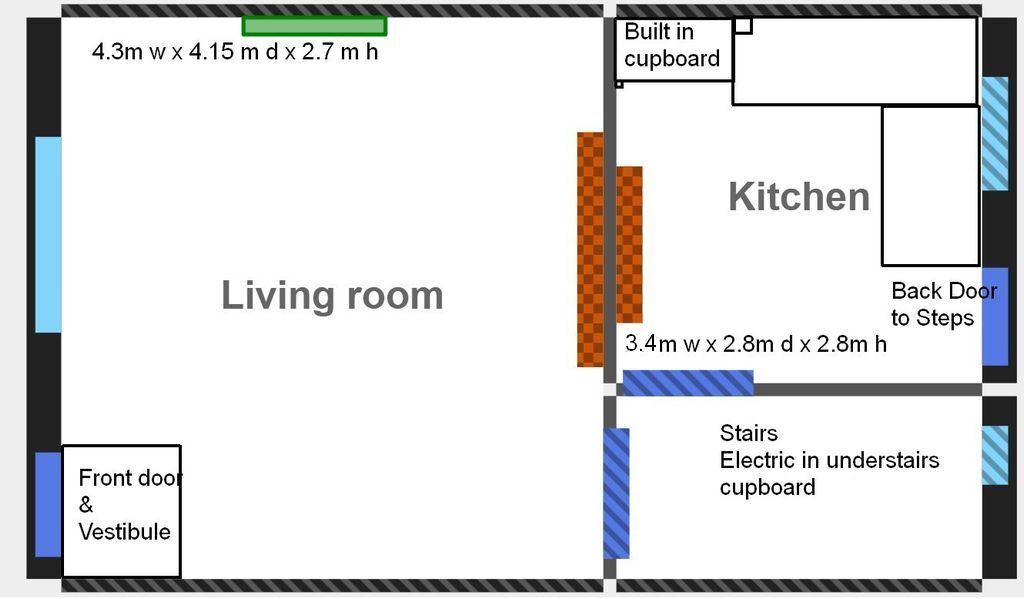
The existing radiators are shown brown, the internal doors hatched blue and my preferred site for a floor console in green (actually a bit forward on the chimney breast). The two sofas are under the window and in front of the radiator, so I think this works well for air flow. It's a bit prominent visually but nothing can be as bad as the gas fire that is currently there.
There's two reasons why I don't think much heat would make it out of the living room door and into the kitchen. I think they're obvious when you see it....
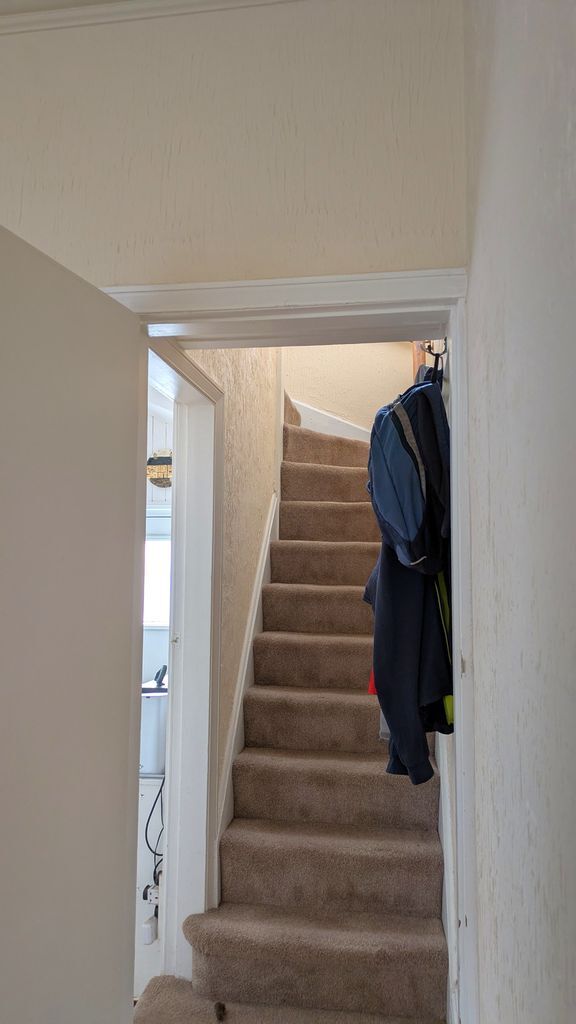
First there's 70cm above the door so I suspect the warmest air will gather there and not make it out at all. A ceiling fan might help with that. Except for the second problem, which is that any warm air that does go through will probably head up the stair well. It's maybe not be clear but there is actually a cupboard above the door next to the coat rack which might help a bit but I doubt by much.
A more extreme idea would be to use a fan at the top of the stair well to drive warm air back down again. The one I got this summer to make my bedroom habitable in the heat waves is too powerful for comfort but might provide a proof of concept.
I could easily get a low level indoor unit in the kitchen. There's a useful 1m high crawl space under the ground floor. I don't favour a high level unit because the ceiling is 2.8m. Plus I do quite a lot of frying and things tend to get greasy on top of the cupboards. However, I'm reluctant to do that because I generally only spend time there when I'm cooking. So I'm not sitting around but I am putting heat into the space from the hob and oven.
The exception is when I have visitors. I suspect it might be more economic to just use a direct electric heater where the existing radiator is. It's at most 20 days each winter and mostly the time the kitchen is toasty because I've been cooking a full roast dinner.
Unfortunately the kitchen is maybe the coldest room in the house. That seems to be down to draughts somewhere behind the kitchen cabinets. I'm hopeful I might have fixed that after I went underneath and blocked where a floor board stopped an inch short of the wall. It's not been cold enough to know if that's fixed it yet.
On a philosophical note it's doubtful whether what I'm suggesting could be called central heating. But if it keeps me comfortably warm that's good enough.
I suppose the reason I'm going into such detail about it isn't merely my personality. I want to be able to get rid of the old gas system altogether so it has to work.
Page 1 / 2
Next
SPONSORS

Degrees of Separation
Latest Posts
-

RE: Indevolt Batteries UK Support & Info Thread
@editor Hi, To resolve this, please tap on the A...
By Indevolt Tech , 6 minutes ago
-
RE: How will removing the standing charge on gas bills benefit heat pumps?
@toodles GIGO always stands! My Cosy 6, as you can...
By Watcher , 9 hours ago
-
RE: How much of your renewable and home setup would still work if the internet went down?
Interestingly we had an internet outage about a month a...
By Rob of York , 15 hours ago
-
RE: Double or Triple Glazed Windows?
Posted by: @singlespeed With 9 years repairing windo...
By Rob of York , 16 hours ago
-
@transparent we’re still running a secure version of PH...
By Mars , 19 hours ago
-
RE: How quickly would you want/expect heat recovery to take from setback?
Much longer than that here. The heating isn't even on. ...
By bobflux , 1 day ago
-
RE: Passiv Smart Thermostat - Help & Forum Support
Obviously the weather is changeable but there's a defin...
By Singlespeed , 1 day ago
-
RE: The Changing Jet Stream Could Challenge UK Air Source Heat Pumps
@rob-of-york I must admit that when we had a Daikin hea...
By Toodles , 1 day ago
-
RE: Forum updates, announcements & issues
Get the Renewable Heating Hub heads-up on WhatsApp. I...
By Mars , 2 days ago
-
RE: Safety study for plug in batteries out to tender - looks like Q3 2027 at best before legal
@editor I pointed out to the one of the Fuse execs that...
By dansus , 2 days ago
-
RE: 15kw pump for 225m2 1990's house - over kill?
@seaviews As well as loft insulation, there are othe...
By Rob of York , 2 days ago
-
RE: BT cuts you off, Plusnet blames Openreach... welcome to “seamless” broadband switching
Both of which (in most cases) use Openreach for the las...
By JamesPa , 2 days ago
-
RE: Renewables & Heat Pumps in the News
Yes, this is a swiss and german standard I believe, Vai...
By Batpred , 2 days ago
-
RE: Octopus Cosy 12 Heat Pump Regret: Incredibly Loud, Poor Heating & Constant Hum - Help!
@editor FWIW my problem was resolved, eventually, after...
By BigFish , 3 days ago





SPONSORS

