Joining the Renewable Heating Hub forums is completely free and only takes a minute. By registering you’ll be able to ask questions, join discussions, follow topics you’re interested in, bookmark useful threads and receive notifications when someone replies. Non-registered members also do not have access to our AI features. When choosing your username, please note that it cannot be changed later, so we recommend avoiding brand or product names. Before registering, please take a moment to read the Forum Rules & Terms of Use so we can keep the community helpful, respectful and informative for everyone. Thanks for joining!
My background is systems practice so biases are something we spend a lot of time on. Part of the problem is that in many cases the science answer isn't answering the underlying worry. You can throw all the statistics you like at someone about the percentage of heatpump installs that go horribly wrong and you won't have any effect because the need to be safe and warm is far deeper in the heirarchy of needs. Deep down nobody cares whether there's a 96% change their heatpump will be ok they care that there's a 4% chance it'll suck.
Humans are very risk averse creatures because for most of our existence risk tended to equate with dead. Thus you can have all the conversations you like about hybrids being stupid and EV ranges but they don't attend to the "but what if can't get work, lose my job, starve" chain of deep down reasoning. What addresses that is seeing that it hasn't happened to all their friends.
Telling people they are being irrational doesn't help either. Many of them have enough introspection to know this but the same is true of people scared of spiders and it doesn't work there for the same reason.
I'm not convinced of the psychological barriers being that significant for the majority, sure there will always be a minority reluctant to embrace new technology, but generally once the new technology is good enough there's a decently large proportion of people who will happily adopt it. I'm struggling to think of any good technologies which have been left on the shelf due to widespread psychological reluctance to use something new. From computers, the internet, digital cameras, digital video, digital audio, digital payments, now EVs, if the tech is good, people adopt it.
I think the problem is that retrofit A2W heat-pump installations in Britain, with our national practices and pricing, haven't reached the point of being good enough yet compared to an efficient gas boiler, to provide that compelling case to change.
It does not help that Britain has taken the perfectionist approach of shutting out the hybrid solutions used in other European countries, which fill in for some of the deficiencies of current heat-pump technology, to make them more attractive as a retrofit solution - the ability to retain the combi for hot water, the ability to work with the existing plumbing and the ability to use gas to provide a ceiling on operating cost, so heating is still affordable during period of peak electricity pricing and during periods of very cold weather / low-CoP.
With a heatpump tariff, it should be cheaper to operate a pump than a boiler..,
8kW Solis S6-EH1P8K-L-PLUS hybrid inverter; G99: 8kW export; 16kWh Seplos Fogstar battery; Ohme Home Pro EV charger; Vaillant Arotherm Pro 7kW; 100Amp head, HA lab on mini PC
With a heatpump tariff, it should be cheaper to operate a pump than a boiler..,
It's swings and roundabouts - during off-peak periods the heat-pump would be expected to be a bit cheaper, but then at other times of day and particularly during expensive peak periods, it's likely more expensive than gas.
Overall it may be better, but there's a load of added complexity for a relatively marginal financial gain on the running costs, particularly in comparison to the installation cost.
The situation would be different if we were in a country with cheaper electricity, so the running costs were always competitive or simply cheaper than gas, with a clear-cut financial benefit or at the very least, certainty that a heat-pump is always competitive with gas.
Deep down nobody cares whether there's a 96% change their heatpump will be ok they care that there's a 4% chance it'll suck.
An excellent concise exposition of loss aversion: a 4% chance of it going wrong matters more that a 96% chance of it going well. Aversion to loss means the 4% gets more weight.
But consider sports where there is some element of individual risk, say sailing or mountain climbing. Let us also imagine an occasion when the risk ratios are the same, 4% bad outcome, 96% good outcome. Here the sportsman or woman reverses the assessment, and the 96% chance of it going well matters more, and off they go, despite the 4% risk of a bad outcome, which includes death. Why? Because the satisfaction of facing a challenge and mastering it outweighs the risk of exiting the situation feet first. How does the reversal of weighting come about? The answer probably has a lot to do with Maslow’s Hierarchy of Needs.
A lot of human decision making is psychological rather than ratiological.
once the new technology is good enough there's a decently large proportion of people who will happily adopt it.
But that's part of the psychological process, a herd effect if you like. People don't sit down and do serious objective research of their own on the subject (surveys of adoption and satisfaction), they get a gut feeling that such and such is now 'good enough' (another term that has much good use in psychology). Again, this (following the herd) is a psychological decision more than it is a rational decision (based on personal fieldwork or an individually done critical review of published studies).
The situation would be different if we were in a country with cheaper electricity, so the running costs were always competitive or simply cheaper than gas, with a clear-cut financial benefit or at the very least, certainty that a heat-pump is always competitive with gas.
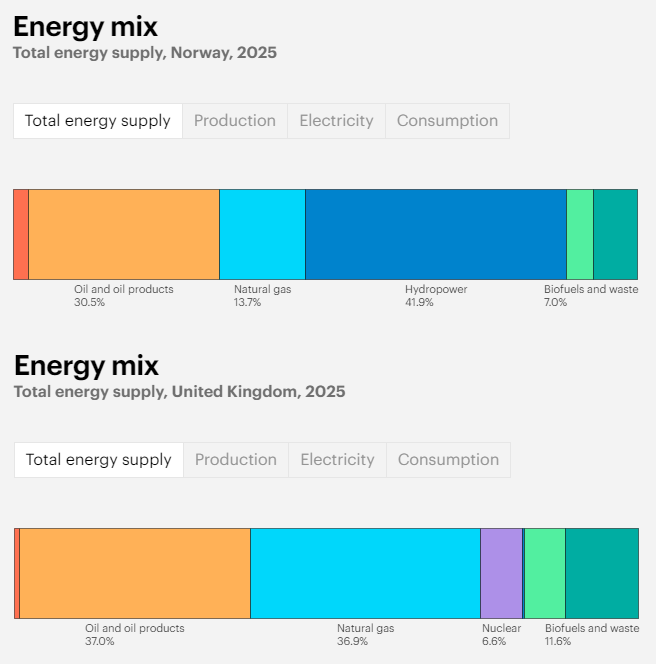
This is the happy position Norway finds itself in. Abundant cheap electricity from hydroelectric generation, not much in the way of gas infrastructure (despite, like us, having access to North Sea gas) and one of the highest rates if not the highest rate of heat pump adoption in the world. From the International Energy Agency (select country from the drop down box):
Midea 14kW (for now...) ASHP heating both building and DHW
With a heatpump tariff, it should be cheaper to operate a pump than a boiler..,
It's swings and roundabouts - during off-peak periods the heat-pump would be expected to be a bit cheaper, but then at other times of day and particularly during expensive peak periods, it's likely more expensive than gas.
Overall it may be better, but there's a load of added complexity for a relatively marginal financial gain on the running costs, particularly in comparison to the installation cost.
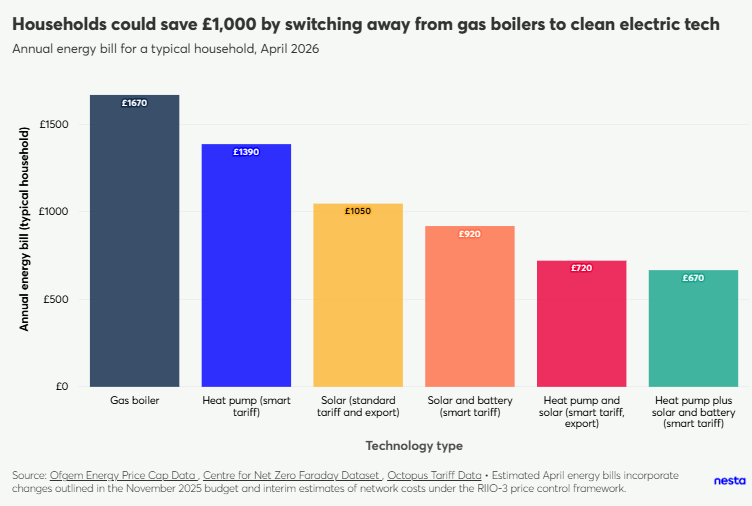
I have been putting together some material for a series of presentations on renewables and this is one example of what I am finding:
8kW Solis S6-EH1P8K-L-PLUS hybrid inverter; G99: 8kW export; 16kWh Seplos Fogstar battery; Ohme Home Pro EV charger; Vaillant Arotherm Pro 7kW; 100Amp head, HA lab on mini PC
Unfortunately, although the dataset used for that NESTA comparison is very good, based on profiles from smart meter readings from 1 million Octopus customers, and Octopus tariffs, there is a significant flaw in the comparison. It's hidden in the fact that a fixed export tariff is assumed. That tends to make the saving in switching to a heat pump from gas roughly the same irrespective of whether solar PV and a battery are present already or not. Gas to a heat pump is estimated at a £1670 - £1390 = £280 saving, whereas solar, battery and gas to solar, battery and heat pump is estimated at a £920 - £670 = £250 saving.
A more appropriate comparison would be to assume that householders seek out the best possible tariff for the equipment that they have, including both import and export tariffs. For example, for solar PV and a battery, that would likely be Octopus flux for both import and export. The arbitrage with a substantial battery would enable export at a high price (roughly 30p per unit) during the peak period (4-7pm). However, adding a heat pump to this tariff alongside solar and a battery means that the heat pump would effectively be running on marginal rate electricity costing 30p per unit. This would make switching to a heat pump from a system with solar PV and a battery already present roughly neutral on running costs compared to staying with the gas, solar and battery combination.
In this sense, the graphic is somewhat misleading. There are larger gains achievable with solar plus a battery than are shown, and those extra gains may well all but eliminate any extra saving in subsequently adding a heat pump.
This situation is an unfortunate consequence of a plethora of tariffs aimed at customers with individual pieces of renewable technology. For example, the cheapest overnight import rates are with EV tariffs, then there are heat pump tariffs with moderate import costs in other time periods as well. Both can only work with fixed export tariffs. Then there is flux which is great for solar and a battery, but isn't particularly good for heat pumps and EVs.
It's a shame there isn't a tariff that is time of use for both import and export that matches the EV rates overnight, the heat pump rates during other moderate usage periods and has a flux-like pattern for export. In other words a tariff that is the best for anyone who has collected any one, two, three, or the full set of renewable technology, without having to deploy a huge spreadsheet to determine which one of the current don't quite fit right tariffs is the best based on solar production, battery size, heat pump electricity usage, and EV miles driven!
I'm a bit late on this one, but I think one thing we sometimes underestimate when discussing why people don't choose heat pumps is that most homeowners aren't really making a judgement about the technology itself. They're making a judgement about risk, cost, inconvenience and whether they can trust the people asking them to spend a substantial amount of money. And when you look at the decision from that perspective, I can understand why so many people conclude that sticking with a gas or oil boiler is the safer option, even if they broadly accept that electrifying heating is the right direction of travel.
Consider what we're actually asking somebody to do. They may have a perfectly serviceable boiler, a local heating engineer they've used for years and a heating system whose behaviour and running costs they broadly understand. We're then inviting them to potentially spend £10-£20k on a substantially different system, perhaps replace radiators, alter pipework, find space for a hot water cylinder, navigate unfamiliar controls and tariffs and place enormous trust in an installer whose technical competence they have very little ability to assess. Even with the BUS grant, that's quite a proposition, particularly when the alternative is familiar, relatively straightforward and generally much cheaper to install.
And this is where I think the heat pump industry has created an enormous problem for itself, because the process of obtaining quotations can actually increase a homeowner's uncertainty rather than resolve it. We regularly receive proposals where different installers have recommended different heat pump capacities, different hydraulic arrangements, different radiator upgrades and markedly different prices for essentially the same property. Sometimes those differences are perfectly legitimate engineering choices, but how is an ordinary homeowner supposed to distinguish a thoughtfully designed £14,000 installation from an unnecessarily complicated one, or establish whether a considerably cheaper proposal represents genuine efficiency or simply important work being omitted?
I don't think we appreciate quite how intimidating that experience can be. I still find it personally daunting. We've spent years telling homeowners that heat pumps need to be designed and installed properly, which is absolutely true, but in doing so we've also told them that the consequences of getting the design or installer wrong could be expensive and difficult to rectify. And then, having established just how important those decisions are, we've provided them with surprisingly few reliable ways of determining whether they're making the right ones. Our own "recommended" installer network on RHH is made up of 70-ish installers. 70 out of 3,500. So getting an installer that is competent feels like a bit of a gamble to consumers IMO.
Running costs compound the problem further. When electricity remains expensive relative to gas, we're asking households to accept a much higher upfront investment without necessarily being able to promise meaningful savings in return. An efficient heat pump on a suitable tariff can be economical, but that's a rather different proposition from a universal financial guarantee. Homeowners shouldn't have to become experts in weather compensation, COP calculations, electricity tariffs and hydraulic design just to feel confident that their new heating system won't cost a fortune to operate.
I also think we need to be careful about attributing every hesitation to misinformation, hostile newspapers or public resistance to change. Those things undoubtedly play a part, but it's too convenient to blame the public for being sceptical when parts of the industry continue to provide perfectly legitimate reasons for scepticism. Poor installations, weak aftercare, inconsistent quotations and a consumer protection framework that consistently struggles to deliver meaningful redress aren't inventions of the tabloid press.
For me, the solution isn't simply more advertising, bigger subsidies or telling people that heat pumps work brilliantly in Scandinavia. We need to make the decision itself feel considerably less risky. That means clearer quotations, transparent design assumptions, realistic running cost expectations, competent installers, proper commissioning and somebody taking responsibility for the finished system rather than just the installation. It also means reducing unnecessary disruption and costs without compromising quality, because not every property needs an expensive bespoke engineering project, just as not every property is suited to a minimal disruption installation.
I think the problem is that retrofit A2W heat-pump installations in Britain, with our national practices and pricing, haven't reached the point of being good enough yet compared to an efficient gas boiler, to provide that compelling case to change.
@temperature_gradient I think this sums the problem up very well! Love the name by the way!!! 😆 🤣 🤩 😘
The fact that we have a privatised energy market is certainly proving to be a massive hindrance to change because the current players don't want to lose their guaranteed money making machines!
t does not help that Britain has taken the perfectionist approach of shutting out the hybrid solutions used in other European countries, which fill in for some of the deficiencies of current heat-pump technology, to make them more attractive as a retrofit solution - the ability to retain the combi for hot water, the ability to work with the existing plumbing and the ability to use gas to provide a ceiling on operating cost, so heating is still affordable during period of peak electricity pricing and during periods of very cold weather / low-CoP.
And I agree with this too! We have chosen the worse of possible accommodations - a Black or White one! 🤪 🤯 The requirement to remove a gas boiler in order to obtain any government grant support is a really bad one!
Installed solar [7.44 kWp] and batteries [Sigenstor 3 x 8kWh] and 12 kW inverter in July 2025.
If people (and corporations controlled by private equity funds) were honest and decent it makes sense, they aren't so many will, rightly, see such a system as a trap for the resident. As you say we simply don't have the legal framework for such a system.
@jamespa I do believe you are as cynical as I am! 🤣 🙃
The Greens are (rightly imo) concerned about large corporate property owners (hedge funds) becoming ever more dominant in the UK housing market that are managing large numbers of renters and fleeceholders, much as the situation is now in America. This will further complicate the problem as these people are not interested in providing great service but rather maximising their profits - not the occupiers/renters! So enabling an ASHP install that they will be liable for in future years is problematic at best...
Installed solar [7.44 kWp] and batteries [Sigenstor 3 x 8kWh] and 12 kW inverter in July 2025.
have been putting together some material for a series of presentations on renewables and this is one example of what I am finding:
While the gas boiler figure is pretty much right (albeit a little out of date with current increasing gas prices), the running costs for a decent hybrid Gas + Renewables setup is not correctly reflected here...
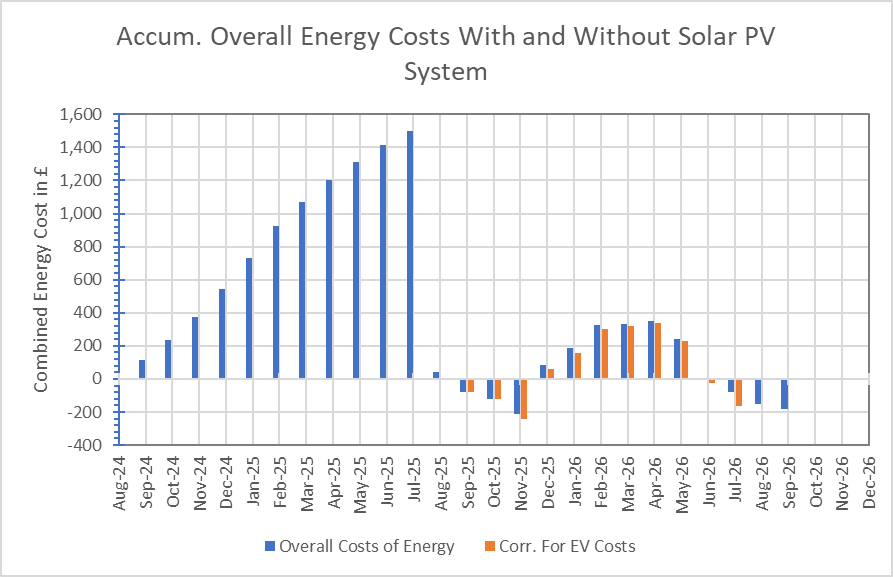
When I first planned out my own Solar + Batteries system I went for 2 x 8 kWh of battery capacity. But I quickly realised that a third battery totally stands the situation on it's head and instead of just bringing the bills down it reduces it to net zero because of the ability to arbitrage as well as using the smart TOU tariffs for load shifting. So I had the 3rd battery installed about 3 weeks after the initial installation. That has proved to have been the right decision (despite the additional £2,000 outlay for the 3rd battery wiping out all my savings). My solar and arbitrage earnings combined means that they pay for my gas bill and electricity bill across the year. The arbitrage pays for the electricity all year round and the solar export during summer pays for the gas during winter. The graph below gives an indication of what I mean. Showing the energy costs for the 2024-25 year vs the 2025-26 year. Negative is a net positive profit from the system... and that includes charging the EV!
So you don't need a heat pump to get to net zero at least financially... You just need a decent solar and battery setup. So I take issue with that £960 figure for solar and batteries and the final £670 figure for a heat pump and solar and batteries and smart tariff figure. That's just not been my experience.
In this sense, the graphic is somewhat misleading. There are larger gains achievable with solar plus a battery than are shown, and those extra gains may well all but eliminate any extra saving in subsequently adding a heat pump.
This situation is an unfortunate consequence of a plethora of tariffs aimed at customers with individual pieces of renewable technology. For example, the cheapest overnight import rates are with EV tariffs, then there are heat pump tariffs with moderate import costs in other time periods as well. Both can only work with fixed export tariffs. Then there is flux which is great for solar and a battery, but isn't particularly good for heat pumps and EVs.
Agreed! The plethora of tariffs are tying people up in knots about how to manage a complicated renewables mix of solar, batteries, ASHP, EVs etc... It's all indicative of a branched infrastructure system that is out of control because it's growing in multiple directions without real government oversight or management of the energy market. Free Market Capitalism screws us again!
Installed solar [7.44 kWp] and batteries [Sigenstor 3 x 8kWh] and 12 kW inverter in July 2025.