

Notifications
Clear all
Joining the Renewable Heating Hub forums is completely free and only takes a minute. By registering you’ll be able to ask questions, join discussions, follow topics you’re interested in, bookmark useful threads and receive notifications when someone replies. Non-registered members also do not have access to our AI features. When choosing your username, please note that it cannot be changed later, so we recommend avoiding brand or product names. Before registering, please take a moment to read the Forum Rules & Terms of Use so we can keep the community helpful, respectful and informative for everyone. Thanks for joining!
Electricity, Tariffs, Monitoring, Electrics & Providers
37
Posts
8
Users
13
Reactions
184
Views

24/11/2026 1:08 pm
Who is responsible for the looping approach in the first place - the housing developers as a cost saving measure?
Looped supplies to houses was the norm up until the 1970s.
No one then could foresee the possibility of EV chargers, and electric showers were rare.
When evaluating the appropriate size of supply cable, DNOs distinguish between continuous demand and temporary/intermittent high current.
Taking the current above the rated capacity of an underground supply cable isn't a problem if it then has the chance to cool down again.
In that era of house-building it was also common for a 3-phase feed from the local substation to have a neutral conductor with a smaller cross-sectional area than the three phases.
That wasn't an issue back then because household demands were much alike. Consequently the Neutral carried very little current.
However, that's now become a big problem.
When one or two houses on an estate add an EV charger, the phases are imbalanced, and the Neutral is the dominant path for electricity to return to the transformer.
Very few local substations have any form of monitoring.
Of those that do, I am easily able to see the consequences of an EV charger being used.
Here's a house on Octopus Go, with cheap rates between 00:30 - 04:30
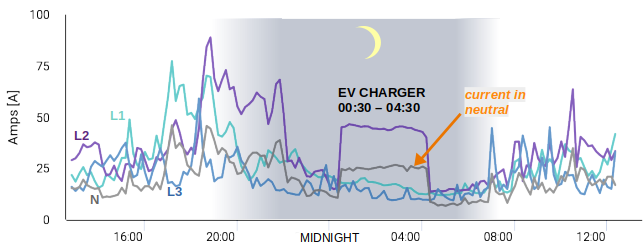
If the Feed to that house uses an underground cable, then the Neutral will be under thermal stress. It results in a breakdown of the insulation between conductors, and eventually a power-cut.
Losses due to phase imbalance now account for around 10% of the electricity carried by local substations supplying single-phase properties.
It was the decision by central Government to subsidise the installation of rooftop solar panels which first highlighted the problem. The Feed-In Tariff started in April 2010, but DNOs didn't kick up a fuss.
After all, increased system losses gives them a good reason to upgrade the grid with higher-capacity cables and transformers. Ofgem recognises that and increases our bills to pay for it.
This post was modified 10 minutes ago by Transparent
This post was modified 9 minutes ago by Transparent
Save energy... recycle electrons!
Page 4 / 4
Prev

