

Notifications
Clear all
Joining the Renewable Heating Hub forums is completely free and only takes a minute. By registering you’ll be able to ask questions, join discussions, follow topics you’re interested in, bookmark useful threads and receive notifications when someone replies. Non-registered members also do not have access to our AI features. When choosing your username, please note that it cannot be changed later, so we recommend avoiding brand or product names. Before registering, please take a moment to read the Forum Rules & Terms of Use so we can keep the community helpful, respectful and informative for everyone. Thanks for joining!
Air Source Heat Pumps (ASHPs)
25
Posts
9
Users
11
Reactions
6,621
Views

Topic starter
21/06/2025 5:58 pm
Hi,
I'm in the early stages of planning my heat pump installation and whilst I know where the pump itself will be sited, I need to work out how to get the water into the garage. The path will see the pipes run up the side access and turn into the garage before getting connected to my heating. The route includes data and power cable.

I have two options.
1. I surface mount the primaries and run them along my neighbour's wall. I then have to either go under the paving or run the pipes up an over. I'll need a bracket of some sort between my neighbour's wall and the heat pump itself as I can't fix them to their failing timber fence.
2. I bury an instulated pipe that holds everything. The problem is that my side access is pretty busy underground with storm, waster and water main pipes. I'm told I should bury the pipe at 600mm, but I don't believe that's possible. At least not all the way. I have photos of this before it was backfilled.
What I want to know is why we can surface mount pipes in insulation, but we're required to put insulated pipes quite deep in the ground.
Has anyone got their primaries buried at a depth less than 600?
Owner of a (rusty) Kronoterm Adapt 0312 ASHP (replacing a 35kW boiler). 4.8kW solar PV with 5.4kWh storage. EV driver.
Follow my journey at https://www.youtube.com/@tomasmcguinness and https://www.tomasmcguinness.com
1

21/06/2025 6:47 pm
I think I would be wary of attaching my services to a neighbours property without some form of legal agreement to allow this and the required access to them in perpetuity. It also leaves the pipework at the risk of the neighbouring owner, or any future owner, making perfectly legal changes to their property which impacts on your pipe run.
1
Topic starter
21/06/2025 8:28 pm
@abernyte That is an excellent point. I hadn't considered that at all! I think I'll be burying a pipe 🙂
Owner of a (rusty) Kronoterm Adapt 0312 ASHP (replacing a 35kW boiler). 4.8kW solar PV with 5.4kWh storage. EV driver.
Follow my journey at https://www.youtube.com/@tomasmcguinness and https://www.tomasmcguinness.com


22/06/2025 8:12 am
Has anyone got their primaries buried at a depth less than 600?
Yes, ours are buried. 20m run from the heat pump to the utility room. Buried at roughly 50-60cm. I dug the trench myself with pickaxe and spade, because I knew there pipes (waste and gutter run off) underground.
The insulated heat loss pipe is quite pricey from what I can remember.


🔥 Britain’s Heat Pump Shitshow
How Installing a Heating System Became a National Nervous Breakdown
Free UK shipping.
📗 Heat Pumps Explained
A Jargon-Free Guide for Homeowners
Rewritten and updated for 2027
📘 From Zero to Heat Pump Hero
🛠️ Bodge Buster
New to heat pumps?
Take the Heat Pump Fundamentals course and use INTRO50 at checkout for 50% off.

Topic starter
22/06/2025 8:24 am
@editor My side access already contains services, so it's not easy. I think I'm going to have to shallow bury the pipe as it will need to go over some of the existing services. There is clay pipe down there and I don't want to disturb that.
Is there any solid guidance on buying pipes? I'm less concerned about the water and more about the electrical cable.
Owner of a (rusty) Kronoterm Adapt 0312 ASHP (replacing a 35kW boiler). 4.8kW solar PV with 5.4kWh storage. EV driver.
Follow my journey at https://www.youtube.com/@tomasmcguinness and https://www.tomasmcguinness.com
22/06/2025 8:52 am
Broadly, the electrical cable will need to be either earthed armoured or in a duct to prevent mechanical damage. Both need to be marked with the required tape.
1
22/06/2025 8:57 am
@tomasmcguinness, because ours runs under our driveway, and I was keen to avoid going too shallow in case it ever got damaged from heavy vehicle deliveries or future resurfacing.
As for guidance on insulation depth, the general 600mm recommendation is more about frost protection and physical damage prevention than some hard and fast requirement (as far as I know anyway). If you’re using decent insulated pipework and you’re not in an area prone to severe frost, going a bit shallower (like 300–400mm) in tight spots should be fine.
In your case, I’d agree that shallow burial with good-quality pre-insulated pipework is a practical way forward. You could always add some additional foam lagging and a protective duct over the section that runs shallower, just to give it a bit of extra mechanical protection.
On the electrical side, the key thing is to use appropriately rated armoured cable, preferably in its own duct separate from the primary pipe, especially if it’s running alongside heat-carrying pipework. It’s also worth checking the manufacturer’s guidance… some kits include pre-bundled solutions, while others require cables to be run independently.
Out of interest, which heat pump are you going with? And who’s installing it? Always helpful context for others following your project too.
🔥 Britain’s Heat Pump Shitshow
How Installing a Heating System Became a National Nervous Breakdown
Free UK shipping.
📗 Heat Pumps Explained
A Jargon-Free Guide for Homeowners
Rewritten and updated for 2027
📘 From Zero to Heat Pump Hero
🛠️ Bodge Buster
New to heat pumps?
Take the Heat Pump Fundamentals course and use INTRO50 at checkout for 50% off.
Topic starter
22/06/2025 9:01 am
@abernyte I was thinking of an SWA *in* the ducting. I'm looking at a combined water and electrical pipe (uponor or isoflow for example).
Owner of a (rusty) Kronoterm Adapt 0312 ASHP (replacing a 35kW boiler). 4.8kW solar PV with 5.4kWh storage. EV driver.
Follow my journey at https://www.youtube.com/@tomasmcguinness and https://www.tomasmcguinness.com
1
Topic starter
22/06/2025 9:04 am
Current thinking is a Kronoterm Adapt. Doing the ground works myself (trench digging, base casting, that sort of thing). Then the professionals will finish the job.
Presently, I'm just exploring my options to get the water from the heat pump into the garage.
I'm constrained by the existing services, so I'm not sure how deep I'll actually manage.
Owner of a (rusty) Kronoterm Adapt 0312 ASHP (replacing a 35kW boiler). 4.8kW solar PV with 5.4kWh storage. EV driver.
Follow my journey at https://www.youtube.com/@tomasmcguinness and https://www.tomasmcguinness.com
1
22/06/2025 11:19 am
@tomasmcguinness bold choice on the Kronoterm. Nice! Will be very curious to see how it performs. Have heard very good things about them.
🔥 Britain’s Heat Pump Shitshow
How Installing a Heating System Became a National Nervous Breakdown
Free UK shipping.
📗 Heat Pumps Explained
A Jargon-Free Guide for Homeowners
Rewritten and updated for 2027
📘 From Zero to Heat Pump Hero
🛠️ Bodge Buster
New to heat pumps?
Take the Heat Pump Fundamentals course and use INTRO50 at checkout for 50% off.

22/06/2025 7:57 pm
@tomasmcguinness HI, The rules is a best practise, the heating pipes do not come under the same rules as services such as gas and mains drinking water.
Mostly its for frost protection but when the pipes are only just below the surface it is advisable to well insulate above 100mm thickness to slow losses and mechanically protect if possible.
AAC Group Ltd covering the Kent Area for design, supply and installation of ASHP systems, service and maintenance, diagnostics and repairs.
1

26/06/2025 7:16 pm
I was thinking of an SWA *in* the ducting.
What you run the cable through will affect its current rating (and hence voltage drop).
SWA is intended for direct burial in the ground... the wetter the better.
You want any heat-loss from the cable to be conducted away into the surrounding soil.
Placing a cable inside an air-filled duct has the opposite effect.
The air acts as an insulating jacket. You've just made yourself an underground oven in a long tube. 😥
When you select the required cable size, you would usually enter the figures into an online calculator.
Here's one on the website for TLC-Direct.
That will tell you the cross-sectional area of the copper conductors you will require.
Secondly, if you have any services at shallow depth, where they might get hit by a garden fork for example,
place some basic paving slabs above them.
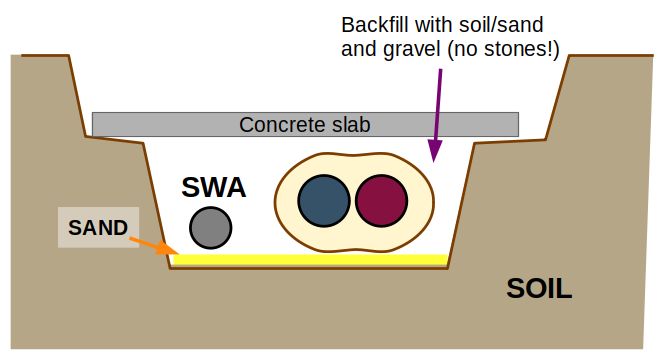
Although buried electrical cables must also have warning tape above them,
there's nothing like having the fork hit a 40mm piece of concrete slab to warn you there's something down there!
Save energy... recycle electrons!
Page 1 / 3
Next
SPONSORS

Degrees of Separation

Latest Posts
-

RE: Heat pump branding. Clever, contemporary… or a bit too much?
I think Heat Geek have done an amazing job on their bra...
By Tomtheheatingengineer , 2 hours ago
-
RE: HeatGeek vs Octopus surveys: puzzling disparity - any ideas why?
I have just had 3 heat loss surveys, one by heat geek o...
By David , 3 hours ago
-
RE: Heat Geek Zero Disrupt: Are We Sleepwalking Into Another Race to the Bottom?
I think that's the key question. After all inverter uni...
By Prunus , 4 hours ago
-
RE: battery storage without solar
As of October 1st they need specific qualifications to ...
By EtchedPixels , 5 hours ago
-
RE: How should the Boiler Upgrade Scheme be reformed?
A unit which uses water to transfer the heat/chill from...
By Temperature_Gradient , 5 hours ago
-
RE: Renewables & Heat Pumps in the News
With regards to the BUS grant raid, I gave it more thou...
By ASHP-BOBBA , 6 hours ago
-
RE: Why are ASHP installs so expensive?
The whole system seems to work on the basis of...
By ian33a , 6 hours ago
-
RE: Missing flow temperature in Heat Geek proposal
Good plan. If you can get half hourly meter readings a...
By JamesPa , 11 hours ago
-
RE: Heat Pumps Without Grants: Would You Have Installed One & Will You Now?
@editor Most certainly. The heat pump was an ideal s...
By Abernyte , 11 hours ago
-
Although regulations may well vary from country to coun...
By Majordennisbloodnok , 12 hours ago
-
RE: Does anyone have experience of a smart water meter?
Yep I caught our slow leak from a £100 bill rise 8)
By EtchedPixels , 12 hours ago
-
RE: Do You Need a Buffer Tank or Low Loss Header for Underfloor Heating in a Large Property?
@jamespa in some cases, failing the Turing test might b...
By GrahamF , 15 hours ago
-
RE: Passiv Smart Thermostat - Help & Forum Support
@energystoragetech The heat capacity of some...
By JamesPa , 17 hours ago
-
RE: tepeo ZEB UK Support & Info Thread
Sorry you are correct, I was remembering figures from t...
By JamesPa , 1 day ago




SPONSORS