

Notifications
Clear all
Joining the Renewable Heating Hub forums is completely free and only takes a minute. By registering you’ll be able to ask questions, join discussions, follow topics you’re interested in, bookmark useful threads and receive notifications when someone replies. Non-registered members also do not have access to our AI features. When choosing your username, please note that it cannot be changed later, so we recommend avoiding brand or product names. Before registering, please take a moment to read the Forum Rules & Terms of Use so we can keep the community helpful, respectful and informative for everyone. Thanks for joining!

Topic starter
17/07/2026 7:39 pm
Hi everyone,
I’m looking for real-world advice and cost benchmarks for the new Vaillant Arotherm Plus 7kW (cooling-enabled) system with Jaga Briza fan coils for active cooling, plus some guidance on Sunamp Thermino selection.
Project background
- London end of terraced house, approx. 104 m² after extension (2 storey house)
- Nearly EnerPHit-level retrofit following Passive House principles (high-performance fabric, airtightness, MVHR, etc.)
- Zehnder MVHR being installed
- Solar PV + Tesla Powerwall 3 also going in
- Ground floor cooling demand estimated at ~6.6 kW (further reduced with external awning)
- Bedrooms have low loads
Proposed system
- Vaillant Arotherm Plus 7kW (new V2, cooling enabled)
- Heating via underfloor heating (UFH)
- Cooling via Jaga Briza fan coil units
- Hot water via Sunamp Thermino
Jaga Briza concealed units planned: – Living/dining/kitchen: Briza 22 (190 cm) – Study: Briza 12 – Two bedrooms: Briza 22 (75 cm each)
- 100 L buffer vessel
- Sunamp Thermino (undecided between xPlus and ePlus – see question below)
- Heatmiser fan-coil controls
- Units to be installed in ceiling / loft voids where possible
We’ve been quoted roughly £13,800 for the four Jaga Briza units supply + install (including controls). Separately we’ve obtained a direct quote from Jaga for the equipment itself at around £6,000–£6,300 (ex VAT + carriage).
Heat pump (100L buffer) + Sunamp (210L) £17,340
Total cost of £31,140
Minus the BUS (£7,500): £23,640
The overall package (ASHP + Sunamp + cooling) is coming in significantly higher than expected once cooling was added. We’re trying to understand whether the installation element for the ASHP and the Briza units is realistic for a London retrofit with ceiling/loft installation and full system integration.
Questions
I feel like I should get a 200L buffer for the ASHP instead of 100L and the 300L thermino instead of the 210L.
- Has anyone here installed Jaga Briza (or similar) fan coils for cooling with a Vaillant (or other) ASHP? How did they perform in practice — noise, response time, comfort, condensation management?
- What kind of installed cost (supply + labour) did you see for a similar number of concealed Briza units in a retrofit?
- Any feedback on the overall cost of adding active hydronic cooling to a Vaillant Arotherm Plus system?
- Sunamp Thermino choice: We will be pairing the ASHP with a Sunamp Thermino and also have solar PV + Tesla Powerwall. Should we go for the xPlus (heat-pump optimised) or the ePlus (more PV/off-peak focused)? Any real-world experience with either in a similar setup would be really helpful.
- Any tips on coordination between the ASHP installer and the fan-coil installation (pipework, drainage, controls, heating/cooling changeover logic)?
We’re keen to keep the system as one coherent package if possible, but want to make sure the pricing and component choices are sensible before we commit.
Any experiences, cost data, or lessons learned would be greatly appreciated. Happy to provide more technical details if useful.
Thanks in advance!

18/07/2026 8:35 am
A lot of this feels very wrong, both price wise and technically. I think you need to break it down into the component parts.
Amongst the things that are wrong are:
7kW for a near passiv Haus 100sq m is way over
You don't want a buffer at all. Maybe a volumiser, not a buffer
What is the strategy re condensation, is it to operate above dew point or below dew point, if the latter how is the pipework to be protected from condensation
31k (plus rads?) sounds like a complete rip off, depending on the answers to previous question and availability of nearby electric socket, fitting a radiator takes less than half a day for one person.
I doubt you want fan coil controls, depending on what control comes with the radiators. The heat pump comes with its own controller and rarely do you need, or want, anything else, particularly with Vaillant which is a good controller. Combining third party controls with a heat pump is generally a bad idea, unless the third party controller is heat pump specific. So far as I can see the native radiator controls plus the Vaillant controller is everything you need and anything else will just make things more expensive, more complex less efficient and less effective.
I presume you are going for a sunamp because there is no space for a cylinder, if there is space for a cylinder go for a cylinder.
If they are being installed as concealed units why Jaga which are very elegant (relevant only if exposed) but also very expensive. Why not something like Mitsubishi i-life 2 or another fan coil?
My strong advice is don't proceed until you have bottomed this out. There is a finite probability you are being taken for a complete ride and will end up with a system that doesnt work well having paid three times what you need to!
Can you clarify the scope and price of the two? jobs and give us a little more insight into the questions above. Also can you explain why you are separating the radiator job from the heat pump job, it means that nobody has overall responsibility and if anything goes wrong (which it will) they will each blame the other!
This post was modified 3 months ago 6 times by JamesPa
4kW peak of solar PV since 2011; EV and a 1930s house which has been partially renovated to improve its efficiency. 7kW Vaillant heat pump.

18/07/2026 9:18 am
+1 for everything
Concealed FCUs are expensive to install due to all the drywall work. Also an issue for maintenance.
That said, your quote is indeed damn expensive.
It makes no sense to use FCUs with water above the dew point, so I assume you will be using 5-7°C water. In this case all piping, valves, manifolds, everything between heat pump and FCUs needs to be vapor tight insulated to avoid condensation, which adds to the hassle and cost.
Good luck putting vapor tight insulation on a buffer tank (which you don't need anyway).
You also need a bunch of motorized valves for the various modes:
- send 5-7°C water to the fan coils ONLY
- send 18°C water to the UFH (and maybe fan coils)
- send heated water to UFH and/or fan coils
- send heated water to DHW tank
ie, something like 3 valves to cut off flow to FCUs, UFH, and DHW depending on mode, so water goes where it should.
The fan coil valve will attract condensation and corrode. It should be in an accessible spot, easy to maintain. Not hidden behind drywall.
Zoning FCUs is generally not super useful because they use tiny pipes with high pressure drop, so your heat pump will probably complain about "flow too low" if you turn off half your FCUs. So if the installation includes one zone valve per FCU they probably won't see much use.
For passivhaus, 7kW is indeed probably too much unless the heat pump was sized for cooling, with heating as an accessory.
Please give details on UFH (slab/no slab, surface, pipes, etc) and how areas without UFH will be heated.
Phase change material thermal storage (Thermino) has the advantage of being more compact and offering more constant output temperature. However all the heat must be generated at the phase transition temperature, therefore lower COP.
1
18/07/2026 9:34 am
Zoning FCUs is generally not super useful because they use tiny pipes with high pressure drop, so your heat pump will probably complain about "flow too low" if you turn off half your FCUs. So if the installation includes one zone valve per FCU they probably won't see much use.
Plus the floor area is only 100 sq m and most fancoils modulate their fan speed according to room temperature anyway! Zoning = madness!
All of this and the above is indicative of a design probably done by someone who doesn't know how to design heat pump based heating/cooling systems!
4kW peak of solar PV since 2011; EV and a 1930s house which has been partially renovated to improve its efficiency. 7kW Vaillant heat pump.

Topic starter
18/07/2026 11:36 am
A lot of this feels very wrong, both price wise and technically. I think you need to break it down into the component parts.
Amongst the things that are wrong are:
7kW for a near passiv Haus 100sq m is way over
You don't want a buffer at all. Maybe a volumiser, not a buffer
What is the strategy re condensation, is it to operate above dew point or below dew point, if the latter how is the pipework to be protected from condensation
31k (plus rads?) sounds like a complete rip off, depending on the answers to previous question and availability of nearby electric socket, fitting a radiator takes less than half a day for one person.
I doubt you want fan coil controls, depending on what control comes with the radiators. The heat pump comes with its own controller and rarely do you need, or want, anything else, particularly with Vaillant which is a good controller. Combining third party controls with a heat pump is generally a bad idea, unless the third party controller is heat pump specific. So far as I can see the native radiator controls plus the Vaillant controller is everything you need and anything else will just make things more expensive, more complex less efficient and less effective.
I presume you are going for a sunamp because there is no space for a cylinder, if there is space for a cylinder go for a cylinder.
If they are being installed as concealed units why Jaga which are very elegant (relevant only if exposed) but also very expensive. Why not something like Mitsubishi i-life 2 or another fan coil?
My strong advice is don't proceed until you have bottomed this out. There is a finite probability you are being taken for a complete ride and will end up with a system that doesnt work well having paid three times what you need to!
Can you clarify the scope and price of the two? jobs and give us a little more insight into the questions above. Also can you explain why you are separating the radiator job from the heat pump job, it means that nobody has overall responsibility and if anything goes wrong (which it will) they will each blame the other!
Thank you for taking the time to review this and for your honest feedback. I really appreciate it, especially as this is a significant investment and I want to make sure I’m getting good value.
To give you some context: this is our long-term home (we’re planning to stay for 15–20+ years if not a forever home), so we’re investing in a high-quality energy retrofit. We’re aiming for near-EnerPHit performance, although we won’t be pursuing full certification. The main limitation is the existing ground floor, which we can’t insulate sufficiently without major structural changes that would affect thresholds and ceiling heights. Our designer has modelled this and the heating demand is around 31 kWh/(m²·a) — close to the EnerPHit target of 20, but not quite there.
We are doing a full renovation of the existing house and the addition of the extension, stripping everything out, updating the floor plan, layout, etc... very comprehensive hence why I wanted to do all of this at the same time.
System Choices
- Heating: We’re using underfloor heating (not radiators), which is being installed by the main contractor. We had to split the work because the preferred supplier couldn’t handle the underfloor heating.
- Cooling: We’re planning concealed Jaga Briza fan coil units in the living area, study, and two bedrooms. The cooling designer recommended a 50L buffer for the ASHP (not sure if it's for both heating and cooling)
- Hot Water: We’ve gone for a Sunamp Thermino because space is limited. While we’re normally a household of two for 90% of the time, we can have 4–6 people staying for the 10% so we wanted sufficient capacity (minimum 210L equivalent, ideally closer to 300L). The Sunamp 300L fits well in ground floor as it cannot be moved to the loft. I would like to use more loft space as it is essentially a plant room and storage than using first floor or ground floor but if a 300L cylinder can go there then I am open to it.
- Controls: The Heatmiser controls were proposed by the cooling designer to manage the fan coils. I’m open to simplifying this if it’s not necessary.
On condensation, I don’t yet have a clear answer — I’ll ask the designer for their strategy (whether they’re operating above or below dew point and how the pipework is protected).
Pricing and Scope
The current quote from Econic breaks down as follows:
- Vaillant Arotherm Plus 7kW (cooling-enabled) + Sunamp: £17,340
- Jaga Briza fan coil package (supply + install): £13,800
- Total before VAT: £31,140
- Less BUS grant: –£7,500
- Net cost to us: £23,640
The main contractor is doing the UFH, while another one is doing the ASHP + cooling. We have engaged a dedicated cooling designer who is coordinating between the design and installation.
We did try to find one contractor who could deliver the full package (ASHP, cooling, UFH, MVHR, Solar PV + Battery), but it proved very difficult or poor perfuming. That contractor who could so everything was essentially outsourcing the MVHR piece for instance and it was just a very poor job and cost wise, it was a lot higher.
Alternatives I’m Considering
I’ve also been looking at some other heat pump systems that might offer better value or future-proofing for a 2 in 1 (A2A and A2W):
- Daikin X Series
- Samsung EHS (particularly the R290 models)
- Panasonic Aquarea EcoFlex
I’d be interested in your thoughts on whether any of these could be a better fit for our needs, especially around cost, refrigerant choice (R290 vs R32), and integration with fan coils and UFH.
Overall
I completely agree that the headline number feels high, and I want to make sure we’re not over-specifying or paying a premium unnecessarily. At the same time, I do value good design, aesthetics (concealed units), future-proofing, and a system that will perform well long-term in a high-performance home.
I’d really appreciate your views on the points you raised — particularly around the buffer, controls, whether Jaga is over-specified for concealed installation, and whether the overall approach makes sense. I’m happy to share more details (including the PHPP modelling) if it helps.
Lastly, I wanted to really appreciate your time going through from a homeowner to homeowner perspective. This is a significant investment, we are happy to pay money but we need to know this is being used judiciously.
Passive House designer notes:
The modelling undertaken to date indicates that the scheme is performing close to EnerPHit levels overall. However, the primary limitation is the existing building fabric, particularly the ground floor construction. With the current agreed build-up, clarified through trial pit investigations during the tender period, we are not able to introduce sufficient insulation at ground floor level without either raising floor levels, which impacts thresholds and ceiling heights, or undertaking more fundamental reconstruction of the existing floor. This results in a calculated heating demand in the order of 31 kWh/(m²·a), compared to the EnerPHit target of 20 kWh/(m²·a)
It is technically possible to improve this further, for example through replacement of the existing ground floor construction to allow a new insulated slab build-up. However, achieving full EnerPHit certification would require a coordinated upgrade across multiple elements, including floor construction, internal insulation strategy, window performance, and airtightness. This would involve significant changes to the current design assumptions, with implications for cost, programme, and coordination with the current contract, which was tendered on a different basis.
At this stage, the design retains strong performance improvements and aligns with EnerPHit principles, but formal certification is not being pursued within the agreed scope.
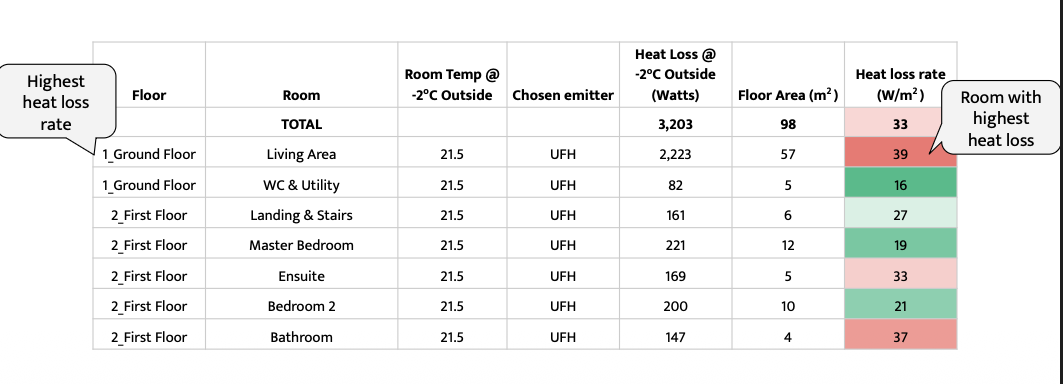
Heat loss modelling (ASHP installers)
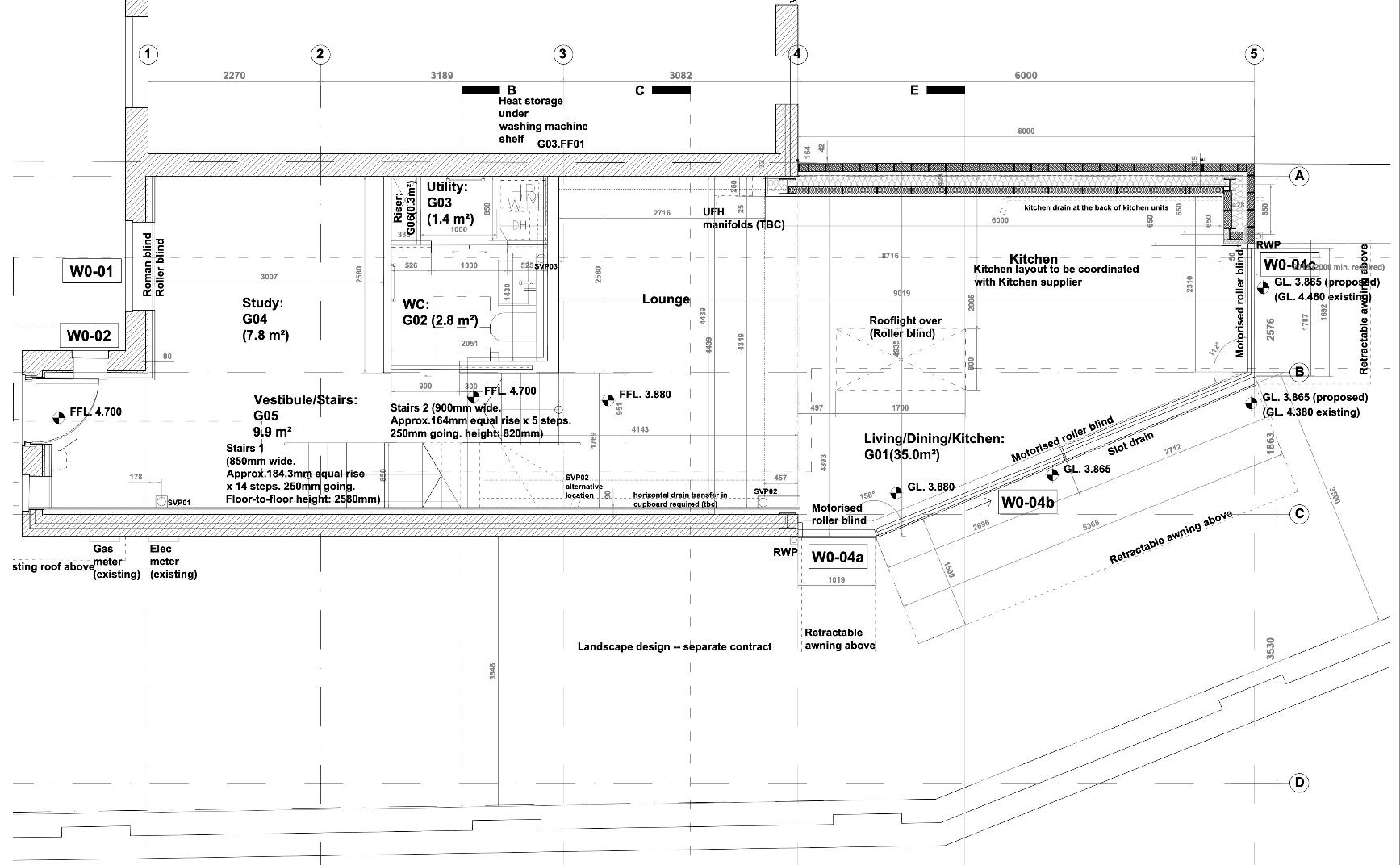
Cooling demand of 6.6kW for the ground floor without any shading applied, once this is done is reduced by 50% to circa 3.3kw. I attach ground floor plan where the majority of the demand is coming from. Note the large glazing on the south east facing side.
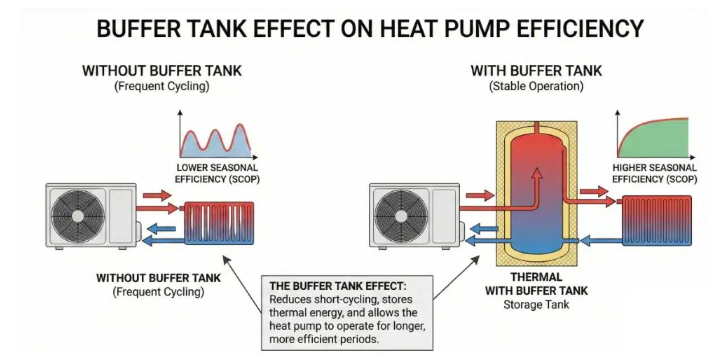
The buffer was suggested by the cooling designer, I am not sure if this is needed at all but what I want to ensure that when we are 4-5 people that we won't have issues with having to wait for hot water:
I have attached PHP calculations done by my designer in case it is useful.
This post was modified 3 months ago by asoksevil
18/07/2026 12:13 pm
Thanks for the further details.
I understand you are prepared to pay money for a quality job, my concern is that you are paying lots of money for a poor design.
Really you need to get some quotes from people who both know what they are doing and aren't intending on ripping you off. The quotes you have seem to indicate that neither apply in this case. Vailant is a perfectly good choice of heat pump, and natively supports above dew point cooking (you need the cooling dongle). The choice of heat pump is not the problem!
I am not convinced it makes sense to try to redesign this on this forum at this stage, because the problem appears to be the contractors so it's unlikely they will change, however, as a starting point,
replace the 4 port buffer with a 2 port volumiser in either flow or return but not both. This will have the same effect on cycling without the downsides. Buffer tanks do not affect hot water so someone is misinforming you.
Eliminate all external controls and zones
Work out if this is light cooling IE above dewpoint or sub-dewpoint cooling in the latter case what is the plan to condensation proof the pipework etc?
Review whether you really need 2 sets of emitters and why. Consider a2a for cooling or even for cooling plus heating given floor area plus standard of insulation.
Sunamp is a fair choice if no space. However tank in loft arguably better if it will fit. Tank could be split into two if a single 300l won't go through loft hatch.
My strong recommendation is get some more quotes. You could ask vaillant for local accreditted installers. Whatever you don't proceed as is and if you are really contemplating sub dewpoint cooling then the pipework will need to be sealed while the flooring is up!
This post was modified 3 months ago 2 times by JamesPa
4kW peak of solar PV since 2011; EV and a 1930s house which has been partially renovated to improve its efficiency. 7kW Vaillant heat pump.

18/07/2026 12:47 pm
I agree with James, this is being made too complicated.
We had a quote from Econic but kept it all very simple, no buffer/volumiser (since we have plenty of rads). Our installer said that, in case we use cooling via only a few rads, potentially the pump will throw a few errors as it may need more volume, so this is something we will monitor when we get to use it. I just plugged the coding resistor today..
Did you consider using the UFH for cooling up to dew point? Potentially you would need a dehumidifier.
You may want to have a look at some posts around here on the sunamp, when it goes wrong.
Another option if you are really interested in cooling may be an a2a pump (allow for one fancoil per room) with a sunamp or a plain old immersion heater for hot water. You may scare the currently installers as they will have to look for their high margin job elsewhere!
8kW Solis S6-EH1P8K-L-PLUS hybrid inverter; G99: 8kW export; 16kWh Seplos Fogstar battery; Ohme Home Pro EV charger; Vaillant Arotherm Pro 7kW; 100Amp head, HA lab on mini PC
Topic starter
18/07/2026 1:23 pm
+1 for everything
Concealed FCUs are expensive to install due to all the drywall work. Also an issue for maintenance.
That said, your quote is indeed damn expensive.
It makes no sense to use FCUs with water above the dew point, so I assume you will be using 5-7°C water. In this case all piping, valves, manifolds, everything between heat pump and FCUs needs to be vapor tight insulated to avoid condensation, which adds to the hassle and cost.
Good luck putting vapor tight insulation on a buffer tank (which you don't need anyway).
You also need a bunch of motorized valves for the various modes:
- send 5-7°C water to the fan coils ONLY
- send 18°C water to the UFH (and maybe fan coils)
- send heated water to UFH and/or fan coils
- send heated water to DHW tank
ie, something like 3 valves to cut off flow to FCUs, UFH, and DHW depending on mode, so water goes where it should.
The fan coil valve will attract condensation and corrode. It should be in an accessible spot, easy to maintain. Not hidden behind drywall.
Zoning FCUs is generally not super useful because they use tiny pipes with high pressure drop, so your heat pump will probably complain about "flow too low" if you turn off half your FCUs. So if the installation includes one zone valve per FCU they probably won't see much use.
For passivhaus, 7kW is indeed probably too much unless the heat pump was sized for cooling, with heating as an accessory.
Please give details on UFH (slab/no slab, surface, pipes, etc) and how areas without UFH will be heated.
Phase change material thermal storage (Thermino) has the advantage of being more compact and offering more constant output temperature. However all the heat must be generated at the phase transition temperature, therefore lower COP.
We like concealed FCU because of the look and since we are already doing so much work, I don't think the cost itself is too incremental as there are economies of scale.
On your points, I genuinely don't have an answer and will need to ask our designer.
the 7kW was indeed specified for the cooling component, not because of heating, the 5kW would have been enough.
For UFH, we are basically having in all areas other than under the kitchen island, covering both ground floor and first floor. I've heard some people say that it is not necessary for 1st floor but I think since I am doing it anyway I don't see why not?
We are using a stone material as it's better as a heat conduit.
Topic starter
18/07/2026 1:28 pm
I agree with James, this is being made too complicated.
We had a quote from Econic but kept it all very simple, no buffer/volumiser (since we have plenty of rads). Our installer said that, in case we use cooling via only a few rads, potentially the pump will throw a few errors as it may need more volume, so this is something we will monitor when we get to use it. I just plugged the coding resistor today..
Did you consider using the UFH for cooling up to dew point? Potentially you would need a dehumidifier.
You may want to have a look at some posts around here on the sunamp, when it goes wrong.
Another option if you are really interested in cooling may be an a2a pump (allow for one fancoil per room) with a sunamp or a plain old immersion heater for hot water. You may scare the currently installers as they will have to look for their high margin job elsewhere!
The quote we have is actually from Econic as well. Will dig more into the Sunamp. I am happy to have a hot water cylinder if it can be fitted in the loft as I think for 300L it won't fit the ground floor...
Below is list of options discussed with our designer:
Chilled floors
When the heat pump is in cooling mode, the chilled water could be piped through the underfloor heating system which would instead act as an underfloor cooling system.
However, this system has limitations. If the floor temperature gets too cold then condensation will form. Also heat rises so cooling the floor creates stratification. i.e. the air is cold at low level but still warm at high level.
A chilled floor system also works best with screeded floors rather than timber floors because screeded floors have more thermal mass to absorb heat from the room as it cools.
A chilled floor system may provide around 15 W/m² of cooling and could be used in combination with a the MVHR comfoclime system so that a total of 33 W/m² is achieved.
It could only be combined with the fan convectors if the water temperature was kept above the dewpoint (circa 12°C) which would reduce the output of the convector does not increase the overall cooling effect.
Comfoclime (MVHR)
It is already proposed to install a Mechanical Ventilation and Heat Recovery unit (MVHR). This will provide around 0.4 air changes per hour (ac/hr) of fresh air.
Zehnder also manufacture a unit called a Comfoclime which is a cooling unit that sits on top of the MVHR unit. This contains a refrigeration cycle and can cool the supply air. If this option were selected, I recommend
installing additional ductwork to each room so that the flow rate can be doubled in cooling mode.
The MVHR proposal by Heat Space and Light has a standard flow rate for the whole house of 33 l/s and a boost rate of 43l/s. If we doubled this to 86l/s and cooled the air down to 18°C using the comfoclime the cooling effect to a room at 23°C would be 1.7kW across the whole house. This is circa 18 W/m² This is much less than the 6.4kW required for the house as calculated earlier in this report.
The other challenge is that the unit is 1.95m tall with the Comfoclime. The following drawing shows that this doesn’t fit in the attic so an alternative location would be required.
Air conditioning
The most common choice of cooling is air conditioning. This consists of a fan coil unit (FCU) in the room and a condenser unit outside.
The FCU works the same way as the heat pump convector but contains a refrigerant that changes between gas and liquid rather than water. Because extra energy is absorbed as the refrigerant changes phase, the
FCU is smaller than the equivalent water based units. For example, the ground floor unit would by 200 x 620 x 1150mm whereas the Jaga unit is 220 x 545 x 1900mm.
The drawback of this proposal is that a location of the condenser unit will need to be agreed. Next to the heat pump or on the flat roof.
18/07/2026 1:36 pm
Above dew point cooling is mostly useless. For actual air conditioning you need both cooling and dehumidification which can only be achieved with below dew point flow temperature and FCUs.
The schematic on the right is incorrect: a second circulator is needed to push water from the tank into the radiator.
Heat capacity of water is 4.18 kJ/kg/°C, so a 50l buffer stores about 1MJ of energy if its temperature rises by 5°C. That's 0.3kWh. Assuming the Vaillant's minimum power is 2kW that's a run time of 8 minutes. It will have no effect on cycling.
What a buffer does is mix hot and cold water, which drops the temperature between the heat pump and your UFH. The result is if the slab needs say 30°C, the heat pump may have to output 5-10°C more depending on flow on both sides. In other words it's an excellent way to destroy your COP.
If your UFH is a thick slab, you already have way more than enough thermal storage there to avoid cycling. So please give info about how the UFH will be built.
18/07/2026 2:04 pm
All (or most) of the above points are entitely valid, but above all what this project needs is a coherent design by someone who actually knows what they are doing. If the actual work is split that's fine, but the design shouldn't be. One person needs to take responsibility for heating, cooling and control design.
@asoksevil I think that first and foremost you need to decide whether you are going to seek someone competent to do this, or try to do it yourself by arbitrating between the people you have and the various bits of advice you will get here. In the latter case you are effectively taking responsibility for the design because the installers will inevitably say that they advised something else, but you declined to follow them. There is absolutely nothing wrong with that approach, it's your house and you have the vested interest, you just need to be comfortable with what you are doing.
This post was modified 3 months ago 2 times by JamesPa
4kW peak of solar PV since 2011; EV and a 1930s house which has been partially renovated to improve its efficiency. 7kW Vaillant heat pump.

18/07/2026 3:14 pm
@jamespa When I contracted a company to install my solar energy system and battery, I was allocated a ‘surveyor’ to ascertain the best arrangement of panels, their positioning, the wiring runs, position of battery and means of connection to my CU and the earthing system etc. By the time it came to the installation, the surveyor had passed on the project to a ‘project manager’. It turned out the PM was a trainee, wet behind the ears and possibly straight from university. The PM’s experience was zero, her competence was through the floor and the various contractors would roll their eyes upon the mention of her name. The result was an installation that took three times longer than estimated with much equipment delivered having to be returned as unsuited to the task, roofers sitting around for three days in high temperatures doing very little waiting for supplies and work having to be re-done later. @asoksevil , if you have several or more contractors involved, please make sure you have a competent Project Manager in overall charge! Regards, Toodles.
Toodles, heats his home with cold draughts and cooks food with magnets.
1

Page 1 / 2
Next

SPONSORS

Degrees of Separation
Latest Posts
-

RE: Electrical works for air to air heat pump
@mrkfm I think that it is reasonable to expect them to ...
By ASHP-BOBBA , 13 minutes ago
-
RE: Are there any comparisons of DHW heat stores around?
If you have a good ToU tarrif and an existing immersion...
By JamesPa , 2 hours ago
-
RE: The Changing Jet Stream Could Challenge UK Air Source Heat Pumps
@hml1827 1962 / 3 winter is remembered by me as my last...
By Toodles , 2 hours ago
-
RE: 15kw pump for 225m2 1990's house - over kill?
@seaviews I have read you latest response re buffer ...
By JamesPa , 19 hours ago
-
RE: How will removing the standing charge on gas bills benefit heat pumps?
The BUS grant funding for 2026/27 will run out at the c...
By Rob of York , 1 day ago
-
-
@editor Ouch, sorry to re start the tick. I had assume...
By DavidB , 3 days ago
-
RE: Say hello and introduce yourself
@e-a-west as the good Major said, welcome to the forums...
By Mars , 3 days ago
-
RE: How much of your renewable and home setup would still work if the internet went down?
Yes I actually have a copy of a tool that whenever a ce...
By EtchedPixels , 3 days ago
-
RE: Indevolt Batteries UK Support & Info Thread
@editor Hi, To resolve this, please tap on the A...
By Indevolt Tech , 4 days ago
-
RE: Double or Triple Glazed Windows?
Posted by: @singlespeed With 9 years repairing windo...
By Rob of York , 4 days ago
-
@transparent we’re still running a secure version of PH...
By Mars , 4 days ago
-
RE: How quickly would you want/expect heat recovery to take from setback?
Much longer than that here. The heating isn't even on. ...
By bobflux , 5 days ago
-
RE: Passiv Smart Thermostat - Help & Forum Support
Obviously the weather is changeable but there's a defin...
By Singlespeed , 5 days ago





SPONSORS

