

Notifications
Clear all
Joining the Renewable Heating Hub forums is completely free and only takes a minute. By registering you’ll be able to ask questions, join discussions, follow topics you’re interested in, bookmark useful threads and receive notifications when someone replies. Non-registered members also do not have access to our AI features. When choosing your username, please note that it cannot be changed later, so we recommend avoiding brand or product names. Before registering, please take a moment to read the Forum Rules & Terms of Use so we can keep the community helpful, respectful and informative for everyone. Thanks for joining!

Topic starter
19/03/2026 9:40 am
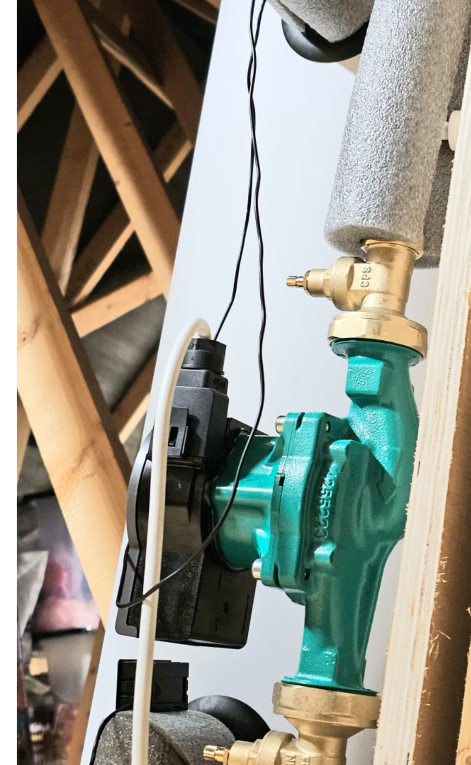
The arrow is pointing down on the pump itself so at least that seems correct

19/03/2026 10:32 am
If the return was at the top the flow setter would read 0? I'm guessing they only work one way. As u said I think a pipe trace needs doing and I'll do it Friday when I have time.
I don't know if flow setters are unidirectional but can imagine a design that is not unidirectional so would not make assumptions. Do the pipe trace to be sure!
I think he said my house is fairly large (19 rads) and very long pipe runs in the loft. It's a L shape. It made sense at the time. I guess I didn't want to think I knew best.
Noted but given it was previously working fine, the guy was wrong and clutching at straws rather than doing a proper diagnosis of a fault that developed over time.
I have 17 radiators with neither a buffer or volumiser.
I don't mind a buffer if it works and get a good temperature difference. I don't want mixing causing wasted energy. I don't have a volumiser so sort of helps with volume. Can a buffer be repiped as a volumiser?
Buffers can work but rarely are set up so they do work, for the simple reason that they are mostly fitted by people who don't know what they are doing precisely because they don't know what they are doing.
Buffers can be replumbed as volumisers, it's pretty straightforward unless the plumber doesn't know what he is doing! You use want 2 ports only both on the flow side of the system, in at the bottom out at the top, positioned after the diverter valve so it doesn't engage in dhw mode. Secondary pump needs to go of course.
4kW peak of solar PV since 2011; EV and a 1930s house which has been partially renovated to improve its efficiency. 7kW Vaillant heat pump.
1
Topic starter
19/03/2026 11:55 am
Buffers can be replumbed as volumisers, it's pretty straightforward unless the plumber doesn't know what he is doing! You use want 2 ports only both on the flow side of the system, in at the bottom out at the top, positioned after the diverter valve so it doesn't engage in dhw mode. Secondary pump needs to go of course.
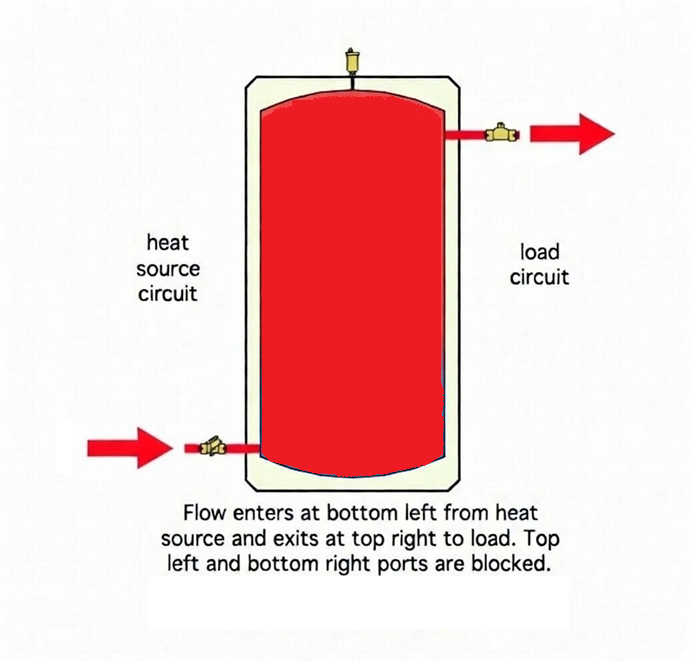
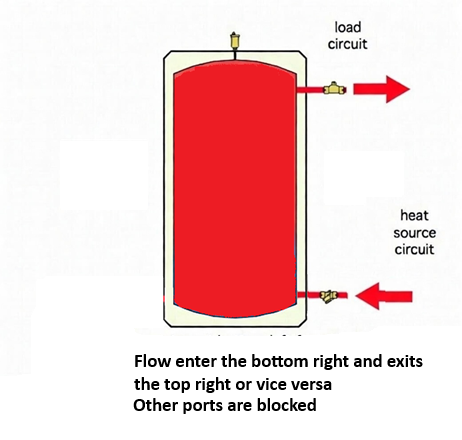
So do you mean like this? Excuse the terrible paint mock up
1
or
2
This post was modified 7 months ago 4 times by HeyMikey

19/03/2026 1:00 pm
Yeah that's the idea, it's dead simple.
Personally I'd put it on return instead of flow, as the lower temperature minimizes heat loss from the tank into the surrounding area. It also makes the heat pump more reactive (direct from heat pump to radiators). And you'll probably need to set the internal circulator settings in the heat pump to let it run for a bit longer after the compressor turns off, so the heat stored into the tank ends up in the radiators instead of slowly leaking into the area. Whether you put it on flow or return it has to be only for the heating circuit, not DHW, because you don't want to waste energy heating the tank to DHW temperature. So whichever way you choose you need to check the DHW three way valve plumbing.
Buffers can work but rarely are set up so they do work, for the simple reason that they are mostly fitted by people who don't know what they are doing precisely because they don't know what they are doing.
🤣 so true

Topic starter
19/03/2026 2:13 pm
Yeah that's the idea, it's dead simple.
Personally I'd put it on return instead of flow, as the lower temperature minimizes heat loss from the tank into the surrounding area. It also makes the heat pump more reactive (direct from heat pump to radiators). And you'll probably need to set the internal circulator settings in the heat pump to let it run for a bit longer after the compressor turns off, so the heat stored into the tank ends up in the radiators instead of slowly leaking into the area. Whether you put it on flow or return it has to be only for the heating circuit, not DHW, because you don't want to waste energy heating the tank to DHW temperature. So whichever way you choose you need to check the DHW three way valve plumbing.
Thank you Bob. Do you think Option 1 or 2 is best from the pictures? I'm thinking Option one just for ease of flow direction plus easier for how mine is plumbed as i wouldn't have to do much extra pipe work. I like your logic on the return which makes perfect sense but I think to make this job easier I'll have to have it on the flow. The buffer is only set up for the heating circuit only as far as I'm aware. I'm going to check it in a minute when the HW comes on. Yep HW is on and the buffer is not being used at all so the diverter is working.
19/03/2026 5:27 pm
I think recent versions of the Yonos Pico can display both pressure drop and flow rate in m3/h, if yours does that, you can check the flow will be sufficient before plumbing the tank as volumiser...
Topic starter
19/03/2026 7:06 pm
I think recent versions of the Yonos Pico can display both pressure drop and flow rate in m3/h, if yours does that, you can check the flow will be sufficient before plumbing the tank as volumiser.
I don't know pretty sure it displays m3h but not sure on the rest. I can only imagine it would be powerful enough as it's a 13kw unit and normally has a volumiser
Topic starter
20/03/2026 8:53 am
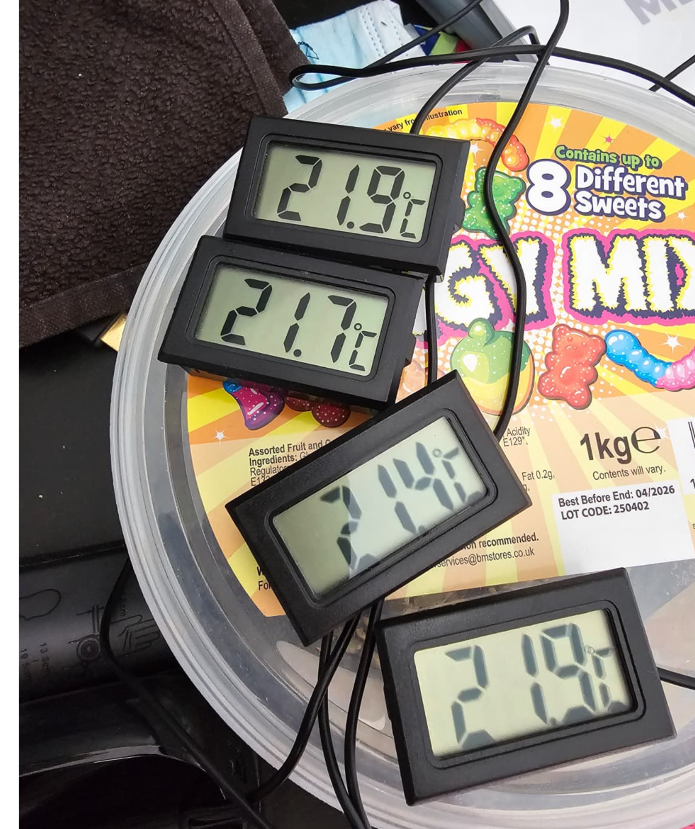
So these are fairly equal to each other. a bit of sway with the 21.4
I'm open to any advice which would be the best way to have it plumbed in as a volumiser. they are coming next week to balance and I kind of just want to say just convert it
20/03/2026 10:45 am
I'm open to any advice which would be the best way to have it plumbed in as a volumiser. they are coming next week to balance and I kind of just want to say just convert it
Given its a large tank either 1 or 2 should work, 1 marginally better perhaps.
The flow vs return thing was debated here at length a year ago. The argument that @bobflux makes for putting it in the return is valid, but there are arguments the other way. The balance of the debate came out in favour of flow, but it was finely balanced, thus I wouldn't sweat about this one.
Before anyone comes trace the pipework so you can personally verify they are doing it correctly. The evidence you have so far produced suggests more or less total incompetence, so you need to treat them as a pair of hands not as someone who knows what they are doing!
4kW peak of solar PV since 2011; EV and a 1930s house which has been partially renovated to improve its efficiency. 7kW Vaillant heat pump.
1
Topic starter
20/03/2026 12:14 pm
Given its a large tank either 1 or 2 should work, 1 marginally better perhaps.
The flow vs return thing was debated here at length a year ago. The argument that @bobflux makes for putting it in the return is valid, but there are arguments the other way. The balance of the debate came out in favour of flow, but it was finely balanced, thus I wouldn't sweat about this one.
Before anyone comes trace the pipework so you can personally verify they are doing it correctly. The evidence you have so far produced suggests more or less total incompetence, so you need to treat them as a pair of hands not as someone who knows what they are doing!
Thanks James,
Yes I saw that post and read it last night and tried to make sense of it 🤣 Is there any other way the buffer could be plumbed in to be even better than 1 or 2? i'm leaning towards 1 as its easier to do and the pipework is already on each side.
The trace is happening Sunday and I'm going to loft the loft boards up and see how it all flows and do a rough schematic if I can.
Thanks for explaining all this for me @jamespa as I'm just a DIY enthusiast who wants the best set up possible.
I'm guessing the heatpumps circulation pumps are fairly strong and wouldn't have an issue with a 25litre tank
This post was modified 7 months ago by HeyMikey
20/03/2026 1:18 pm
The tank used as volumizer behaves like a portion of extra large diameter pipe, it has negligible flow resistance and pressure drop, no worries about that.
You can actually use the Wilo circulator to check for flow and pressure drop in your installation : if you open all TRVs, the pressure drop and flow rate reported by the Wilo gives you one point on the flow vs pressure drop curve of your installation, which is enough to answer the question.
If you know the length and diameter of the pipes to the heat pump, then it's possible to calculate what flow you'll get once you plumb the tank as a volumizer and remove the Wilo. That requires knowing the heat pump circulator's curve, and the internal heat exchanger pressure drop, unfortunately they are not in the manual...
1
Topic starter
20/03/2026 1:25 pm
You can actually use the Wilo circulator to check for flow and pressure drop in your installation : if you open all TRVs, the pressure drop and flow rate reported by the Wilo gives you one point on the flow vs pressure drop curve of your installation, which is enough to answer the question.
Thanks Bob. I'm willing to give this a go. So I open all the TRV's, what about the Lock shields? What is the exact process on how to really figure this out? Like a simple dummy guide?
1

SPONSORS
Degrees of Separation

Latest Posts
-

RE: Heat pump branding. Clever, contemporary… or a bit too much?
I think Heat Geek have done an amazing job on their bra...
By Tomtheheatingengineer , 4 hours ago
-
RE: HeatGeek vs Octopus surveys: puzzling disparity - any ideas why?
I have just had 3 heat loss surveys, one by heat geek o...
By David , 5 hours ago
-
RE: Heat Geek Zero Disrupt: Are We Sleepwalking Into Another Race to the Bottom?
I think that's the key question. After all inverter uni...
By Prunus , 6 hours ago
-
RE: battery storage without solar
As of October 1st they need specific qualifications to ...
By EtchedPixels , 7 hours ago
-
RE: How should the Boiler Upgrade Scheme be reformed?
A unit which uses water to transfer the heat/chill from...
By Temperature_Gradient , 7 hours ago
-
RE: Renewables & Heat Pumps in the News
With regards to the BUS grant raid, I gave it more thou...
By ASHP-BOBBA , 8 hours ago
-
RE: Why are ASHP installs so expensive?
The whole system seems to work on the basis of...
By ian33a , 8 hours ago
-
RE: Missing flow temperature in Heat Geek proposal
Good plan. If you can get half hourly meter readings a...
By JamesPa , 13 hours ago
-
RE: Heat Pumps Without Grants: Would You Have Installed One & Will You Now?
@editor Most certainly. The heat pump was an ideal s...
By Abernyte , 13 hours ago
-
Although regulations may well vary from country to coun...
By Majordennisbloodnok , 14 hours ago
-
RE: Does anyone have experience of a smart water meter?
Yep I caught our slow leak from a £100 bill rise 8)
By EtchedPixels , 14 hours ago
-
RE: Do You Need a Buffer Tank or Low Loss Header for Underfloor Heating in a Large Property?
@jamespa in some cases, failing the Turing test might b...
By GrahamF , 17 hours ago
-
RE: Passiv Smart Thermostat - Help & Forum Support
@energystoragetech The heat capacity of some...
By JamesPa , 19 hours ago
-
RE: tepeo ZEB UK Support & Info Thread
Sorry you are correct, I was remembering figures from t...
By JamesPa , 1 day ago




SPONSORS