

Notifications
Clear all
Joining the Renewable Heating Hub forums is completely free and only takes a minute. By registering you’ll be able to ask questions, join discussions, follow topics you’re interested in, bookmark useful threads and receive notifications when someone replies. Non-registered members also do not have access to our AI features. When choosing your username, please note that it cannot be changed later, so we recommend avoiding brand or product names. Before registering, please take a moment to read the Forum Rules & Terms of Use so we can keep the community helpful, respectful and informative for everyone. Thanks for joining!

Topic starter
18/03/2026 12:42 pm
Hello all,
I had a HUG2 Scheme heat pump installed about a year and a half ago. There were loads of issues with this I won't go too much into but needless to say it was sub-contracted out and I got a rush job albeit it worked on awful settings. Then over the year the flow I had of 30+lmin slowly fell to about 24lmin where it seemed to stay which worked. Then it started to fall and vibrate when it got below 20l'min. It eventually fell to nothing and normally under 10 l/min on the rare occasion which pointed to a block. The return strainer was missing so I thought maybe that might have been the cause or it got caught in the pipework. Grant came out and did a heat exchanger test and the flow was 46l/min so seemed to be fine.
The responsible company came out and did a full survey and suggested the below:
Option 1: The property is around 170.49 m2 as per the technical survey which suggest ideally this property should have been on x2 heating zones to ensure flow rates & even destitution of heat throughout the property. However, the property currently has x1 heating zone & all pipework is installed inside the walls in which the customer doesn't want the disruption to change.
Option 2: Disconnect the heat pump & carry out a power flush on the system + replace flow setter & leave the system as it currently is.
Option 3: 2-days work for a team of 2 operatives.
Day 1: Disconnect the heat pump & carryout a power flush on the system only.
Day 2:
Install 25L buffer in loft space with an additional circulation pump to help with flow rates when in heating mode.
replace flow setter on primary return pipework.
Install new additional flow setter on heating return pipework (before buffer).
Replace all AAV's in loft for manual ones & Install additional air vents in loft space.
Test & commission (change parameter 2104 back to -4)
I didn't want option 1 as that would mean ripping walls apart as the pipes were already set and decorated over. I let the engineer decide on what he would do if it was his house and he said Option 2. I did question the 25 litre buffer install as I know they get a lot of hate and I've seen videos from various people (Mars, Adam) saying they are not needed. Who am I to argue as I'm not a heating engineer and I know only by what I've read and watched.
Anyways they did the flush and installed all the above without finding the original issue and of course there was very little flow. They even tested a new Grant unit. That didn't work. They took out the primaries and replaced with new 28mm copper and that seemed to fix the flow, nothing was found to be the cause. Possible loft insulation in the pipe.
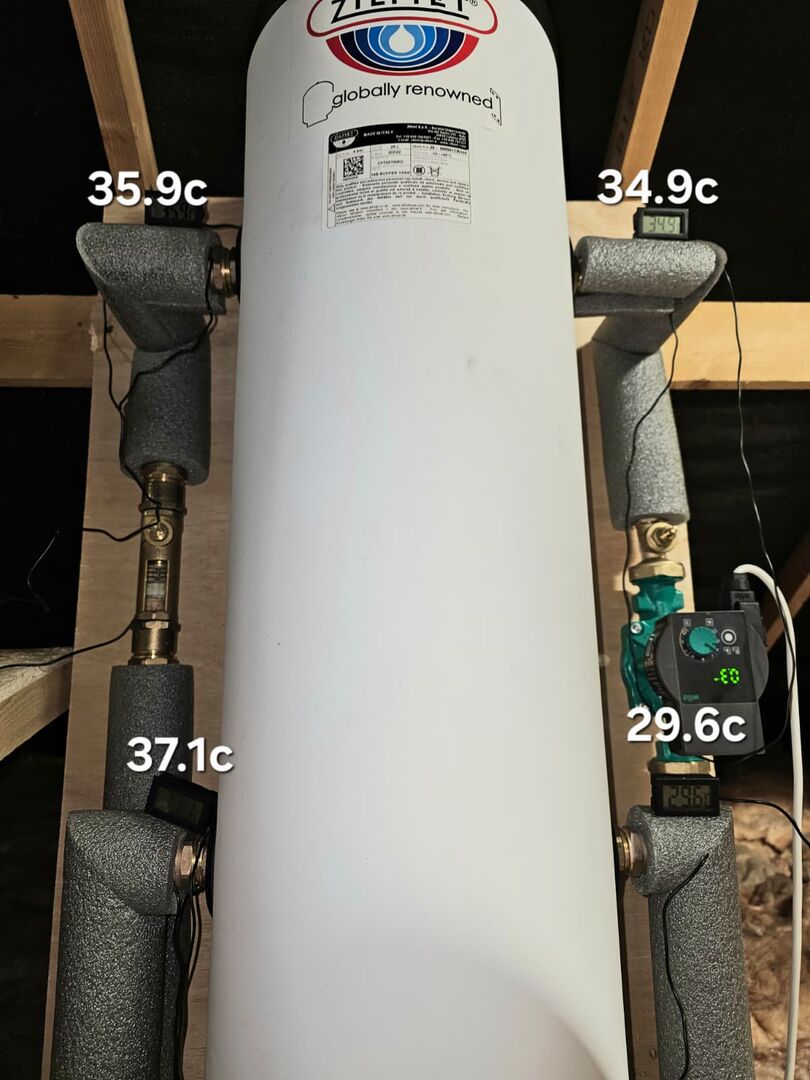
I checked the basic white Grant readings and the flow and return were very close, about 2c difference (32/34) which suggested to me the Buffer was mixing. I thought I'd do a temp check on all 4 pipes and I got some very strange readings and I can't wrap my head round. The extra pump is a wilo yonos pico 25/1-8-180. No matter what the speed is for this pump it does not change any of the flow setter speeds in the slightest. The top left flow setter is about 28 l/min and the one in the airing cupboard which is the return is about 33 l/min
I have raised this with the installer but just wanted opinions. I thought originally the left side was back to front but surely the flow setter would read 0?
Any help is greatly appreciated.
Full system details can be found here: https://renewableheatinghub.co.uk/forums/postid/56607/
This topic was modified 7 months ago by HeyMikey

18/03/2026 2:03 pm
I have raised this with the installer but just wanted opinions. I thought originally the left side was back to front but surely the flow setter would read zero
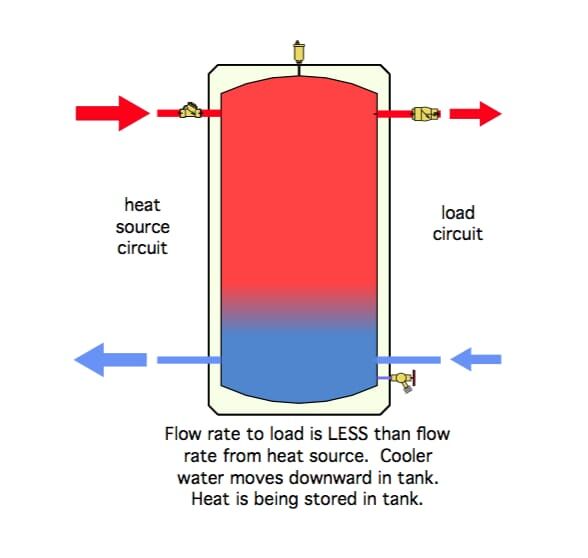
If those temperatures are correct the buffer is plumbed wrongly, with the input from the heat pump at the bottom and the output to the rads at the top. Flow from heat pump and flow to radiators should be at top, returns at bottom, like the diagram. This is a rookie error if the figures are correct. I can't see why this would cause the flow setter to read zero because flow will still occur, it will just be more turbulent within the buffer tank.
The bigger question is why install a buffer at all. It WAS working satisfactorily but something changed. So the fix is to work out what changed and change it back, not add a pointless additional component which can only degrade performance.
Are all your trvs fully open? Could anyone have changed the lsvs? Has the mag filter been cleaned, has the water pump in the heat pump been checked, is there a filter that isn't obvious. These are some of the questions that need to be asked and should have been asked and answered.
The stuff about 2 zones was Bow Locks btw so you were right to resist.
This post was modified 7 months ago 5 times by JamesPa
4kW peak of solar PV since 2011; EV and a 1930s house which has been partially renovated to improve its efficiency. 7kW Vaillant heat pump.
1

18/03/2026 2:03 pm
I assume the Wilo pump in the photo is on the load side, not the heat pump side.
In this case changing the settings on the Wilo will not influence the flow through the heat pump, that's normal, it's the buffer tank doing its job of hydraulic separation. Which you probably don't need as James said, since it worked fine without the tank before something clogged that pipe.
> I thought originally the left side was back to front but surely the flow setter would read 0?
Good catch!
I see the circulator is upside down. It's the beginning of a trend! Have you double checked if the flow setter is upside down too? There's probably an arrow on the side to indicate direction of flow. Since it's on the top pipe, flow through this device should go towards the tank.
If the tank connections on the left are on the heat pump side, and the bottom is hotter than the top... they're probably inverted.
Hot (flow from heat pump) is supposed to be on top, as shown on the schematic you posted...
Regarding the circulator, as long as it is flowing in the right direction then it's okay, but it is possible to remove the motor (4 screws), and flip it around, so the display and controls are in the user-friendly orientation and the cable doesn't bend like it currently does. Takes about 5 minutes, but apparently someone was in a hurry. With that level of workmanship, I'd recommend double checking absolutely everything else.
Since you have temperature probes, good idea to also check if the flow and return are not inverted on the heat pump side, who knows, if they took out the circulator inside to check it maybe they put it back in the wrong way!
Topic starter
18/03/2026 2:57 pm
@jamespa
Thanks James, I agree with you on most of this. it's just that I'm not a plumber or heating engineer so my knowledge is literally based on what I've read or watched. It's hard to argue something that's not your field and I was trying to step back a bit and let experts do their job. Maybe a mistake but again when you don't have someone in your corner it's hard to fight it. Thing is that this is all remedial work which costs me nothing. But maybe it will in the future on efficiency. I will compare it this winter and if I have to I'll ask them to put it back or just pay someone I feel who is better qualified.
If it is plumbed wrongly and the bottom left is from the Heat Pump, top right is to the heating circuit and the bottom right is back from the heating circuit, that only leaves the top left being the return to the heat pump. If that is the case wouldn't the flow setter read 0? The arrow is pointing up which makes me think that it does flow in from the top left. This whole set up has confused me. I know its hard to say without being here and seeing the pipework but something seems wrong.
TRV's are fully open, nothing in the mag filters, lockshield valves were all messed with as closest rads were getting all the flow and the furthest getting nothing. I've been adjusting them to balance them using temp probs as above.
They are coming back out Next Friday so any advice on how to proceed would be great. Temped to do a pipe trace before hand to fully understand how it all flows.

Topic starter
18/03/2026 3:03 pm
@bobflux
yes the wilo pump is on the heating circuit side.
The flow setter is not upside down as the arrow is pointing up. towards the tank. plus I get a 28l/min.
I don't mind the wilo pump display being upside down. if anything I prefer it so I know nobody has messed it up 😀
Good shout on the heat pump flows not being inverterted. I'd be surprised since Grant did come out and check everything. Nothing is impossible I guess.
I do not have a low loss header or volumizer so i'm guessing in the future if I was to get this sorted I could get plumbed in a way so this can become a make shift one? is that a good idea?
18/03/2026 3:09 pm
If it is plumbed wrongly and the bottom left is from the Heat Pump, top right is to the heating circuit and the bottom right is back from the heating circuit, that only leaves the top left being the return to the heat pump. If that is the case wouldn't the flow setter read 0? The arrow is pointing up which makes me think that it does flow in from the top left. This whole set up has confused me. I know its hard to say without being here and seeing the pipework but something seems wrong.
@bobflux may have solved this with his observation that the secondary pump is the wrong way round. Alternatively it depends what the 'flow setter' actually is. I suggest to trace the pipes back to the heat pump but for sure the one with the highest temperature is the feed from the heat pump because that's the only source of energy.
TRV's are fully open, nothing in the mag filters, lockshield valves were all messed with as closest rads were getting all the flow and the furthest getting nothing. I've been adjusting them to balance them using temp probs as above.
All understood but the fact remains that, based on what you say, something changed to reduce flow and that MUST be fixed, adding additional components is not the solution. The corollary is that what changed needs to be found.
. Temped to do a pipe trace before hand to fully understand how it all flows.
Definitely do this. While you are at it measure temperatures and post the results.
4kW peak of solar PV since 2011; EV and a 1930s house which has been partially renovated to improve its efficiency. 7kW Vaillant heat pump.
Topic starter
18/03/2026 3:33 pm
@bobflux may have solved this with his observation that the secondary pump is the wrong way round. Alternatively it depends what the 'flow setter' actually is. I suggest to trace the pipes back to the heat pump but for sure the one with the highest temperature is the feed from the heat pump because that's the only source of energy.
I don't think this solves it as being upside down would mean the pump is pulling the other way and it would be the coldest flow as it would have been thru the rads and cooled down?
All understood but the fact remains that, based on what you say, something changed to reduce flow and that MUST be fixed, adding additional components is not the solution. The corollary is that what changed needs to be found.
This part was fixed as they piped new primaries to the airing cupboard. Flow was restored.
This post was modified 7 months ago by HeyMikey
18/03/2026 6:01 pm
I don't think this solves it as being upside down would mean the pump is pulling the other way and it would be the coldest flow as it would have been thru the rads and cooled down?
It looks from your temperatures as if flow to rads is from top, return from rads at bottom. Flow from heat pump at bottom, return to heat pump at top. This would be correct for a phe but is a rookie mistake for a buffer.
That said temperature measurements on pipes can be wrong and we don't know at what point in the cycles you captured this. I would definitely trace the pipework for absolute certainty.
This part was fixed as they piped new primaries to the airing cupboard. Flow was restored.
So why did they add an unnecessary buffer, probably incorrectly plumbed? And if new primaries fixed it what was wrong with the old ones that somehow had changed from when it was first installed? Doesn't make sense.
TRV's are fully open, nothing in the mag filters, lockshield valves were all messed with as closest rads were getting all the flow and the furthest getting nothing. I've been adjusting them to balance them using temp probs as above.
Well something caused the flow to reduce from 40l/min to nothing, this didnt happen by magic, Have you maybe turned lsvs down too much, at least one should be fully open, often several. If you have balanced for a specific deltat then you could possibly have done this , depending on the demand at the time.
it's just that I'm not a plumber or heating engineer
Neither am I. But I do have a background in physics and engineering and can think logically. Sadly quite a few heating 'engineers' can't do the latter!
It's hard to argue something that's not your field
True, and what the BS merchants rely on. I take the view that, if a tradesman can't or wont explain their reasoning, it's because they don't understand it, not because I would be unable to understand it if someone were to explain it!
This post was modified 7 months ago 5 times by JamesPa
4kW peak of solar PV since 2011; EV and a 1930s house which has been partially renovated to improve its efficiency. 7kW Vaillant heat pump.
Topic starter
18/03/2026 7:20 pm
It looks from your temperatures as if flow to rads is from top, return from rads at bottom. Flow from heat pump at bottom, return to heat pump at top. This would be correct for a phe but is a rookie mistake for a buffer.
That said temperature measurements on pipes can be wrong and we don't know at what point in the cycles you captured this. I would definitely trace the pipework for absolute certainty.
If the return was at the top the flow setter would read 0? I'm guessing they only work one way. As u said I think a pipe trace needs doing and I'll do it Friday when I have time.
So why did they add an unnecessary buffer, probably incorrectly plumbed? And if new primaries fixed it what was wrong with the old ones that somehow had changed from when it was first installed? Doesn't make sense.
I think he said my house is fairly large (19 rads) and very long pipe runs in the loft. It's a L shape. It made sense at the time. I guess I didn't want to think I knew best.
Well something caused the flow to reduce from 40l/min to nothing, this didnt happen by magic, Have you maybe turned lsvs down too much, at least one should be fully open, often several. If you have balanced for a specific deltat then you could possibly have done this , depending on the demand at the time.
Deffo something did and I think it was either fibre glass or the Inta strainer came out and got lodged, or a push fitting possibly. I did balance the radiators down but I didn't go nuts. Most say a delta T of 5 to 8 but mine was closer to 2-4. And had many with the lockshield fully open at the further ends. Definately didn't choke it as the return flow rate was good. 24ish.
I don't mind a buffer if it works and get a good temperature difference. I don't want mixing causing wasted energy. I don't have a volumiser so sort of helps with volume. Can a buffer be repiped as a volumiser?
Thanks for all your input, I appreciate it.
18/03/2026 8:59 pm
I had issues with similar temperature probes, the error can reach a few degrees, which matter in your case since the temps are pretty close.
Best accuracy is with the probes taped to a copper pipe (brass fittings have too much thermal mass and take too long to settle), then the whole thing wrapped with an insulating sleeve, taped shut. Without the sleeve the measurement depends on the ratio of heat transfer from the pipe to the probe versus heat loss from the probe to ambient. Also check the probes display the same temp when mounted on the same pipe!
If the heat pump is defrosting by going into reverse gear, then flow temperature will be lower than return, then return to normal once it resumes heating...
The circulator control panel can be rotated relative to the body, so to know which way it flows, you have to look at the body not the panel. Here's mine:
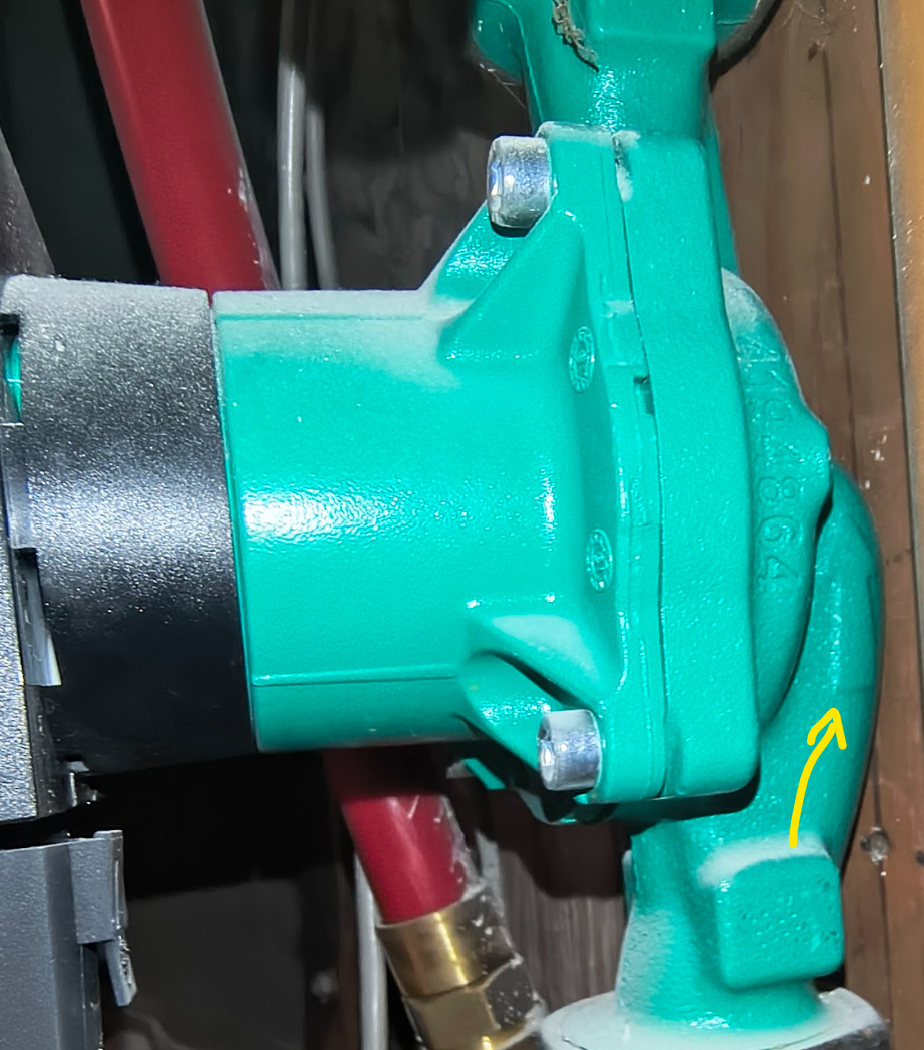
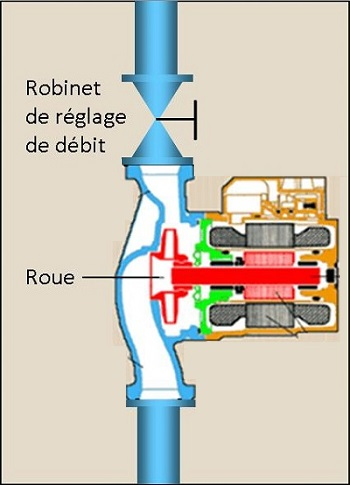
The arrow is on both sides. Anyway it's a centrifugal pump, so the suction is whatever side connects to the center of the impeller through the bulge in the back.
> Can a buffer be repiped as a volumiser?
Yes
Topic starter
18/03/2026 10:13 pm
I had issues with similar temperature probes, the error can reach a few degrees, which matter in your case since the temps are pretty close.
Best accuracy is with the probes taped to a copper pipe (brass fittings have too much thermal mass and take too long to settle), then the whole thing wrapped with an insulating sleeve, taped shut. Without the sleeve the measurement depends on the ratio of heat transfer from the pipe to the probe versus heat loss from the probe to ambient. Also check the probes display the same temp when mounted on the same pipe!
Yes all those probes in the photo are tucked and wrapped around the copper pipes and insulated with no air to interfere with the readings. I will put all 4 on the same pipe to see how much they differ on Friday. I'll put on a fixed temperature and watch them and see what they do.
The arrow is on both sides. Anyway it's a centrifugal pump, so the suction is whatever side connects to the center of the impeller through the bulge in the back.
That's really helpful, I'll look soon to see what the direction is.
Thank u for your thoughts and help also.

Page 1 / 3
Next

SPONSORS

Degrees of Separation

Latest Posts
-

RE: Heat pump branding. Clever, contemporary… or a bit too much?
I think Heat Geek have done an amazing job on their bra...
By Tomtheheatingengineer , 3 hours ago
-
RE: HeatGeek vs Octopus surveys: puzzling disparity - any ideas why?
I have just had 3 heat loss surveys, one by heat geek o...
By David , 4 hours ago
-
RE: Heat Geek Zero Disrupt: Are We Sleepwalking Into Another Race to the Bottom?
I think that's the key question. After all inverter uni...
By Prunus , 5 hours ago
-
RE: battery storage without solar
As of October 1st they need specific qualifications to ...
By EtchedPixels , 6 hours ago
-
RE: How should the Boiler Upgrade Scheme be reformed?
A unit which uses water to transfer the heat/chill from...
By Temperature_Gradient , 6 hours ago
-
RE: Renewables & Heat Pumps in the News
With regards to the BUS grant raid, I gave it more thou...
By ASHP-BOBBA , 7 hours ago
-
RE: Why are ASHP installs so expensive?
The whole system seems to work on the basis of...
By ian33a , 7 hours ago
-
RE: Missing flow temperature in Heat Geek proposal
Good plan. If you can get half hourly meter readings a...
By JamesPa , 12 hours ago
-
RE: Heat Pumps Without Grants: Would You Have Installed One & Will You Now?
@editor Most certainly. The heat pump was an ideal s...
By Abernyte , 12 hours ago
-
Although regulations may well vary from country to coun...
By Majordennisbloodnok , 13 hours ago
-
RE: Does anyone have experience of a smart water meter?
Yep I caught our slow leak from a £100 bill rise 8)
By EtchedPixels , 13 hours ago
-
RE: Do You Need a Buffer Tank or Low Loss Header for Underfloor Heating in a Large Property?
@jamespa in some cases, failing the Turing test might b...
By GrahamF , 16 hours ago
-
RE: Passiv Smart Thermostat - Help & Forum Support
@energystoragetech The heat capacity of some...
By JamesPa , 18 hours ago
-
RE: tepeo ZEB UK Support & Info Thread
Sorry you are correct, I was remembering figures from t...
By JamesPa , 1 day ago




SPONSORS
