

Notifications
Clear all
Joining the Renewable Heating Hub forums is completely free and only takes a minute. By registering you’ll be able to ask questions, join discussions, follow topics you’re interested in, bookmark useful threads and receive notifications when someone replies. Non-registered members also do not have access to our AI features. When choosing your username, please note that it cannot be changed later, so we recommend avoiding brand or product names. Before registering, please take a moment to read the Forum Rules & Terms of Use so we can keep the community helpful, respectful and informative for everyone. Thanks for joining!

19/01/2026 12:08 am
ah such a shame when that happens. I don't want to hijack the post but basically the pump outside is vibrating through the pipes when the pump is on. Identical to Cally. It didn't always do it but has in the last week and the kids has dropped 4lmin. No air in the system and balanced well after me going round temperature checking each rad. The fan is quiet and when I put my hand on the flow and return at the pump u can feel it. The house is warm and so is the tank. It's just noisy and vibrating thru the house, not super loud but I can tell. I've raised it with installer and I have a service in a few weeks so I'm hoping all is OK.
I will report back.
Thanks so much for reaching out
1


19/01/2026 12:33 am
@heymikey, you’re not hijacking the post. I’ll email Cally (maybe notifications are off). There’s clearly interest in this subject as it’s had over 7,000 views. Let me see what I can do to help you (and others).
🔥 Britain’s Heat Pump Shitshow
How Installing a Heating System Became a National Nervous Breakdown
Free UK shipping.
📗 Heat Pumps Explained
A Jargon-Free Guide for Homeowners
Rewritten and updated for 2027
📘 From Zero to Heat Pump Hero
🛠️ Bodge Buster
New to heat pumps?
Take the Heat Pump Fundamentals course and use INTRO50 at checkout for 50% off.
1

19/01/2026 11:32 am
Hello @heymikey,
I'm not Cally and I haven't read the whole of this thread, but I did have noise problems with my Grant before I rewired it. So just chipping in a couple of pennies just in case I can turn up any clues.
Can you describe the setup you have? When was it installed? Is it an R32 or the newer R290 heat pump? How do the pipes run - do you have a buffer tank or low loss header? Do you have the Grant control boxes (eg one with a 1 inch display and tiny rubber buttons that's a timer for the immersion) or the Grant smart controller? Does it use an external boiler controller (like Nest/Hive/etc) or do you program it via the heat pump's own display on the wall?
When you say 'it didn't always do it' can you describe the timeline of what happened - eg when the system was installed, how long it ran before hearing the noise, if the noise was intermittent when it started (and any clues as to when it *didn't* happen), has it got longer/louder as time went on?
My first line of thinking is that you could have air in the circuit between the heat pump and the buffer (if you have one), which is effectively a separate loop compared with the loop with the radiators (even though they are hydraulically connected, air goes up and if you have two 'ups' then air could collect in either one. But we'd need to know a bit more about your system first. Do you have automatic air release valves (they stick up above the pipes, supposed to be fitted at the highest points)?
Mostly some vague stabs in the dark - more info would be useful to understand your system.
1
19/01/2026 12:06 pm
@prunus
Thank you very much. I'll do my best to give all the details.
So I have the 13kw Grant Aerona3 R32. No buffer or volumiser at all. I know the manual says to have one but I have 19 Radiators and fairly long pipe runs so I "think" that's possibly why I don't have one. So I don't have any air in that as I don't have one. I've been very into learning the heat pump and I've driven out any air as I was getting locks when it was first installed. I went round and did each radiator at time and you could literally hear the air being pushed out. Since I did that I've had no air locks all issues. It was a poorly balanced system. The pipes that leave the Pump are 28mm Copper and they run up the side of my house into the loft. This is where it changes to PVC and goes to the Flow Cyl 250l hot water tank FCHPD3250. Then to the radiators it is all run on 22mm PVC throughout until it goes to the radiator on 15mm copper from the loft.
Installed September 2024, I have the basic Grant Aerona3 with the white display (rebranded chofu). Definitely not the smart controller and I have it set up on Weather compensation. This is all controlled by the Drayton Wiser Wireless Heating & Hot Water 2-Channel Thermostat.
Weather Compensation details:
Design outdoor temperature: −3 °C
Flow temp at −3 °C: 41 °C
Flow temp at +20 °C: 27 °C
Max outdoor temp: 20 °C
This was much higher when installed and kept reducing it until it didn't feel as warm as it should.
It's hard to say but since install I guess it has been dropping slow. The flow rate was around 22l'min when installed on a medium pump speed. Then it has slowly dropped over that year to where it hit 18l/min a few weeks ago and that's when I noticed the noise as I was in the loft, I was checking the Automatic Air Vents, I have 4 in the loft and one in the airing cupboard on the hot water tank. This morning the flow has dropped to about 14lmin so something has affected it.
I checked the Inta valve strainer yesterday and the filter is missing. I have raised it with the installer and they said they are coming out in a couple of weeks and will install the strainer and will power flush the system and check the other filter.
I think I covered everything 🙂
This post was modified 9 months ago by HeyMikey

19/01/2026 12:51 pm
@heymikey OK, so that rules out a number of things. I would lean towards thinking you do actually have a flow restriction of some kind. If it's not air then 'something' is reducing the flow. Do you have any additional pump or are you using the outdoor unit pump only?
If you look in the New Zealand Chofu manual page 15 there's section 3.4 'Pressures and quantity available at heat pump outlet'. There's a DIP switch on the outdoor unit you can set to adjust the pump speed. On the AEYC-1242U (12kW in NZ, 13kW in UK) there 3 levels of flow based on the required head, with below 15L/min being the danger zone. So sounds like something is wrong with your flow. You could look at what these are set at and see if a higher setting improves the flow rate.
But I suspect somebody needs to check if there's a blockage somewhere. When you say 'PVC pipe' do you actually mean PVC (garden hose type) or PEX or Polybutylene? Both PEX and PB are rated for heating while PVC collapses when hot. If it's in HDPE (blue water supply pipe) then that's only rated to about 38C.
1
19/01/2026 1:01 pm
@prunusk
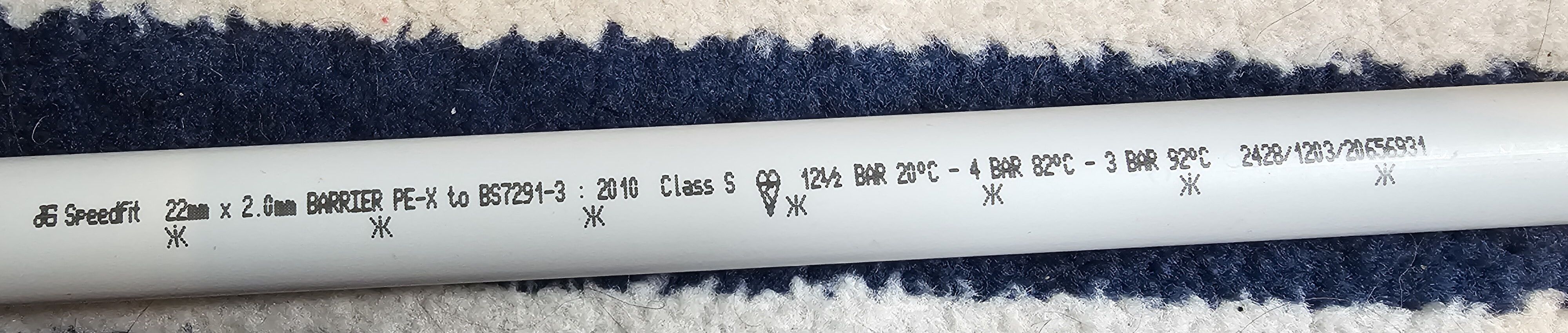
I guess I was being generic with PV The pipe is the below.
JG Speedfit WC22BPEX PEX Pipe.
12/02/2026 11:06 pm
So an update but not much success. System was power flushed which seemed to get rid of the vibrating, but my flow rate still is awful. It slowly degraded down to almost nothing. Loads of air in the system and even Grant came out to check the unit as they suspected it was the heat exchanger but the manifold test came back at 46lmin.
So something is restricting but no answer as to why yet. Couple of guys are coming in the next few weeks to do a trace, flush and some other bits.
This post was modified 8 months ago by HeyMikey
1
12/02/2026 11:14 pm
@heymikey thanks for the update and sorry to hear that the issue persists. Hopefully they can identify the problem area. What a nightmare.
🔥 Britain’s Heat Pump Shitshow
How Installing a Heating System Became a National Nervous Breakdown
Free UK shipping.
📗 Heat Pumps Explained
A Jargon-Free Guide for Homeowners
Rewritten and updated for 2027
📘 From Zero to Heat Pump Hero
🛠️ Bodge Buster
New to heat pumps?
Take the Heat Pump Fundamentals course and use INTRO50 at checkout for 50% off.
1

05/03/2026 10:31 pm
Hi Mars,
I hope you are well. I wasn't sure if I should post a question or PM so I did both.
I jumped on a threat recently when someone had the same issue as me, https://renewableheatinghub.co.uk/forums/postid/58614/
The company is coming back on the 4th and 5th march this week to hopefully sort the issues once and for all. They admitted that there has been issues and things that were not done on the original install. 1st thing was that as our house is larger than 150m2 it should have been split into 2 heating zones. Currently on 1 heating zone for upstairs and downstairs. Now they offered to fix that but as all the previous work was in the walls I chose not to go down that route.
But here are the original 3 options they gave me
"Option 1: The property is around 170.49 m2 as per the technical survey which suggest ideally this property should have been on x2 heating zones to ensure flow rates & even destitution of heat throughout the property. However, the property currently has x1 heating zone & all pipework is installed inside the walls in which the customer doesn't want the disruption to change.
Option 2: Disconnect the heat pump & carry out a power flush on the system + replace flow setter & leave the system as it currently is.
Option 3: 2-days work for a team of 2 operatives.
Day 1: Disconnect the heat pump & carryout a power flush on the system only.
Day 2:
Install 25L buffer in loft space with an additional circulation pump to help with flow rates when in heating mode.
replace flow setter on primary return pipework.
Install new additional flow setter on heating return pipework (before buffer).
Replace all AAV's in loft for manual ones & Install additional air vents in loft space.
Test & commission (change parameter 2104 back to -4)
(Electrician also required this day to complete the wiring of the new heating pump)"
I've went with the option 2 as stated about about the walls. I went with Option 2 as that's what he said what he would do. Now I know buffers have a bad name and I did wince at the idea. I then did a youtube search on them and I came across your video https://www.youtube.com/watch?v=bZEii9tSyyU and I'm having doubts on telling them "where to stick it" 😀
Now I know you don't know the full details of my house but I guess wanted your thoughts on the above? https://renewableheatinghub.co.uk/forums/postid/56607/ has a lot of detail of the system if that makes sense.
Is it possible to fit a bypass on a buffer system so it's something I could avoid should I feel its sucking away efficiency? I really struggled to find information on when to use a buffer.
Thank you for reading the above if you got this far I appreciate it.
This post was modified 7 months ago by HeyMikey
1
05/03/2026 11:58 pm
Hmm. When they say the pipes are in the walls, is this all the 22mm of PEX you showed upthread? Do you know where they all go? Roughly how long is the pipe run?
The fact that your flow has been gradually dropping suggests something changed about your pipes. Why did it work to begin with? How long did it take to drop to where you are now?
When they did your system, what didn't they change? Is there anything left that was iron or steel that might be corroding and generating sediment? Or perhaps it 'worked' when it was full of air and now that's gone the pump is struggling?
I can see the logic of their options 1 and 3 - they both give you more flow. I'm assuming splitting it into zones, effectively two parallel circuits, is not going to invoke thermostats so that they are controlled separately? Just that putting in a fork where it goes from 28 to 22mm effectively doubles the area cross sectional area of the pipework seen by the HP and so halves(ish) the resistance to allow more flow. I think I would probably look at that before going for a buffer. The potential downside is that it 'short circuits' the problem - you may find one side doesn't get as much heat as the other if that side is constricted.
If they are controlling zone valves separately, it's possible to add a second slave room controller that allows independent temperature control of the second zone - the Pump2 output would control your zone 2 valve. That could be useful if there's a sensible zone spilt, eg upstairs and downstairs.
(I'm assuming you are using the room controller as your thermostat as the HP designers intended. If you're using an external controller / smart thermostat then that's another place things could go wrong)
This post was modified 7 months ago by Prunus
06/03/2026 9:42 am
@prunus I thought the pipes in the walls were15mm which come off the 22 pex in the loft. But having just checked it looks like they are 22's and then spur off to 15s to the radiator so the flow would be better than I thought. I found out that the INTA strainer valve was installed upside down and it was missing when i checked several weeks ago. I tested the theory with a spare one by holding the strainer upside down as it was installed and opened the valve and the strainer fell out of the casing. This leads me to believe that it is in the pipework stuck on a bend or around the antifreeze valve. As i have a grant they use a 3rd party thermostat on my basic system. It was working for a year and I don't think that is the issue.
This has been going on for a month and I'm confident my issues are to do with the strainer coming out as i found the clip but no strainer so i think someone put it back in without it and its got stuck

06/03/2026 1:38 pm
Here's a LibreOffice spreadsheet.
I put the formula for pipe pressure drop in a macro, so you'll have to enable macros in the options when it loads. Just fill in the blanks :
- Enter Flow and DeltaT, it gives Power
- Enter Pipe Internal Diameter, it gives pressure drop in mmH2O per m of pipe.
Water in a pipe cares about the internal diameter of the pipe. So if it's 22mm OD copper with wall thickness of 1mm, ID=20mm. if it's "22x2 PEX" with wall thickness of 2mm, then ID=18mm, equivalent to 20mm copper pipe. I assume the Heat Geeks table uses copper.
For elbows and other singular points, the most accurate is to pull the pressure drop from the manufacturer documentation, or you can approximate by counting an elbow as an extra length of pipe like 1-1.5m if it's a reduced bore PEX elbow, or 0.5m for wide radius copper elbow.
For stuff like filters, check Kv in the datasheet.
Then check your heat pump datasheet for something like "Available pump head" which gives how much pressure the internal circulator can push after pressure drop from the heat pump internal components has been accounted for. Say it gives "Available pump head 5m" then you have a 5000 mmH20 pressure budget to allocate between the various pressure drops in the circuit. To save on electricity, it's preferable to not run the circulator at 100% all the time, so aiming for 50-60% of max available pump head works nicely.
Pressure drop is proportional to:
- Flow squared: 2x the flow, 4x the drop, that's why your primary pipes are critical, but the tiny pipes going to your radiators carrying only a small fraction of the flow are much less of a problem. With 10 radiators each getting 1/10th of the flow, the pressure drop problem is divided by 100 in these pipes.
- Internal diameter to the power of about 4-5!
That's because with "d" as pipe internal diameter, pipe internal cross section is in d^2, speed of water is flow/cross_section so 1/d^2, and pressure drop is in v^2 thus 1/d^4 ; then there's the turbulent flow that makes it worse ; in other words 2x smaller pipe internal diameter gets 16-30x worse pressure drop. Ouch. That's why if the pipes are too small there's really nothing you can do besides upgrading the pipes.
1

Page 3 / 3
Prev
SPONSORS
Degrees of Separation

Latest Posts
-

RE: Heat pump branding. Clever, contemporary… or a bit too much?
I think Heat Geek have done an amazing job on their bra...
By Tomtheheatingengineer , 4 hours ago
-
RE: HeatGeek vs Octopus surveys: puzzling disparity - any ideas why?
I have just had 3 heat loss surveys, one by heat geek o...
By David , 4 hours ago
-
RE: Heat Geek Zero Disrupt: Are We Sleepwalking Into Another Race to the Bottom?
I think that's the key question. After all inverter uni...
By Prunus , 6 hours ago
-
RE: battery storage without solar
As of October 1st they need specific qualifications to ...
By EtchedPixels , 7 hours ago
-
RE: How should the Boiler Upgrade Scheme be reformed?
A unit which uses water to transfer the heat/chill from...
By Temperature_Gradient , 7 hours ago
-
RE: Renewables & Heat Pumps in the News
With regards to the BUS grant raid, I gave it more thou...
By ASHP-BOBBA , 7 hours ago
-
RE: Why are ASHP installs so expensive?
The whole system seems to work on the basis of...
By ian33a , 8 hours ago
-
RE: Missing flow temperature in Heat Geek proposal
Good plan. If you can get half hourly meter readings a...
By JamesPa , 13 hours ago
-
RE: Heat Pumps Without Grants: Would You Have Installed One & Will You Now?
@editor Most certainly. The heat pump was an ideal s...
By Abernyte , 13 hours ago
-
Although regulations may well vary from country to coun...
By Majordennisbloodnok , 14 hours ago
-
RE: Does anyone have experience of a smart water meter?
Yep I caught our slow leak from a £100 bill rise 8)
By EtchedPixels , 14 hours ago
-
RE: Do You Need a Buffer Tank or Low Loss Header for Underfloor Heating in a Large Property?
@jamespa in some cases, failing the Turing test might b...
By GrahamF , 17 hours ago
-
RE: Passiv Smart Thermostat - Help & Forum Support
@energystoragetech The heat capacity of some...
By JamesPa , 19 hours ago
-
RE: tepeo ZEB UK Support & Info Thread
Sorry you are correct, I was remembering figures from t...
By JamesPa , 1 day ago




SPONSORS