

Notifications
Clear all
Joining the Renewable Heating Hub forums is completely free and only takes a minute. By registering you’ll be able to ask questions, join discussions, follow topics you’re interested in, bookmark useful threads and receive notifications when someone replies. Non-registered members also do not have access to our AI features. When choosing your username, please note that it cannot be changed later, so we recommend avoiding brand or product names. Before registering, please take a moment to read the Forum Rules & Terms of Use so we can keep the community helpful, respectful and informative for everyone. Thanks for joining!
Air Source Heat Pumps (ASHPs)
65
Posts
5
Users
5
Reactions
2,510
Views

Topic starter
05/09/2026 10:47 am
Thank you both for continuing the conversation.
I thought it was @JamesPA who suggested the 2300 (or thereabouts) figure but I didn't wish to blame him if it wasn't him. I have to admit that I couldn't get my head around where that number came from and, having badgered him with so many questions at the time I didn't want to bother him yet another time.
Now that I know where the number comes from (thank you @CathodeRay) it clears things somewhat but, with energy use being very seasonally dependent, a lot more is used in winter than in summer and that got me to recall a discussion that I had with @cathodeRay about the difficulty of measuring oil usage on a daily basis in a cylindrical tank when there isn't a volumetric flow meter available.
I have played around with monthly data - which is the best granularity that I have, and it suggests a HL figure of about 11.1 - but I appreciate that this is still very crude and doesn't take into account varying OAT (although the average for that month was about 6 degrees C).
I'll certainly need to take the cross correlation data of oil consumption against heat loss with a big bag of salt !
Escaped to the country : central Devon - 280 sqm converted mill - 4KW Solar - 15 KWh Battery - UFH - Vaillant Arotherm V2 Plus 12KW (soon!)

05/09/2026 10:57 am
When you say 'scientifically derived', does this mean from first principles
Yes from first principles.
The temperature profile in any given location is well known and fairly consistent (averaged over a season) from year to year. Thus the number of degree days is fairly consistent from year to year. Since energy lost is proportional to iat-oat x a factor dependent on house loss it's thus possible to calculate the loss from the energy delivered to the house, making an assumption about the iat. If the iat isn't reasonably constant one can make an adjustment if one has some idea what the IAT profile is. This latter factor is part of the reason for setting the sense check lower bound at 2000.
There is a further adjustment to be made for boiler efficiency. For most cases this means that the calculation is an upper estimate, for most by 10% unless you have a really old boiler. The exception to this is if you have a really well set up condensing boiler which could just be as much as 110% 'efficient' (that's for gas). These are all known things which can therefore be corrected for to within say 10%.
Taken together this is good enough, intelligently applied, for a sense check which is what I advocate the use of annual consumption for.
Better still of course is to plot demand Vs average daily oat (or degree days, it doesn't matter). This is IMHO good enough to size the heat pump unless there are large iat variations or a really old boiler of uncertain efficiency. This plot is not generally possible for oil because the meter is ready infrequently. It is possible for gas if you have a smart meter and is how I sized my heat pump.
This post was modified 1 month ago 3 times by JamesPa
4kW peak of solar PV since 2011; EV and a 1930s house which has been partially renovated to improve its efficiency. 7kW Vaillant heat pump.
05/09/2026 10:58 am
I'll certainly need to take the cross correlation data of oil consumption against heat loss with a big bag of salt !
That is indeed the take away message in my view. It would be very useful if we could find a way to use oil consumption to derive heat loss, but I think we are stumped because (a) oil use is the least metered fuel used and (b) the old bugbear of all heat loss calculations, variables can and do change all the time. That said, if you do keep the IAT constant, and can meter OAT and energy use at hourly or thereabouts intervals, then you can get a very good empirical estimate. Adequately monitored heat pumps are ideal for this, but not much use if you are trying to do a heat loss estimate to decide what it is before getting a heat pump! If the above conditions are met, gas consumption can also be used to derive an estimated heat loss, but that again is no use if you don't have gas.
Midea 14kW (for now...) ASHP heating both building and DHW
05/09/2026 11:26 am
Not a lot of whatiffery
But there is a whiff of whatiffery:
(a) what if 'the number of degree days is fairly consistent from year to year'. But what if it is not? This can be checked by looking at the data. I got the Farnborough data from degreedays.net for the last 36 months (max available for free) and summed the degree days for the last three 1st Sep to 31 Aug intervals and got 1709.4 1883.4 and 1706.4 degree days. The first and last are almost too close, but the middle one is different, perhaps significantly so. Getting more data might indicate how significant the variation is.
(b) what if 'a factor dependent on house loss' is X? Or Y?
(c) what if 'an assumption about the iat' is that it is constant? What if it varies? I appreciate you have covered this bit of whatiffery.
I agree it makes sense to look for possible upper and lower bounds but I suspect they will in practice be too far apart to be of much practical use.
What I am getting at here is that heat loss estimates derived by these methods are in reality not specific number eg 11.3 kW, but rather a sanity check based on a range so wide eg 10 to 20 kW as to be not very useful. The problem is that when people see a particular number, eg 11.3 kW, they tend to think it means something, but in this case it really doesn't. Perhaps only the range should be quoted.
Edit: I see you have added more to the post while I was posting the above, making things clearer, but I still think my caveat that the results of these checks are wide ranges and not specific numbers needs emphatic emphasis (and the results quoted as a range not a specific number).
This post was modified 1 month ago by cathodeRay
Midea 14kW (for now...) ASHP heating both building and DHW

05/09/2026 11:53 am
But there is a whiff of whatiffery:
Its not perfect but the world isnt perfect . If one were to set up a controlled experiment with comprehensive logging that would be better than any other method, but few if any will do this. I would suggest that its less whatiffery than guessing the house construction and then plugging the guess into an opaque tool, certainly for older houses that have been retrofitted at various times and where the house construction is not evident.
However even if its the same level of whatiffery its better to have tow independent means and to compare them, than to rely on one alone
(a) what if 'the number of degree days is fairly consistent from year to year'. But what if it is not? This can be checked by looking at the data. I got the Farnborough data from degreedays.net for the last 36 months (max available for free) and summed the degree days for the last three 1st Sep to 31 Aug intervals and got 1709.4 1883.4 and 1706.4 degree days. The first and last are almost too close, but the middle one is different, perhaps significantly so. Getting more data might indicate how significant the variation is.
Yes but the difference is still only 10% which is about as good as you are ever going to do. However of course getting more data would bound things better, but once again its about whats practical not whats ideal.
Just before I got my heat pump we had a cold year followed by a warm year, the difference was 10%. Thats good enough for me, this is not an exact science!
(b) what if 'a factor dependent on house loss' is X? Or Y?
The 'factor' is the 'heat transfer coefficient' (HTC, unit W/K ) which is what you are trying to calculate to determine the loss!
(c) what if 'an assumption about the iat' is that it is constant? What if it varies? I appreciate you have covered this bit of whatiffery.
Since the calculation is linear throughout the significant range you can substitute average IAT for IAT. Hence the talk of a correction factor for IAT variations.
I agree it makes sense to look for possible upper and lower bounds but I suspect they will in practice be too far apart to be of much practical use.
Not at all for the purposes of a sense check.
Consider a house with a consumption of 20MWh/year. Divide by 3000h and you get to 6.6kW, divide by 2000 and you get to 10kW. That rules out the jokers claiming the loss is 14-16kW, the purpose of a sense check. If you divide by 2900 you get to 6.9kW which is very likely the answer. These figures, and the jokers, aren't invented, they are the ones for my house.
I reiterate that I am not claiming that the 2000/3000 calculation is any more than a sense check on what is otherwise a calculation (the survey) that has little or no anchor in actual measurement. To me thats pretty valuable on its own.
I would claim that the plot of consumption vs OAT, intelligently applied and excluding cases where the IAT varies wildly and is not logged, is better than any survey and a good way to determine loss if you have the data.
This post was modified 1 month ago 9 times by JamesPa
4kW peak of solar PV since 2011; EV and a 1930s house which has been partially renovated to improve its efficiency. 7kW Vaillant heat pump.
05/09/2026 12:01 pm
Consider a house with a consumption of 20MWh/year. Divide by 3000h and you get to 6.6kW, divide by 2000 and you get to 10kW. That rules out the jokers claiming the loss is 14-16kW, the purpose of a sense check. If you divide by 2900 you get to 6.9kW which is very likely the answer. These figures aren't invented, they are the ones for my house.
But that is using a range (6.6 to 10 kW) to rule out the 14-16 kW jokers! I've said I agree the method can be and often is useful as a sense/sanity check. The problem is that at the time you do the range estimate, you don't know where in the range the actual value lies.
Midea 14kW (for now...) ASHP heating both building and DHW
05/09/2026 12:05 pm
But that is using a range (6.6 to 10 kW) to rule out the 14-16 kW jokers! I've said I agree the method can be and often is useful as a sense/sanity check. The problem is that at the time you do the range estimate, you don't know where in the range the actual value lies.
Our posts crossed and I have added some more explanation/clarification
In answer to your comment - no you dont know where in the range it lies, and I don't claim otherwise.
To determine where in the range you need one of
- more granular data so you can plot consumption vs OAT
- to trust 2900 or whatever figure is applicable to your location, and do/estimate some corrections then make an engineering judgement given the granularity of capacity available
- to trust a survey.
I wouldn't personally do (3) without the sanity check, except in a new or unmodified house! I might do (2) if there were no realistic alternative, but would probably apply a 10-20% margin. I would (and did) do (1) by preference.
Remember also that heat pumps come in discrete capacities. So the engineering choice is 5, 7 or 12kW if you restrict yourself eg to Vaillant, 8 or 16 if you restrict yourself to Daikin, and similar for Mitsubishi (these are all sticker capacities, obviously the choice must be made on actual but the same principle applies). Heat loss calculations only need to be good enough to clarify the design decision between models. How good that is depends on where your heat loss lies. If its less than 5kW (and excepting a passivhaus) it barely matters one jot what the loss is, you are getting a 5-6kW pump anyway. Since the Ofgem standard (medium) house has an annual gas consumption of 11.5MWh, its a fair bet that a large proportion of houses fall into this last category and thus the heat loss survey is more to size emitters than the heat pump, which could probably be done with only slightly worse results by simply scaling from existing ones!
In summary what Im saying is:
- Use the divide by 2000, divide by 3000 as a sense check on a survey
- If you have granular consumption data then this can be used to size the heat pump and arguably, dependent on the house etc, is better than a survey.
- If you dont have more granular data then, again depending on the house, its worth considering giving 'divide by 2900' the same or even more weight as a survey
- Bear in mind always that what matters is NOT the exact figure, but the design decisions it drives and it is this that determines the accuracy required.
This post was modified 1 month ago 12 times by JamesPa
4kW peak of solar PV since 2011; EV and a 1930s house which has been partially renovated to improve its efficiency. 7kW Vaillant heat pump.
05/09/2026 12:31 pm
@jamespa — I can't argue with any of that. I also take the important point that what you need to know in practical terms for heat pump sizing is not what your exact heat loss is, but what band your heat loss falls into. There is a similar principle in navigation, sometimes you do not need to know where you are, but rather where you are not. The problem is most humans are more used to thinking about where they are, rather than where they are not!
Midea 14kW (for now...) ASHP heating both building and DHW
1

Topic starter
05/09/2026 12:33 pm
And really, that's how I always considered the use of the heat loss based upon oil usage, just as a sanity check.
I also did my own heat loss survey and, finally, managed to get three installers to do their own heat loss surveys too.
I had hoped that the three installers would all be close to one another, or close enough to be acceptable on bounds of variability. What I found was that the two installers who I felt least comfortable about came in close to one another and the one who I felt happiest with came closer to my HeatPunk and my oil estimation checks - so this left me head scratching - and the reason for the thread.
It also goes to show that heat loss survey results can differ worryingly, and this is especially a problem when some push the suggest heat pump capacity in to a higher power bracket than others.
"Will we end up cold?"... "Will we end up with higher running costs than expected?" and so on...
This post was modified 1 month ago by ian33a
Escaped to the country : central Devon - 280 sqm converted mill - 4KW Solar - 15 KWh Battery - UFH - Vaillant Arotherm V2 Plus 12KW (soon!)
05/09/2026 1:03 pm
It also goes to show that heat loss survey results can differ worryingly, and this is especially a problem when some push the suggest heat pump capacity in to a higher power bracket than others.
Absolutely, due to a combination of genuine unknowns (eg air change rate, effect of thermal bridging and even uncertainty in U values of certain materials) and poor surveying (eg ignoring upgrades that cannot be verified, or just ignoring them anyway).
From 2-3 years on this forum I get the impression that some heat pumps have a flatter 'efficiency vs output' curve than others, so are more tolerant of oversizing, provided of course you dont grossly oversize. The sense check more or less guarantees you wont unless you are unlucky enough to sit just on a capacity boundary. Thats where other methods come into active play.
4kW peak of solar PV since 2011; EV and a 1930s house which has been partially renovated to improve its efficiency. 7kW Vaillant heat pump.

05/09/2026 6:04 pm
I recently did a heat loss calculator spreadsheet based on gas usage over a cold period in winter e.g. January. I'm sure you could easily adapt it to oil usage, assuming that you have a reasonably accurate measure of oil use during that period. The main additional values that you need are average indoor and outdoor temperatures for the month.
It takes into account a few other things including the heating effects of electricity usage, people burning calories, and solar gain.
You can find the spreadsheet in this thread:
It worked out surprisingly close to the calculated value that I got from a carefully constructed model of the house's heat loss, including thermal conduction (U-values), thermal bridging, and ventilation.
It would be interesting to see what it gives in your case.
Topic starter
05/09/2026 6:28 pm
@rob-of-york Interesting that you mentioned this as an idea!
I had actually done just this, and for January too, but decided to not mention the fact earlier -
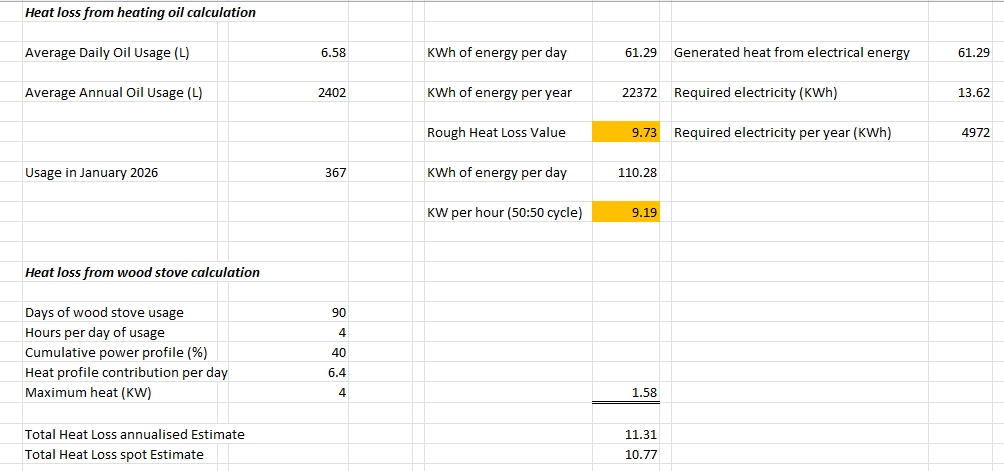
We have a thermal store and I worked on the assumption in January that the boiler was running 50% of the time. As you have found with gas, the numbers for pure oil usage did come out very close to the annualised figure: 11.31 annualised and 10.77 as a snapshot monthly figure. In fairness, that January that I used wasn't especially cold, but we haven't experienced that much cold weather where I live for several years now.
Plugging numbers in for other months, especially in spring and autumn, show that the instantaneous heat loss does drop, as would be expected with higher OAT.
With the 50:50 estimate, it is just that, a different duty cycle would yield different results. Trouble is, I don't really know how much of the time the boiler was really running. The stated spec of the boiler in what the burner consumes would suggest a 20:80 duty cycle (20% on) and that throws the heat loss way up and it felt like the boiler really does remain on for much of the time in the colder months.
Escaped to the country : central Devon - 280 sqm converted mill - 4KW Solar - 15 KWh Battery - UFH - Vaillant Arotherm V2 Plus 12KW (soon!)

SPONSORS

Degrees of Separation

Latest Posts
-

RE: Heat pump branding. Clever, contemporary… or a bit too much?
I think Heat Geek have done an amazing job on their bra...
By Tomtheheatingengineer , 6 hours ago
-
RE: HeatGeek vs Octopus surveys: puzzling disparity - any ideas why?
I have just had 3 heat loss surveys, one by heat geek o...
By David , 6 hours ago
-
RE: Heat Geek Zero Disrupt: Are We Sleepwalking Into Another Race to the Bottom?
I think that's the key question. After all inverter uni...
By Prunus , 8 hours ago
-
RE: battery storage without solar
As of October 1st they need specific qualifications to ...
By EtchedPixels , 9 hours ago
-
RE: How should the Boiler Upgrade Scheme be reformed?
A unit which uses water to transfer the heat/chill from...
By Temperature_Gradient , 9 hours ago
-
RE: Renewables & Heat Pumps in the News
With regards to the BUS grant raid, I gave it more thou...
By ASHP-BOBBA , 9 hours ago
-
RE: Why are ASHP installs so expensive?
The whole system seems to work on the basis of...
By ian33a , 10 hours ago
-
RE: Missing flow temperature in Heat Geek proposal
Good plan. If you can get half hourly meter readings a...
By JamesPa , 15 hours ago
-
RE: Heat Pumps Without Grants: Would You Have Installed One & Will You Now?
@editor Most certainly. The heat pump was an ideal s...
By Abernyte , 15 hours ago
-
Although regulations may well vary from country to coun...
By Majordennisbloodnok , 16 hours ago
-
RE: Does anyone have experience of a smart water meter?
Yep I caught our slow leak from a £100 bill rise 8)
By EtchedPixels , 16 hours ago
-
RE: Do You Need a Buffer Tank or Low Loss Header for Underfloor Heating in a Large Property?
@jamespa in some cases, failing the Turing test might b...
By GrahamF , 19 hours ago
-
RE: Passiv Smart Thermostat - Help & Forum Support
@energystoragetech The heat capacity of some...
By JamesPa , 21 hours ago
-
RE: tepeo ZEB UK Support & Info Thread
Sorry you are correct, I was remembering figures from t...
By JamesPa , 1 day ago




SPONSORS