

Notifications
Clear all
Joining the Renewable Heating Hub forums is completely free and only takes a minute. By registering you’ll be able to ask questions, join discussions, follow topics you’re interested in, bookmark useful threads and receive notifications when someone replies. Non-registered members also do not have access to our AI features. When choosing your username, please note that it cannot be changed later, so we recommend avoiding brand or product names. Before registering, please take a moment to read the Forum Rules & Terms of Use so we can keep the community helpful, respectful and informative for everyone. Thanks for joining!

Topic starter
15/01/2026 10:35 am
I am going around in circles. My property has foundation air bricks sited below the damp proof layer to ventilate the void under the property's suspended concrete floor.
I have spoken to the UK Technical Team for a well known German HP manufacturer and they are adamant that the air bricks need to sit outside of the R290 protection zone.
An Octopus Energy representative has posted on another forum 'Air bricks are not a concern.' This is reflected in the following guide:
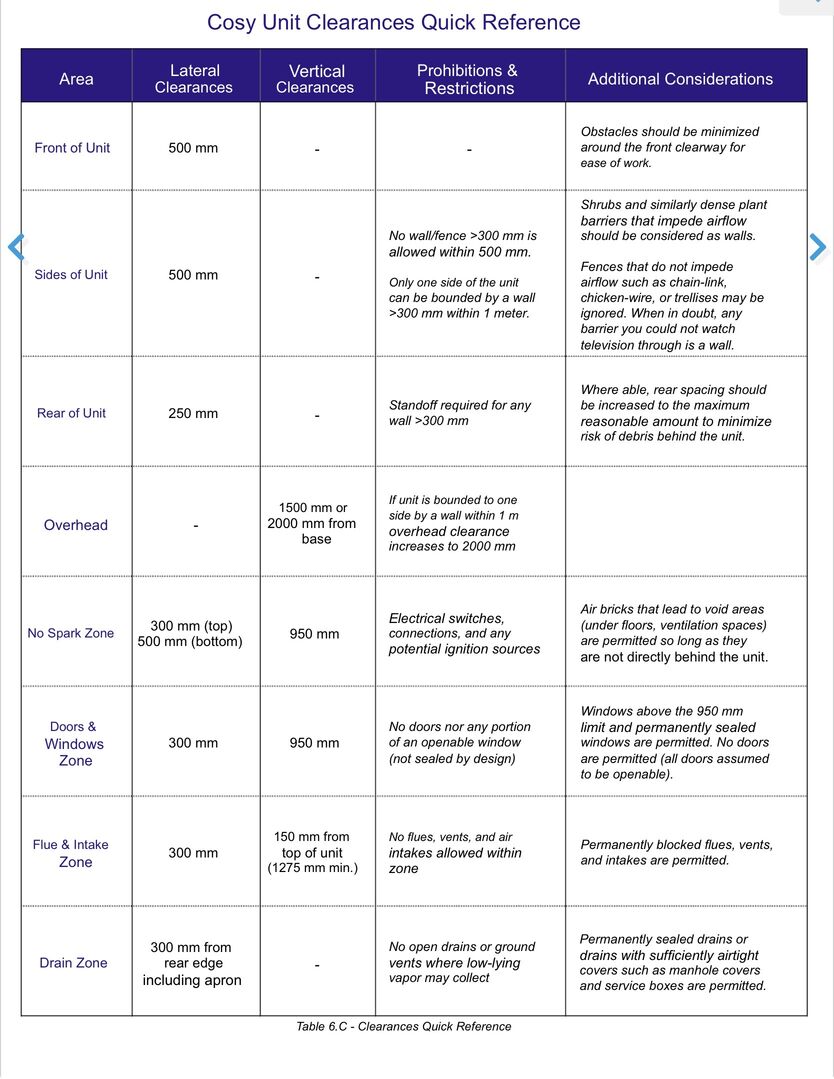
Clearly, both HP manufacturers cannot be right. Searching for Regulations on this is something of a Fools Errand. The Heat Pump association states the following:
'Where defined within the manufacturer safety-related protection area, there must be
no:-
- permanent or temporary sources of ignition during normal operation, such as,
but not limited to, open flames, electrical systems, sockets, lamps, and light
switches, electrical housing connections, sparking tools, or objects with high
surface temperatures, etc.
- building openings, such as windows, doors, light shafts, flat roof windows, and
ventilation system inlets and openings,
- property boundaries or neighbouring properties, walkways and driveways and
public access areas
- ground depressions, dips or low-lying recesses, and any water or sewage
services, and no open pump shafts, etc.'
I am considering either a Stiebel Elton or Valliant R290 heat pump but air bricks would be an issue. The irony here is that a Cosy heat pump safe zone would just fit between two air bricks.
Any thoughts/advice or should I give up and look at a R32 filled heat pump?
This topic was modified 9 months ago by Mars
1

15/01/2026 12:42 pm
I looked for actual regulations some months ago, found none and indeed found some evidence that there are none, ie the rules are being devised up by the manufacturers. This being the case its possible that both are right, in the sense that they have come to their own decision and take different approaches to the risk.
Propane sinks so an air brick is clearly a vulnerable point of entry. That said we make a vast fuss about 1.5kg of propane in a heat pump, but can have a 13kg bottle more or less anywhere including in eg a boat. How many points of ignition are there under the floorboards which are likely to trigger before the propane disperses? It all feels a bit disproportionate to me!
This post was modified 9 months ago by JamesPa
4kW peak of solar PV since 2011; EV and a 1930s house which has been partially renovated to improve its efficiency. 7kW Vaillant heat pump.
2
Topic starter
15/01/2026 1:14 pm
I appreciate that the risk is probably proportionate to the amount R290 gas in the HP system. That said, gas is gas and once released it immediately becomes manufacturer agnostic.
I have just looked at an Ideal R290 HP installer's guide which states the following:
'When selecting an installation area, it should be considered that
R290 has a higher density than air and therefore in the event of
leakage from the heat pump, will displace air and pool in low-
lying areas. A protective safety zone is defined around the area
to prevent explosive and asphyxiating atmospheres, by avoiding
the following within this area:
1. Building openings, e.g., doors, windows, air intakes,
exhausts, cellar entrances, etc.
2. Ignition sources, e.g., electrical switches, plugs sockets,
drills, heaters, etc.
3. Areas outside of the property lines e.g., public areas,
adjacent buildings.
4. Ditches, troughs, un-trapped drains, or depressions in
the ground.
5. Surfaces exceeding 400 °C in temperature.'
An underfloor void is in all but name a cellar.
Looking at HP R290 capacities, Valliant and Cosy are nearly the same.
1

15/01/2026 8:00 pm
I discussed this topic with my installer late last year before the install of my Grant R290. There is an air brick within the exclusion zone for the unit. Given that there are about 16 air bricks in the house in total we agreed that he could seal the one in the zone with silicone. Maybe not the most elegant of solutions, but simple, and given no history of damp/condensation losing one didn't seem like a big deal. His view was that this was going to be an increasingly common discussion point with R290 and Grant tech support were adamant that it was a no-go with the air brick open.
1


15/01/2026 9:55 pm
@l8again this is an interesting topic. Thanks for starting it.
I'm going to enquire further with a few installers and see what the industry says on the ground, but I have to say it's staggering how pedantic some aspects of heat pump installs get treated (like this), yet when really big, obvious mistakes happen in other parts of the process that aer deemed 'safe' they're often just ignored or dismissed. Bananas, really.
@jamespa, you appear to be spot on that there's no actual regulation forcing this after a quick search... it's all manufacturer guidelines, and they can differ based on their own risk calls. The propane sinking point is valid, and yeah, the fuss over 1.5kg in a heat pump versus a 13kg BBQ bottle sitting happily in a shed (or boat!) does feel disproportionate.
But as @l8again says, once released it's just gas, manufacturer-agnostic and an underfloor void is basically a cellar, so I get why some are cautious in a health and safety focussed world.
@efftee, that's interesting about your Grant install... sealing the one air brick with silicone worked fine, especially with plenty of others and no damp history. Sounds like a practical workaround.
🔥 Britain’s Heat Pump Shitshow
How Installing a Heating System Became a National Nervous Breakdown
Free UK shipping.
📗 Heat Pumps Explained
A Jargon-Free Guide for Homeowners
Rewritten and updated for 2027
📘 From Zero to Heat Pump Hero
🛠️ Bodge Buster
New to heat pumps?
Take the Heat Pump Fundamentals course and use INTRO50 at checkout for 50% off.
15/01/2026 10:06 pm
@l8again, who was the German manufacturer you referred to in your original post? I've reached out Octopus, Vaillant and Stiebel Elton for clarity, as well as to other industry people that will hopefully answers. I'll pop answers here when I get them.
🔥 Britain’s Heat Pump Shitshow
How Installing a Heating System Became a National Nervous Breakdown
Free UK shipping.
📗 Heat Pumps Explained
A Jargon-Free Guide for Homeowners
Rewritten and updated for 2027
📘 From Zero to Heat Pump Hero
🛠️ Bodge Buster
New to heat pumps?
Take the Heat Pump Fundamentals course and use INTRO50 at checkout for 50% off.
15/01/2026 10:31 pm
Whilst you are contacting installers you may also ask about R290 heat pumps below windows. My reading of the diagrams from several manufacturers (some are clearer than others) is that siting an R290 heat pump below an opening window is OK, and indeed that is where mine is and what logic would dictate (propane sinks). There are however several on this forum whose installers have said this is a no no. I don't know if they have stuck to this when pushed mind you.
The attitude of my installer was initially to say it was doubtful, then when I pointed out that the diagrams, at least to my reading, clearly say otherwise he said - well as long as you are happy, I'm happy!
4kW peak of solar PV since 2011; EV and a 1930s house which has been partially renovated to improve its efficiency. 7kW Vaillant heat pump.

15/01/2026 10:33 pm
My view in this is to weigh the risk to the reward. There’s no actual regulation I know of that limits siting of R290 plant.
But, and this is the real issue, should there be some disaster befall the site, the insurer may well do the insurer type thing of wiggling out of it as it’s not installed to manufacturer guidelines.
then you get to the sue the installer and all the shenanigans that goes with it.
So I would take the simple route a look at an R32 unit. There’s not a lot of difference in performance and in some situations, the R290 is actually worse than the R32.
I know we might be choosing based on GWP or newest tech, but don’t get too hung up on it.
view the entirety of the system not just the source.
Internationally recognised award winning installer of heat pumps and stuff
1

15/01/2026 11:40 pm
@l8again, as an update, I’ve been in touch with person from Octopus Energy you’ve referenced above (he’s the author of the manual), and he’s pointed out that the version floating around online (the one above) was an old draft from about 2 years ago that somehow got uploaded to a PDF site, hence why it explicitly allowed air bricks (with notes like not directly behind the unit and optional shrouds). That’s no longer current.
If you’re still pursuing Cosy, I’d suggest reaching out to Octopus installers directly for a fresh site survey they’ll apply the latest manual and can confirm on air bricks for your setup.
This post was modified 9 months ago by Mars
🔥 Britain’s Heat Pump Shitshow
How Installing a Heating System Became a National Nervous Breakdown
Free UK shipping.
📗 Heat Pumps Explained
A Jargon-Free Guide for Homeowners
Rewritten and updated for 2027
📘 From Zero to Heat Pump Hero
🛠️ Bodge Buster
New to heat pumps?
Take the Heat Pump Fundamentals course and use INTRO50 at checkout for 50% off.
15/01/2026 11:55 pm
@saenergy, thanks Simon. That’s very helpful. Can you also give us your take on R290 heat pumps below windows?
This post was modified 9 months ago by Mars
🔥 Britain’s Heat Pump Shitshow
How Installing a Heating System Became a National Nervous Breakdown
Free UK shipping.
📗 Heat Pumps Explained
A Jargon-Free Guide for Homeowners
Rewritten and updated for 2027
📘 From Zero to Heat Pump Hero
🛠️ Bodge Buster
New to heat pumps?
Take the Heat Pump Fundamentals course and use INTRO50 at checkout for 50% off.

16/01/2026 12:18 am
Professional risk assessment (inc some common sense)
Multiple foundation air bricks offering 30% free air ventilation for block and beam type floating floors as defined as a well ventilated area acts as a plenum permanently moving air not as a pooling zone, this means even on a still day, due to the temperature difference under the floor the plenum will naturally vent all the time this could mean the risk of gas build up is minimal.
We must also stop assuming that every bit of gas leaked would poor through the very small holes and not be partly carried away by air along the side of the wall while the gas is boiling off, so no longer the full volume of gas, if air is moving the gas and gas is sinking some gasses will spread out away from the vents, nothing is to say that all of the gas would leak at once, 90% of refrigerant leaks on DX systems are very slow and often noticed within days due to performance of the system dropping. The exclusion zone is a manufacture recommended guide line to help prevent risk at the worst case scenario.
If you were to Risk asses this correctly you would have to measure, likelihood = 1 - Severity = 5 L x S= 5 Medium.
R290 Refrigerant also boils off very rapidly so the only way to pool it is to confine it or reduce its surface area to slow the boiling:- example, if 1.5kgs leaked next to a sump or drain pipe, the sump and or drain pipe could fill quickly reducing its boiling surface and in some small way confining it for a short while, this adds to some of the risk if there is an ignition, if the gas leaks to a larger open area it boils off much faster, if it leaks in to a well ventilated area the boil of or dispersion is even faster.
I have yet to see any R410A, R32 and R290 monoblock loose any refrigerant so they are normally very well built. (I have seen a lot of units -Likelihood is very low)
Argument 1
Now think of the rules for NG to be plumbed in flats (which is an endless supply BTW of M3), all risers must have a free air grilles of 25% H/L ventilation so in the event of the gas leaking it can disperse on ignition and be smelt before ignition to evacuate the area.
Argument 2
Most caravans have the small cylinders in a chamber inside the side of the van, it is recommended for safety while in use stand the cylinder externally under the caravan in a well ventilated area. like a well ventilated void under the living area (13kgs). Same as the well vented area under a house.
IMHO with regards to the exclusion zone specifically
We should always follow the manufacturers guid lines as they have spent a lot of money and time making sure they cannot be prosecuted for any damage or harm their equipment may cause should it fail, in the event we cannot obaide by these rules rigidly then you should always risk asses and take the so far as is reasonably practicable solution (this does mean if it is safer to place the unit in the middle of the garden, then this is really where it should go), H&S is a about preventing injury but not at the expense of not moving forward, other wise they would not place R290 in the machines as that would be the safest course of action.
I think as the home owner you can sign a weaver to say you refuse to have the unit in safer location as it will be undesirable and I also think the installer can say I am not installing it near your air vents.
Conclusion
It is not the law so there is no legal requirement to follow this rule, it is however at this moment best practice and a risk and should something however slim go wrong and someone got hurt, it would be insurance and professional bodies as well as RIDDOR H&S exec that would decide yours and the installers fate.
For the sake of the fate, the risk your house would be damaged by 2 less vents out of 20 verses an explosion is indisputable and I would get your agreement to block the vents.
AAC Group Ltd covering the Kent Area for design, supply and installation of ASHP systems, service and maintenance, diagnostics and repairs.
1
16/01/2026 7:19 am
@editor apart from the question of noise, as the argument is that propane is heavier than air, I see no reason not to have the heat pump under a window.
again though, I would be far more concerned about insurance risk if manufacturer instructions are not adhered to.
my view is that you use the right kit for the right job. Just because a heat pump can produce high temps, doesn’t mean it’s better for the job. The real target is to drop flow temps. Designing out LT is not the way forward.
Internationally recognised award winning installer of heat pumps and stuff

Page 1 / 4
Next
SPONSORS
Degrees of Separation

Latest Posts
-

RE: Heat pump branding. Clever, contemporary… or a bit too much?
I think Heat Geek have done an amazing job on their bra...
By Tomtheheatingengineer , 4 hours ago
-
RE: HeatGeek vs Octopus surveys: puzzling disparity - any ideas why?
I have just had 3 heat loss surveys, one by heat geek o...
By David , 5 hours ago
-
RE: Heat Geek Zero Disrupt: Are We Sleepwalking Into Another Race to the Bottom?
I think that's the key question. After all inverter uni...
By Prunus , 6 hours ago
-
RE: battery storage without solar
As of October 1st they need specific qualifications to ...
By EtchedPixels , 7 hours ago
-
RE: How should the Boiler Upgrade Scheme be reformed?
A unit which uses water to transfer the heat/chill from...
By Temperature_Gradient , 7 hours ago
-
RE: Renewables & Heat Pumps in the News
With regards to the BUS grant raid, I gave it more thou...
By ASHP-BOBBA , 8 hours ago
-
RE: Why are ASHP installs so expensive?
The whole system seems to work on the basis of...
By ian33a , 8 hours ago
-
RE: Missing flow temperature in Heat Geek proposal
Good plan. If you can get half hourly meter readings a...
By JamesPa , 13 hours ago
-
RE: Heat Pumps Without Grants: Would You Have Installed One & Will You Now?
@editor Most certainly. The heat pump was an ideal s...
By Abernyte , 13 hours ago
-
Although regulations may well vary from country to coun...
By Majordennisbloodnok , 14 hours ago
-
RE: Does anyone have experience of a smart water meter?
Yep I caught our slow leak from a £100 bill rise 8)
By EtchedPixels , 14 hours ago
-
RE: Do You Need a Buffer Tank or Low Loss Header for Underfloor Heating in a Large Property?
@jamespa in some cases, failing the Turing test might b...
By GrahamF , 17 hours ago
-
RE: Passiv Smart Thermostat - Help & Forum Support
@energystoragetech The heat capacity of some...
By JamesPa , 19 hours ago
-
RE: tepeo ZEB UK Support & Info Thread
Sorry you are correct, I was remembering figures from t...
By JamesPa , 1 day ago




SPONSORS
